
- September 24, 2026
- Posted by: wellcoindustries
- Category: Geogrid
Geogrid reinforces soil or aggregate through an open grid that interacts with the material around it. In an aggregate base, contact and interlock between the fill and the grid transfer force to the reinforcement and can help restrain sideways movement of the stone. The aggregate and grid must be matched for that mechanism to work as intended.[1][2] In a reinforced soil structure, the grid becomes part of an engineered system that resists movement of the soil mass. The result depends on the site conditions, the selected grid and the design—not on the word “geogrid” alone. This guide focuses on aggregate-base and reinforced-soil applications.
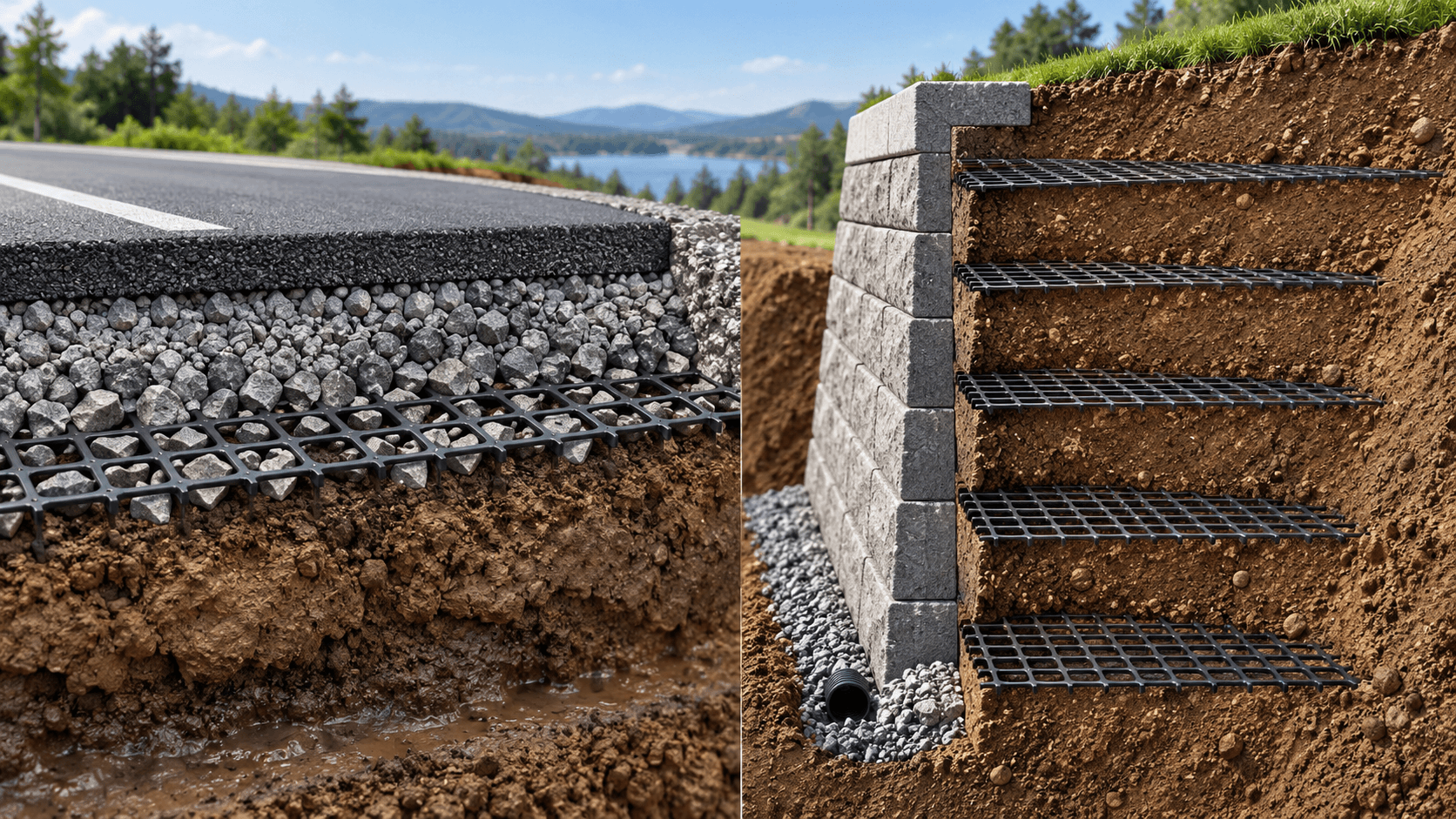
Start with the job the grid must do
Before comparing product names, identify the required function in the project drawings or specification. The same roll description does not answer every site question.
| Project question | What to establish before choosing a grid |
|---|---|
| Is the goal to reinforce an aggregate base? | Record the subgrade condition, aggregate gradation, expected traffic or loading, and the location of the proposed reinforcement. The designer can then assess whether a geogrid belongs in the base design. |
| Is it a retaining wall or reinforced slope? | Use the engineered layout to identify the required reinforcement direction, strength criteria, connection details and placement location. A roll’s width or a broad “uniaxial/biaxial” label does not approve it for a wall. |
| Are fines migration or water also concerns? | Identify the required separation, filtration and drainage functions separately. A geogrid does not automatically perform all of them. |
FHWA treats reinforcement, separation, filtration and drainage as distinct functions; its retaining structures guidance also places product selection within the full design and construction process.[3][4]
Choose the type by function and direction
Uniaxial and biaxial describe whether a geogrid’s principal strength is oriented in one or two directions. “Biaxial” does not necessarily mean equal strength in both directions.[7]
Match the installation direction to the property and strain level required by the design. Equal ultimate strength in two directions does not, by itself, establish equivalent behavior at a specified strain. FHWA illustrates this distinction for one reinforced-soil bridge system; its system-specific direction requirements are not a universal wall specification.[5] For structural earthwork, follow the engineer’s required values and direction. For an aggregate base, check the selected grid against the base design and the aggregate it will contact.
For a base application, aperture geometry also matters: the openings must be considered alongside the aggregate gradation so the grid and fill can interact as intended. FHWA’s geogrid definition explicitly connects the apertures with surrounding fill.[1] Do not select a roll from an image or nominal strength label without checking the project specification.
Read the specification as a set of linked checks
Use this short worksheet when comparing a proposed type with a project requirement:
- Function and location: Where will the grid sit, and is its purpose base reinforcement or engineered soil reinforcement? Record any separate need for filtration or drainage.
- Direction and data basis: Which direction carries the design load? Match the specified test procedure, direction, reporting unit and property definition. Check whether the result is for one rib or per unit width, and whether it is an ultimate value or a value at a specified strain.
- Fill and geometry: Compare the specified aggregate or backfill with the proposed aperture and the designed layer arrangement. Send unclear matches back to the designer rather than treating a roll size as proof of suitability.
- Roll and construction constraints: Check the required coverage, roll width and length, handling limitations and the project’s placement details before calculating an order quantity. Overlaps, cover depth and equipment access must come from the applicable design and product instructions, not a universal rule in a buying guide.
If a specification calls for a tensile test, note the exact method and version as well as the procedure and reporting basis. ASTM D6637/D6637M reports index tensile properties; citing the method does not show that a particular product was tested or meets a project requirement.[6] An index tensile result is not, by itself, a long-term design strength. For permanent reinforced-soil structures, confirm how the applicable design addresses creep, installation damage and durability for the selected product.[7]
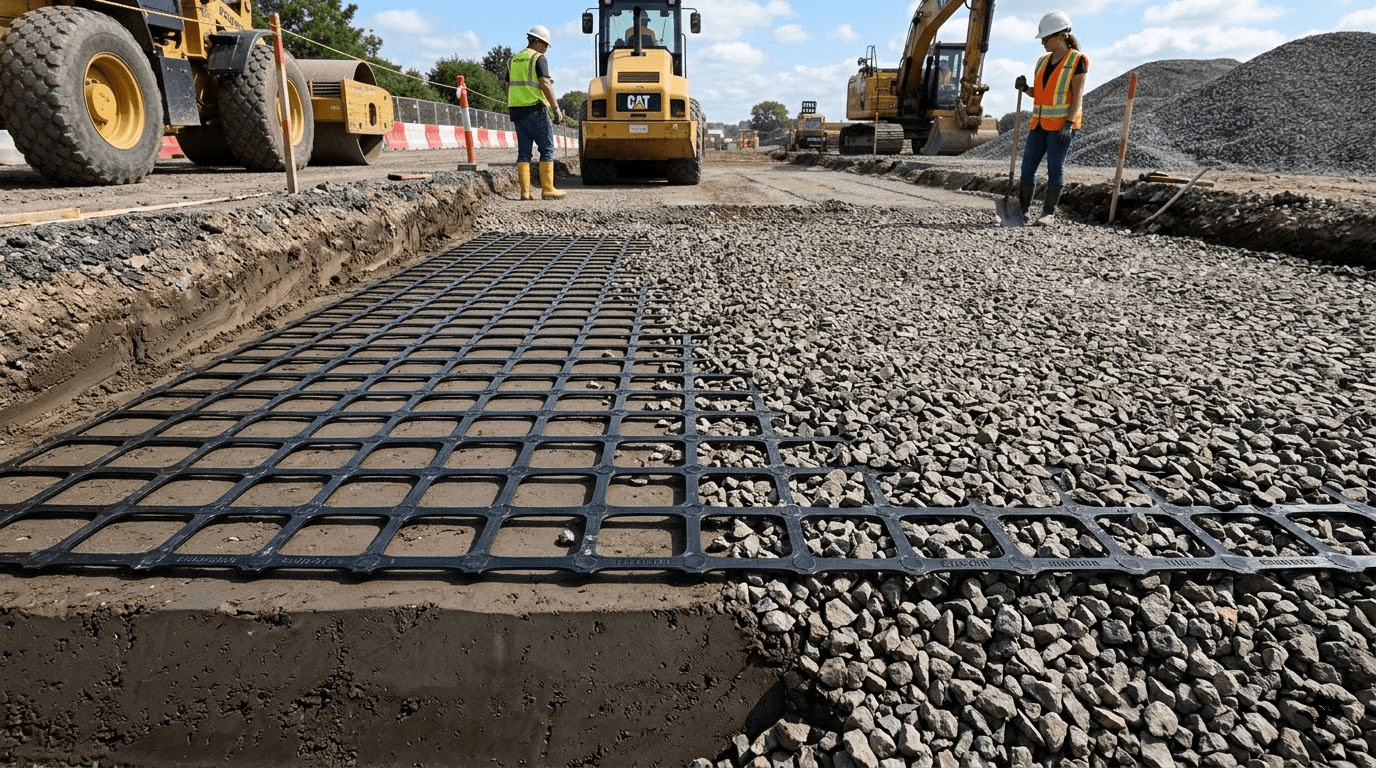
When to pause the selection
Pause before choosing a model if the design function is unclear, the fill or subgrade information is missing, the required strength direction cannot be matched, or the project needs a separation or drainage function that has not been specified. Those gaps affect the selection itself; a higher-sounding product label cannot fill them. FHWA notes that geogrid reinforcement does not, by itself, prevent fine subgrade material from entering a base layer.[3] An open grid alone also does not establish a filtration or drainage design; specify those functions separately when the site requires them.
Once the project requirements are clear, you can review our geogrid product options. Send our team the application, drawings or specification, required properties and test methods, preferred roll dimensions, quantity and delivery location through our contact page. We can review the request against the relevant product option; final specifications and order terms are confirmed for that request.
References
- FHWA, Geotechnical Aspects of Pavements, Appendix A: definitions.
- FHWA, Geotechnical Aspects of Pavements, §7.3.4: base reinforcement.
- FHWA, Geotechnical Aspects of Pavements, §7.6: stabilization and geosynthetic functions.
- FHWA, Earth Retaining Structures guidance.
- FHWA, Geosynthetic Reinforced Soil Integrated Bridge System FAQ.
- ASTM International, D6637/D6637M-15(2023), public scope.
- FHWA, Corrosion/Degradation of Soil Reinforcements for Mechanically Stabilized Earth Walls and Reinforced Slopes, NHI-09-087, §4.1 (printed pp. 4-1, 4-7) and §4.5 (printed p. 4-22).