
- October 14, 2026
- Posted by: wellcoindustries
- Category: Fiberglass fire blanket
A single-use emergency fire blanket should be replaced after it has been used on a fire, even if it appears intact. BS EN 1869:2019 covers non-reusable fire blankets, and Fire and Rescue NSW describes emergency fire blankets as designed for one use. Fiberglass content alone does not establish that a blanket can be used again. [1][2]
For a blanket with a different stated purpose, check the instructions for that exact product. Do not approve reuse from a photograph, a temperature claim or an undamaged appearance. The useful distinction is between an unused blanket being maintained in storage and one that has already been exposed to a fire.
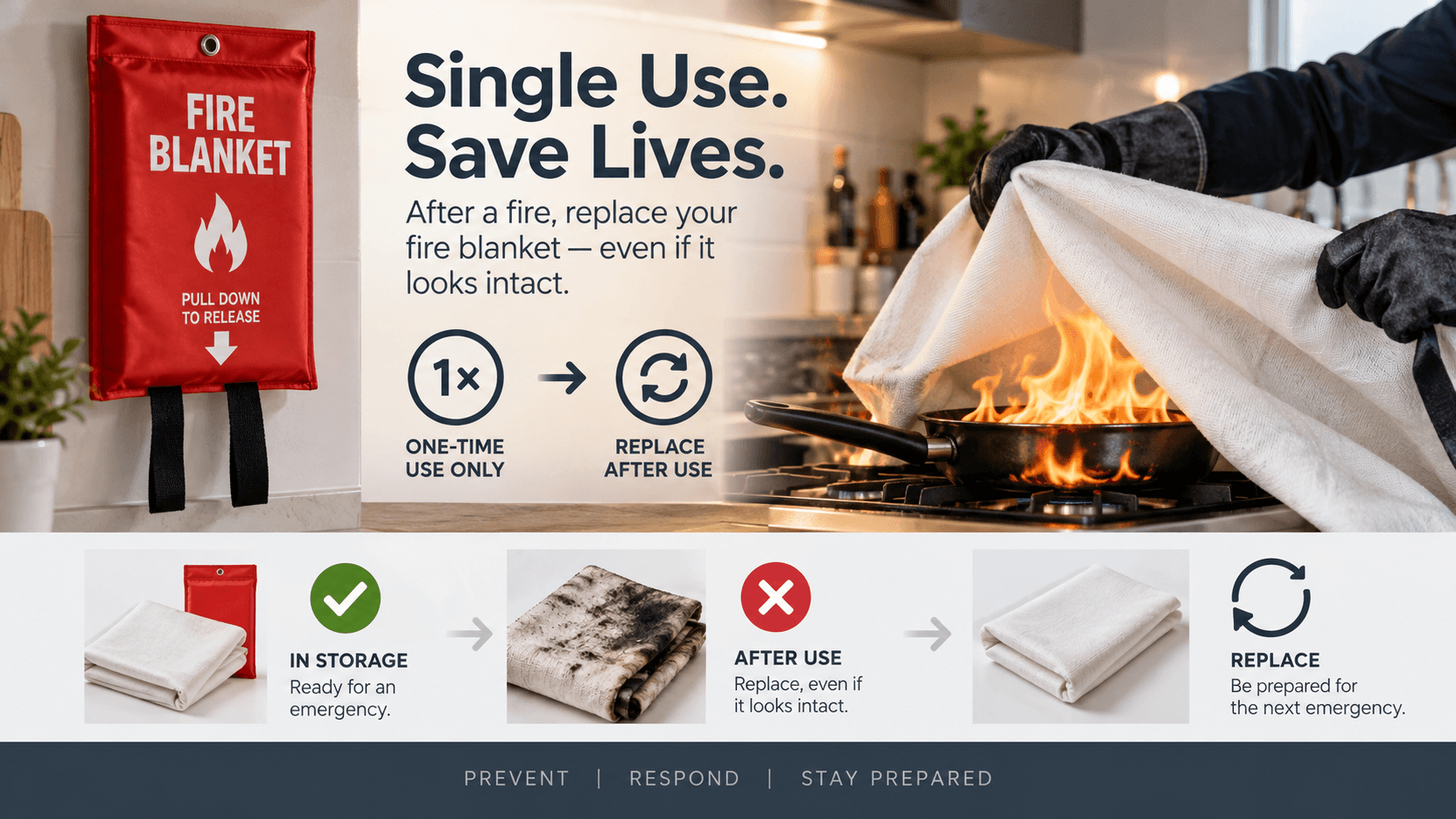
How many times can you use a fire blanket?
For a product labeled single-use, the limit is one fire use. Inspection does not create an exception to that instruction. A clean-looking surface or intact stitching is not permission for a second deployment. [1][2]
The name “fire blanket” also appears on products used for hot work or other industrial tasks. Their intended use and maintenance requirements must be assessed separately. A reusable welding shield does not establish a reuse rule for a kitchen emergency blanket, or vice versa.
Decide what happened before deciding what to do
Use this table to organize the decision after an incident or during routine maintenance. It is not a test that certifies a blanket for reuse.
| Blanket history or condition | Next action |
|---|---|
| Single-use emergency blanket used on a fire or otherwise exposed to fire | Replace it. Do not clean, refold or inspect it as a way to approve another fire use. |
| Removed for permitted inspection or training, without fire exposure | Have a suitably trained person check its condition and repack it according to the product’s maintenance procedure. Keep it out of emergency service until these checks are complete. If correct condition and repacking cannot be established, arrange assessment or replacement. |
| Unused blanket with damage, contamination, or suspected fire-related damage to the blanket or container | Remove it from service for assessment. Replace it when damage makes it unserviceable. |
| Unknown product identity, missing instructions or uncertain fire-exposure history | Keep it out of emergency service while its identity, instructions and use history are checked. If suitability for return cannot be established, replace it. |
The maintenance guidance behind these checks distinguishes routine inspection from a service provider’s assessment of defects. It does not authorize a visual check to override a single-use instruction. [1][2][3][4]
What to check on a stored fire blanket
For routine checks, start with the parts visible without unfolding the blanket:
- Is it in its designated position, visible and unobstructed?
- Are the operating instructions readable?
- Is the container intact, with accessible, undamaged pull tabs?
- Are any fitted tamper indicators present and intact?
The Fire Industry Association includes these checks in its maintenance guidance. An abnormality calls for corrective action or a service assessment. Opening, examining the fabric and repacking should follow the selected product’s maintenance instructions. [3]
Assign routine visual checks to a named person. Any opening, detailed examination and repacking should be handled by someone with the necessary training and product instructions.
Keep a record of the location, model, inspection date, finding and action taken. Recording “looks fine” after a fire does not make a single-use blanket reusable.
Can you wash a fiberglass fire blanket?
Do not wash a fire blanket unless the instructions for that exact product expressly permit it. A general cleaning recipe is not a substitute for its care requirements. Kidde’s own fire-blanket guide, for example, prohibits washing the fabric and requires replacement after fire exposure. Those directions describe Kidde’s product, rather than every fiberglass blanket. [4]
Cleaning also does not reverse a single-use instruction. If a stored blanket is soiled or contaminated, use its manufacturer’s assessment or replacement procedure rather than inventing a detergent concentration, pressure-washing method or home strength test.
Cleaning the container is separate from washing the blanket fabric. Follow the product’s care instructions for each.

Storage, inspection intervals and replacement age
Use the storage and mounting requirements supplied with the blanket. Keep access clear, and arrange inspection around the conditions in which the equipment is kept.
A workplace inspection plan needs to identify who checks the blanket, what they check and how problems are resolved. The UK Health and Safety Executive (HSE) uses risk, environmental conditions and manufacturer recommendations to determine inspection needs in its general work-equipment guidance. This is a planning principle, not a universal maintenance interval for every fire blanket. [5]
Do not assign a blanket a five-year or ten-year service life from its material description alone. Check any stated replacement date or service-life limit for the actual product, alongside its condition and use history. A blanket being within an age limit does not make it reusable after fire use.
Where the manufacturer states a service limit, record its starting date and any specified replacement date. Check whether the limit runs from manufacture, installation or another stated event; do not choose the starting point yourself.
Arrange replacement after a fire
During an active incident, safety and evacuation take priority over inspecting or recovering equipment. Follow the emergency plan and the blanket’s instructions. Once the incident is safely resolved, record that the blanket was used and arrange replacement where it is single-use.
For a workplace, identify the affected equipment location so that staff know its fire blanket has been removed. Follow the manufacturer’s disposal instructions and any applicable local waste requirements, especially if contamination is involved. Do not cut a used emergency blanket into another protective product and assume it remains suitable.
Record the replacement model and installation date. Before marking the equipment location ready, check that the replacement is correctly positioned, accessible and accompanied by its applicable instructions. [3]
If you are arranging replacement stock, view our fiberglass fire blanket product information and send us the intended use, model or required size, quantity and destination-market requirements. Include any labeling or instruction requirements in your inquiry.
Sources
- BSI — BS EN 1869:2019, Fire blankets. Public scope for non-reusable fire blankets.
- Fire and Rescue NSW — Fire safety equipment. Single-use emergency-blanket guidance and manufacturer-instruction priority.
- Fire Industry Association — Code of Practice for the Commissioning and Maintenance of Fire Blankets Manufactured to BS EN 1869. Version 1, May 2016; Sections 4 (commissioning), 6 (visual inspection), 7 (basic service) and 9 (fitness assessment). UK maintenance guidance, used here for inspection considerations rather than US legal requirements.
- Kidde UK — Fire Blanket Safe Use Guide. Product-specific care and replacement guidance.
- HSE — Inspection of work equipment. General workplace inspection planning; not a fire-blanket product specification or US regulation.