
- April 3, 2026
- Posted by: wellcoindustries
- Category: Burlap
Introduction
Industry estimates place yield losses from root-bound container crops at 10–20% annually, depending on crop type and production cycle length — a figure that compounds fast across large nursery inventories or multi-cycle greenhouse operations. The container you choose directly affects root architecture, and root architecture drives everything else: nutrient uptake, transplant success, and final plant vigor. Fabric root bags address the core failure of rigid containers by engineering a different outcome from the first day a seedling is potted. This article explains what fabric root bags are, how the air pruning mechanism works, and what specifications procurement managers and growers should evaluate before placing a bulk order.
What Are Fabric Root Bags?
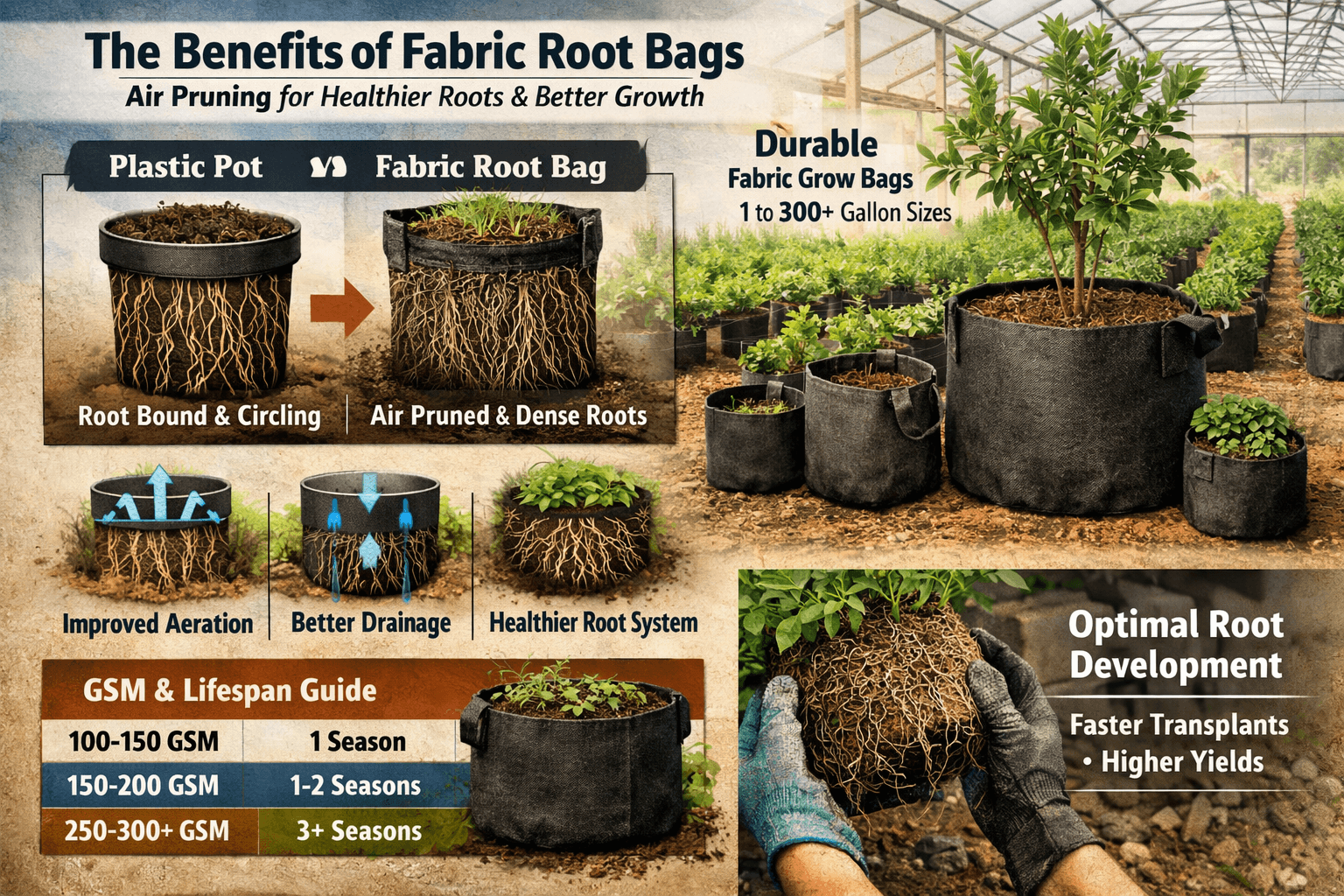
Fabric root bags are permeable, flexible growing containers made from geotextile material — most commonly woven or nonwoven polypropylene. Unlike rigid plastic pots, their porous walls allow air, water, and oxygen to pass through freely. That permeability is not incidental — it is the functional core of how these containers improve plant performance.
Commercial operations use fabric root bags across a wide range of applications: nursery stock production, cannabis cultivation, fruit tree propagation, vegetable transplant programs, and large-scale reforestation projects. Their scalability — from 1-gallon seedling bags to 300-gallon field containers — makes them practical across the full spectrum of B2B growing environments.
Materials and Construction
Most commercial-grade fabric root bags are constructed from BPA-free polypropylene geotextile, either woven or nonwoven. Nonwoven fabrics, produced by needle-punching or thermal bonding fibers together, are the more common choice for horticultural use. They offer a consistent pore structure, good tensile strength, and predictable air exchange rates.
Fabric weight is measured in grams per square meter (GSM). Entry-level bags typically run 100–150 GSM; heavy-duty commercial bags designed for multi-season reuse range from 200–300 GSM. Higher GSM ratings deliver greater puncture resistance and UV stability — both relevant factors when bags are deployed outdoors for extended production cycles.
Seam construction matters too. Stitched seams with UV-stabilized thread outperform heat-bonded seams in field conditions, particularly under repeated filling, watering, and handling stress. For large-volume bags — 25 gallons and above — reinforced handles are standard in quality commercial product lines.
Available Sizes and Formats
Fabric root bags are available in gallon-based sizing from 1 gallon through 300 gallons or more. Standard round formats dominate the market, but square-base designs are increasingly specified for high-density greenhouse benching and vertical production systems, where footprint efficiency directly affects revenue per square foot.
Handle configurations vary: soft loop handles on mid-size bags (5–25 gallon) support manual repositioning, while large-format bags (45 gallon and above) may feature reinforced strap handles or integrated lifting points suited for mechanical handling. Buyers sourcing for large nursery or field programs should specify handle type alongside GSM and size to avoid operational mismatches at the growing site.
How Fabric Root Bags Work: The Air Pruning Mechanism
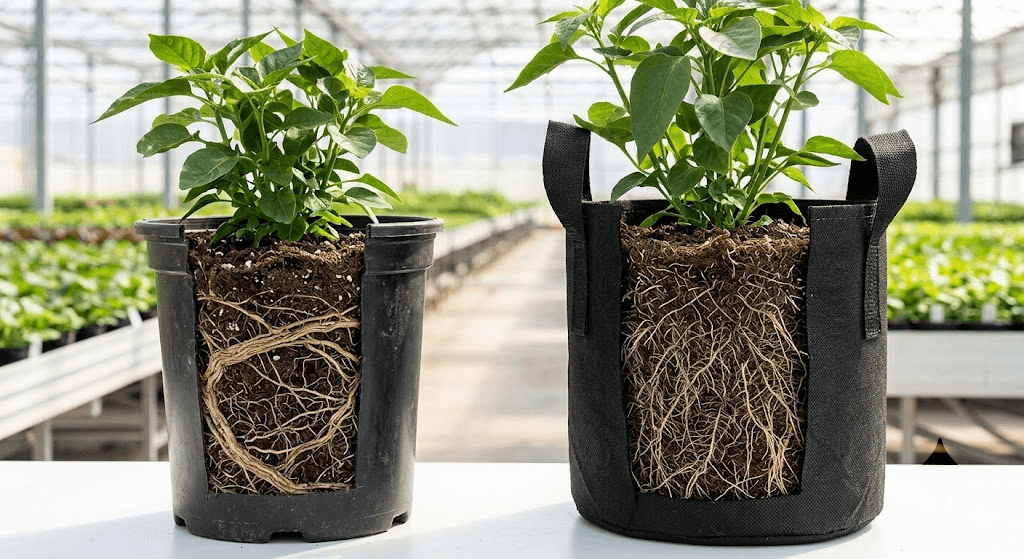
Understanding why fabric bags outperform plastic containers requires a clear picture of what happens at the root tip level. In a rigid container, roots grow outward until they hit the wall — then, finding no resistance signal to stop them, they turn and continue growing in circles. That circling pattern, left uncorrected, produces a strangled root system that limits water and nutrient uptake long after transplant.
Fabric walls interrupt that cycle entirely.
Root Behavior in Traditional Containers vs. Fabric
When a root tip reaches the permeable wall of a fabric bag, it encounters two conditions simultaneously: air exposure and reduced moisture. Both trigger a natural response — the root tip desiccates and stops elongating. The plant responds by branching laterally from behind the pruned tip, producing a denser, more fibrous root mass. This is air pruning: a passive, continuous process that requires no intervention from the grower.
In a large-scale nursery trial growing 3-gallon containerized shrubs for municipal landscaping contracts, growers switching from standard plastic nursery pots to 200 GSM fabric bags reported measurably faster canopy closure at week six — attributed to the denser root mass establishing more quickly after potting. That kind of transplant timeline compression has direct implications for crop turnover and contract fulfillment schedules.
The contrast with conventional plastic containers is significant across several performance dimensions. The table below compares root development and container performance across three common container types:
| Parameter | Plastic Pot | Fabric Root Bag | Open Grow Tray |
|---|---|---|---|
| Root behavior | Circling / girdling | Air-pruned, fibrous | Unrestricted / spreading |
| Drainage | Drain-hole dependent | Full-wall permeability | Open base |
| Aeration | Limited | High — continuous airflow | Moderate |
| Root mass density | Low–Moderate | High | Variable |
| Reusability | High (rigid) | Moderate (1–3 seasons) | Low |
| Transplant shock risk | Moderate–High | Low | Low–Moderate |
For procurement managers evaluating container systems at scale, the transplant shock column carries significant cost implications. Reduced transplant shock translates directly into lower replacement rates and more predictable crop scheduling.
Oxygen and Moisture Dynamics in the Root Zone
Air pruning is the headline benefit, but the oxygen and moisture profile inside a fabric bag also differs structurally from a plastic container. Geotextile walls allow excess moisture to evaporate laterally — not just drain from the base. This prevents the anaerobic, waterlogged conditions that drive root rot in poorly drained rigid containers.
The result is a root zone that stays aerobic throughout the growth cycle. Aerobic root zones support higher microbial activity, better nutrient solubilization, and stronger symbiotic relationships with beneficial fungi. For growers running organic or low-input programs, this is a meaningful agronomic advantage built into the container itself.
The aerobic root environment created by fabric bags also sets up the performance gains documented in commercial trials — which leads directly into how those benefits translate at production scale.
Key Performance Benefits for Commercial Operations
Switching container systems is a procurement decision that carries real operational risk. The performance case for fabric root bags needs to be grounded in data, not generalities. The evidence from nursery trials and commercial grower reports is consistent: air-pruned plants produce measurably denser root systems.
Yield and Root Mass Data
Nursery trials conducted by university extension programs — including research programs affiliated with the USDA Forest Service’s container seedling production initiatives — have consistently shown that air-pruned seedlings develop 30–50% more root tips compared to container-grown equivalents in standard plastic pots over equivalent growth periods. Root tip density is a leading indicator of post-transplant establishment speed — a variable that carries direct cost implications in large nursery operations where crop turnover drives revenue.
Commercial cannabis cultivators have reported canopy development advantages of 10–15% in vegetative cycle length when shifting from plastic to fabric containers, attributed to improved root zone aeration. In reforestation programs, air-pruned seedling stock has demonstrated higher first-year survival rates in outplanting trials, reducing costly replanting cycles.
Drainage, Aeration, and Disease Resistance
Fabric bags drain faster than plastic pots — in some configurations, lateral evaporation accounts for 20–30% of total moisture loss between irrigation cycles. For a greenhouse pepper operation running automated drip irrigation, that difference required recalibrating emitter run times by 15–20% after switching to fabric containers — a straightforward adjustment, but one that needs to happen before crop stress occurs. Buyers transitioning container types at scale should audit soil moisture at both the bag center and edge before finalizing irrigation schedules.
Pythium and Phytophthora root rots — two of the most economically damaging root pathogens in container production — are strongly associated with anaerobic, waterlogged root zones. The aerobic environment created by fabric bags reduces the moisture conditions these pathogens require to establish. While fabric bags reduce the favorable conditions for infection, they do not eliminate risk — substrate selection and sanitation protocols remain essential components of any disease management program.
Selecting the Right Fabric Root Bag: Specs That Matter
Not all fabric bags perform equally. Buyers sourcing for commercial programs should evaluate four core specification variables: GSM weight, porosity, UV stability, and sizing precision. A bag that underperforms on any one of these in a multi-thousand-unit deployment compounds losses quickly.
Weight, Porosity, and UV Stability
The table below maps GSM rating to production cycle length and application fit — use it to match fabric weight to your program’s reuse expectations and budget structure:
| GSM Rating | Typical Lifespan | Best Application | Key Tradeoff |
|---|---|---|---|
| 100–150 GSM | 1 season | Seedling propagation, annual crops | Lower durability; cost-effective for single-use programs |
| 150–200 GSM | 1–2 seasons | Vegetable transplants, small shrubs | Balanced cost and reusability |
| 200–250 GSM | 2–3 seasons | Nursery stock, cannabis production | Higher upfront cost; better ROI over multi-cycle programs |
| 250–300+ GSM | 3+ seasons | Fruit trees, large shrubs, reforestation | Maximum durability; suited for outdoor multi-year deployment |
UV stabilization is a non-negotiable specification for outdoor applications. Unstabilized polypropylene degrades rapidly under prolonged UV exposure — bags can lose significant tensile strength within a single growing season in high-sun environments. Buyers should request accelerated UV weathering test data referenced to ASTM G154 or ISO 4892 standards from suppliers, rather than relying on product claims alone. If a supplier cannot provide test data against a named standard, that is a procurement risk signal.
Sizing for Crop Type and Container Density
Gallon sizing in fabric bags does not always map directly to equivalent plastic container volumes. The flexible wall of a fabric bag means fill volume varies with substrate density and tamping pressure. For precision crop programs, buyers should request actual interior volume data from the manufacturer rather than relying on nominal gallon ratings alone.
Container density planning — how many bags fit per bench meter or per field row — should account for the bag’s footprint at full fill. Round bags lose bench space at the corners; square-base formats recover that footprint at a modest per-unit cost premium. For high-value crops where bench space directly limits production volume, that premium pays back quickly.
Sourcing and Supply Considerations for B2B Buyers
Fabric root bag procurement at commercial scale introduces supply chain considerations that differ from standard nursery supply purchasing. Lead times, minimum order quantities, and customization options all affect how buyers should plan their sourcing cycle.
Wellco Industries supplies fabric root bags as part of a broader agricultural and geotextile product range — covering GSM options from entry-level propagation bags through heavy-duty multi-season formats, with OEM and private-label customization available for distributors and branded growing programs. For buyers managing multiple product categories across agriculture, erosion control, and container production, consolidating supply through a vertically integrated source reduces vendor management overhead and improves documentation consistency across programs. Material safety data sheets, country-of-origin records, and product compliance documentation are available on request.
MOQ, Lead Times, and Customization
Standard commercial fabric root bags typically carry minimum order quantities of 500–1,000 units per SKU for stock sizes, with custom sizing or branded OEM orders requiring higher volume commitments. Lead times for stock product run 2–4 weeks from confirmed order; custom production — including non-standard dimensions, print branding, or handle configurations — typically requires 6–10 weeks.
Buyers running seasonal programs should align order timing with production schedules, not planting schedules. A bag arriving two weeks after transplant season opens is a bag that costs revenue.
Compliance and Material Safety
For buyers supplying organic growing programs or food production operations, material safety documentation matters. Commercial-grade fabric root bags should be manufactured from BPA-free polypropylene and carry documentation confirming the absence of heavy metals or restricted chemical additives. Buyers in regulated markets — particularly cannabis and organic vegetable production — should request material safety data sheets and country-of-origin documentation as standard procurement practice, and confirm compatibility with their certifying body before deployment.
Conclusion
Fabric root bags are not simply a substitute for plastic containers — they are a system change that affects root architecture, moisture dynamics, disease pressure, and transplant outcomes simultaneously. For B2B buyers evaluating container systems at commercial scale, the key takeaways are:
- Air pruning is passive and continuous — no grower intervention required; root density improvements begin immediately and translate directly into transplant performance gains.
- GSM rating drives lifespan and ROI — match fabric weight to your production cycle length and reuse expectations, not just upfront unit cost.
- UV stabilization requires test data, not claims — specify ASTM G154 or ISO 4892 compliance and request documentation before committing to large outdoor programs.
- Volume and sizing precision matter — validate actual fill volume and bench footprint data before scaling deployment across a full production facility.
- Supply chain timing is a procurement risk — custom orders require 6–10 week lead times; build that window into seasonal planning, not as an afterthought.
[Request bulk pricing and product specifications from Wellco Industries →]
Frequently Asked Questions
Stock sizes typically carry MOQs of 500–1,000 units per SKU. Custom dimensions, handle configurations, or OEM-branded orders generally require higher volume commitments. Confirm thresholds and lead times with your supplier well before your planting season window opens — custom production requires 6–10 weeks from order confirmation.
Reuse lifespan depends on GSM rating, UV exposure level, and how thoroughly bags are cleaned and dried between cycles. Entry-level 100–150 GSM bags are designed for single-season use. Heavy-duty 250–300 GSM bags, with proper washing and off-season storage away from UV exposure, can deliver three or more production cycles before structural integrity degrades.
Yes, but irrigation scheduling requires recalibration after switching from plastic containers. Fabric bags lose moisture laterally through the walls in addition to base drainage, increasing total moisture loss between cycles. Audit soil moisture at both the bag center and edge under your specific substrate and emitter configuration before finalizing run times across the full production system.
Most commercial-grade bags are manufactured from BPA-free polypropylene, which is generally compatible with organic production requirements. Buyers should request material safety data sheets confirming the absence of restricted additives and verify compatibility with their specific certifying body before deployment — certification standards vary by program and jurisdiction.
Custom dimensions, reinforced handle configurations, and OEM or private-label branding are available. Custom production requires higher minimum order volumes than stock SKUs and a 6–10 week production lead time. Contact Wellco Industries directly with project specifications — GSM requirement, size range, volume, and any compliance documentation needs — to receive an accurate quote and timeline.