
- May 27, 2026
- Posted by: wellcoindustries
- Category: Fiberglass Stakes
Introduction
Bulk buyers rarely lose money on tree stakes because of the stake price alone. The larger cost appears later, when crews return to replace cracked, rotted, bent, or undersized supports across a nursery block, orchard row, roadside planting, or municipal landscape project.
For purchasing teams, the real question is simple: which fiberglass tree stakes suppliers can deliver consistent product quality, predictable lead times, practical packaging, and field ready specifications at scale?
This guide helps buyers evaluate suppliers through the lens of material performance, product specifications, warehouse reliability, MOQ flexibility, landed cost, and long term field value. It is written for landscape contractors, commercial growers, nursery operators, municipal buyers, and procurement managers who buy in bulk or repeat purchase volumes.
Wellco Industries serves agricultural, gardening, erosion control, and fiberglass product buyers with plant support systems, fiberglass stakes, FRP products, and related field supplies. For North America focused buyers, U.S. warehouse support, flexible bulk ordering, and repeat supply capability can matter as much as the stake itself.
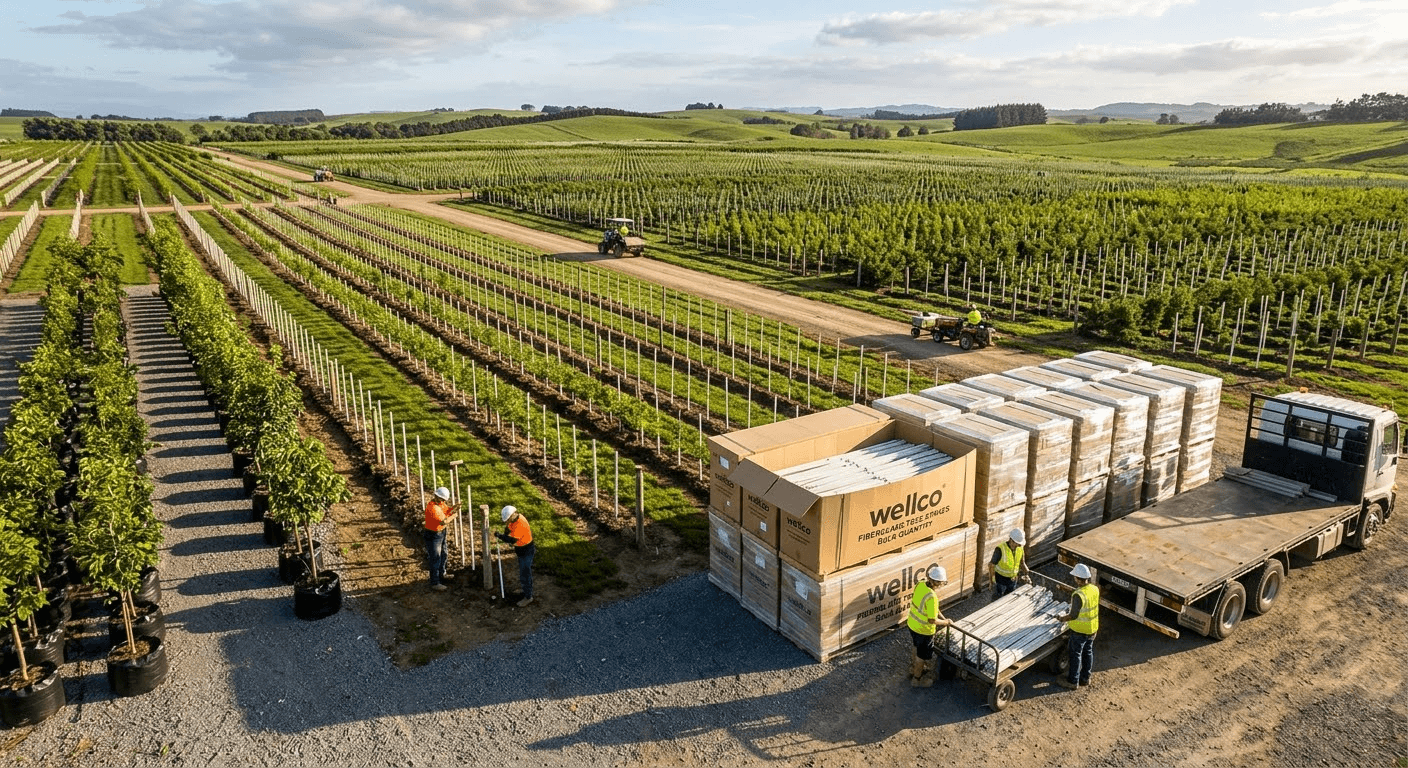
Why Bulk Buyers Are Choosing Fiberglass Tree Stakes
Fiberglass Stakes Solve Common Field Failure Problems
Bulk buyers often start looking for fiberglass when familiar materials begin creating jobsite problems. Wood can rot, split, warp, and vary in straightness depending on species, treatment, and storage conditions. Bamboo gives projects a natural appearance, although diameter and wall consistency can vary from bundle to bundle. Light duty plastic can become brittle after prolonged sunlight exposure if it lacks suitable UV stabilization.
In commercial planting work, those small inconsistencies create labor waste. If a crew installs 5,000 stakes and only 5% fail early, that still leaves 250 locations needing inspection, removal, replacement, and retie work. The cost of the second site visit can exceed the savings from choosing the cheapest stake.
Fiberglass tree stakes give buyers a more consistent engineered option. They are especially useful where irrigation cycles, fertilizer exposure, wet soil, repeated handling, and outdoor sunlight shorten the useful life of organic materials.
A good supplier should help buyers match the stake to the field condition before the order ships.
Key Performance Advantages for Professional Use
Fiberglass stakes combine strength, low weight, moisture resistance, and dimensional consistency in a way that fits repetitive field work. A typical buyer specification may include diameter, length, color, surface finish, pointed end or flat end, cap option, UV package, carton quantity, pallet count, packed weight, and shipping point.
For field crews, weight matters. A lightweight stake is easier to carry, stage, and install during large planting jobs. For procurement teams, consistency matters even more because predictable diameter and length help standardize ties, storage, packaging, and installation procedures.
Fiberglass also provides a non conductive profile, which can be relevant near utility areas, roadside projects, or locations where metal supports create corrosion or safety concerns. The practical value depends on proper specification. Buyers should ask whether the product is designed for outdoor agricultural or landscape use, rather than assuming every fiberglass stake performs the same.
How Long Do Fiberglass Tree Stakes Last in the Field?
Fiberglass tree stakes can often support multi season outdoor use when properly specified with suitable resin, UV protection, consistent diameter, and clean surface finishing. Actual service life depends on sunlight intensity, soil moisture, irrigation frequency, handling method, stake diameter, and whether crews reuse the stakes across planting cycles.
Buyers should avoid vague durability claims. A supplier that simply says “long lasting” gives less confidence than one that can discuss resin type, UV package, diameter tolerance, surface quality, outdoor exposure, and typical application fit.
In practice, the best field life usually comes from pairing the right stake size with the right tree height, soil condition, and wind exposure. A small diameter stake may work for container plants or young nursery stock. Taller trees in open sites may need longer and stronger profiles.
The takeaway is straightforward: fiberglass can reduce replacement cycles, but only when the supplier helps buyers spec the right product for the job.
Fiberglass Tree Stakes vs Traditional Alternatives
Material Comparison for Bulk Purchasing
Material choice should reflect use duration, exposure, labor cost, and project expectations. Treated wood may perform adequately in short term landscape jobs. Bamboo can be appropriate for seasonal, garden, and visual applications. Steel can serve heavy duty uses where weight, conductivity, and corrosion do not create problems.
Fiberglass becomes more attractive when buyers need repeatable quality, moisture resistance, clean appearance, and lower replacement labor across large volumes.
The table below compares common tree stake materials across practical purchasing factors:
| Material | Durability | Handling | Weather Resistance | Consistency | Best Fit Use Case |
|---|---|---|---|---|---|
| Fiberglass | High when properly specified for outdoor use | Lightweight and easy to stage | Strong resistance to moisture and rot | High from reliable suppliers | Nurseries, contractors, municipal planting, repeat use programs |
| Wood | Medium, depending on species and treatment | Moderate weight | Can rot, warp, or split over time | Medium to low | Short to medium term landscape support |
| Bamboo | Medium for light to moderate use | Very lightweight | Can degrade with moisture exposure | Natural diameter variation | Gardens, seasonal crops, light duty plant support |
| Steel | High structural strength | Heavier to handle | Can rust without coating or galvanizing | High | Heavy duty support where conductivity and corrosion are acceptable |
| Plastic | Low to medium, depending on UV stabilization | Lightweight | UV brittleness can occur | Medium | Temporary residential or light garden use |
This comparison does not make one material the right choice for every project. Buyers should weigh service life, installation labor, storage, exposure, and visual requirements together.
For bulk purchasing, the strongest decision usually comes from lifecycle thinking.
When Fiberglass Delivers the Best Value
Fiberglass usually delivers the best value when buyers calculate landed cost per usable stake over time. That calculation includes unit price, freight, breakage, storage, installation speed, replacement frequency, and whether the stake can be reused.
Consider a contractor managing a multi acre planting project. If failed stakes require a second visit, the real cost includes crew hours, truck time, scheduling delays, fuel, retie materials, and possible client dissatisfaction. That labor burden can outweigh a small difference in initial unit price.
A practical procurement benchmark works well: when a support product must survive more than one season or one project cycle, buyers should compare lifecycle cost instead of only comparing the first purchase price.
Material value depends heavily on supplier consistency, so the next step is evaluating the supplier behind the product.
How to Evaluate Fiberglass Tree Stakes Suppliers
Product Specifications Buyers Should Confirm
Reliable fiberglass tree stakes suppliers should help buyers confirm the right specification before quoting volume. Core details include stake diameter, length range, color, surface finish, pointed or flat ends, cap options, flexibility, UV resistance, carton quantity, pallet count, packed weight, and delivery location.
Diameter and length should match plant size and exposure. For small nursery stock, shorter and slimmer stakes may be enough. For roadside trees, windy sites, or exposed commercial landscapes, buyers may need longer stakes and stronger profiles.
Procurement teams should also ask for tolerance guidance. Even basic details such as diameter consistency, straightness, surface smoothness, and cut quality can affect tying, safety, installation speed, and storage.
Packaging affects cost too. A quote that looks cheaper per stake may become less attractive if carton counts, pallet loading, and freight efficiency are poor. Buyers should ask for packed dimensions and weights before approving repeat orders.
Supplier Capability Checklist
Beyond the product, buyers should evaluate whether the supplier can support repeat purchasing. The best supplier for a one time carton order may not be the best partner for a long term planting program.
The table below shows the supplier capabilities that matter most in bulk purchasing:
| Evaluation Factor | Why It Matters | What Buyers Should Ask |
|---|---|---|
| Inventory availability | Prevents project delays and partial shipments | Are common sizes stocked, and how often are they replenished? |
| MOQ flexibility | Helps buyers test before scaling | Can samples, cartons, pallets, or mixed size orders be supplied? |
| Lead time | Protects planting schedules | What is the current lead time for stock and custom sizes? |
| OEM or private label options | Supports distributors and branded programs | Are custom colors, labels, packaging, or lengths available? |
| Packaging details | Affects damage rate and freight cost | How many stakes per carton and pallet, and what are the packed dimensions? |
| Shipping coverage | Controls landed cost and delivery speed | Which warehouse or shipping point will fulfill the order? |
| After sales support | Reduces repeat order risk | Who handles shortages, damage claims, or specification questions? |
A supplier that answers these questions clearly gives buyers more confidence than one that only provides a unit price.
What Questions Should You Ask Before Placing a Bulk Order?
Before placing a bulk order, buyers should ask about stake size, application, quantity, lead time, packaging, UV performance, shipping point, sample availability, and customization options. They should also confirm whether the recommended stake fits tree size, soil condition, wind exposure, and installation method.
A nursery operator may care most about bundled packaging and repeat availability. A municipal buyer may care more about consistent appearance, freight timing, and documentation. A landscape contractor may prioritize fast delivery, easy installation, and clean finished presentation.
The strongest quotes usually come from suppliers that understand the application. A request that includes tree height, caliper, soil type, exposure, tie method, and order volume will usually produce a better recommendation than a request for “standard fiberglass stakes.”
Clear questions reduce costly mismatches before materials reach the jobsite.
Application Fit: Matching Stakes to Real Buying Scenarios
Commercial Nurseries and Growers
Commercial nurseries need products that support both plant growth and operational flow. Stakes must be consistent enough for crews to install quickly, bundle efficiently, and use across repeat production cycles.
In container grown tree and shrub operations, consistent stake diameter helps standardize ties and handling. If a nursery uses thousands of supports across a season, even small variations can slow crews down. Repeat availability also matters because switching sizes midseason can disrupt visual consistency and tying methods.
Fiberglass stakes can also work for vines, young trees, shrubs, and specialty crops where moisture exposure is constant. In these environments, rot resistance and repeat handling can justify the higher initial material cost.
For growers, consistency is a production tool, not only a product feature.
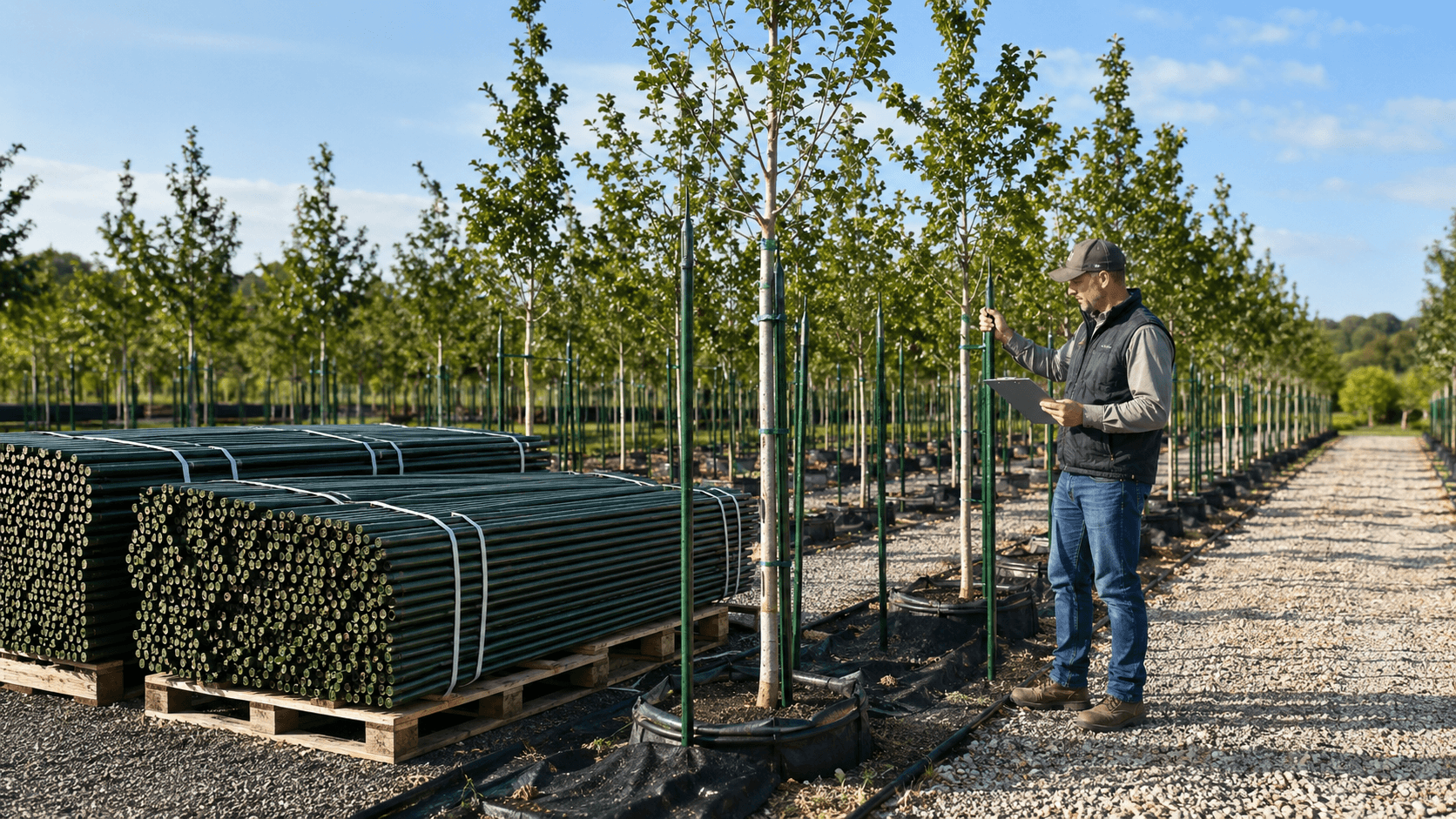
Landscape Contractors and Municipal Projects
Landscape contractors and municipal agencies often work under schedule pressure. Roadside plantings, public parks, commercial developments, and civic greening projects require supports that look clean, install quickly, and perform consistently.
In one common roadside planting scenario, crews may install hundreds of young trees along exposed medians or public right of way areas. Wind, irrigation, mowing equipment, and maintenance access all add stress. If lower grade stakes fail after installation, the contractor may need traffic control, extra labor, and another maintenance visit just to correct a support problem.
That is where fiberglass can create practical value. Stake straightness, visibility, cap options, surface smoothness, and tie compatibility become procurement details with direct field consequences.
Contractors should also consider safety and appearance. Smooth surfaces, clean cuts, and consistent color help reduce handling issues and create a more professional finished project.
Agricultural and Specialty Growing Uses
Fiberglass stakes are not limited to tree planting. Buyers may use them for orchard support, vineyard training, garden structures, nursery rows, trellis reinforcement, and specialty crop systems.
Agricultural environments can be hard on organic materials. Fertilizer, moisture, soil contact, and seasonal handling can shorten the useful life of wood and bamboo. Fiberglass can be a stronger fit when the same support must be stored, moved, and reused.
The best application fit comes from matching stiffness and length to the crop or plant system. A stake that is too flexible may not provide enough support. An oversized stake can increase landed cost without adding useful performance.
Application fit should guide supplier selection before price comparison begins.
Buying from U.S. Based or North America Focused Suppliers
Why Warehouse Location and Lead Time Matter
Once buyers understand application fit, the next question is supply reliability. Warehouse location can determine whether a planting project starts on time or waits for delayed materials.
For North America focused buyers, domestic or regional stock can reduce transit uncertainty, especially during planting windows. A supplier with U.S. warehouse capacity may support faster replenishment, smaller repeat orders, and more predictable freight planning.
Wellco Industries, based in Corona, California, serves agricultural, gardening, erosion control, and fiberglass product markets. Its product range includes plant protection products, fiberglass plant stakes, trellis products, weed barriers, jute netting, burlap, FRP rebar, FRP grating, handrails, ladders, and structural fiberglass products.
For procurement teams, that breadth can simplify mixed category purchasing. A buyer sourcing plant support products, erosion control materials, and fiberglass items from one supplier may reduce vendor complexity and improve repeat order planning. Wellco’s U.S. warehouse network and flexible bulk ordering model also support replenishment needs for contractors, distributors, and seasonal agricultural buyers.
Lead time should always be confirmed before a buyer commits to a project schedule.
MOQ, Bulk Pricing, and Packaging Considerations
MOQ flexibility can make a supplier much easier to work with. Some buyers need samples first. Others need carton quantities for a pilot job, then pallet quantities for repeat work. Distributors may need private label packaging, mixed sizes, or regular restocking support.
Bulk pricing should be evaluated through landed cost. That includes unit price, carton quantity, pallet density, freight class, delivery address, and replacement risk. A lower unit price can lose its advantage if packaging wastes space or creates damage during shipping.
Buyers should also ask whether custom lengths, colors, caps, labels, or packaging are available. These details can support contractors, retailers, distributors, and municipal programs with specific presentation or installation needs.
Should You Choose a Local Supplier or Factory Direct Source?
Buyers should choose a local or warehouse based supplier when speed, smaller replenishment orders, and lower delivery uncertainty matter most. Factory direct sourcing may work better for high volume orders, custom specifications, private label packaging, or planned seasonal purchases where longer lead times are acceptable.
Local inventory can help when a planting crew needs material quickly. Factory direct sourcing can help when a distributor wants a custom size, color, length, or branded packaging program. The right choice depends on urgency, volume, freight cost, and customization needs.
A balanced sourcing strategy often works best. Buyers can test stocked sizes first, then move to larger or custom orders once the specification has been proven in real field conditions.
Supply model matters because even a high quality stake creates problems if it arrives late.
Quality Control and Installation Considerations
Signs of a Reliable Fiberglass Stake
Quality control starts with visible details. Buyers should inspect straightness, surface smoothness, consistent diameter, clean cutting, color consistency, safe handling, and cap or tip quality.
A reliable fiberglass stake should avoid sharp exposed fibers, uneven resin areas, major bends, inconsistent sizing, and rough cut edges. For outdoor use, buyers should also ask whether the stake is designed for UV exposure and repeated field handling.
Sample testing helps here. Before a large order, buyers can check how the stake handles installation, tying, storage, and exposure. A small sample order can reveal whether the product fits the crew’s actual working method.
Supplier claims should connect to observable product details and application conditions.
Installation Practices That Protect Field Performance
Even strong stakes can fail the planting objective if crews install them poorly. Proper installation should support the tree while still allowing enough movement for healthy trunk development.
Buyers and contractors should confirm anchoring depth, spacing, tie type, tie tension, and inspection schedule. Ties should hold the tree without cutting into bark. In young tree installations, overly tight ties can damage trunks even when the stake itself performs well.
A common field practice is to inspect ties seasonally and adjust them as trees grow. For high volume projects, including this step in maintenance planning can reduce plant damage and improve survival rates.
Good installation protects the plant, the stake, and the buyer’s investment.
Common Buyer Mistakes to Avoid
The most common mistake is choosing stakes by lowest unit price alone. That approach can ignore freight, breakage, replacement labor, and application mismatch.
Other mistakes include ordering one size for all tree types, skipping sample testing, ignoring UV exposure, overlooking packaging, and assuming every fiberglass product has the same flex behavior. Buyers should also avoid vague specifications such as “standard stake” when they actually need a defined length, diameter, color, and end style.
Before approving a bulk order, procurement teams can use this quick checklist:
| Buying Check | What to Confirm | Why It Matters |
|---|---|---|
| Application | Nursery, landscape, municipal, orchard, or specialty growing use | Prevents under sizing or over specifying |
| Plant size | Tree height, trunk caliper, growth stage, and exposure | Matches support strength to real load |
| Product specification | Diameter, length, finish, end style, UV design, and cap option | Improves consistency and installation quality |
| Packaging | Carton count, pallet count, packed dimensions, and weight | Controls freight cost and storage planning |
| Supply plan | Samples, MOQ, lead time, warehouse location, and repeat order support | Reduces delay and reorder risk |
This checklist helps buyers move from a simple price request to a controlled procurement process.
Conclusion
Fiberglass tree stakes can offer strong long term value when bulk buyers need durability, consistency, and repeat field performance. They are especially useful for nurseries, contractors, municipal planting programs, and agricultural buyers working in wet, windy, or high volume environments.
The strongest purchasing decisions usually come down to five takeaways. First, buyers should match stake size and stiffness to plant size, soil condition, and wind exposure. Second, supplier reliability matters as much as material choice. Third, landed cost gives a more accurate picture than unit price alone. Fourth, sample testing can reduce risk before large repeat orders. Fifth, packaging, warehouse location, and lead time can decide whether a project stays on schedule.
The best fiberglass tree stakes suppliers help buyers turn field conditions into clear specifications, then support those specifications with consistent inventory, practical packaging, and responsive bulk order service.