
- May 22, 2026
- Posted by: wellcoindustries
- Category: Fiberglass fire blanket
Introduction
A small fire in a welding bay, maintenance bench, warehouse packing area, or battery charging corner can change in seconds. The first decision is usually simple and stressful: can your team contain the incident safely, or should everyone evacuate and escalate immediately?
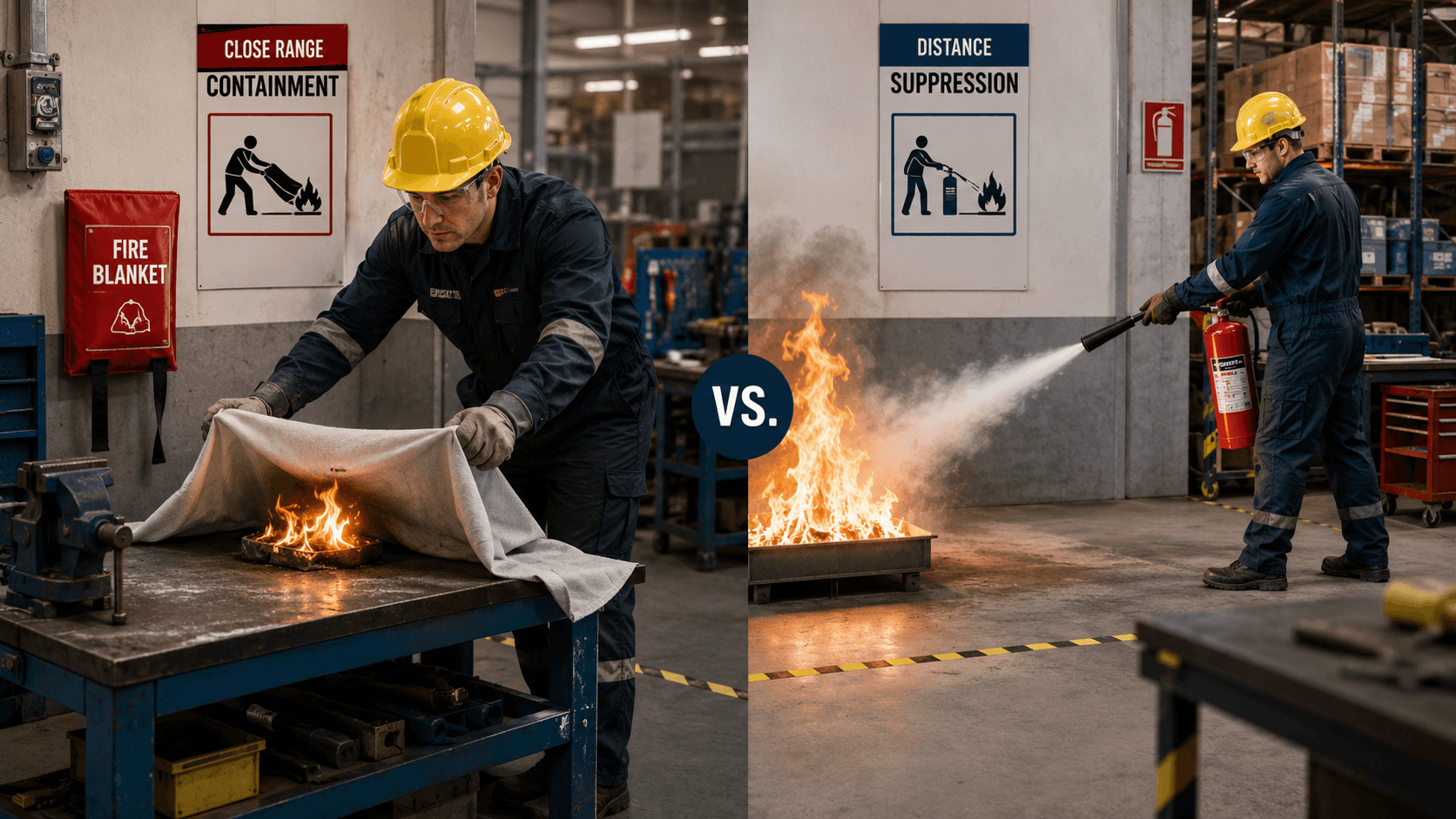
That is why comparing a fire blanket for industrial use with a fire extinguisher matters for procurement teams. A fire blanket can smother small, contained flames or isolate hot materials at close range. A fire extinguisher delivers a rated suppression agent from a safer distance and covers a wider set of fire scenarios when matched correctly.
This guide helps you decide where each tool fits, how to compare specifications, and how to build a practical fire response setup for industrial sites, workshops, warehouses, and maintenance areas.
What a Fire Blanket Does in Industrial Fire Response
Before you compare products, start with the job a fire blanket performs. It is a close range containment tool for small incidents where a trained worker can act without stepping into heavy smoke, spreading flame, or electrical danger.
How Fire Blankets Work
Fire blankets work by smothering a flame. When a worker places the blanket over a small fire, the fabric blocks oxygen and helps reduce flame activity. Industrial blankets commonly use woven fiberglass, silicone coated fiberglass, vermiculite coated fiberglass, or other heat resistant composite fabrics.
You should review more than the listed size. Key specifications include fabric weight, coating type, edge stitching, pull tab design, maximum exposure guidance, storage case durability, and manufacturer documentation. A blanket that looks acceptable in a product photo may perform poorly if the fabric tears, the pouch jams, or workers cannot deploy it under pressure.
Where Industrial Fire Blankets Are Commonly Used
You will often see fire blankets near welding tables, machine maintenance stations, laboratories, commercial kitchens, warehouse packing areas, vehicle service zones, battery handling spaces, and small fabrication benches. These areas create localized ignition risks close to workers, tools, packaging, and equipment.
For example, a technician repairing a compact motor may keep a blanket nearby to cover hot components or isolate a small surface flame on nearby material. In that situation, the blanket supports fast containment while the extinguisher remains ready if the incident spreads.
What Fire Classes Can a Fire Blanket Help With?
A fire blanket can help with small, contained fires where smothering can safely reduce oxygen around the flame. Suitability depends on the fuel source, blanket rating, blanket size, heat exposure, and facility procedures. Buyers should verify product documentation and never assume one blanket covers every fire class.
For practical procurement, think in terms of scenario control. A blanket may suit a small bench top flame, a container edge fire, or emergency wrap use during evacuation support. A spreading solvent fire, energized electrical incident, or deep seated material fire usually requires another response method.
The key takeaway is clear: use fire blankets for fast, close range containment only when the situation matches the product rating and site procedure.
What Fire Extinguishers Do Better
After you define close range containment, the role of extinguishers becomes easier to understand. Extinguishers provide distance, agent selection, and rated suppression performance that blankets cannot provide on their own.
Why Extinguishers Remain the Primary Industrial Fire Tool
Extinguishers work by delivering a suppression agent toward the base of a fire. Depending on the type, the agent may cool the fuel, interrupt the chemical reaction, displace oxygen, or coat the burning surface.
For industrial buyers, the major advantage is fire class matching. A facility can select extinguishers for Class A combustibles, Class B flammable liquids, Class C energized electrical equipment, or specialized hazards. Workers can also discharge many extinguishers from several feet away, which matters when heat, smoke, splash risk, or unknown fuel sources make close approach unsafe.
Common Extinguisher Types for Industrial Buyers
The table below compares common extinguisher categories that procurement teams often evaluate for industrial facilities:
| Extinguisher Type | Typical Fire Class Coverage | Residue Level | Common Industrial Use Case | Key Limitation |
|---|---|---|---|---|
| Water | Class A | Low | Wood, paper, cardboard, general combustibles | Unsafe for energized electrical equipment |
| Foam | Class A and Class B | Medium | Flammable liquid surface fires | Cleanup required after discharge |
| CO2 | Class B and Class C | Low | Electrical panels, machines, server rooms | Limited cooling effect after discharge |
| Dry Chemical | Class A, Class B, and Class C depending on rating | High | Workshops, warehouses, mixed risk areas | Powder residue can affect equipment |
| Clean Agent | Class B and Class C, with some Class A applications depending on rating | Very low | Electronics, control rooms, sensitive assets | Higher unit cost |
Use this table as a screening tool, then confirm the exact extinguisher rating, capacity, placement rules, and maintenance requirements with qualified safety personnel or local code guidance.
When Should You Use an Extinguisher Instead of a Fire Blanket?
Use an extinguisher when flames are spreading, the fire involves energized equipment, the fuel source is uncertain, or the worker needs distance from heat and smoke. Extinguishers also fit situations where site policy requires a rated suppression agent for the specific fire class and hazard.
Extinguishers also need a clear maintenance rhythm. Teams should check visibility, access, pressure gauges where applicable, inspection tags, hose condition, seals, and mounting height. Annual service, documented inspections, and employee training strongly influence whether the extinguisher performs well during a real incident.
The takeaway: extinguishers give broader response capability when the hazard exceeds safe close range containment.
Fire Blanket for Industrial Use vs Extinguishers: Key Differences
Now you can compare both tools side by side. The strongest facility plans use fire blankets and extinguishers as separate layers, with each tool placed where it makes the most sense.
Comparison by Response Speed, Safety, Residue, and Training
The table below compares fire blankets and extinguishers across practical procurement criteria:
| Criteria | Fire Blanket | Fire Extinguisher |
|---|---|---|
| Best fire size | Small, contained, coverable flames | Small to moderate fires within extinguisher rating |
| Response distance | Close range use | Allows greater stand off distance |
| Main action | Smothers and isolates | Discharges suppression agent |
| Cleanup | Usually minimal when fabric remains intact | May require powder, foam, or agent cleanup |
| Training complexity | Simple deployment with scenario based training | Requires fire class awareness and discharge practice |
| Maintenance | Inspect case, fabric, pull tabs, contamination, and visible damage | Inspect pressure, tags, hose, seal, weight, and service date |
| Storage | Wall case, pouch, cabinet, or vehicle kit | Wall bracket, cabinet, or marked station |
| Replacement trigger | Contamination, burn damage, fabric compromise, or failed inspection | Discharge, pressure loss, failed inspection, or service interval |
Use the comparison to assign each product to a task. A blanket often wins on speed and low mess for a small coverable incident. An extinguisher wins on distance, rated fire class response, and escalation control.
Risk Control Takeaway for Procurement Teams
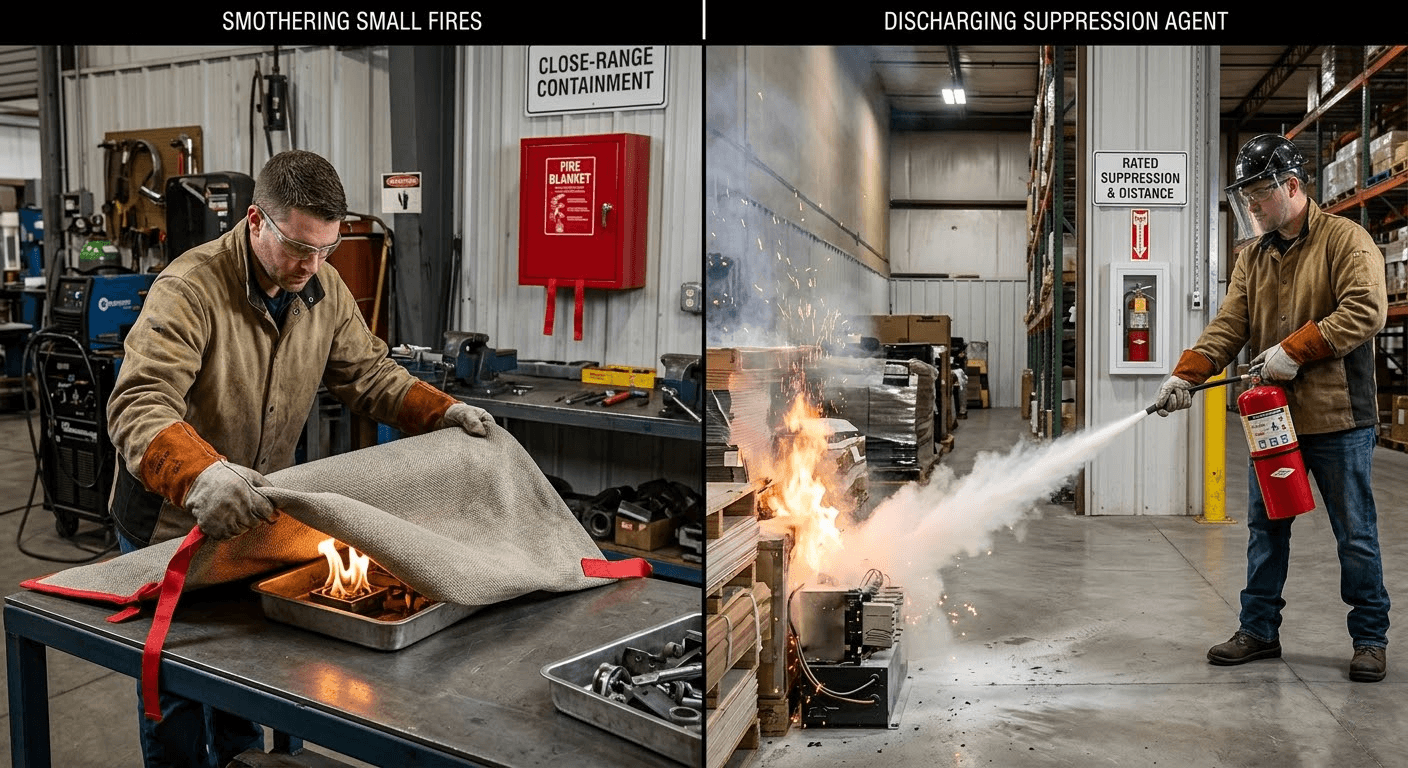
Consider an anonymized fabrication bench scenario. Workers cut metal near oily rags, cardboard packaging, and a small parts bin. A wall mounted blanket sits beside the bench for fast coverage of a small surface flame, while an ABC rated extinguisher remains visible near the exit path for escalation.
That layout gives workers two decision points. If a tiny, contained flame can be covered safely, the blanket may help. If heat increases, smoke spreads, or the fuel source looks uncertain, workers step back and follow the extinguisher or evacuation procedure.
The buying lesson is practical: specify blankets for fast containment in defined zones and extinguishers for rated suppression across the wider facility plan.
How to Choose the Right Industrial Fire Blanket
Once you decide to add blankets, the next step is specification. Weak materials, unclear documentation, or poor storage design can create a false sense of readiness.
Material and Coating
Fiberglass fabric is common because it offers heat resistance, flexibility, and dimensional stability. Silicone coated fiberglass can improve surface durability and handling in dirty, oily, or outdoor adjacent work zones. Vermiculite coated fiberglass may fit some higher heat hot work applications, depending on manufacturer data.
Match the material to the environment. A clean laboratory may prioritize compact storage and low shedding. A fabrication shop may prioritize abrasion resistance, reinforced edges, and a rugged wall case.
Size, Storage, and Deployment Access
Size should match the likely fire footprint. A small blanket may work for a bench top container, while larger workstations, carts, vehicle bays, and equipment areas may need wider coverage or multiple stations.
Placement matters as much as size. Mount blankets near exits, hot work zones, battery areas, and maintenance benches so workers can grab them without crossing the fire path. In real facilities, even a short walk can decide whether workers use the blanket or abandon the attempt.
Product Specification Checklist
The table below gives buyers a practical checklist for comparing industrial fire blanket options:
| Spec | What to Check | Why It Matters |
|---|---|---|
| Blanket size | Width, length, coverage area | Must fully cover the likely fuel source |
| Fabric type | Fiberglass, coated fiberglass, specialty fabric | Determines flexibility and heat behavior |
| Coating | Silicone, vermiculite, uncoated | Affects handling, durability, and use environment |
| Temperature data | Contact and short term exposure guidance | Helps match blanket to hot work risk |
| Edge stitching | Reinforced seams and pull tab strength | Reduces failure during fast deployment |
| Case type | Pouch, hard case, wall cabinet | Controls visibility and access speed |
| Mounting option | Wall mount, vehicle mount, kit storage | Supports zone based placement |
| Documentation | Product specs, safety guidance, batch consistency | Supports procurement review and staff training |
Use this checklist during supplier review, especially for repeat orders. You want consistent construction, clear documentation, and packaging that workers can identify quickly.
Wellco Industries is a Corona, California based supplier with agriculture, garden, industrial fiberglass, and home product lines, along with wholesale service, OEM or ODM options, and a North American warehouse network described in company information as 90,000 square feet. For procurement teams, that context supports repeat purchasing, bulk supply planning, and specification consistency when safety products need stable replenishment.
The core point: choose a blanket by risk zone, documentation, and deployment quality, then confirm the product fits your facility procedure.
How to Build a Practical Fire Safety Setup
A strong setup uses layers. Fire blankets support fast localized action. Extinguishers provide rated suppression. Procedures, signage, inspections, and training connect both tools into a system workers can actually use.
Use Fire Blankets as a First Response Layer
Place blankets where workers perform hot work, handle small flammable materials, charge batteries, or service machinery. The goal is quick access during the first moments of a small incident.
In field use, contractors often prefer visible wall mounted pouches near workstations because workers can spot them under stress. A blanket stored in a drawer may look tidy during an audit, yet it slows response when a small flame appears.
Keep Extinguishers as the Rated Suppression Layer
Extinguishers should remain in the facility fire safety plan with correct agent selection, marked locations, and inspection records. Safety teams should train workers to recognize when to use an extinguisher and when to evacuate.
A practical training method is scenario mapping. Workers should know which fires they can address, which fires require immediate evacuation, and which hazards need emergency services. This reduces overconfidence with both blankets and extinguishers.
How Many Fire Blankets Should an Industrial Facility Keep?
The right quantity depends on risk zones, work area layout, travel distance, hot work frequency, and local safety requirements. Buyers should map blankets by zone, such as welding benches, charging stations, maintenance bays, and loading areas, instead of relying on one blanket for an entire site.
For example, a warehouse may place one blanket near a maintenance bay, one near a battery charging area, one near a fabrication bench, and one near a loading dock where packaging materials increase ignition risk. Extinguishers would remain distributed according to local rules, hazard classification, and the facility safety plan.
The takeaway: build placement around real work zones, then train staff around those exact locations.
Procurement Mistakes to Avoid
Even good safety products can fail as a purchasing program when buyers focus on the wrong details. The most common problems come from weak specifications, poor visibility, and unclear training.
Buying Only by Lowest Unit Cost
Low cost blankets may use thin fabric, weak stitching, unclear temperature claims, or flimsy storage pouches. Those issues reduce confidence during deployment and increase replacement risk.
Procurement teams should request clear specifications before bulk purchase. Check size, material, coating, case design, packaging, and batch consistency. For repeat orders, ask whether the supplier can maintain the same construction across shipments.
Ignoring Staff Training and Visibility
A fire blanket looks simple, yet workers still need to know when to use it. They should understand how to pull it from the case, how to shield hands during approach, how to place it over the fuel source, and when to retreat.
Visibility also drives usage. Wall mounted cases, clear labels, and placement near risk zones reduce hesitation. If employees cannot find the blanket in seconds, the placement needs work.
Treating Fire Blankets as a Compliance Shortcut
Fire blankets should support a facility’s fire safety plan. They should align with extinguisher placement, emergency procedures, insurance expectations, and local fire code requirements.
Buyers should verify product ratings, manufacturer documentation, facility procedures, insurance requirements, and local fire code before deployment. Balanced planning protects workers better than relying on any single product for every fire scenario.
The procurement takeaway: buy for documented risk, train for real behavior, and review placement regularly.
Conclusion
A fire blanket for industrial use gives workers a fast way to smother small, contained flames and isolate hot materials. Fire extinguishers remain essential for rated suppression, wider fire class coverage, and safer response distance.
For purchasing teams, the strongest setup comes from four decisions. Map the risk zones first. Match extinguishers to fire classes and site requirements. Place blankets where fast close range containment is realistic. Verify specifications, documentation, visibility, and training before rollout.
Use blankets near high risk workstations where quick containment makes sense. Keep extinguishers visible, inspected, and matched to facility hazards. Train workers with clear scenarios so they know when to act and when to evacuate.