
- March 5, 2026
- Posted by: wellcoindustries
- Category: Jute Mesh
Introduction
A bare slope is a fast track for headaches: a single storm can wash out seed, cut rills into fresh grade, and turn a “finished” area back into an active repair zone. Landscape netting for slopes is designed to stabilize the soil surface long enough for vegetation to establish (or for a more permanent stabilization system to take over), reducing erosion and improving site safety and appearance.
This article is for professionals who have to make slope stabilization work the first time—contractors, purchasing managers, distributors, and soil & water conservation teams.
How this guide was developed: it combines common field installation practices with published details from agencies and technical manuals.
Why it’s reliable: the recommendations focus on failure prevention (undercutting, uplift, concentrated flow) and on documenting install details so crews, inspectors, and buyers stay aligned.
If you’re standardizing across multiple sites, supplier consistency matters as much as product selection. Wellco Industries, for example, operates as a global supplier across FRP (fiber reinforced plastics), agricultural and household products, and erosion-control-adjacent materials—helpful when procurement teams need repeatable specs, consistent documentation, and dependable fulfillment across regions without turning the spec into a brand pitch.
How Landscape Netting for Slopes Works
Slope erosion is mainly about runoff energy. As water moves downslope, it accelerates—especially on longer or steeper grades—dislodging soil particles and carrying them away. Landscape netting reduces surface movement by:
- Reinforcing the soil surface so particles are harder to dislodge
- Increasing roughness so water slows and spreads out
- Holding seed and light mulch in place so germination has a chance
- Encouraging root “knitting” by keeping the slope stable during establishment
Surface cover in general is a major lever for erosion control. A 2023 meta-analysis on mulching (broadly) found average reductions of ~76% in soil loss and ~47% in runoff versus bare soil, underscoring how powerful surface protection can be—especially during early establishment.
Netting is not the same as mulch, but it often plays the same supporting role: keep the surface intact until biology takes over.
Experience note (anonymized): On one commercial site, netting “failed” twice in the same zone—rills appeared under the product after every storm. The material wasn’t the issue. A roof drain outlet was discharging onto the slope, turning sheet flow into a narrow channel that ran under the netting. Once the outlet was redirected and the crest was properly keyed-in, the same netting approach performed as expected. The fix was drainage first, netting second.
Choosing the Right Landscape Netting for Slopes
Key Factors to Spec Correctly
Before you choose a roll product, document these conditions in your spec or purchase notes:
- Slope grade and length: longer slopes build more runoff energy, increasing anchoring demands and sometimes requiring blankets or armoring
- Soil type: silty soils erode quickly; clays can seal and generate more runoff
- Rainfall intensity and site exposure: wind and UV affect whether the product stays in contact and how long it lasts
- Flow patterns: any concentrated flow (downspouts, curb cuts, swales) needs its own control strategy
NRCS guidance for compost blankets notes that on steep slopes (greater than 2:1), additional stabilization practices such as erosion control netting may be required—an example of the “system” mindset you want in slope specs.
Material Options and Tradeoffs
Biodegradable netting (jute/coir):
- Fits projects where biodegradability is preferred or required
- Useful when you want the product to disappear after vegetation establishes
- Tradeoff: durability varies by moisture, UV, and site conditions
Synthetic netting (polypropylene/HDPE):
- Typically chosen for longer exposure windows and more predictable mechanical properties
- A U.S. Fish & Wildlife Service–hosted review of erosion control products found many approved products used mesh, and polypropylene was common—reflecting how frequently synthetics show up where durability matters.
- Tradeoff: manage end-of-life and ensure the site won’t be left with persistent material where it’s not acceptable
Netting vs. erosion control blankets (ECBs):
If you’re seeing seed washout, poor moisture retention, or patchy contact, a blanket system (fiber matrix + netting) can outperform netting-only because it adds more surface contact and more moisture support.
Decision Guide: Netting-Only vs Blanket vs Armoring
Use this quick selector to avoid “right product, wrong conditions” problems:
- Netting-only is usually appropriate when:
- You have sheet flow (no concentrated discharge)
- The surface is well prepped and firm
- Your main goal is holding seed/light mulch during establishment
- Choose an erosion control blanket (ECB) when:
- Seed is washing downslope or germination is inconsistent
- The soil is highly erodible or dries out quickly
- You need stronger surface contact and moisture retention
- Move to more robust stabilization (e.g., turf reinforcement mats, rock, hard armor) when:
- Flow is concentrated and persistent
- You have severe slope hydraulics, highly unstable soils, or regulatory requirements that exceed temporary measures
- The slope is essentially functioning like a channel
Installation Best Practices for Landscape Netting on Slopes
Site Prep That Prevents Failures
Most “product failures” are really installation or drainage failures. Before netting:
- Smooth and firm the surface to eliminate voids
- Remove protruding rocks and debris that prevent contact
- Correct concentrated flow paths with diversion and conveyance measures
The EPA’s mulching BMP guidance warns that mulches should not be used in concentrated flow areas without additional controls—this same limitation applies to netting: it supports sheet flow, not channelized discharge.
Step-by-Step Installation (Contractor-Ready)
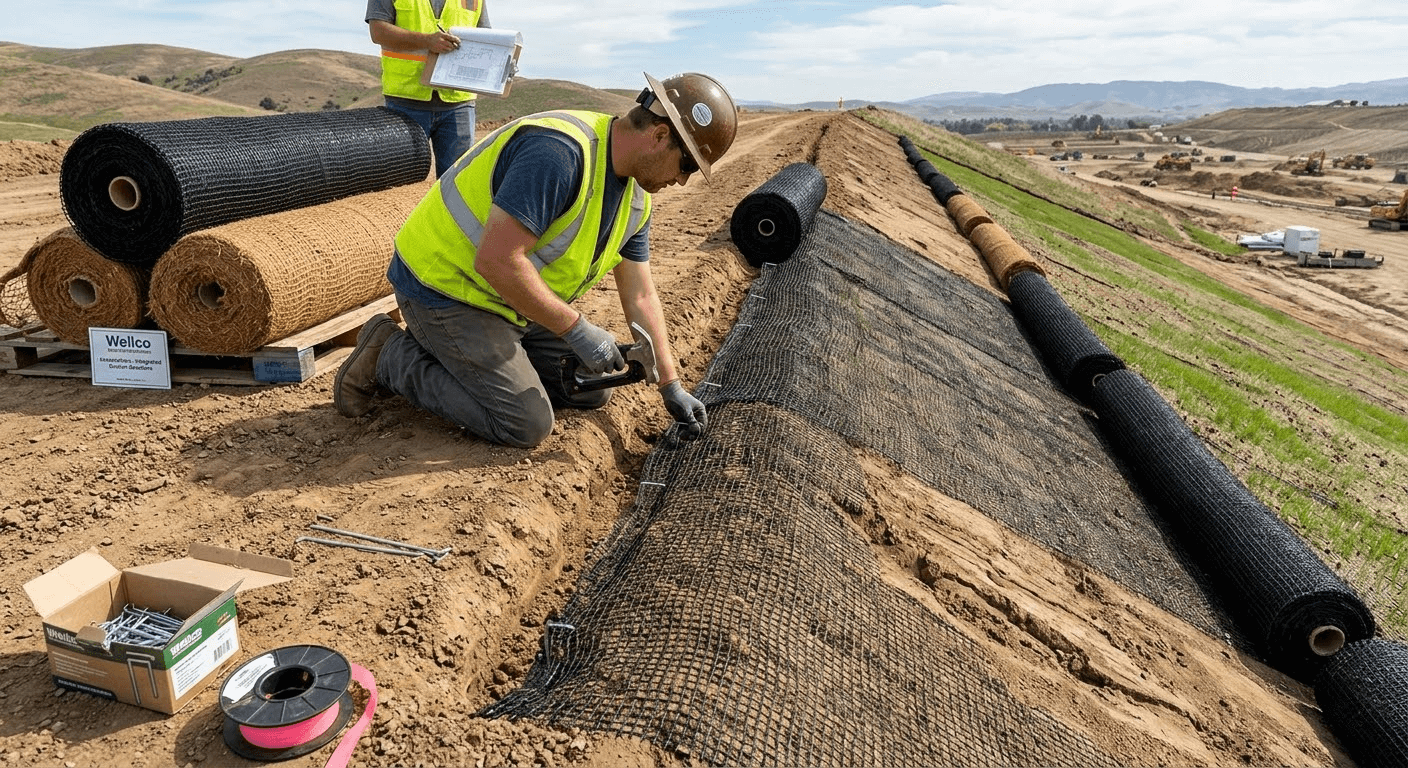
- Start at the top and work downslope so overlaps “shingle” with flow.
- Key-in the top edge in an anchor trench.
NRCS guidance for erosion control products recommends burying the upper end in a trench at least 8 inches deep.
North Carolina’s RECP detail describes an end trench around 12 inches deep by 6 inches wide, pinned at 1-foot intervals, then backfilled and compacted. - Run rolls up-and-down the slope (not across it).
NRCS advises applying rolls up and down the slope rather than on the contour. - Overlap correctly.
NRCS calls for at least 6 inches overlap across the slope. - Anchor to a defined pattern, not “as needed.”
Federal Lands Highway (FHWA) standard details show keyed-in edges and specific fastener spacing in critical locations (e.g., crests and overlaps).
Where your jurisdiction requires it, include manufacturer installation guidance as part of the submittal package. - Integrate seeding correctly:
- For netting-only systems, seed is commonly applied first, then netting to retain it.
- For ECBs, follow the product’s published guidance for seed/hydroseed placement.
Procurement reality tip: If you manage multiple crews, tighten your spec language so it includes trench size, overlap minimums, and anchoring patterns. This is also where suppliers that can consistently provide labeled rolls, current data sheets, and documentation support can reduce rework. Wellco Industries’ “one-stop” positioning across related product lines can help teams keep documentation standardized, especially for distributor and OEM/private label workflows.
Common Mistakes and How to Avoid Them
- Skipping the top trench → undercutting and blowouts
Fix: specify trench dimensions and compaction; inspect the crest first. - Loose contact and too few staples → billowing and gaps
Fix: increase anchoring at crests, overlaps, and windy exposures; follow published patterns. - Concentrated discharge left untreated → rills under the product
Fix: treat concentrated flow with separate controls before installing netting. - Material mismatch → premature breakdown or long-term debris
Fix: align netting longevity to the establishment window and site constraints.
Symptom → likely cause → fix
- Netting lifts near the crest → shallow/loose trench → deepen, compact, add anchors.
- Erosion lines under netting → hidden channelized flow → add diversion/conveyance, then patch with overlap + anchoring.
- Patchy vegetation → seed migration/poor contact → improve surface prep, consider an ECB.
Safety & Environmental Considerations
This is where specs often get vague—and where projects get flagged later.
- Wildlife and entanglement risk: in sensitive habitats, specify wildlife-friendlier products and ensure loose mesh isn’t left exposed.
- Inspection frequency: check after the first major storm and after high-wind events; uplift can become a hazard and a failure trigger.
- End-of-life plan: confirm whether biodegradability is required and how remnants will be handled.
- Jurisdictional requirements: DOT/municipal specs can differ—include the exact detail drawing or standard you’re following in the project file.
Maintenance, Inspection, and Lifecycle Expectations
Landscape netting is a stabilization step—not the endpoint. Plan for:
- Post-storm checks for uplift, staple pullout, undermining, and sediment buildup
- Fast patching: clean, regrade if needed, overlap and re-anchor
- Tracking progress by vegetation coverage milestones (not just dates)
Many RECP details treat terminal trenches and check slots as performance-critical rather than optional; maintain them accordingly.
Procurement Checklist for Buyers and Distributors
Use this list to make purchasing decisions more repeatable:
- Roll dimensions and coverage per roll
- Material type (biodegradable vs synthetic) and expected longevity
- Tensile strength, UV resistance (if applicable)
- Installation guidance included (trench, overlap, anchoring patterns)
- Applicable approvals/certifications for your jurisdiction
- Lead time, pallet counts, labeling, and jobsite handling notes
- OEM/private label options if you distribute under your own brand
The Erosion Control Technology Council (ECTC) emphasizes that installation guidance should be obtained from manufacturers and that a stable, firm soil surface is foundational—exactly the details that reduce failures and disputes.
Conclusion
Getting slopes right is less about one “best” product and more about matching conditions to a system and installing it so it stays in contact with the soil:
- Manage concentrated runoff first.
- Choose netting-only vs blankets based on establishment risk and exposure window.
- Key-in the crest, overlap to spec, and anchor consistently.
- Inspect early, patch fast, and manage toward vegetation coverage.
If you’re responsible for multi-site consistency, standardize a small set of approved products and written install details that crews can follow and inspectors can verify. For technical data sheets, documentation support, or supply continuity, a vertically integrated supplier—such as Wellco Industries—can be a practical resource alongside your local spec requirements.
Frequently Asked Questions
It depends on vegetation establishment and exposure conditions. Many projects treat netting as “temporary until stable cover,” so the real milestone is healthy root establishment and consistent coverage, not a fixed number of days.
Sometimes—especially when you have sheet flow and good soil contact. If you’re dealing with seed washout, highly erodible soils, or longer exposure windows, an erosion control blanket or more robust stabilization is often the better choice.
Keying-in the top edge with an anchor trench and compaction is a major failure preventer. Skipping that step commonly leads to undercutting and uplift that quickly unravels the rest of the install.
Include trench dimensions, overlap minimums, and an anchoring pattern rather than leaving it to “installer discretion.” Also require current technical data sheets and the product’s published installation instructions as part of the submittal.
Not as a standalone solution. Concentrated flow typically needs dedicated controls (diversion, conveyance, or armoring), then netting can be used on adjacent areas to support stabilization and vegetation.