
- November 13, 2025
- Posted by: wellcoindustries
- Categories: Erosion Control, Jute Mesh
Byline: Prepared for purchasing managers, contractors, distributors, and OEM/private-label teams in agriculture, construction, and soil & water conservation.
Last reviewed: Nov 13, 2025
Introduction
Soil can disappear from a fresh slope after a single storm. If you need stabilization that supports vegetation and avoids plastic cleanup, jute mesh netting—a biodegradable, open-weave textile—can be the right fit. This guide shows when to choose it, when to upgrade, and how to specify and install it for compliance and ROI.
Supplier context (value-add, no hard sell): Wellco Industries provides erosion-control materials alongside fiberglass composites and agricultural inputs. We support OEM/private label programs, lot traceability and documentation, coordinated shipments of pins/staples/adjacent BMPs, and consistent lead times for multi-site rollouts.
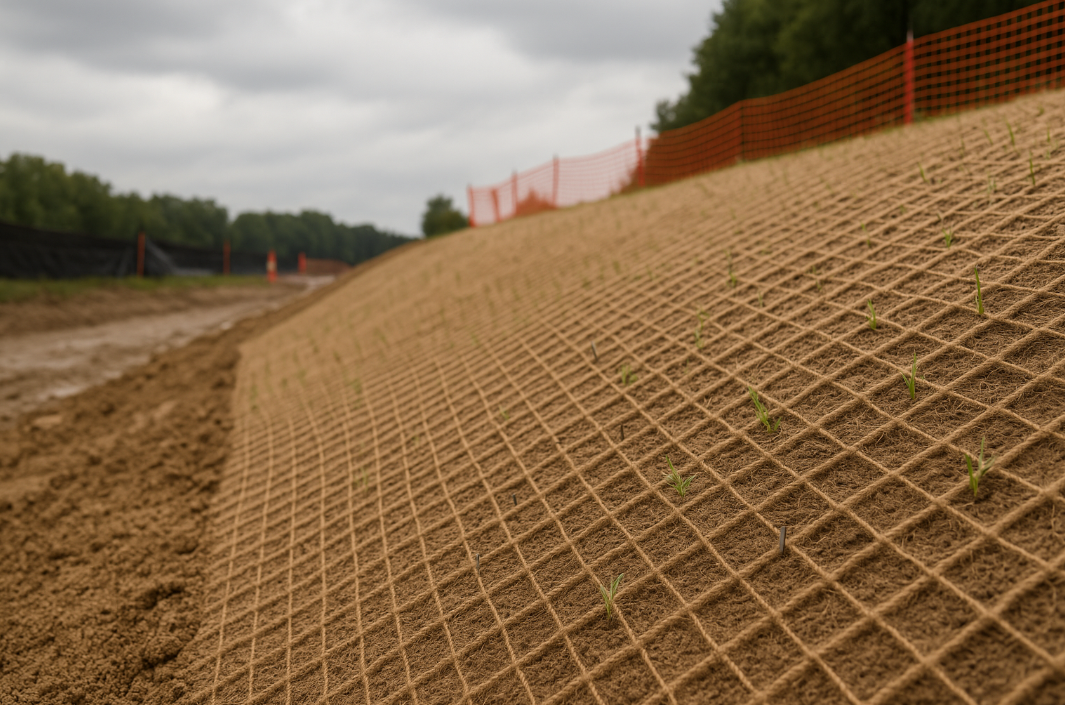
What Is Jute Mesh Netting?
Jute fibers are woven into an open grid that increases surface roughness, helps hold seed and mulch in place, and moderates surface moisture while roots establish. Caltrans classifies jute mesh as an open-weave textile with a typical functional longevity around 12 months, generally used on cut/fill slopes between 4:1 and 2:1 (H:V) and listed under ECTC Category 3B. dot.ca.gov
“Think of jute mesh as temporary scaffolding for soil and seed—there to help roots grab on, then quietly disappear.” — Municipal stormwater coordinator
Where it excels
Gentle to moderate slopes, disturbed embankments, and swales with low to moderate flows.
Projects prioritizing biodegradability and avoiding plastic removal.
Where it struggles
High-shear channels, outfalls, culvert aprons, or zones with sustained design velocities (consider coir blankets or TRMs there). As a reference point for alternatives, many straw/coconut double-net blankets carry permissible shear ~2.0 psf (≈96 Pa) in vendor testing, and are chosen when energy is higher than jute mesh can handle.
Quick Decision Path
(Use project hydraulics to confirm. Caltrans guidance for jute mesh: slopes 4:1 to 2:1, ~12-month function.) dot.ca.gov
Selection & Specifying Guide
Match the product to the site
Slope length/grade & aspect: long, south-facing slopes dry faster—consider heavier natural-fiber blankets or companion mulch.
Soil: sands and dispersive clays may need closer staple spacing; ensure firm, smooth seedbed.
Hydrology: any concentrated flow path across the slope usually merits an upgrade (coir/TRM) on that path.
Specs that actually matter
GSM (basis weight) and aperture (e.g., ~1–2 in grid) affect durability and seed retention.
Functional longevity: expect ~12 months nominal for jute mesh; local climate and soil biology drive real-world breakdown.
Roll sizes/core type: plan for crew productivity and minimal waste.
Compliance & standards
Mirror DOT/municipal spec language (GSM, weave, labeling, biodegradability); request product data, installation guide, and lot traceability.
NRCS guidance emphasizes overlaps and proper anchoring for jute products used with seeding and mulch.
Mini selection table
| Site condition | Choose | Why |
|---|---|---|
| 4:1–2:1 slope, sheet flow | Jute mesh | Biodegradable scaffold, supports rapid vegetation; Caltrans use case. |
| Slope w/ intermittent concentrated flow or longer establishment window | Coir/straw-coir blanket | Higher functional longevity & shear tolerance (example ratings ~2.0 psf). |
| Continuous flow channel/high energy | TRM or hard armor | Permanent reinforcement or structural armoring needed. |
Installation That Holds (Field-Proven)
“Nine out of ten failures trace back to anchoring and overlaps.”
Tools & materials
Jute rolls, erosion-control staples/pins, seed/soil amendments, trenching tools, safety gear, marking paint.
Step-by-step
Prep & seed: grade smooth, remove clods/debris, seed/fertilize per plan. Ensure full soil-to-mesh contact.
Top anchor trench: 75–100 mm deep at the crest; place tail in trench, backfill, compact.
Roll downslope: keep mesh in intimate contact—no bridging.
Overlaps: shingle downslope; side laps ~75–100 mm; end laps ~100–150 mm.
Staples: tighten patterns on edges/ends and windy areas; follow project detail (staggered grid typical).
Termination: secure at toe or bottom trench; patch obstacles with extra staples (don’t rely on cuts alone).
Verified best practice: NRCS notes that jute netting must be overlapped and anchored according to manufacturer instructions—don’t skip these steps.
Staple pattern sketch (conceptual)
X . X . X . X
. X . X . X .
X . X . X . X (tighten spacing at edges/ends)
. X . X . X .
Safety & environmental
Fall protection on steep slopes; collect packaging and stray staples; keep wildlife-safe work zones.
First-Hand Field Note (Experience)
On a roadside cut where a crew skipped the crest trench and under-stapled to save time, the first storm lifted the top course and peeled half a roll. We re-laid the mesh with a proper trench, shingled overlaps downslope, and doubled edge staples. The slope tracked clean through three subsequent storms—no rilling, and the seed took evenly.
Performance, Longevity & Cost
Expect early-storm reduction in rilling and vegetation emergence in ~4–8 weeks during growing season (climate-dependent).
Jute’s biodegradability eliminates retrieval/removal logistics; that’s direct labor/freight savings vs. persistent plastics.
Where energy is higher, upgrading to coir/TRM is often cheaper than repairing blowouts.
Case snapshot (anonymized)
Project: 2.8-acre highway cut (sandy loam).
Approach: native seed + jute mesh on slopes; coir blanket on concentrated flow paths.
Outcome: stable surface after first storm; coverage surpassed acceptance by ~60 days; no patch repairs that season.
Procurement & Quality Checklist
Labeling: GSM, aperture, roll dimensions, lot number.
Docs: product data sheet, installation guide, lot traceability/COA, SDS (if applicable).
Packaging/logistics: palletized rolls with barcode/QR, roll IDs, weather-resistant wrap; confirm freight class/stack height.
OEM/private label: custom widths/lengths, branded wrap, spec inserts.
Where Wellco helps: we bundle pins/staples and adjacent BMPs, coordinate mixed loads, and support private-label kits for distributors.
Sustainability & Compliance
Biodegradability: jute returns to soil; breakdown accelerates in warm, moist, biologically active soils.
Microplastic avoidance: natural fibers reduce entanglement and cleanup risks associated with plastic netting.
Program alignment: supports ESG narratives and municipal specs that prefer natural-fiber RECPs.
Agency guidance: Caltrans documents jute mesh use cases and limits; NRCS publications emphasize proper anchoring/overlaps. dot.ca.gov+1
When Jute Is Not the Right Choice
Channels/outfalls with sustained shear or design velocities that exceed jute’s practical envelope.
Very steep slopes beyond the 2:1 guideline—consider netted blankets/TRMs or engineered armoring.
Limitations & Assumptions
Performance depends on installation quality, seed/soil contact, climate, and traffic/wildlife.
Ratings and envelopes vary by product; verify against project hydraulics and your authority’s BMP manual.
Example shear values cited for alternatives (straw/coconut blankets) come from vendor datasheets and can differ by brand.
Frequently Asked Questions
1) How long does jute mesh last in the field?
Caltrans lists ~12 months functional longevity for jute mesh; warmer, wetter, biologically active soils can shorten that window.
2) Can I use jute mesh in drainage channels?
Not typically. Jute mesh is intended for slopes; channels/outfalls with sustained flow usually require coir blankets, TRMs, or hard armor.
3) Should seed go above or below the mesh?
Either can work. NRCS notes seeds may be applied before or after placing jute; just ensure overlaps and anchoring per instructions.
4) What staple spacing should I use?
Follow the project detail; tighten spacing at edges/ends and in windy areas. The big failures stem from under-stapling and missing the crest trench.
5) How do I spec an upgrade when flows are higher?
Look to natural-fiber blankets with published shear ratings (e.g., straw/coconut ~2.0 psf in some datasheets) or TRMs; confirm with your hydraulics and local BMP manual.
Technical review: Add reviewer name/credential before publishing (e.g., “Reviewed by [Name], CPESC — 2025-11-13”).
Contact: Request a spec sheet, submittal package, or private-label options from Wellco Industries.