
- April 8, 2026
- Posted by: wellcoindustries
- Categories: Burlap, Erosion Control
Introduction
A single unforecasted frost event can damage or kill 10–15% of unprotected nursery stock in affected seasons, according to field reports compiled by USDA cooperative extension programs on horticultural cold damage. For contractors, landscape managers, and agricultural buyers managing large installations, that loss rate translates directly into replacement costs, client disputes, and schedule delays. The question isn’t whether to protect plants before winter — it’s which material does the job reliably, without introducing new risks.
Burlap has been the field standard for decades because it solves the core problem: it insulates without sealing. This guide covers how to use burlap to protect plants from frost, including installation technique, application timing by plant type, and how to specify the right grade for commercial-scale procurement. Wellco Industries supplies burlap in bulk across standard and heavy-duty grades, with consistent GSM-certified stock and private-label options for distributors and contractors who need reliable seasonal availability.
What Makes Burlap Effective for Frost Protection
Choosing the wrong frost protection material costs more than the material itself — it costs plant stock, labor hours, and client trust. Understanding why burlap outperforms alternatives starts with the physics of how plants lose heat overnight.
How Burlap’s Woven Structure Traps Heat
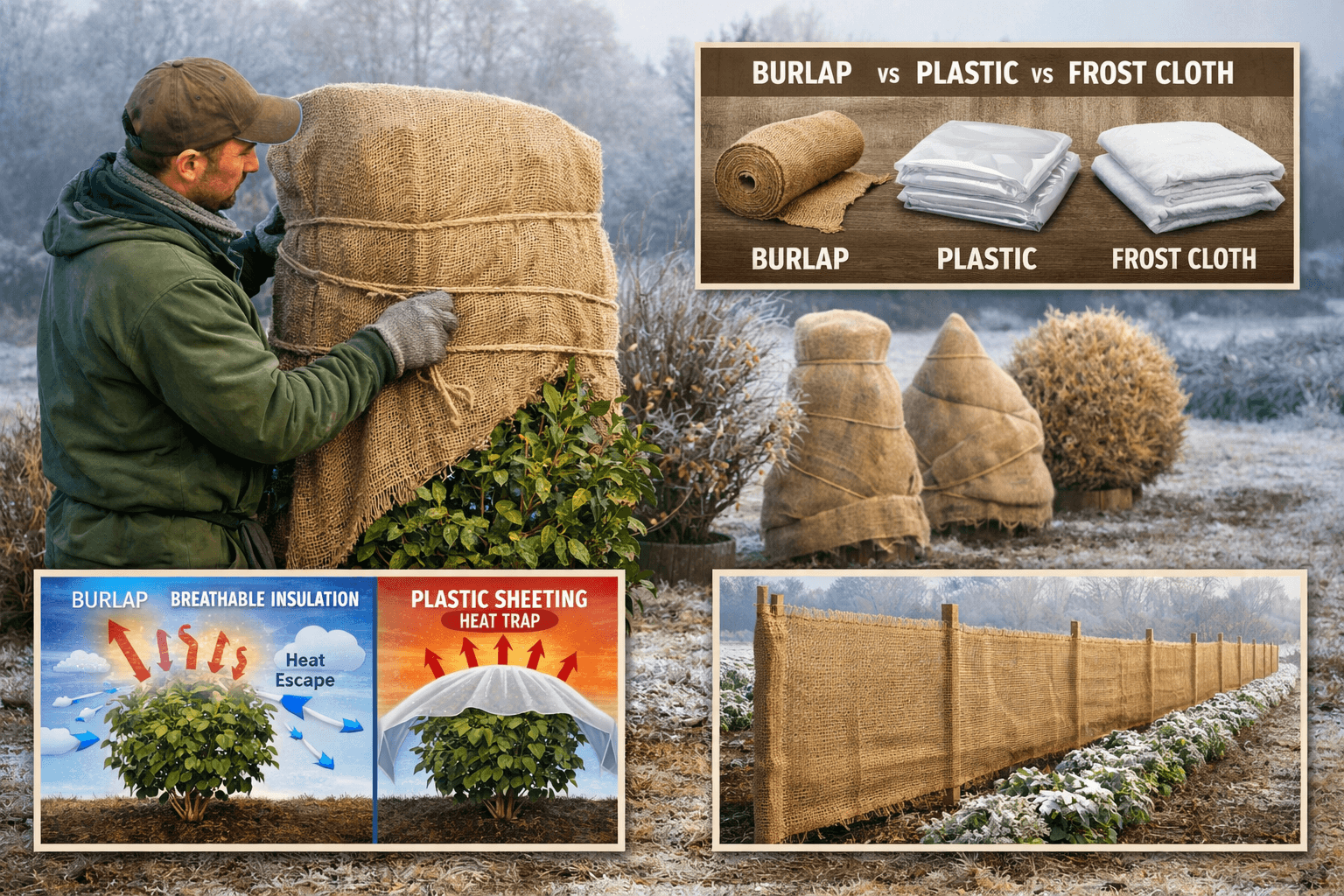
When temperatures drop, plants lose heat through two primary mechanisms: radiant cooling from exposed surfaces and convective heat loss driven by wind. Burlap’s open-weave structure creates a thin insulating air layer directly around plant tissue, slowing radiant heat loss without sealing the microclimate. That partial airflow is the critical advantage — plants continue to respire, excess humidity escapes, and the risk of fungal disease from trapped condensation stays low.
Non-woven polypropylene frost cloths offer comparable breathability at lighter weights but degrade faster under UV exposure if left in place across multiple seasons. Plastic sheeting, by contrast, traps heat aggressively on sunny days — raising canopy temperatures to damaging levels even in winter — and blocks gas exchange entirely. For contractors managing large installations, the material choice affects both plant survival rates and the labor cost of ongoing monitoring and adjustment.
Burlap vs. Plastic Sheeting vs. Frost Cloth
The table below compares the three most commonly specified frost protection materials across the performance criteria that matter most to commercial buyers:
| Property | Burlap | Plastic Sheeting | Frost Cloth (Non-Woven PP) |
|---|---|---|---|
| Breathability | High — open weave allows airflow | None — fully sealed | Moderate — microporous |
| Insulation Value | Moderate (slows radiant loss) | High (traps heat) | Moderate to High |
| Wind Resistance | High — dense weave holds shape | Moderate — tears in high wind | Low to Moderate |
| Reusability | 3–5+ seasons with proper storage | 1–2 seasons | 1–3 seasons |
| UV Risk to Plants | None | High (heat buildup on sunny days) | Low |
| Cost per Season | Low–Moderate | Low (replacement costs accumulate) | Moderate |
| Best Use Case | Shrubs, trees, windbreaks, row covers | Short-term cold snaps only | Lightweight annual frost events |
Burlap’s combination of breathability, wind resistance, and multi-season reusability makes it the preferred specification for most commercial landscape and agricultural frost protection projects.
When to Apply Burlap for Maximum Protection
Timing matters as much as material selection. Installing burlap too late — after the first hard frost — can lock in existing tissue damage. Installing too early in the fall may limit photosynthesis during the critical hardening-off period when plants are building cold tolerance naturally.
Reading Frost Risk Indicators
The standard field threshold for frost risk is an ambient air temperature at or below 36°F (2°C) by late evening, particularly when relative humidity is low and skies are clear. Clear nights accelerate radiant cooling — plant and ground surfaces can drop 5–8°F below the recorded air temperature under these conditions, a phenomenon well-documented in USDA NRCS guidance on cold air drainage and frost pocket management. Experienced landscapers apply a practical rule: if the forecast shows 38°F overnight with clear skies and low humidity, treat it as a frost night and install protection the afternoon before.
USDA Plant Hardiness Zone maps provide a reliable baseline for first-frost date planning, but microclimatic factors — low-lying terrain, proximity to pavement, wind exposure — can shift local frost risk by two to three weeks relative to zone averages. Buyers specifying burlap for large regional projects should account for zone variability when planning inventory and delivery schedules.
Application Timing by Plant Type
The table below summarizes recommended burlap application timing by plant category, based on field practice documented across commercial landscaping and agricultural extension programs:
| Plant Category | Recommended Timing | Burlap Method | Key Reason |
|---|---|---|---|
| Broadleaf evergreens (rhododendron, holly) | After first hard frost (below 28°F) | Full wrap, staked frame | Prevent desiccation and windburn through winter |
| Newly planted deciduous trees | When temps consistently drop below 32°F | Trunk wrap only | Protect thin bark from freeze-thaw cracking |
| Container shrubs and perennials | Before first frost forecast | Full wrap or burlap skirt to ground | Root zone more vulnerable than in-ground stock |
| Row crops and ground-level plantings | Night before forecast frost event | Horizontal windbreak or drape | Short-duration protection; remove by mid-morning |
| Established conifers | Mid-to-late November (Zone 5–6) | Burlap windbreak on windward side | Reduce needle desiccation from winter wind |
Matching the installation method to the plant type prevents both under-protection and the growth suppression that comes from wrapping too early or too tightly. Correct timing, combined with correct technique, is what separates effective frost management from reactive damage control.
How to Wrap and Stake Burlap Correctly
Selecting the right material and timing is only half the job. Improper installation is the most common reason burlap underperforms in the field — either because wrapping restricts the plant structurally, or because loose installation allows cold air to channel directly to vulnerable tissue.
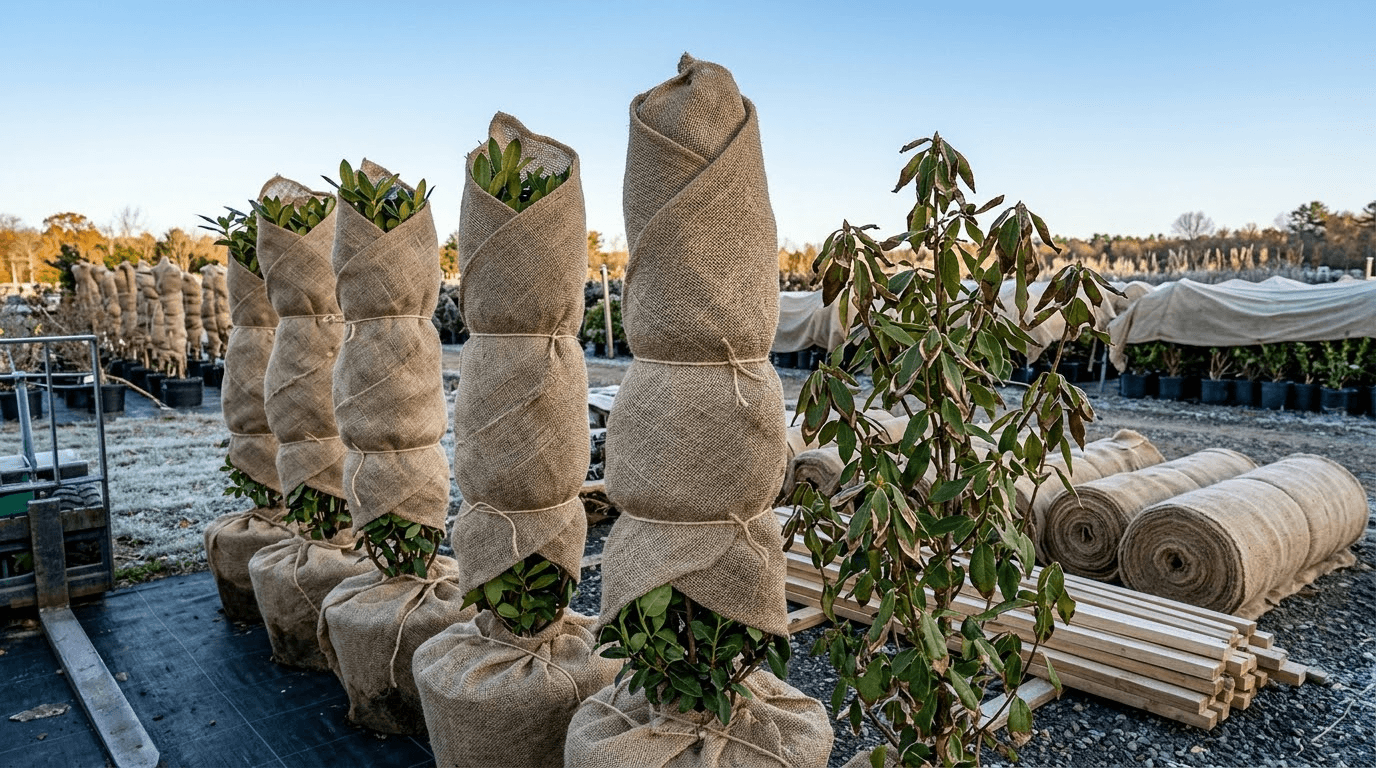
Step-by-Step Wrapping for Shrubs and Small Trees
On a commercial landscape contract covering more than 200 broadleaf evergreens across a Zone 5 suburban corridor, one installation crew documented that pre-tying branches inward before wrapping reduced per-plant installation time by nearly 30% compared to wrapping untied specimens — while also producing a tighter, more wind-resistant profile. That workflow translates directly to the following field-tested process:
- Measure before cutting. Wrap a flexible tape around the plant’s widest point and add 6–8 inches of overlap. For height, measure from ground level to the top of the canopy or uppermost branch requiring protection.
- Tie branches loosely inward on multi-stemmed shrubs before wrapping to reduce effective diameter and prevent the burlap from catching wind like a sail.
- Wrap in a spiral from the base upward, overlapping each pass by 3–4 inches. Upward wrapping ensures overlaps shed water rather than channel it toward the trunk.
- Secure with natural twine, not wire or plastic zip ties. Tie at the mid-point and top — never cinch tightly around the main stem.
- Leave the top open on broadleaf evergreens wrapped for windburn protection; close the top fully only when protecting against hard freeze events below 20°F.
The most frequent installation error is wrapping too tightly around the main stem, which creates a girdling effect that damages the cambium over a full winter season. A two-finger gap between burlap and the primary stem at all tie points is the reliable field standard.
Creating Burlap Windbreaks for Row Crops and Garden Beds
For row-level protection across larger agricultural or landscape installations, a post-and-stake windbreak is more efficient than individual plant wrapping. Drive stakes at 6–8 foot intervals along the windward side of the planting area, then staple or tie burlap panels between posts, keeping the bottom edge staked or weighted to prevent cold air from undercutting the barrier.
Field data from Cornell Cooperative Extension trials on horticultural windbreak performance indicates that properly installed burlap windbreaks can reduce effective windchill exposure on protected plantings by 50% or more — a meaningful performance difference on exposed sites in Zone 4 and 5 winter conditions. For contractors managing installations across multiple properties, pre-cut burlap rolls in standard widths (36″, 40″, or 48″) reduce on-site cutting time significantly. Factor a 10–15% material overage for end-posts, overlaps, and installation damage when estimating quantities.
Selecting the Right Burlap Specification for the Job
Knowing how to install burlap correctly leads directly to the next procurement decision: not all burlap performs equally under the same field conditions. Buyers who specify by weight class and weave density get consistent seasonal results; buyers who order on price alone frequently deal with material that tears mid-season or degrades after a single storage cycle.
Weight, Weave, and Grade — What Buyers Need to Know
Burlap is measured in grams per square meter (GSM), and the correct weight depends on application severity and reuse expectations. The table below summarizes standard commercial grades and their appropriate uses:
| Grade | GSM Range | Approximate Frost Range | Best Application |
|---|---|---|---|
| Standard Landscape (7–8 oz) | 220–270 GSM | Down to ~25°F (field guideline, USDA extension) | Shrub wrapping, light windbreaks, annual frost events |
| Heavy-Duty (10 oz) | 340 GSM | Down to ~15°F in sheltered installation | Exposed sites, hard freeze protection, multi-season reuse |
| Natural Jute | Varies by grade | Matches weight class above | Projects with environmental compliance or composting requirements |
| Synthetic (Woven PP) | Varies by grade | Matches weight class above | Multi-year reuse programs with covered storage infrastructure |
Natural jute burlap is fully biodegradable and compostable at end of life — preferred for projects with organic certification requirements or where disposal logistics are a factor. Synthetic polypropylene burlap offers higher UV resistance and longer reuse lifespan, making it cost-effective for contractors running structured seasonal programs with proper storage in place.
For commercial buyers placing bulk orders, requesting a GSM specification sheet and physical sample before committing to large quantities is standard procurement practice. Wellco Industries offers OEM and private-label options for distributors supplying branded materials to landscape contractors, with bulk availability across standard and heavy-duty grades.
Storage, Reuse, and End-of-Season Handling
Properly dried and stored natural jute burlap delivers 3–5 seasons of reliable performance. The single most common cause of premature degradation is storing burlap while damp — which accelerates fiber breakdown and produces mold that weakens the weave structurally within a single off-season.
End-of-season handling protocol: remove burlap by mid-spring once frost risk has passed, shake out debris, and allow full air-drying in a ventilated area before folding and storing in a dry location away from direct sunlight. For synthetic burlap, UV exposure during off-season storage is the primary degradation risk — store covered or indoors. Natural jute that has reached end of functional life can be composted directly, returning organic matter to the soil with no disposal cost.
Conclusion
Burlap remains the most practical, cost-effective frost protection material for commercial landscape and agricultural applications — when selected, timed, and installed correctly. Here are the five takeaways that drive results in the field:
- Match burlap weight to frost severity. Standard 7–8 oz grade suits most frost events; specify 10 oz for hard freeze exposure or high-wind sites.
- Time installation to plant type, not just air temperature — root zone vulnerability, bark thickness, and foliage type all determine the correct trigger point.
- Install with technique. A two-finger gap at stem tie points, upward spiral wrapping, and properly anchored windbreaks prevent the errors that cost plant stock.
- Plan for reuse. Proper drying and storage converts burlap from a single-season expense into a multi-year asset with a measurable cost-per-season advantage.
- Specify by GSM and fiber type for bulk procurement — price-only purchasing leads to inconsistent field performance and higher total cost of ownership.
[Request a bulk burlap quote from Wellco Industries →]
Frequently Asked Questions
A: Minimum order quantities vary by product grade, width, and roll length. Contact Wellco Industries directly for current MOQ thresholds, volume pricing tiers, and lead times by SKU. Private-label and OEM configurations are available for qualifying distributors.
A: Heavy-duty 10 oz burlap is the recommended specification for Zone 4 and colder. For plants with lower cold hardiness ratings, combine burlap wrapping with root zone mulching — typically 3–4 inches of organic mulch — to address both above-ground and below-ground frost exposure.
A: Natural jute is a plant-based, biodegradable material and is generally compatible with organic production practices. Buyers should confirm material approval with their specific certification body, as requirements vary by program and jurisdiction.
A: Use double-stapling at each post connection point and stake the bottom panel edge directly to the ground with 6 inches of overlap. Pre-cut panels to allow ground overlap rather than trimming flush, and use intermediate stakes between primary posts on runs longer than 20 feet in high-wind exposure zones.
A: Synthetic polypropylene burlap typically delivers 5–8 seasons with proper covered storage; natural jute averages 3–5 seasons. The per-season cost gap narrows significantly when natural jute’s composting disposal advantage and zero end-of-life handling cost are factored into total cost of ownership — making jute the preferred specification for buyers with active sustainability or compliance requirements.