
- April 1, 2026
- Posted by: wellcoindustries
- Category: Fiberglass Stakes
Introduction
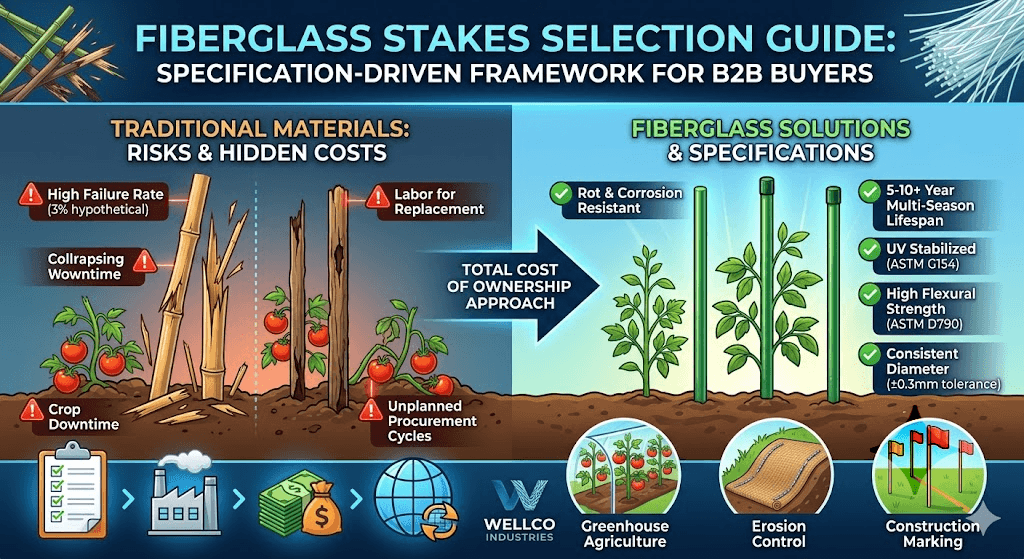
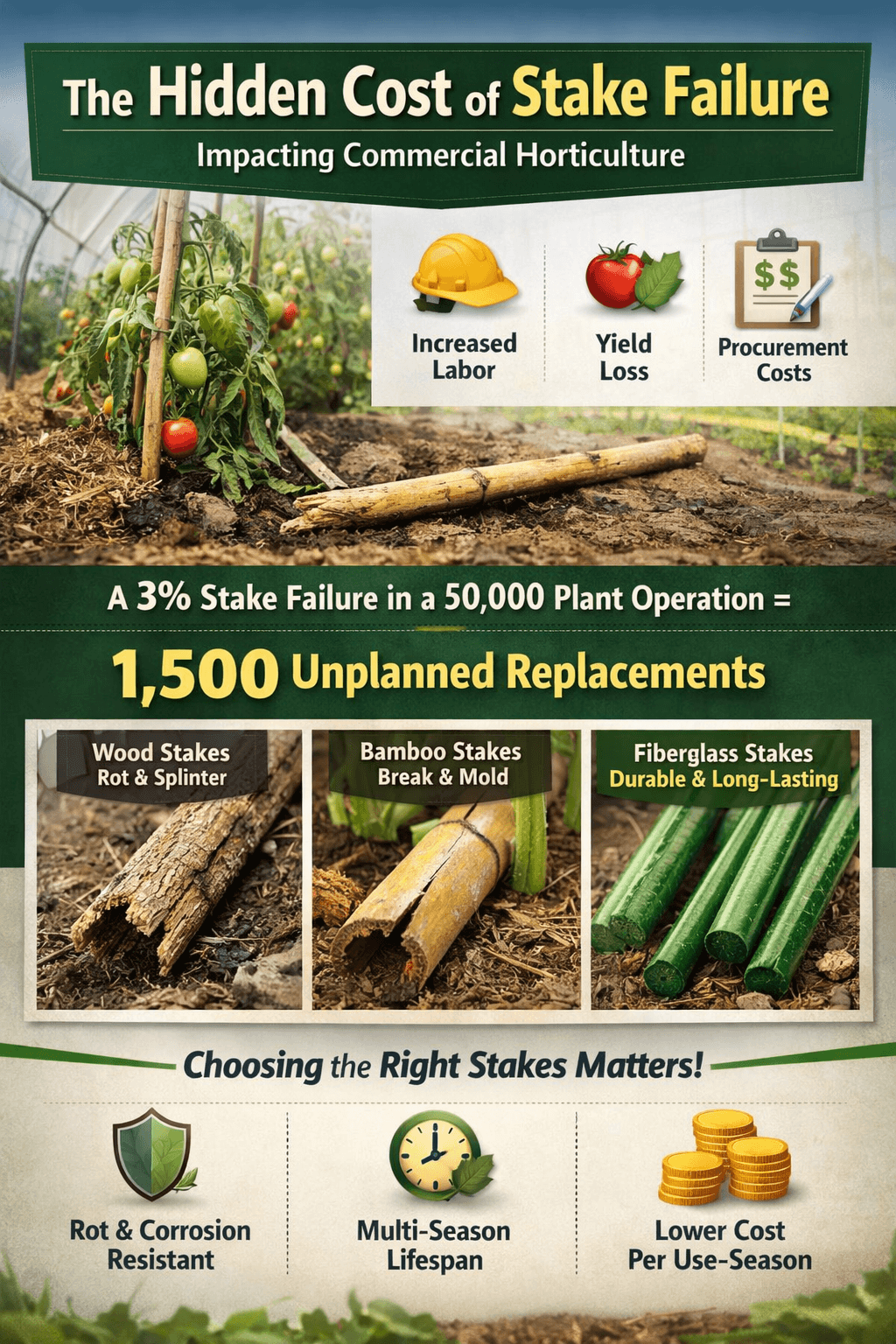
Stake failure costs commercial growers more than most procurement teams account for. In a greenhouse tomato operation running 50,000 plants per cycle, even a 3% stake failure rate — a conservative estimate for bamboo in high-humidity environments — generates roughly 1,500 unplanned replacement interventions per season. That is not a staking problem: it is a labor, yield, and procurement planning problem. For purchasing managers and contractors sourcing at scale, stake selection is a structural decision that affects crop performance, installation efficiency, and total project cost across multiple seasons.
This guide gives B2B buyers a practical, specification-driven framework for selecting fiberglass stakes for garden and agricultural use. You will find material comparisons grounded in testable data, key specifications to request from suppliers, application-matched guidance for agriculture through erosion control, and procurement questions that separate reliable suppliers from risky ones.
Wellco Industries is a leading global supplier of FRP (Fiber Reinforced Plastics), agricultural, and household products — including fiberglass stakes engineered for large-volume agricultural, horticultural, and erosion control deployments. As a vertically integrated supplier serving purchasing managers, contractors, and OEM buyers, Wellco provides the product consistency and bulk availability that high-volume operations require.
1. Why Stake Material Matters at Commercial Scale
Material choice rarely receives serious attention until something fails in the field. At commercial scale, that failure rarely stops at the stake itself — it cascades into labor, crop, and procurement consequences that dwarf the cost of the original material.
1.1 The Hidden Cost of Stake Failure
When wooden or bamboo stakes rot mid-season, the visible cost is replacement material. The invisible costs are larger: labor to pull and replace stakes while avoiding root damage, crop downtime, potential yield loss from unsupported plants, and the administrative burden of an unplanned procurement cycle. To be clear, the 3% scenario above is a hypothetical illustration — real failure rates vary by material, environment, and season length — but the cost structure it reveals is consistent with what procurement managers in commercial horticulture regularly encounter when switching from seasonal to multi-year stake strategies.
Total cost of ownership, not unit price, is the correct metric for evaluating stake materials at scale. Fiberglass stakes carry a higher upfront cost than wood or bamboo alternatives, but their multi-season lifespan, resistance to rot and corrosion, and consistent dimensional stability routinely deliver lower cost per use-season when amortized across the asset’s service life.
1.2 How Fiberglass Outperforms Wood, Bamboo, and Metal
The performance gap between fiberglass and traditional staking materials becomes clearest when evaluated across the dimensions that matter most to commercial buyers: structural integrity, environmental resistance, and longevity. Note that fiberglass tensile strength varies significantly by product construction — fiber content, resin type, and fiber orientation (unidirectional vs. woven layup) all affect the final figure; the range below reflects this variance across commercially available grades.
The table below compares primary performance characteristics of common garden stake materials across the criteria most relevant to procurement decisions at scale:
| Property | Fiberglass (FRP) | Wood | Bamboo | Coated Steel |
|---|---|---|---|---|
| Tensile Strength | 70,000–150,000 psi (varies by fiber content and layup) | 8,000–12,000 psi | 7,000–10,000 psi | 65,000–100,000 psi |
| Corrosion / Rot Resistance | Excellent — unaffected by moisture or soil chemistry | Poor — rots within 1–3 seasons | Poor — splits, molds in humidity | Moderate — coating integrity degrades over time |
| UV Stability | Good (UV-stabilized grades per ASTM G154) | Poor — degrades and splinters | Poor — bleaches and weakens | Good — powder coat dependent |
| Typical Lifespan | 5–10+ years (UV-stabilized, standard outdoor agricultural conditions) | 1–3 seasons | 1–2 seasons | 3–7 years |
| Weight | Very light (≈ 0.06–0.12 lb/ft) | Moderate | Light | Heavy |
| Cost Per Use-Season | Low (amortized across multi-season lifespan) | Moderate to high | High | Moderate |
Taken together, the data in this table points to a clear conclusion for multi-season operations: fiberglass does not rot, does not corrode, does not splinter, and maintains dimensional consistency across its entire service life — advantages that coated steel cannot match on weight, and that wood and bamboo cannot match on durability.
Knowing the material advantages is the starting point. Selecting the right fiberglass stake still requires evaluating specific product specifications against your deployment conditions.
2. Key Specifications to Evaluate Before You Buy
Not all fiberglass stakes are manufactured to the same standard. Two stakes of identical diameter and length can perform very differently depending on resin formulation, fiber content, and surface treatment. These are the specifications to examine before committing to a bulk order.
2.1 Diameter and Length Ranges for Different Applications
Stake dimensions are not interchangeable across applications. Using an undersized stake to support a heavy-fruiting crop — or an oversized stake for light row marking — creates either structural risk or unnecessary cost.
Common diameter and length pairings map to application type as follows:
- 3–4 mm diameter, 60–90 cm length — lightweight row marking, seedling support, propagation beds
- 5–6 mm diameter, 90–120 cm length — tomatoes, peppers, cucumbers, lightweight trellis systems
- 7–8 mm diameter, 120–180 cm length — heavy fruiting crops, vineyard wire support, hop yard training
- 10–12 mm diameter, 150–240 cm length — erosion control plantings, land restoration, construction site marking
For greenhouse operations using automated clipping or tying systems, diameter consistency is as operationally critical as load rating. Common automated clip systems are engineered to tolerances of ±0.3 mm — stakes that are out-of-round or dimensionally inconsistent batch-to-batch will cause clip misfires, slow installation rates, and increase labor cost per row. Specify diameter tolerance explicitly in your RFQ.
When sourcing for a mixed crop operation or multi-project supply contract, buyers often standardize on two or three diameter and length SKUs that cover the majority of applications — reducing inventory complexity while maintaining structural adequacy across use cases.
2.2 Load-Bearing Capacity and Flexural Strength
Tensile strength describes how much axial force a stake can withstand before breaking. Flexural strength — resistance to lateral bending — is the more operationally relevant figure for most agricultural applications, where wind load and crop weight apply sideways force to the stake rather than downward axial load. The relevant test standard is ASTM D790, which governs flexural properties of unreinforced and reinforced plastics and is the appropriate benchmark to request from FRP stake suppliers.
In commercial greenhouse environments, a fully loaded tomato or cucumber plant can exert estimated lateral loads in the range of 5–15 kg on its support stake, depending on variety, training system, and canopy density — a range based on horticultural engineering estimates for high-wire growing systems, which buyers should verify against their specific crop and training configuration. Contractors should request flexural modulus data from suppliers and confirm that the stake specification covers peak load conditions with a safety factor of at least 1.5–2x the expected operational load.
Underspeccing on flexural strength is one of the most common and costly errors in commercial stake procurement. A stake that handles routine loads may fail during a wind event or at peak fruit load — precisely when crop value is highest and replacement intervention is most disruptive.
2.3 UV Stabilization and Surface Coating
Fiberglass without UV stabilization will chalk and lose surface integrity under prolonged sunlight — weakening the outer resin layer that protects the glass fiber core. For multi-season outdoor deployment, UV stabilization is a baseline specification requirement, not a premium feature.
When evaluating suppliers, ask specifically:
- What UV stabilizer is incorporated, and at what loading level?
- Is UV protection in the resin matrix, a surface coating, or both?
- What accelerated weathering test data per ASTM G154 is available?
Surface coatings also affect soil penetration ease, grip for plant ties and clips, and resistance to agricultural chemicals. Smooth coatings ease ground insertion; textured or knurled surfaces improve grip for manual ties. Specify surface finish based on your installation workflow and tooling.
3. Matching Stake Type to Application
Selecting the correct specification is half the decision. Matching that specification to the actual field or operational environment determines whether a product that performs on paper also performs in the ground.
3.1 Agriculture and Horticulture Use Cases
In controlled environment agriculture, fiberglass stakes are used for direct plant support, trellis wire anchoring, and row system training. Performance criteria differ meaningfully by crop type.
For tomatoes and cucumbers in greenhouse settings, consistent diameter and straightness are prerequisites for automated clip systems — structural performance is assumed, but dimensional precision determines installation efficiency. Vineyard and hop yard applications demand high flexural strength at wire-anchor contact points, where leverage forces concentrate and stake failure risk is highest. Row markers require visibility and light weight over structural rating.
In nursery and horticulture environments, fiberglass stakes offer an underappreciated biosecurity advantage over bamboo: they do not harbor fungal spores or soil-borne pathogens. For growers managing Fusarium or Pythium pressure, this is a meaningful operational differentiator — not a minor feature.
3.2 Erosion Control and Land Restoration Plantings
Erosion control contractors use fiberglass stakes to support transplanted native plants, erosion control blankets, and straw wattles on disturbed slopes — applications requiring stakes to remain structurally sound for two to five years as vegetation establishes. Rot resistance is not a preference in this context: it is a project-critical requirement.
The consequences of stake failure in erosion control are well-documented in practice. On a riparian slope restoration project in a high-rainfall coastal environment, a soil conservation contractor who switched from 1.2 m wooden stakes to 8 mm fiberglass after a prior-season failure documented an 18% wooden stake failure rate before native shrub species achieved root establishment at month four — requiring a full re-staking intervention that exceeded the original staking budget. Fiberglass eliminated that failure mode in the following season entirely.
For rocky or compacted soils common in disturbed-land restoration settings, tip integrity under driving force is an additional specification criterion. Request supplier data on tip-split resistance or specify a reinforced tip profile for hard-ground deployment.
3.3 Construction and Landscaping Marking Applications
In construction and civil engineering contexts, fiberglass stakes are used for survey flagging, site boundary marking, underground utility indication, and temporary erosion barrier installation. High-visibility color coding — orange, yellow, white, pink — is a standard safety compliance requirement on active work sites, and re-usability across project phases reduces per-project material cost.
The table below maps common deployment scenarios to recommended stake specifications and key selection criteria:
| Use Case | Recommended Stake Spec | Key Selection Reason |
|---|---|---|
| Greenhouse tomato / cucumber support | 6 mm dia., 150 cm, smooth coat, ±0.3 mm tolerance | Flexural strength; diameter consistency for clip systems |
| Vineyard / hop yard wire training | 8–10 mm dia., 180 cm | High flexural modulus at wire contact point |
| Erosion control planting (standard soil) | 6–8 mm dia., 90–120 cm | Rot resistance; multi-season durability |
| Erosion control planting (compacted / rocky soil) | 8 mm dia., 120 cm, reinforced tip | Tip integrity under driving force |
| Row and bed marking | 3–4 mm dia., 60 cm, bright color | Visibility; light weight; easy removal |
| Construction site flagging | 5–6 mm dia., 90–120 cm, high-vis color | Color compliance; weather resistance; re-usability |
Construction and landscaping buyers frequently procure fiberglass marking stakes in pallet quantities with custom color or flag-top options. Supplier flexibility on color specification and packaging format is a procurement criterion worth qualifying before contract award.
4. Procurement Considerations for Bulk and OEM Buyers
With specification and application alignment confirmed, the remaining procurement decisions determine whether supply performance matches product performance across the life of the contract.
4.1 MOQs, Lead Times, and Supply Consistency
For large agricultural or infrastructure projects, supply reliability carries the same weight as product specification. A stake that meets dimensional and structural requirements but arrives late or in inconsistent batch quality creates project-level risk that no unit price advantage can offset.
Key questions to ask suppliers before committing to a volume purchase:
- What is the standard MOQ per SKU, and what flexibility exists for mixed-SKU pallet orders?
- What is the standard production lead time, and what is the surge capacity for urgent orders?
- How is batch-to-batch dimensional consistency maintained — what in-process QC steps are standard, and is test data available per lot?
- Is vendor-managed inventory or forward stocking available for high-volume accounts?
Buyers sourcing for multi-season contracts or distributed project portfolios should prioritize suppliers with demonstrated production scale and documented QC processes over those offering the lowest unit price on spot orders.
4.2 Custom Sizing, Color Coding, and Private Label Options
Standard catalog dimensions cover most applications, but OEM buyers and large distributors frequently require non-standard lengths, tighter diameter tolerances, proprietary color codes for brand differentiation, or private-label packaging.
For buyers whose project portfolios span multiple application types, custom capability with a single supplier offers a workflow advantage: it consolidates vendor management, simplifies compliance documentation, and reduces the coordination overhead that comes with managing multiple specialty suppliers across a product category. Request sample production runs from any prospective supplier before committing to full custom volume, and verify that custom color or length specification does not compromise UV stability or structural performance relative to the standard catalog product.
4.3 Compliance, Certifications, and Material Safety
Regulatory requirements for fiberglass stakes vary by end market and application. Buyers sourcing for edible crop contact — direct plant support in commercial food production — should confirm that surface coatings and resin formulations meet applicable food-safety standards in their market.
For import and export compliance, request full material composition documentation: fiber content percentage, resin type and formulation, and coating chemistry. Confirm alignment with applicable import regulations in the destination market. RoHS compliance documentation may be required for institutional or government procurement contracts.
Soil conservation and land restoration buyers working on government-funded projects may need to demonstrate material compliance with project specifications and environmental standards. Make supplier documentation capability — not just product capability — part of your RFQ evaluation criteria.
Conclusion
Selecting the right fiberglass stake is a total-cost-of-ownership decision, not a unit-price decision. Five takeaways for procurement managers and contractors:
- Evaluate on cost per use-season, not cost per unit — fiberglass consistently outperforms wood and bamboo over multi-season deployments when amortized across the asset’s service life.
- Match diameter and flexural strength to peak load conditions — specify to ASTM D790 flexural data and apply a 1.5–2x safety factor over expected operational load.
- Require UV stabilization test data, not just a product claim — ask for ASTM G154 accelerated weathering results and specify the performance threshold you require.
- Use the application suitability table to align stake spec to deployment environment — the same diameter stake performs very differently in a greenhouse tomato row versus a compacted erosion control slope.
- Qualify suppliers on supply consistency, dimensional tolerance, and custom capability — for volume buyers, execution reliability is a specification in itself.
Fiberglass stake adoption in commercial horticulture, erosion control, and infrastructure marking is accelerating as procurement teams move from reactive annual replacement cycles to planned, multi-season asset strategies. Buyers who establish reliable supply relationships — with documented QC, custom capability, and demonstrated production scale — will be better positioned as demand for consistent, high-performance staking solutions continues to grow.
[Request a bulk quote or custom spec sheet from Wellco Industries →]
Frequently Asked Questions
MOQs vary by supplier and SKU configuration, but most manufacturers set standard minimums in the range of 1,000–5,000 units per diameter and length combination for catalog items. Mixed-SKU pallet orders may carry different MOQ structures. Confirm MOQ flexibility for mixed-spec orders if your operation requires multiple diameter and length configurations from a single purchase order.
Yes — most FRP stake manufacturers support custom length production for qualifying volume orders, typically with a sample run prior to full production. Buyers should confirm whether cut-length tolerances, tip finishing, and surface coating are maintained to the same specification as standard catalog products. Request a pre-production sample for dimensional and structural verification before committing to a full custom run.
UV-stabilized fiberglass stakes are typically rated for five to ten or more years under standard outdoor agricultural conditions, based on accelerated weathering testing equivalent to ASTM G154 exposure cycles. Actual service life depends on UV exposure intensity, soil chemistry, mechanical loading, and installation practice. Request supplier-specific weathering test data and confirm the test conditions against your deployment environment.
Food-safety compliance for stake materials in edible crop contact applications depends on the specific resin formulation and surface coating used. Buyers sourcing for commercial food production should request material safety data sheets and confirm that the coating chemistry meets applicable food-safety standards in their market. Not all catalog products carry this qualification — raise it explicitly in your RFQ.
At minimum, request: material composition documentation (fiber content, resin type, coating chemistry), UV stabilization test data (ASTM G154 or equivalent), flexural strength test data (ASTM D790), and RoHS compliance documentation if required for your procurement category. Government-funded erosion control or land restoration projects may require additional environmental or material compliance declarations — confirm project specification requirements before finalizing supplier selection.