
- March 25, 2026
- Posted by: wellcoindustries
- Category: Other
Introduction
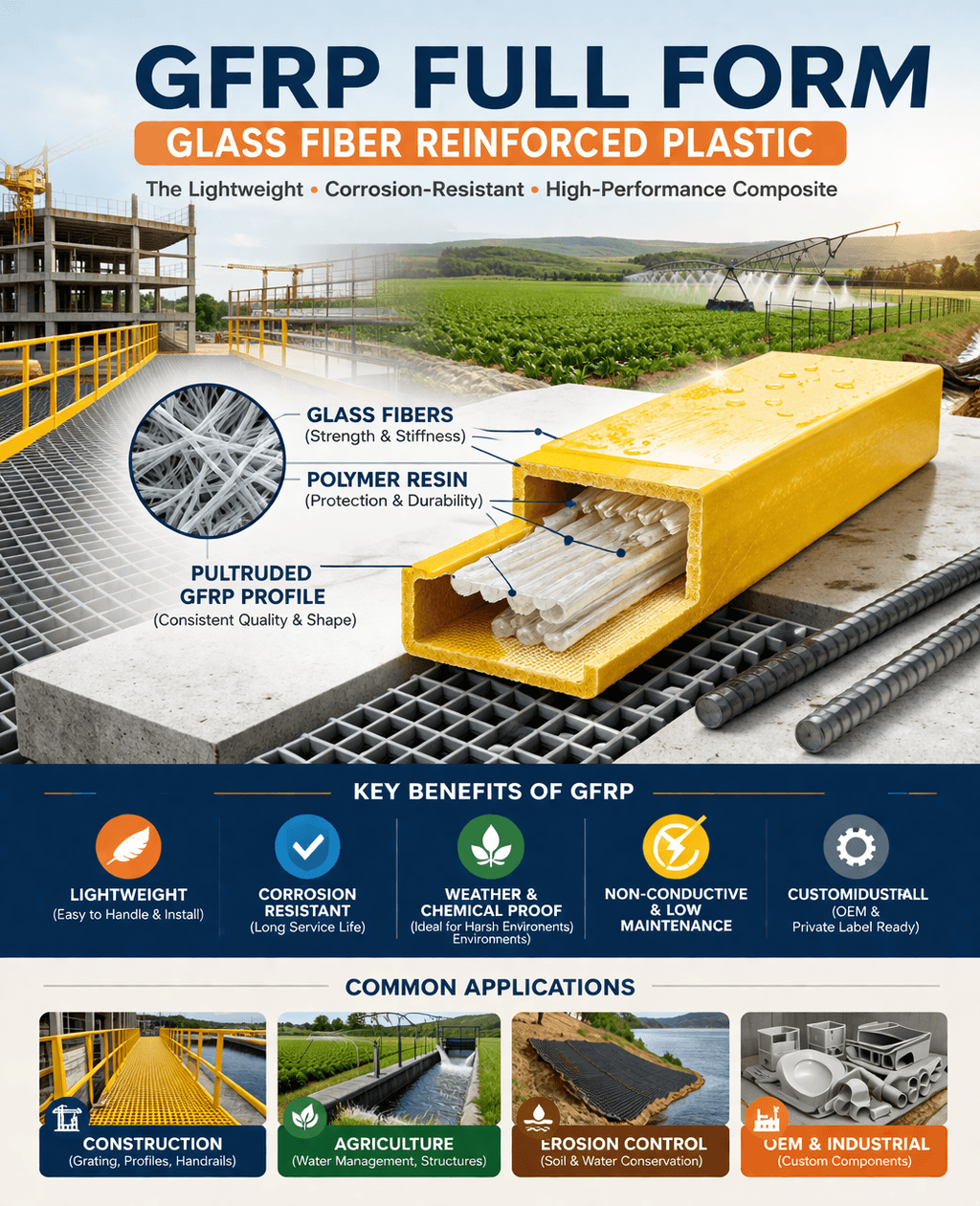
The GFRP full form is Glass Fiber Reinforced Plastic. It describes a composite material made by combining glass fibers with a polymer resin to create parts that are lighter than steel and valued for corrosion resistance in demanding environments. Official sources such as NIST describe fiber-reinforced plastics as polymer-matrix materials reinforced with fibers, with glass among the most common reinforcement types, while the Federal Highway Administration highlights lightweight and corrosion resistance as key reasons FRP composites are used in infrastructure.
For buyers in construction, agriculture, and soil and water conservation, knowing the acronym is not enough. You also need to know how the product is made, what resin system it uses, and whether it fits the jobsite conditions. That is especially relevant for purchasing managers, contractors, distributors, and OEM/private-label buyers who compare durability, lead time, and lifecycle value across suppliers. Wellco Industries fits naturally into that conversation because its FRP, erosion-control, and agricultural product range reflects the way many professional buyers source across related categories rather than as one-off purchases.
What Is the GFRP Full Form?
What does GFRP stand for?
The GFRP full form is Glass Fiber Reinforced Plastic. You may also see closely related wording such as glass-reinforced polymer or fiberglass composite. In practical terms, the glass fibers provide much of the strength, while the resin binds the structure together, protects the fibers, and shapes the final part. NIST notes that FRPs are used widely in construction and infrastructure, not just in aerospace or automotive applications.
Common resin systems include:
- Polyester for many general-purpose products
- Vinyl ester where better chemical resistance is needed
- Epoxy for higher-performance structural or specialty applications
A useful buyer takeaway is this: two products can both be labeled GFRP and still perform very differently because resin choice, fiber content, and manufacturing method all matter.
Why the term matters to buyers
When a spec sheet says GFRP, it signals more than a material family. It affects weight, corrosion performance, handling, installation planning, and maintenance expectations. FHWA specifically points to lightweight and corrosion resistance as major advantages in bridge decks, GFRP rebars, and pultruded structural members. That is why experienced buyers do not stop at the acronym; they ask what kind of GFRP it is and what service conditions it is designed to handle.
How GFRP Is Made and Why That Affects Performance
Core manufacturing process
Most GFRP products start with glass fibers, a selected resin system, a shaping process, curing, and quality checks. Depending on the product, manufacturers may use pultrusion, molding, or lay-up methods. Pultruded members are common when a project needs consistent cross-sections such as structural shapes, ladders, handrails, or grating supports. FHWA lists pultruded structural members among established FRP applications in transportation structures.
Why manufacturing details matter
A practical lesson in composite buying is that appearance alone can be misleading. Two profiles may look similar in a catalog, but one may use a resin better suited for wet, chemical, or UV-heavy service. Another may have different fiber architecture, affecting stiffness or durability. ACI’s guidance for FRP-reinforced concrete exists precisely because FRP materials have unique properties that must be considered in design and construction rather than treated like a direct copy of steel behavior.
For that reason, smart buyers ask suppliers about:
- Resin type
- Fiber content or reinforcement design
- Manufacturing process
- Testing or standards used
- Intended service environment
Key Properties and Benefits of GFRP
Strength-to-weight advantage
One of GFRP’s biggest commercial advantages is its favorable strength-to-weight profile. FHWA highlights its low weight as a major reason it is used in infrastructure applications. For buyers, that can translate into easier transport, simpler installation, and less need for heavy lifting equipment on some jobs.
In real buying scenarios, that matters most when access is difficult or labor efficiency is a priority. A lighter product can reduce handling time, simplify field replacement, and make installation easier in remote agricultural or conservation settings.
Corrosion and weather resistance
GFRP is often selected where steel or other metals would corrode too quickly. FHWA repeatedly emphasizes corrosion resistance in FRP bridge and structural applications, and AMPP continues to frame corrosion as a major infrastructure challenge requiring better material and management choices.
That is one reason GFRP shows up in applications exposed to:
- Moisture
- Fertilizers or chemicals
- Coastal air
- Wastewater or drainage conditions
- Outdoor weathering over long service periods
For agriculture, water management, and erosion-control work, those exposure conditions are not edge cases. They are everyday design realities.
Electrical and thermal characteristics
GFRP is also attractive in applications where non-conductive behavior or lower thermal conductivity than metal is useful. Those benefits can matter around electrical equipment, exposed walkways, and industrial environments where metal heat transfer or conductivity is a concern. Even so, buyers should verify the exact product grade and test data before making a safety-related decision.
Common Applications Across Industries
Construction and infrastructure
GFRP is used in rebar, structural members, bridge components, grating, platforms, ladders, and walkways. FHWA’s composites program specifically references GFRP rebars, FRP bridge decks, and pultruded members in construction and transportation settings.
Agriculture and land management
In agricultural and conservation projects, buyers often need materials that can tolerate water, weather, and long service cycles with limited maintenance windows. That makes GFRP relevant for selected supports, access components, water-related structures, and other outdoor composite applications. Wellco Industries’ mix of FRP, agricultural, and erosion-control products is a good example of how these buying needs often overlap in the real market.
OEM and private label supply
For distributors and OEM buyers, GFRP can also be attractive because composite products are often customizable in size, shape, finish, and branding. That matters when supply consistency and spec repeatability are just as important as raw performance. A vertically integrated supplier can add value by reducing coordination friction across sourcing, customization, and replenishment.
What to Verify Before Ordering
A more trustworthy buying guide should also say where caution is needed. GFRP is not automatically the best answer for every structural or industrial application. ACI’s FRP guidance exists because these materials behave differently from conventional reinforcement and need project-appropriate design and detailing.
Before ordering, verify:
- The resin system matches the exposure conditions
- The load requirements are clearly defined
- Applicable standards or testing are documented
- UV, chemical, and moisture resistance claims are specific
- The supplier can support custom dimensions or OEM needs if required
That extra step protects buyers from the most common mistake in composite sourcing: comparing unit price without comparing service life, maintenance risk, and installation fit.
Conclusion
Understanding the GFRP full form gives you a much better starting point for evaluating composite materials: Glass Fiber Reinforced Plastic is not just a label, but a material system whose performance depends on fibers, resin, process, and quality control. For professionals in construction, agriculture, and soil and water conservation, that knowledge helps you choose products based on real operating conditions instead of catalog shorthand.
The best next move is to compare GFRP options by application fit, standards, and lifecycle value. If your team is reviewing FRP solutions alongside erosion-control or agricultural materials, a supplier with broad category experience such as Wellco Industries can help you match product selection to field conditions, sourcing goals, and customization needs.
Frequently Asked Questions
They are closely related terms. In most commercial contexts, GFRP refers to a fiberglass-based composite made with glass fibers and a polymer resin, although exact formulations can differ by product and application.
It is commonly used in infrastructure, structural members, bridge components, grating, platforms, and selected industrial or agricultural applications where low weight and corrosion resistance matter. FHWA highlights these uses in transportation structures.
The main reasons are lower weight and better corrosion resistance in certain environments. That can reduce maintenance needs and make handling easier, especially in wet or chemically exposed settings.
Ask about resin type, intended environment, load requirements, manufacturing process, and any testing or standards support. Those details matter because GFRP products can vary significantly even when they look similar.
No. It is a strong option in many environments, but the right choice depends on design requirements, exposure conditions, and verified performance data. For structural uses, project-specific engineering and standard-based design are important.