
- February 25, 2026
- Posted by: wellcoindustries
- Category: Burlap
Introduction
Choosing between garden burlap fabric and weed fabric isn’t a “better vs. worse” decision—it’s a timeline and performance decision. Burlap (usually jute) is often selected because it’s breathable and designed to break down, while weed fabric (typically polypropylene geotextile/landscape fabric) is selected because it’s built to survive installation stress and last longer.
This buyer-focused comparison covers where each material wins, where it fails, and how to write specs that hold up across crews and sites. If you routinely source across erosion control and agricultural materials, a broad, vertically integrated supplier (such as Wellco Industries, with erosion control materials alongside agricultural and household product lines) can also help standardize specs and simplify repeat ordering without turning your material list into a patchwork of one-off vendors.
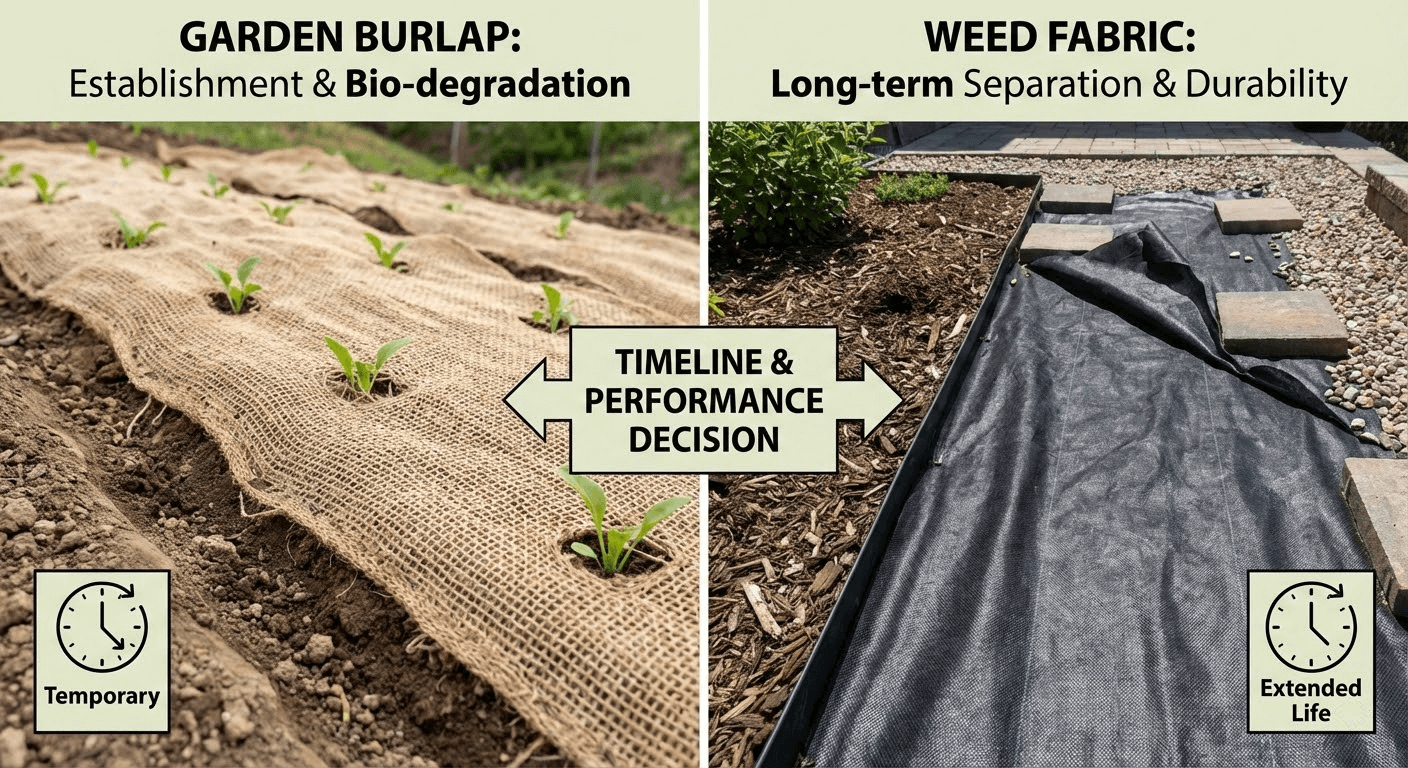
Garden burlap fabric vs. weed fabric: quick definitions
What “garden burlap fabric” usually means in procurement
In bids and POs, garden burlap fabric typically refers to woven jute/burlap rolls or jute netting/blankets used for temporary stabilization, plant protection, or handling. For erosion-control use, transportation agencies often list functional longevity on jute mesh products—for example, Caltrans’ toolbox lists jute mesh with 12 months functional longevity (under its rolled erosion control product guidance).
Specs buyers should request
- Mass/weight (oz/yd² or g/m²), weave openness, roll size
- Treatments (confirm if any), and expected field longevity range (with conditions)
What “weed fabric” usually means on bids and POs
“Weed fabric” usually means synthetic landscape fabric/geotextile, commonly polypropylene, used for separation under aggregates and longer-life installations. In roadway/geo contexts, survivability is often framed through standards: AASHTO notes minimum strength values are based on geosynthetic survivability from installation stresses.
Specs buyers should request
- Type (woven vs. nonwoven), mass/weight
- Strength metrics (grab tensile, tear, puncture) and UV stability claims (with test method)
When garden burlap fabric is the better choice
Biodegradable erosion control and slope stabilization
For slopes and seeded areas where you need protection until vegetation establishes, garden burlap fabric/jute netting is a strong fit—especially when the job spec prefers a material that won’t require future plastic removal. On post-fire or disturbed slopes, USDA NRCS guidance for jute netting/erosion control blankets emphasizes details that prevent early failure, including overlapping edges at least 6 inches and burying the upslope end in a trench at least 8 inches deep.
Field-proven install notes
- Write overlap and trenching into the scope (don’t leave it “by installer discretion”).
- Use enough staples/pins at seams and flow lines—this is where undercutting starts.
Tree wrap, root ball protection, and transplant handling
Burlap works well for handling because it’s flexible, easy to cut, and breathable around plant material. The purchasing “gotcha” is treatments: ask for fiber type and any treatment documentation so you’re not wrapping sensitive root systems with unknown additives.
Experience note (what I’ve seen go wrong): crews often grab whatever “burlap” is on hand; the fix is adding one line to the order: “Untreated jute/burlap; provide treatment disclosure on packing list.” That single requirement prevents a lot of downstream debate.
Frost protection and breathable plant covering
For frost and wind protection, breathable coverings matter. Burlap helps block wind while still allowing airflow, reducing condensation and heat spikes that can happen under non-breathable covers. Where crews are rotating covers daily, the ease of handling and lower tear risk compared to thin plastics can also reduce replacement churn.
When weed fabric is the better choice
Long-term weed suppression in ornamental beds and hardscapes
Weed fabric can suppress weeds short-term, but it’s not a “set it and forget it” solution—especially under organic mulch. North Carolina State Extension summarizes research going back to the 1980s showing landscape fabric mulched with organic mulch can become “just as weedy” as if no fabric were used, requiring similar effort to control weeds over time.
University of Illinois Extension similarly notes landscape fabric may help suppress weeds only for a couple of years and can create issues as landscapes age.
Actionable guidance
- Use weed fabric when you can also specify maintenance (mulch depth, refresh schedule, edging discipline).
- If the owner expects “no weeding,” set expectations in writing.
Underlay for gravel paths, pavers, and construction staging
This is weed fabric’s best use case: separation and stabilization under aggregate. If your priority is preventing stone from pumping into subgrade soil, a geotextile specified for survivability will typically outperform natural fibers in durability.
AASHTO M288-style survivability is commonly summarized with properties like grab tensile, trapezoidal tear, CBR puncture, and UV stability—a practical framework to align product selection with installation harshness.
High-traffic or UV-exposed applications
If fabric will be exposed (even temporarily), require UV performance language tied to a test method. ASTM D4355 describes generating a deterioration curve to determine a geotextile’s tendency to deteriorate under xenon arc radiation, moisture, and heat, and it notes results vary with operating conditions—exactly why your RFQ should call out the method and context, not just “UV stabilized.”
Performance comparison that matters to buyers
Durability and lifespan
- Garden burlap fabric/jute: designed for temporary performance; agency guidance often lists functional longevity (e.g., 12 months for jute mesh in a DOT toolbox context).
- Weed fabric/geotextile: designed for survivability under installation stress; AASHTO frames minimum strength values around survivability.
Water infiltration and soil outcomes
Permeability matters in both categories—but long-term outcomes differ. Colorado State University Extension notes landscape fabric pores can clog over time, restricting water and air, allowing weeds to germinate on top, and creating soil/ecology issues in beds.
Burlap typically integrates into soil as it degrades, which is desirable when your end goal is vegetation establishment rather than permanent separation.
Installation speed, labor, and rework
Most early failures are installation-detail failures:
- Burlap/jute: undercutting occurs when overlaps and trenching aren’t enforced (NRCS’ overlap/trench guidance exists for a reason).
- Weed fabric: seam lift and edge exposure cause weed breakthrough and tripping hazards (maintenance reality is well documented by Extension sources).
Safety & site considerations
- Exposed synthetic fabric can create trip hazards and become unsightly when mulch migrates (plan edging and mulch depth).
- Removal/disposal can become a real cost if roots grow through fabric—budget removal labor if the scope may change.
- For burlap, confirm treatments before use near sensitive plantings (ask for disclosure).
How to choose: a practical spec checklist
Match the fabric to the project timeline
- Temporary stabilization and establishment: consider jute/burlap with a stated functional longevity (e.g., jute mesh 12 months in DOT guidance).
- Multi-year separation under gravel/hardscape: specify a geotextile aligned to survivability (AASHTO installation-stress premise).
Confirm performance requirements
- Slope grade + flow type (sheet vs. concentrated)
- Installation harshness (equipment traffic, aggregate thickness)
- Exposure (sun/UV; specify method like ASTM D4355 when relevant)
RFQ callout: example spec language buyers can paste
- Material: (a) untreated jute/burlap roll OR (b) PP geotextile (woven/nonwoven)
- Roll size: ___ ft x ___ ft; pallet count: ___
- Strength/survivability (if synthetic): provide grab tensile, trapezoidal tear, CBR puncture, and UV stability values (test methods listed)
- Install details (erosion control): minimum 6-inch overlaps; upslope trench 8 inches (or project-specific)
- Documentation: treatment disclosure (natural fiber) + UV method statement (synthetic)
Anonymized field example: mixed-use site outcomes
Scenario
A contractor stabilized fresh slopes for seeding and built gravel walkways for staging. Burlap/jute netting went on slopes; weed fabric went under gravel.
Result and lesson
The slope system succeeded because overlap and trench details were enforced—matching NRCS-style guidance (overlap and trenching reduce undercutting and edge lift).
The walkway system initially failed at seams where overlap was rushed; rework was minimal once the crew treated seams like a structural detail, not a cosmetic one. The lesson: write overlap/anchoring as measurable requirements, not “install per manufacturer.”
Where a vertically integrated supplier helps (without the hard sell)
If your projects span erosion control plus agricultural/household categories, the operational advantage is consistency: standardized roll labeling, repeatable specs, fewer substitutions, and smoother private label/OEM workflows. Wellco Industries’ wide range across erosion control materials and related product lines is a practical example of how consolidating categories can reduce procurement friction while still keeping specs performance-driven.
Conclusion
Use garden burlap fabric when you want breathable, temporary protection that supports establishment and avoids long-term removal. Use weed fabric when you need durable separation under aggregate or a longer-life barrier—while being honest about maintenance and seam/edge failure modes (Extension guidance is clear that long-term “no weeds” claims rarely hold without ongoing maintenance).
CTA: Before buying volume, request a sample and a one-page spec sheet, then confirm three items in writing: timeline, exposure, and installation details (overlaps/anchoring). That’s the fastest way to prevent “it looked right on paper” failures.
Frequently Asked Questions
It can be, if the slope application is matched to the product and the install details are enforced. Overlaps and trenching matter as much as the roll itself—NRCS-style guidance (overlap and bury the upslope end) reduces early edge lift on slopes.
It can reduce weeds for a period, but many extension sources note it often becomes weedy over time as soil and organic matter accumulate on top. Plan for maintenance and don’t treat fabric as a permanent substitute for proper mulching and edging.
Ask for the UV test method reference and conditions used (not just the phrase “UV stabilized”). ASTM D4355 is commonly referenced for assessing deterioration trends under light, moisture, and heat.
Yes, but confirm whether the burlap is untreated and ask for treatment disclosure if the fabric will be in direct contact with soil or sensitive plantings. This avoids surprises from additives or coatings.
Weed fabric/geotextile is typically better for aggregate separation and survivability under traffic. Burlap is more appropriate for temporary stabilization and plant-focused uses rather than long-term separation under stone.