
- April 23, 2026
- Posted by: wellcoindustries
- Category: Fiberglass fire blanket
Introduction
The National Fire Protection Association (NFPA) estimates that industrial fires cost North American businesses billions in property damage annually — and a significant share of those losses trace back to inadequate thermal protection on equipment, pipes, and active work zones. When buyers start comparing fireproof blanket options, two materials dominate the shortlist: fiberglass and carbon fiber. Both carry credible heat-resistance claims. Both appear in industrial catalogs at very different price points.
But “fireproof” is not a single specification. The material that holds up better depends entirely on your temperature exposure, application environment, and total budget over a product’s service life.
This article breaks down how fiberglass and carbon fiber thermal blankets actually perform — at the fiber level, in the field, and on the balance sheet — so procurement managers and site supervisors can make a defensible purchasing decision.
What Makes a Blanket “Fireproof”? Understanding the Baseline
Temperature Ratings and Industry Standards
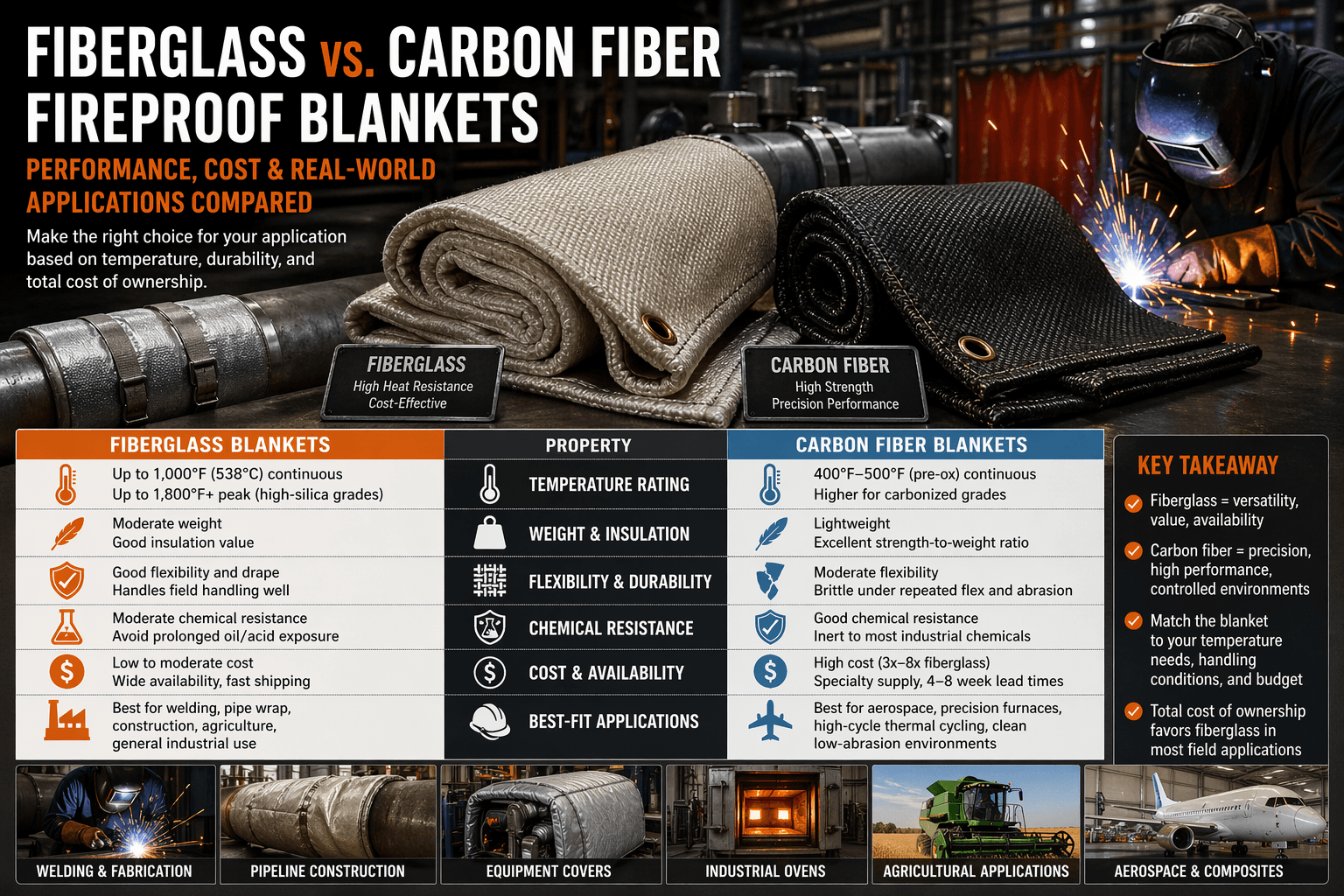
The term “fireproof” in industrial contexts refers to a product’s ability to resist ignition and limit heat transfer within defined temperature thresholds — not permanent immunity to fire. Two ratings matter most when evaluating any thermal blanket:
- Continuous service temperature: the sustained heat level a blanket handles without structural degradation.
- Peak exposure temperature: the maximum short-duration heat the material can withstand before losing integrity.
Buyers should verify compliance with recognized standards before specifying any product. ASTM E84 governs surface burning characteristics. UL 94 classifies flammability in vertical and horizontal burn tests — products achieving UL 94 V-0 classification self-extinguish within 10 seconds of flame removal, a meaningful performance threshold for welding blanket applications. ISO 11612 applies to protective clothing against heat and flame and is frequently referenced in industrial PPE-adjacent applications. A product without traceable third-party test data against at least one of these standards warrants scrutiny.
How Fiberglass and Carbon Fiber Handle Heat Differently
Fiberglass resists heat primarily through its amorphous silica structure, which has a true melting point of approximately 1,400°F–1,500°F (760°C–815°C) for standard E-glass, and higher for high-silica variants. It does not burn — it softens only at extreme temperatures.
Carbon fiber behaves differently. Rather than melting, carbon fiber oxidizes at elevated temperatures, particularly above 800°F (427°C) in oxygen-rich environments. This oxidation threshold is a critical variable that many buyers overlook when comparing spec sheets side by side. Understanding this distinction is the foundation for every performance comparison that follows.
Fireproof Fiberglass Blankets: Performance Profile
Construction and Material Properties
Fireproof fiberglass blankets are manufactured in two primary constructions: woven and needled (also called needle-punched). Woven fiberglass offers tighter dimensional stability and suits applications with repetitive flex or mechanical contact. Needled fiberglass provides higher loft and insulation value per unit thickness, making it a common choice for pipe wrapping and equipment covers.
Material grade matters significantly. Standard E-glass blankets handle continuous service temperatures up to approximately 1,000°F (538°C). High-silica fiberglass — which contains 96%+ silica content — extends continuous ratings to around 1,800°F (982°C) intermittent, with some grades rated for continuous use above 1,600°F (871°C). For most industrial, agricultural, and construction applications, E-glass performs well within the required temperature window at a substantially lower cost than high-silica or carbon fiber alternatives.
Where Fiberglass Blankets Perform Best
Fiberglass thermal blankets cover a broad range of field applications. Welding curtains and blankets in fabrication shops rely on fiberglass to protect adjacent surfaces from spatter and radiant heat. In pipeline construction, contractors wrap fiberglass blankets around joints during curing to maintain consistent temperature gradients.
On a pipeline construction project in California’s Central Valley, crews wrapped high-silica fiberglass blankets around weld joints during overnight cool-down cycles. The blankets maintained consistent temperature gradients without a single reported failure across a six-week installation window — a result that reflects how well fiberglass performs when thermal cycling is predictable and physical handling is moderate. Industrial oven walls and door seals also frequently use fiberglass blanket insulation to reduce energy loss during sustained operation.
In utility and construction worksites, crews reach for fiberglass blankets when heat exposure is episodic rather than constant — equipment covers during torch work, temporary protection for wire bundles near hot work zones, and fire watch blankets staged near welding operations. The material’s wide availability through regional distributors means replacement stock is rarely a logistical problem on active job sites.
Limitations to Know Before You Buy
Fiberglass has real handling drawbacks. The fine glass fibers shed during cutting and handling can cause skin and respiratory irritation — gloves, long sleeves, and a dust mask are standard PPE during installation. Repeated flexing of woven fiberglass can cause fiber breakage at fold lines over time, shortening service life in high-cycle applications.
Wet environments and direct chemical exposure present additional concerns. Fiberglass retains moisture and can degrade when repeatedly exposed to oils, acids, or alkaline washdown. Buyers operating in food processing, chemical plants, or marine environments should verify chemical compatibility before specifying standard fiberglass blankets.
Carbon Fiber Blankets: Performance Profile
Construction and Material Properties
Most carbon fiber thermal blankets use PAN-based (polyacrylonitrile) carbon fiber, processed at high temperatures to produce the graphitic crystal structure responsible for carbon fiber’s strength and thermal stability. For blanket applications specifically, oxidized PAN (pre-ox) fiber is more common than fully carbonized fiber — pre-ox retains greater flexibility while still delivering superior temperature performance over standard E-glass.
Pre-ox carbon fiber blankets typically handle continuous service temperatures in the 400°F–500°F (204°C–260°C) range with very high tensile retention — meaning the material does not lose structural integrity at temperature the way polymeric insulation would. Fully carbonized carbon fiber extends that range substantially, but at significantly higher cost and with greater brittleness under mechanical stress.
Where Carbon Fiber Blankets Perform Best
Carbon fiber thermal blankets earn their premium price in high-precision, high-cycle applications where dimensional stability and low thermal mass are non-negotiable. Aerospace composite layup shops use carbon fiber blankets during cure cycles to achieve uniform temperature distribution without introducing contaminating fibers. In these environments, technicians report that carbon fiber’s consistent drape and minimal off-gassing at cure temperatures make it the only viable option — fiberglass alternatives introduce fiber contamination risk that aerospace quality standards do not tolerate.
High-frequency industrial furnaces — where blankets are installed and removed dozens of times per week — benefit from carbon fiber’s resistance to mechanical fatigue at elevated temperatures. Precision thermal management scenarios, such as maintaining tight temperature windows during semiconductor bonding or advanced ceramics sintering, are environments where carbon fiber’s performance profile justifies its cost premium.
Limitations to Know Before You Buy
The cost premium for carbon fiber blankets is substantial — typically 3x to 8x the per-unit cost of a comparable fiberglass blanket, based on published distributor pricing across comparable grades and constructions. Beyond price, carbon fiber is brittle under flex stress. Blankets that are folded, rolled tightly, or subjected to mechanical abrasion in rough industrial environments will develop fiber fractures that degrade both thermal performance and structural integrity over time.
Replacement sourcing adds another variable. Carbon fiber blankets are not widely stocked by regional industrial distributors. Lead times from specialty suppliers can run 4–8 weeks — a timeline that creates real project delays in field-driven operations where standard fiberglass blankets are available with same-week domestic shipping.
Head-to-Head Comparison: Fiberglass vs. Carbon Fiber
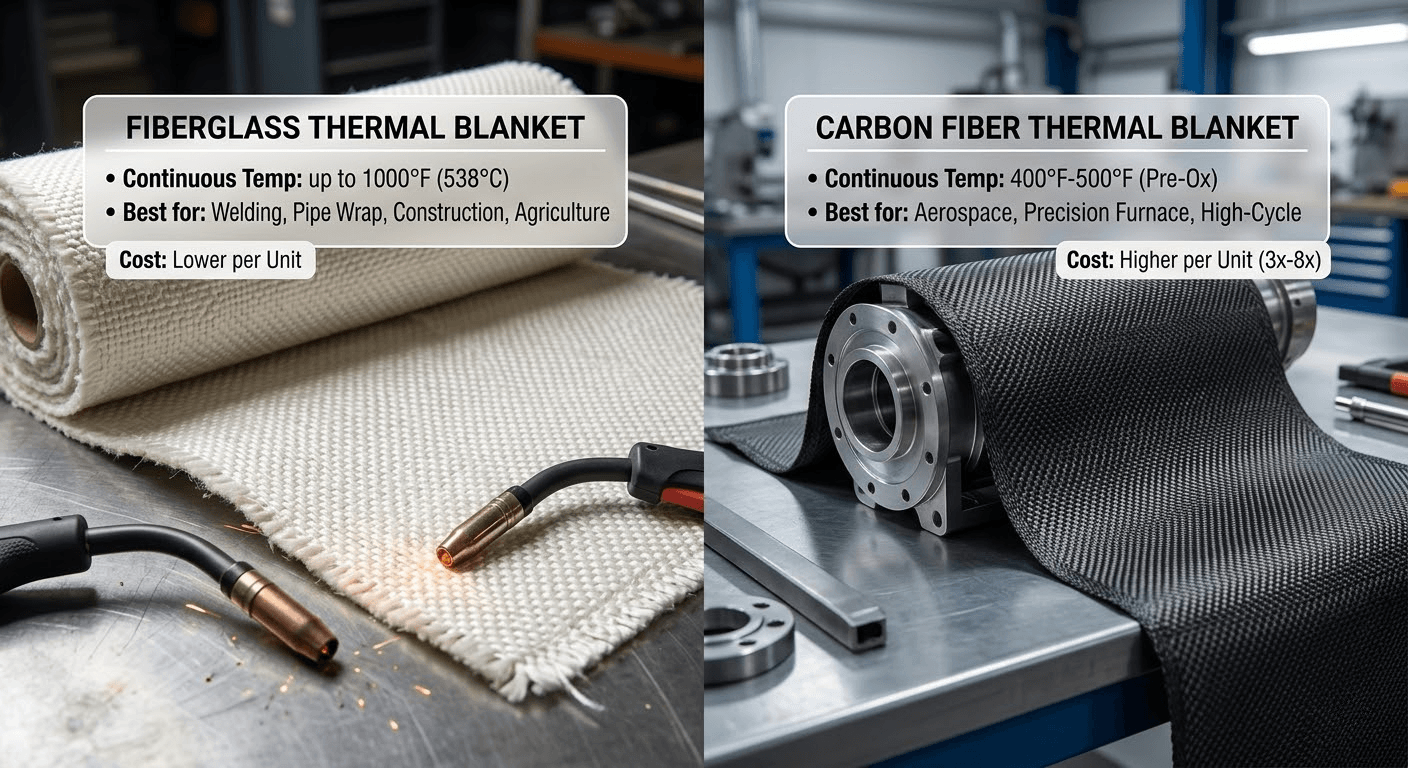
For procurement managers evaluating both options against a single application, the table below consolidates the key performance and logistics variables in one place:
| Property | Fireproof Fiberglass Blanket | Carbon Fiber Blanket |
|---|---|---|
| Continuous temp rating | Up to 1,000°F (538°C); 1,800°F for high-silica | 400°F–500°F (pre-ox); higher for carbonized grades |
| Peak temp rating | 1,800°F+ (high-silica grades) | Varies by carbonization grade |
| Weight | Moderate | Light; excellent strength-to-weight ratio |
| Flexibility / drapeability | Good (woven); high (needled) | Moderate; brittle under repeated flex |
| Chemical resistance | Moderate; vulnerable to oils and acids | Good; inert to most industrial chemicals |
| Abrasion resistance | Moderate | Low to moderate; fiber fracture risk |
| Typical cost tier | Low to moderate | High (3x–8x fiberglass) |
| Best-fit application | Welding, pipe wrap, construction, agriculture | Aerospace, precision furnace, high-cycle thermal cycling |
The comparison makes clear that these two materials do not compete directly across all use cases — they serve different ends of the temperature precision and budget spectrum. Knowing where each material breaks down is as important as knowing where it excels.
Total Cost of Ownership: What the Price Tag Doesn’t Show
Raw performance data tells half the story — the other half plays out in procurement budgets and replenishment logistics over a product’s full service life. A lower unit price does not automatically mean a lower total cost, and buyers evaluating annual spend should model full replacement cycles rather than per-blanket pricing.
Upfront Cost vs. Service Life
The table below outlines the key cost-of-ownership variables across both materials. Service life estimates reflect standard industrial handling conditions; actual performance varies with exposure frequency, temperature cycling, and environment.
| Cost Factor | Fiberglass Blanket | Carbon Fiber Blanket |
|---|---|---|
| Unit price (relative) | Low to moderate | High |
| Avg. service life (standard industrial use) | 1–3 years | 3–7 years (controlled environments only) |
| Replacement frequency | Higher in abrasive or wet environments | Lower in clean, controlled settings |
| Maintenance requirements | Minimal; shake-clean or replace | Careful handling required; no mechanical stress |
| Disposal | Standard industrial waste stream | Jurisdiction-dependent; carbon fiber composite waste classification varies by region and may require specialty disposal |
In most construction, agricultural, and general industrial environments — where blankets face physical handling, outdoor exposure, and variable temperatures — fiberglass’s lower unit cost and wide domestic availability produce a lower total cost of ownership over a 3-year horizon than carbon fiber’s longer theoretical service life. Carbon fiber’s durability advantage only materializes in the controlled, low-abrasion environments it was specifically engineered for.
Sourcing, Lead Times, and Availability
Availability is a procurement variable that spec sheets never capture. For buyers in the US and Canada, fiberglass thermal blankets — including welding blankets and agricultural thermal covers — are stocked domestically by distributors like Wellco Industries, which supplies construction contractors, agricultural operations, and industrial buyers across North America from 90,000 square feet of US warehouse space. Standard orders ship within the week, meaning a job site running low mid-project can replenish without schedule disruption.
Carbon fiber blankets require ordering through specialty composites suppliers, with lead times of 4–8 weeks for non-stock grades. For project-driven buyers managing active construction or harvest timelines, that lead time introduces real operational risk that domestic fiberglass distribution simply does not create.
How to Choose: A Buyer’s Decision Framework
Three questions reliably narrow the field for most procurement decisions:
1. What is your sustained temperature exposure? If your application runs above 1,000°F continuously, move to high-silica fiberglass or consult a supplier for application-specific guidance. Below that threshold, standard E-glass fiberglass handles the thermal load at a fraction of the cost — and for the vast majority of construction, agricultural, and general industrial applications, that threshold is never approached.
2. How often will the blanket be installed, removed, and repositioned? High-cycle applications — multiple installations and removals per day — accelerate carbon fiber’s brittleness-related failure. Fiberglass woven blankets tolerate repeated handling better under rough field conditions, making them the lower-risk specification for crews working at pace on active sites.
3. What is your sourcing environment? If your operation is in North America and requires reliable replenishment on short notice, domestic fiberglass distribution channels offer a structural advantage that specialty carbon fiber suppliers cannot match. If your procurement team routinely manages long-lead specialty materials and operates in a controlled production environment, carbon fiber’s supply chain complexity becomes more manageable — but it remains a procurement overhead that field-driven buyers rarely need to absorb.
For the majority of buyers in industrial, agricultural, and construction sectors across the US and Canada, a commercial-grade fiberglass blanket — sourced through a distributor with strong domestic inventory — delivers the right balance of thermal performance, durability, and total cost for most field-driven applications.
[Request a bulk quote from Wellco Industries →]
Conclusion
- Standard E-glass fiberglass blankets handle continuous temperatures up to 1,000°F and are the practical specification for welding, pipe insulation, construction site protection, and agricultural thermal management across North America.
- High-silica fiberglass extends that range to 1,800°F intermittent — covering the overwhelming majority of industrial temperature exposures without the cost premium or sourcing complexity of carbon fiber.
- Carbon fiber blankets outperform fiberglass in high-precision, low-abrasion, controlled environments — particularly aerospace and specialty furnace applications — but carry 3x–8x the unit cost, meaningful brittleness risks under field handling, and 4–8 week lead times that project-driven operations cannot easily absorb.
- Total cost of ownership in rough field conditions consistently favors fiberglass, even accounting for shorter replacement cycles, because availability, handling tolerance, and replenishment speed all work in fiberglass’s favor.
- For buyers in construction, agriculture, and general industry prioritizing availability, value, and operational continuity, fiberglass is the default-correct specification for most field-driven applications — and a distributor with strong domestic inventory makes the decision straightforward.
Frequently Asked Questions
Wellco Industries offers flexible wholesale pricing starting from a single unit, making it accessible for both small contractors and large procurement programs. Orders exceeding $300 qualify for free shipping, and volume pricing is available for recurring large-order customers.
Under standard industrial handling — moderate flex cycles, episodic heat exposure, and dry storage — commercial fiberglass blankets typically deliver 1–3 years of service life. Exposure to repeated moisture, chemical washdown, or high-abrasion environments will shorten that range; high-silica grades generally outlast standard E-glass under identical conditions.
Yes. Wellco Industries offers OEM and ODM customization services for buyers requiring non-standard dimensions, configurations, or branded packaging. Lead times and minimums for custom orders vary — contact the wholesale team directly for project-specific requirements.
Buyers should request test documentation confirming compliance with applicable standards — ASTM E84, UL 94, or ISO 11612 — relevant to their specific application. Wellco Industries can provide product-level compliance documentation upon request for procurement and safety review purposes.
Store blankets in a dry, covered environment away from direct UV exposure and chemical contact. Avoid compressing blankets under heavy loads for extended periods, which can permanently deform needled constructions. Inspect blankets before each use for fiber degradation, edge fraying, or moisture contamination — replace any blanket showing visible structural compromise before returning it to service.