
- February 27, 2026
- Posted by: wellcoindustries
- Category: Fiberglass fire blanket
Introduction
A fire that starts as “just a little flame” can become downtime, claims, or injuries in minutes—especially in busy farm shops, construction sites, and light industrial work areas where hot work, charging stations, and fuels are part of daily operations. A fire suppression blanket can be one of the fastest tools for controlling incipient-stage fires because it works by smothering flames rather than blasting agent everywhere.
This guide is written for professional buyers and specifiers—purchasing managers, contractors, distributors, and OEM/private label teams—who need clear selection criteria, documentation checkpoints, and practical rollout steps.
Who / How / Why (transparency):
- Who it’s for: teams responsible for standardizing safety equipment across multiple locations.
- How it was compiled: based on workplace fire data (NFPA), standards references (e.g., EN 1869), and operational guidance from fire authorities and industry associations.
- Why it’s written this way: to prioritize safe use, repeatable procurement specs, and easier training—so what you buy can actually be deployed under stress.
How a Fire Suppression Blanket Works
Smothering mechanics: oxygen exclusion and heat containment
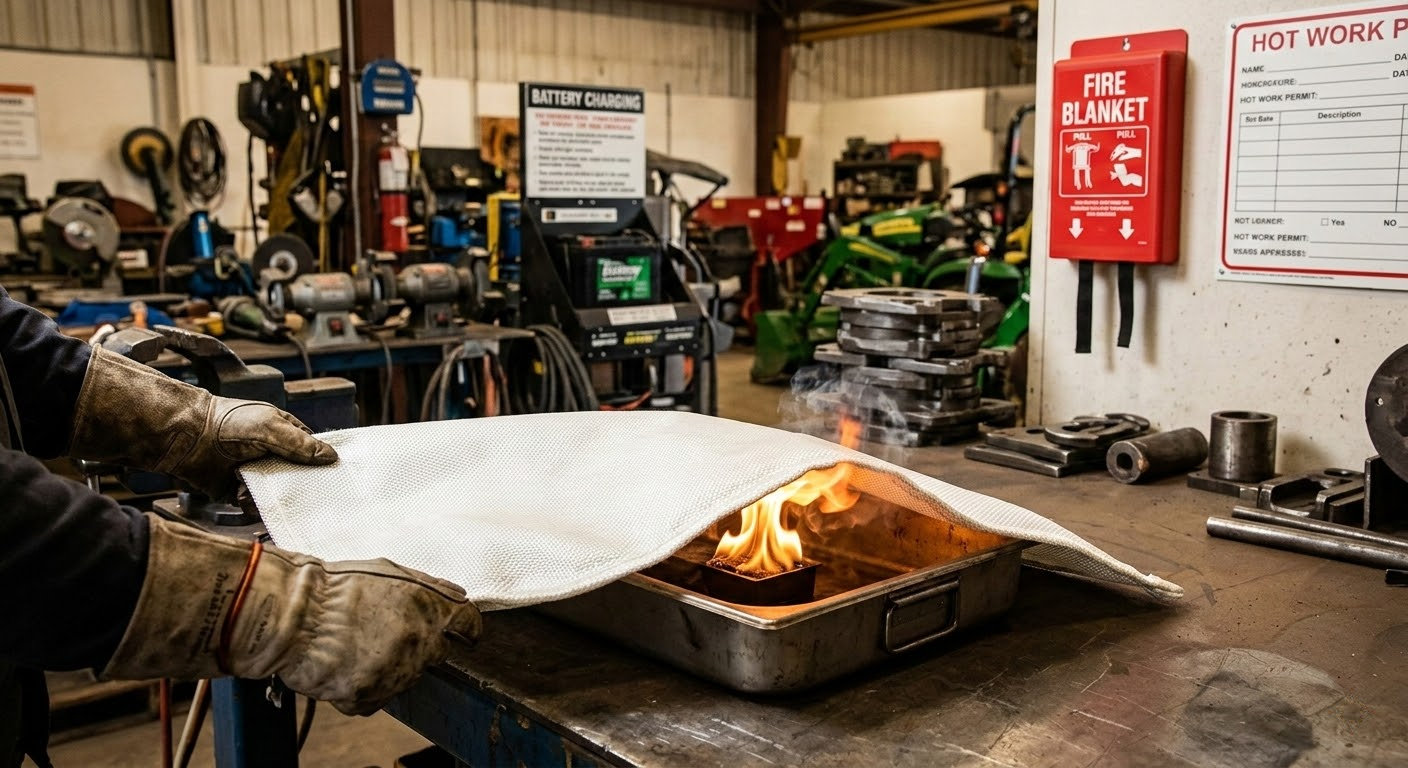
A fire suppression blanket attacks the fire triangle by cutting off oxygen. When the blanket fully covers the burning material (and seals around edges), flame production drops quickly because fresh air can’t feed combustion. That’s why blankets are best for small, contained fires—like a pan, bin, or benchtop ignition—where complete coverage is realistic.
A practical reminder from the South Australian Metropolitan Fire Service: using a fire blanket correctly is “one of the safest ways to extinguish a flammable liquid burning in a container—e.g., oil or fat burning in a saucepan.”
Common materials and coatings (and what to verify)
Most workplace blankets use woven fiberglass (sometimes with a coating) designed to resist heat long enough to smother a small fire without melting or dripping. For buyers, treat temperature claims carefully:
- “Continuous” vs. “peak” exposure: many products can tolerate a brief peak temperature but only a lower continuous temperature over time.
- What to request: the test method, the standard, and the conditions (duration, configuration) that match the claim.
Key standards and compliance checkpoints
If you buy in markets referencing European standards, BS EN 1869:2019 sets requirements for non-reusable fire blankets intended for use by one person and includes considerations such as limiting electric shock risk in case of unintentional use on live electrical equipment.
You don’t need to be a standards expert, but you do need supplier documentation that matches your compliance needs (and remains consistent across production lots).
Fire Suppression Blanket Use Cases in Agriculture, Construction, and Industrial Settings
Agriculture: shops, equipment bays, and maintenance areas
Common “blanket scenarios” include grinding/welding stations, battery charging benches, and small-engine servicing/fueling areas. A simple improvement many sites miss: stage the blanket where the risk is, not where it’s convenient (e.g., mount near the hot-work permit board and charging station signage).
Workplace fire risk is not theoretical. NFPA estimates that U.S. fire departments responded to an annual average of 8,077 structure fires at industrial/manufacturing properties (2017–2021), with $988 million in direct property damage per year.
Construction: hot work, temporary power, and site offices
Construction sites add variability: temporary heaters, generators, cords, and makeshift cooking areas. A blanket can be a fast first response for a small, contained ignition—if access is immediate and teams have practiced the motion.
A useful placement benchmark for many facilities programs: Fire Industry Association guidance suggests mounting so the hand-hold device sits around 1.5 m from the floor and ideally no further than 10 m from where it’s likely to be needed.
OEM/private label and distribution applications
For distributors and OEM/private label buyers, blankets often ship as part of a safety “kit” (case + signage + multilingual instructions). This is where supply-chain discipline becomes part of safety performance: consistent labeling, stitch quality, and packaging integrity reduce failure modes during real-world deployment.
Choosing the Right Fire Suppression Blanket
Size and coverage: match the blanket to the hazard
Size is about coverage plus control. You want enough material to fully cover the fire source and keep hands protected behind the leading edge as you place it.
A buyer-friendly way to standardize sizes:
- List your top 3 likely scenarios per site (e.g., “charging station,” “hot-work bench,” “small container liquids”).
- Assign a blanket size to each scenario based on full coverage plus a safety margin for grip/arm shielding.
- Stage that size at that location—don’t force one-size-fits-all across every hazard.
Performance specs to compare (what matters in procurement)
When comparing suppliers, prioritize items you can verify and enforce:
- Fabric weight (gsm) / weave density (durability and handling)
- Edge finishing (hemmed vs. raw cut; reinforced corners)
- Stitching and thread suitable for heat exposure (so seams don’t fail)
- Labeling fields (standard/version, instructions, disposal guidance, traceability)
- Packaging and mounting (wall case vs. pouch, pull tabs, pictograms)
Datasheet Verification Checklist (copy/paste for RFQs)
- Standard referenced (and version/date), test method, and configuration
- Fabric construction and weight (gsm)
- Edge finish and stitch specification
- Marking/label contents (traceability, instructions, language)
- Packaging type, mounting hardware, and pull-tab design
- Statement of reusability vs. single-use and disposal guidance
Packaging, mounting, and deployment speed
Under stress, packaging is part of performance. Wall cases with clear pull tabs and pictograms reduce “fumble seconds,” while soft pouches can end up buried.
A simple inspection cue from FIA guidance: check the container for damage and confirm the hand-hold devices are visible and undamaged during routine inspections.
Step-by-Step: How to Use a Fire Suppression Blanket Safely
Immediate actions (assess, alert, isolate)
- Alert: call for help and trigger the site response.
- Assess: if the fire is spreading, threatens egress, or involves pressurized fuel—evacuate and escalate.
- Isolate if safe: shut off power/heat sources without crossing the fire area.
Correct deployment technique
- Pull the tabs and hold the blanket like a shield, hands behind the top edge.
- Approach carefully and place (don’t throw) the blanket over the flames to seal edges.
- Leave it in place long enough for heat to drop—avoid lifting early “to check.”
Experience note (what changed that improved outcomes): In one multi-site rollout I observed, teams “knew” the steps but still lost time because blankets were stored inside cabinets. Switching to wall cases at the point of risk, adding a one-page placement map, and running a 3-minute drill during weekly toolbox talks noticeably reduced hesitation and shortened the time-to-cover in practice scenarios.
After-action steps (disposal and reset)
Fire blankets are typically treated as single-use after deployment; the Metropolitan Fire Service notes they must be disposed of and replaced after use because they’re not designed to be re-used.
Log the incident, restock immediately, and review whether placement, signage, or training needs to change.
Procurement Checklist for Professional Buyers
Documentation and quality assurance
- Certificate of conformity and documentation matching your compliance environment
- Lot/batch traceability on labels or packaging
- Incoming inspection checklist (case integrity, pull tabs, legible instructions)
- Written change-control expectations in PO terms (materials, stitch spec, label format)
Logistics, MOQ, and private label considerations
- Lead times, MOQ, and packaging/artwork approvals
- Packaging type (pouch vs. wall case), language requirements, and barcode formats
- If you’re consolidating vendors, define “must-have” documentation requirements across all SKUs so suppliers can meet uniform QA expectations
Where supplier capability helps (without the hard sell): When buyers need private label packaging, consistent specs, and multi-product sourcing, a vertically integrated supplier with broad industrial lines—such as Wellco Industries, which serves agricultural, household, and industrial product needs—can simplify vendor management. The key is to treat the blanket like any safety-critical item: lock the spec, require traceability, and enforce change control.
Training and implementation at scale (a simple rollout model)
- Pilot (2–4 weeks): stage blankets at top-risk points; run short drills; collect “time-to-deploy” observations
- Standardize (30–60 days): finalize sizes, cases, signage, and inspection cadence
- Sustain: include checks in routine walkthroughs and refresh drills quarterly
Safety Considerations and Limitations
When to choose an extinguisher instead
Use an extinguisher and/or evacuate (per site policy) when:
- The fire is not contained and cannot be fully covered
- There’s a spill feeding the fire beyond a small container
- You’re uncertain the heat source is isolated and safe to approach
Fires you should not fight with a blanket
Do not attempt blanket suppression when the incident involves:
- Pressurized gas or jetting flames
- A rapidly growing fire or blocked escape path
- Any situation where you must cross the fire zone to reach shutoffs or exits
Blankets complement extinguishers and site fire plans, and the scale of industrial losses underscores why response tools must be paired with training and clear escalation criteria.
Conclusion
A fire suppression blanket is most valuable when speed, simplicity, and low maintenance matter—especially for small, contained fires and certain container-based liquid fires. Procurement success comes from aligning blanket size/specs to real hazards, verifying documentation and traceability, and making deployment muscle memory through short, repeatable drills.
CTA: Build a one-page RFQ spec using the datasheet checklist above, run a short pilot at high-risk points, then standardize across sites with a placement map and inspection cadence. If you’re supporting multi-site or private-label programs, prioritize suppliers who can consistently meet those specs and documentation requirements—because repeatability is what keeps safety gear reliable.
Frequently Asked Questions
Most workplace fire blankets are treated as single-use after deployment. Guidance from fire authorities commonly recommends disposal and replacement after use because damage, contamination, or heat exposure can reduce performance.
Start with your top hazard scenarios (hot-work bench, charging station, small container liquids) and choose a size that fully covers the likely fire source with extra material for hand/arm shielding. Standardize by location type rather than forcing one size for every area.
Blankets are primarily for small, contained fires and should not be used if you can’t safely isolate the power source or if the incident is escalating. Follow your site policy and local guidance; some standards address electric shock risk considerations, but that doesn’t mean “safe for all energized situations.”
Mount them at the point of risk with quick access, and include them in routine safety inspections. Industry guidance suggests mounting height and proximity targets (e.g., around 1.5 m height and near the hazard area) and checking the container and hand-hold devices for damage.
At minimum: standard/test references, fabric construction and weight, stitch/edge finishing details, labeling fields (traceability, instructions), packaging specs, and a clear statement on disposal after use. Treat any change in materials, labels, or packaging as a controlled change requiring notification.