
- July 22, 2026
- Posted by: wellcoindustries
- Category: Fiberglass Stakes
Introduction
A low-priced plant stake can still raise total costs when crews must replace damaged stock or restake plants after wind and irrigation. For commercial growers and landscape contractors, the useful comparison is cost per successful growing cycle.
Content methodology: This comparison uses bamboo durability research, extension guidance, pultrusion references, supplier specifications, and procurement practice. Technical reviewer: [Name, title].
Wellco Industries supplies agricultural and gardening products, including fibreglass plant stakes, trellis systems, plant protection materials, and related landscape supplies.
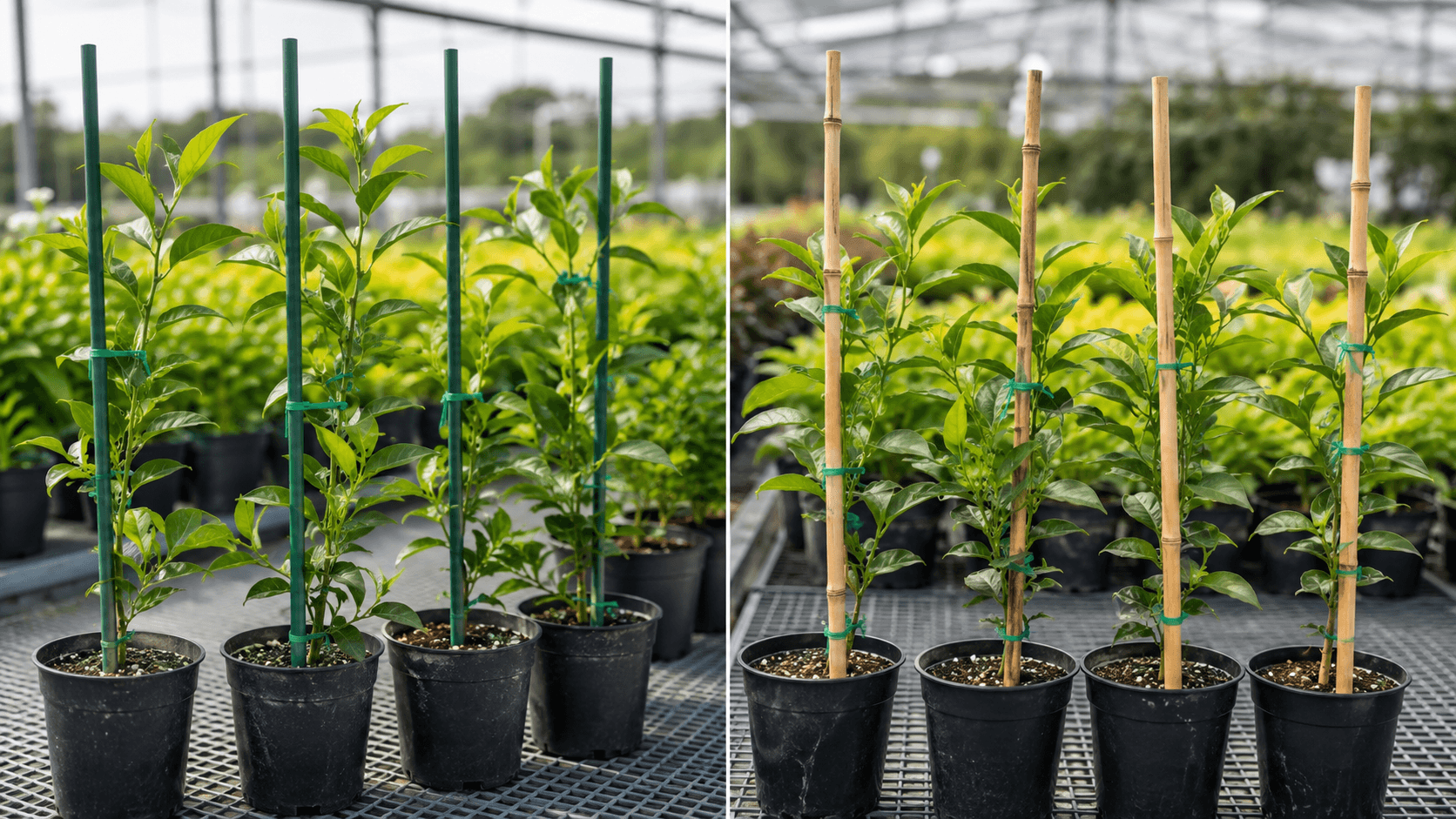
Fibreglass Plant Stakes vs Bamboo at a Glance
Pultruded fibreglass stakes contain continuous glass reinforcement within a cured resin matrix. Bamboo naturally varies in diameter, wall thickness, nodes, moisture, and straightness.
Actual lifespan depends on quality, climate, load, storage, and maintenance.
| Performance factor | Fibreglass plant stakes | Bamboo stakes | Procurement implication |
|---|---|---|---|
| Moisture exposure | Does not biologically rot; moisture performance depends on resin and surface integrity | Susceptible to fungal decay under prolonged wet conditions | Fibreglass generally suits repeat irrigation cycles |
| Dimensional consistency | Diameter, length, colour, and finish can be specified | Natural taper and nodes create variation | Uniform stakes simplify packing and installation |
| UV exposure | Requires a suitable resin system and UV protection | Can fade, check, split, and become brittle | Confirm intended outdoor service conditions |
| Reuse | Often reusable after inspection | More likely to be discarded after damage or decay | Track return-to-service rate |
| Initial price | Usually higher | Usually lower | Compare cost per crop cycle |
| Appearance | Manufactured, uniform finish | Natural appearance | Bamboo fits decorative and sell-with-plant programs |
Which lasts longer, fibreglass plant stakes or bamboo stakes?
Fibreglass plant stakes generally last longer in repeated wet and outdoor use because they do not decay through fungal activity. Their service life still depends on resin quality, UV protection, diameter, surface condition, handling, and load. Bamboo durability varies with species, maturity, treatment, moisture, cut-end exposure, and storage.
Research found wet bamboo in soil contact especially vulnerable to fungal degradation, while sealing crosscut ends reduced decay. Durability also differed among species and culm locations.
Why Fibreglass Stakes Usually Deliver Longer Service
Longitudinal glass reinforcement helps a pultruded stake resist bending, while resin transfers load and protects the fibres. Performance depends on diameter, profile geometry, unsupported length, embedment depth, tie location, and applied load. Tensile strength alone cannot predict crop support.
EN 13706 can help buyers understand how structural pultruded profiles may be controlled for dimensions, surface quality, and mechanical properties. It applies specifically to load-bearing structural profiles, so it should not be presented as a plant-stake certification unless the supplier provides applicable documentation.
In a nursery trial, compare equal-length stakes across several blocks. After each cycle, record bending, splitting, exposed fibres, soil-line deterioration, cleaning time, and the percentage approved for reuse. This creates site-specific evidence.
How moisture and soil contact affect lifespan
A properly manufactured fibreglass stake generally maintains low moisture uptake while its resin and surface remain intact. Exposed fibres, cracks, and poor end finishing can reduce durability.
Bamboo can be attacked by fungi and insects under suitable conditions. Testing has found low natural outdoor durability in some species and substantial variation among samples.
After each crop cycle, crews should check fibreglass for cracks, fibre exposure, bending, damaged tips, and worn tie areas. Bamboo checks should cover mould, soil-line softness, splits, node fractures, and sharp edges.
How UV exposure affects plant stakes
Outdoor fibreglass requires a product design suited to sunlight. Pultrusion manufacturers identify resin selection, UV inhibitors, surfacing veils, pigmentation, and protective coatings as methods used to improve UV resistance.
Buyers should ask whether colour and surface protection are integral or applied after production. Trial records should cover chalking, fading, fibre blooming, roughness, and stiffness changes.
Where Bamboo Stakes Still Make Commercial Sense
Bamboo remains practical when initial price, natural appearance, easy cutting, or short-term use carries more weight than reuse. Penn State Extension describes bamboo stakes as natural-looking supports commonly available in diameters from 1/4 to 3/4 inch and lengths from 2 to 8 feet.
A garden centre may bundle bamboo with a seasonal potted plant. Recovery has little value in that model, while a nursery retaining stakes after every crop has more reason to evaluate fibreglass.
How long do bamboo plant stakes last outdoors?
Untreated bamboo may remain usable for one or several seasons, but there is no reliable universal lifespan. Climate, species, treatment, diameter, irrigation, soil contact, cut ends, and storage all affect decay. Buyers should request stated test conditions and verify performance through a representative field trial before planning replacement intervals.
Dry storage and protected cut ends may slow deterioration, although soil-line decay can remain difficult to see.
Choosing the Right Stake for Different Applications
The best material depends on the plant, support duration, wind exposure, soil, tie system, and ownership model.
| Use case | Recommended starting point | Key reason | Buying note |
|---|---|---|---|
| Repeat nursery containers | Fibreglass | Consistency and reuse potential | Specify diameter and straightness tolerances |
| Young tree training | Tested fibreglass or suitable heavy bamboo | Support must match root-ball and wind conditions | Use broad, flexible ties |
| Seasonal retail pots | Bamboo | Natural appearance and lower entry cost | Inspect for mould and splitting |
| Greenhouse vines | Fibreglass | Uniform sorting and repeated handling | Confirm cleaning compatibility |
| Decorative garden displays | Bamboo | Blends into planting | Budget for replacement |
| Wind-exposed crops | Field-tested fibreglass profile | Predictable geometry and flex | Test diameter and embedment depth |
Which stake is better for young trees?
The system must stabilize the root ball while allowing controlled stem movement. University of Minnesota Extension recommends broad, flexible attachments, loose tying, and removal after establishment, commonly after one growing season. Poor ties can damage bark regardless of stake material.
Which stake is better for greenhouse and nursery use?
Fibreglass suits operations that sort, clean, and reinstall stakes across crop cycles. Uniform diameter supports repeatable ties, rack storage, and packaging. Bamboo may fit short-cycle plants sold with their supports.
Installation, Handling, and Maintenance Differences
Installation can shorten the life of either material. Hard or compacted ground may require a pilot hole, insertion tool, or protective cap. Direct impact with an unsuitable metal hammer can damage a fibreglass surface, while bamboo may split around nodes or cut ends.
Workers should wear gloves and eye protection when handling damaged stakes. Segregate exposed-fibre fibreglass and sharply split bamboo. Store reusable stakes on supported racks by size.
For incoming inspection, procurement teams should sample several cartons and record length, diameter, straightness, finish, tip quality, and packaging damage.
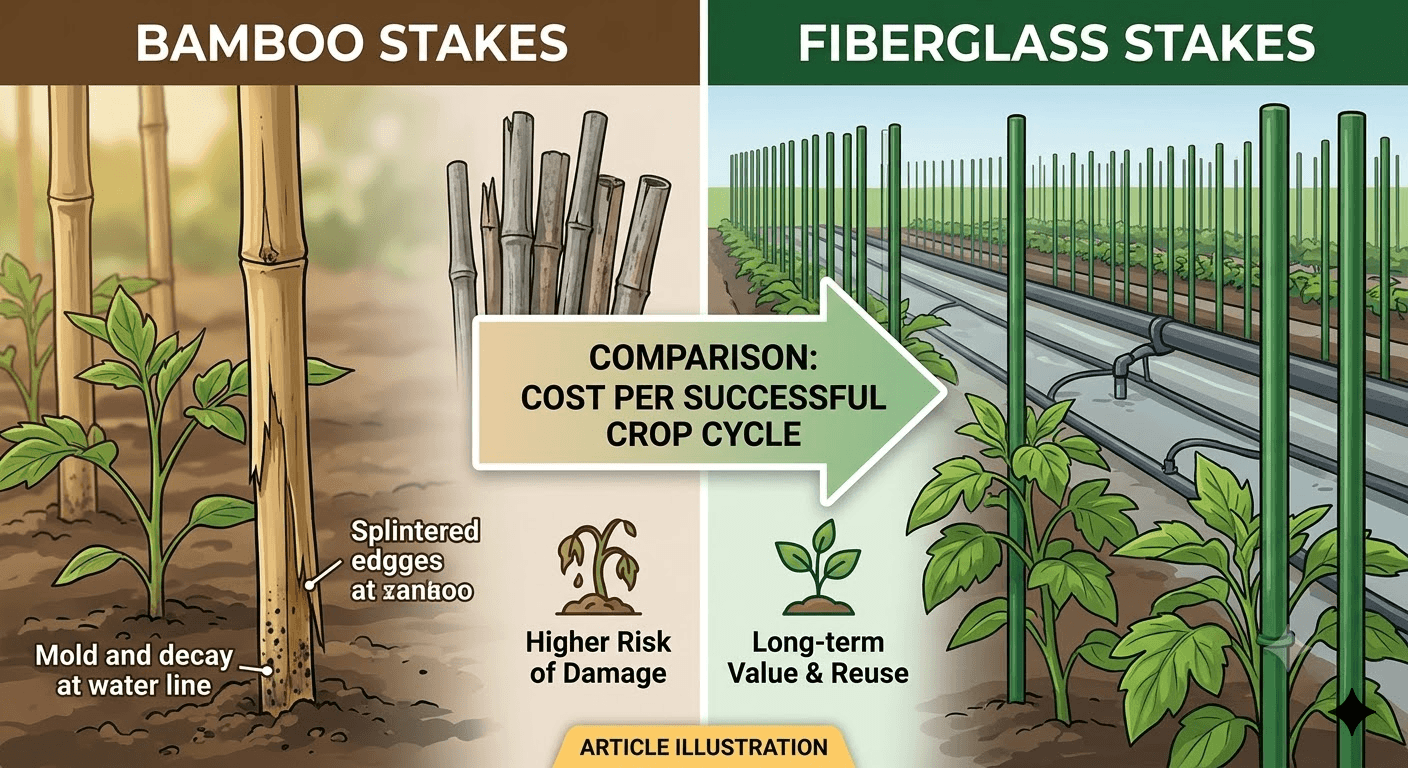
Can fibreglass plant stakes be reused?
Quality fibreglass plant stakes can often be reused across multiple growing cycles when they remain straight, undamaged, and suitable for the crop. Inspect the surface, ends, and tie areas before reuse. Clean them according to the operation’s hygiene procedures, then store them by length and diameter to prevent bending and selection errors.
Operations should use pass, repair, and reject categories, then include the return-to-service rate in lifecycle calculations.
Cost per Season and Total Procurement Value
Unit price is only one input. A complete comparison includes purchase price, freight, replacement frequency, installation labour, inspection, cleaning, storage, disposal, and crop losses caused by failed support.
Consider an illustrative 10,000-stake requirement. Bamboo at $0.25 per stake and replaced each cycle costs $2,500 per cycle. Fibreglass at $0.70 per stake and fully reused for four cycles averages $1,750 per cycle. These assumed prices demonstrate the calculation method and exclude freight, losses, cleaning, labour, and residual value.
Repeat the model with actual quotations and trial data, including damage, reuse, labour, and plant losses.
How should buyers compare quotations?
Buyers should compare identical lengths, diameters, profiles, tips, colours, finishes, tolerances, packaging, and delivery terms. Quotations should identify freight, pallets, labels, custom colours, private-label packaging, tooling, samples, and testing.
Wellco lists EcoStake fibreglass plant supports in diameters from 5/16 to 1/2 inch and lengths from 2 to 8 feet, illustrating why quotations must be matched by size and application.
What to Specify When Buying Fibreglass Plant Stakes
A request for quotation should state the application, crop load, length, diameter or profile, construction, colour, finish, UV exposure, required flex, insertion method, tip, packaging, MOQ, lead time, and sample approval process.
For incoming quality control, define acceptable tolerances and visible defects. Check for exposed fibres, rough surfaces, cracks, permanent bends, inconsistent diameter, poor cut ends, contamination, and severe colour variation.
Buyers should require an approved sample and documented specification, then test the product in its intended environment, as Strongwell’s custom pultrusion checklist advises.
Conclusion
Fibreglass plant stakes are generally the stronger lifecycle choice for repeated wet, outdoor, and reuse applications when the profile includes suitable resin, surface quality, and UV protection. Bamboo remains useful for seasonal, lightweight, decorative, or sell-with-the-plant programs.
Four buying rules matter:
- Buyers should match diameter, length, flexibility, embedment, and ties to the crop.
- Buyers should test samples under real irrigation, soil, wind, and handling conditions.
- Operations should inspect and grade stakes after each cycle.
- Procurement teams should compare cost per successful crop cycle.
[Request fibreglass plant stake specifications or a bulk quote from Wellco Industries →]