
- March 12, 2026
- Posted by: wellcoindustries
- Category: Rebar
Introduction
Choosing between fiberglass vs rebar in concrete is not just a material choice. It affects service life, installation efficiency, maintenance exposure, and the long-term cost of the structure. For contractors, purchasing managers, distributors, and OEM buyers in construction, agriculture, and soil and water conservation, the better option is usually the one that matches the environment and design requirements rather than the one that looks most familiar on a quote sheet.
In practice, this decision becomes more important when concrete will face moisture, chlorides, fertilizers, manure, or chemical exposure. The American Concrete Institute recognizes GFRP reinforcement as a noncorrosive alternative to steel and notes that FRP bars have different physical and mechanical behavior, which is why they require their own design guidance rather than being treated as direct one-for-one substitutes.
That is also why buyers increasingly look for suppliers with real FRP depth instead of viewing composite reinforcement as a niche add-on. Wellco Industries, for example, serves global customers across FRP, agricultural, and household product categories, which positions the company well for buyers who want a more integrated sourcing partner rather than a single-product vendor.
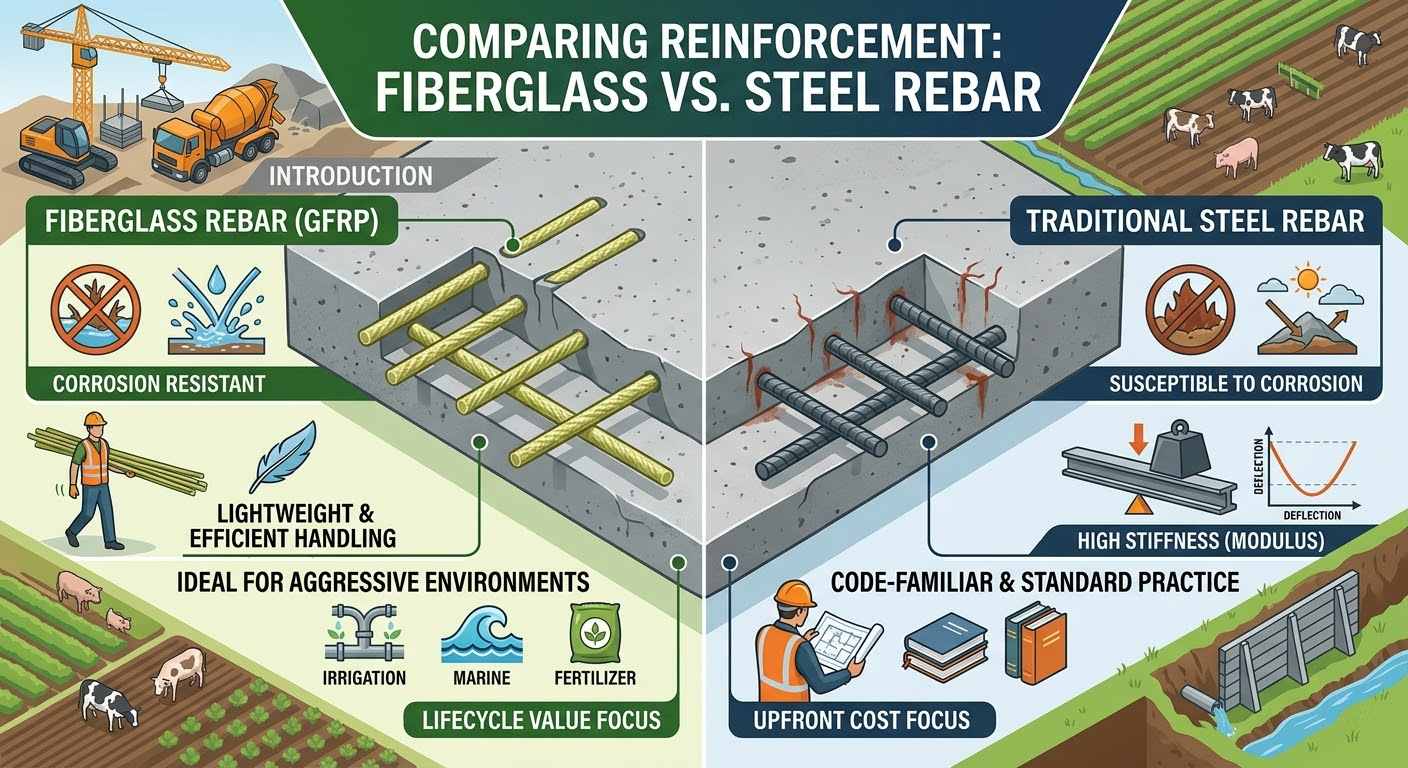
Fiberglass vs Rebar in Concrete: What’s the Core Difference?
Material composition and structure
Fiberglass rebar, commonly called GFRP rebar, is made from glass fibers held together in a polymer resin matrix. Traditional rebar is steel. That single difference drives the rest of the comparison: corrosion resistance, weight, conductivity, stiffness, and design behavior.
ACI guidance highlights several reasons FRP bars are considered in concrete structures. They can be noncorrosive, nonmagnetic, and in some cases nonconductive. Those benefits are especially relevant where reinforcement is likely to face aggressive exposure over time.
Why this comparison matters to buyers
A contractor may focus on handling speed and durability in harsh field conditions. A distributor may want to expand into corrosion-resistant reinforcement without compromising supply consistency. A purchasing manager may care more about lifecycle cost than first cost. Those are different priorities, but they all point back to the same issue: the best reinforcement choice depends on where the concrete will be used, how it will be designed, and what failure risks matter most.
That buyer-focused lens is important because fiberglass rebar is not automatically better than steel. It is better in certain conditions, especially when corrosion is likely and lighter material handling creates jobsite value.
Strength and Performance in Real-World Concrete Applications
Tensile strength, stiffness, and load behavior
One of the most common mistakes in a fiberglass vs rebar in concrete comparison is assuming that higher tensile strength tells the whole story. It does not. GFRP bars can offer strong tensile performance, but steel has much higher stiffness, or modulus of elasticity. That means steel generally resists deformation better under service loads, while GFRP requires different design assumptions for deflection, crack width, and load behavior. ACI’s GFRP code exists specifically because structural concrete reinforced with GFRP bars needs its own minimum requirements for materials, design, and detailing.
That distinction matters on real projects. A reinforcement product can be strong in tension and still behave differently enough that engineers cannot design it like steel. Buyers who understand that early tend to avoid costly redesigns later.
Crack control, flex, and design implications
From a practical standpoint, steel often remains the easier fit when a project depends heavily on familiar stiffness assumptions, legacy specifications, or conventional detailing. Fiberglass rebar can still be the smarter long-term answer in corrosive environments, but only when the engineer designs for its behavior instead of assuming it will perform exactly like steel.
On field-driven projects, this difference shows up quickly. One common pattern is that teams attracted to fiberglass for its corrosion resistance are satisfied with the long-term logic, but the most successful projects are the ones that involve structural review up front. That is the “extra E” many articles skip: experienced buyers do not just compare materials, they compare material plus design pathway.
Corrosion Resistance and Durability
Where fiberglass rebar has a clear advantage
Corrosion is where fiberglass rebar usually makes its strongest case. FHWA has reported that the annual direct cost of corrosion to U.S. bridges is estimated at $5.9 billion to $9.7 billion, and the agency notes that indirect costs can be much higher. It also explains that chloride exposure from deicing salts or marine environments is a major driver of reinforced concrete deterioration.
For buyers, the takeaway is simple: if the concrete will live in a high-moisture, salt-rich, fertilizer-heavy, or chemically aggressive environment, reinforcement corrosion should not be treated as a minor detail. It should be one of the first screening factors. That makes fiberglass rebar especially relevant for drainage structures, irrigation systems, agricultural slabs, marine-adjacent concrete, retaining systems, and soil and water conservation applications.
A realistic field-style example
Consider an anonymized scenario that mirrors what many procurement teams run into: a concrete drainage structure serving an agricultural site begins showing cracking and early deterioration risk because the environment stays wet and routinely sees fertilizer exposure. In that case, the reinforcement decision is no longer just about purchase price. It becomes about avoiding future repair cycles, shutdowns, and concrete replacement work. A buyer looking at that exposure profile often finds fiberglass more compelling, even if steel looked simpler at the bid stage.
That type of example is one reason composite-focused suppliers continue to gain interest. Buyers want reinforcement choices that hold up in the environments they actually build for, not just in ideal conditions.
When steel rebar still performs well
Steel is still a very practical option in many projects. Dry interior slabs, lower-risk environments, and jobs built around conventional codes and familiar contractor workflows can all point toward steel. In those settings, the extra corrosion resistance of fiberglass may not justify the design change, training adjustment, or pricing difference.
A trustworthy recommendation has to say that clearly: steel is not obsolete. It is simply more vulnerable when the environment becomes aggressive.
Installation, Handling, and Jobsite Efficiency
Weight, freight, and labor considerations
Fiberglass rebar is widely valued for being lightweight compared with steel, and ACI has also highlighted lightweight properties among the recognized advantages of GFRP reinforcement. That can make transport, staging, and placement easier, especially on jobs where crews move material across large sites or where freight efficiency matters.
For purchasing managers and distributors, lighter reinforcement can also affect packaging, shipping strategy, and labor planning. That does not replace structural criteria, but it absolutely affects project efficiency.
Cutting, tying, and workflow differences
Fiberglass rebar also changes field workflow. Installation teams may need different cutting practices, clearer handling guidance, and tighter coordination with the engineer and supplier. This is not a reason to avoid it. It is a reason to treat it as a distinct system.
That is where supplier capability matters. A vertically integrated supplier such as Wellco Industries can create value beyond simply shipping material by supporting consistent FRP product quality, broader sourcing needs, and clearer communication across buyer, distributor, and project teams.
Cost Comparison: Upfront Price vs Lifecycle Value
Initial material costs
Upfront price is usually the first comparison buyers make, and it is often the most misleading one. Steel may appear more economical in many standard applications, especially if a team compares only material cost per unit. Fiberglass can look more expensive depending on quantity, specification, resin system, and freight assumptions.
A better comparison includes:
- Freight and handling
- Installation efficiency
- Exposure severity
- Expected service life
- Repair and replacement risk
That framework is more useful than a simple price-per-length comparison because reinforcement decisions play out over years, not just at purchase order stage.
Long-term maintenance and replacement costs
Once corrosion risk is added to the equation, lifecycle value becomes much more important. FHWA’s bridge corrosion estimates show how expensive reinforced concrete deterioration can become when corrosion is allowed to drive repairs. Even though not every project is a bridge, the lesson is transferable: in corrosive environments, the cheaper reinforcement option up front may become the more expensive choice over the asset’s life.
For owners and procurement teams, that is often the turning point in the fiberglass vs rebar in concrete discussion.
Best Use Cases for Fiberglass Rebar in Concrete
Projects exposed to water, salts, or chemicals
Fiberglass rebar is often a strong fit for:
- Marine and coastal concrete
- Drainage and irrigation structures
- Agricultural slabs exposed to fertilizer or manure
- Soil and water conservation installations
- Retaining structures in wet environments
- Concrete exposed to deicing salts or repeated wet-dry cycling
These are the environments where corrosion resistance can change the ownership math in a meaningful way. ACI’s materials and code resources support the use of GFRP as a serious structural reinforcement option when design and detailing are handled correctly.
Buyers who benefit most from composite reinforcement
The buyers who often benefit most include contractors working in aggressive environments, distributors building out FRP lines, and OEM or private label customers who need reliable composite supply. For those groups, material selection is tied not just to engineering but also to sourcing stability, product consistency, and the ability to scale.
That is one reason a one-stop supplier model can matter. When reinforcement is just one piece of a broader composite or infrastructure materials program, an established supplier relationship can reduce friction across quoting, logistics, and repeat ordering.
When Steel Rebar May Be the Better Choice
High-stiffness or code-familiar structural applications
Steel may still be the better fit where design teams prioritize stiffness, familiar detailing, and legacy approval pathways. On projects with low corrosion exposure and conventional workflows, steel often remains the fastest and most straightforward option to specify and install.
Teams prioritizing standard practice
Some projects are won or lost on simplicity. If the engineer, contractor, and owner all operate within well-established steel-based specifications, and the environment is not especially aggressive, steel can remain the sensible choice. The important thing is not to force fiberglass into projects where its benefits are marginal.
Important Design and Specification Checks
Before ordering fiberglass rebar, buyers should confirm four things:
- Code and engineering alignment
ACI 440.11-22 provides minimum requirements for structural concrete reinforced with GFRP bars, but the design still needs to match the actual application and local acceptance pathway. - Material qualification
The product should conform to the relevant material requirements referenced by the applicable code or specification. ACI 440.11-22 points to ASTM D7957-22 for bars covered by the code. - Installation readiness
Crews should understand the handling and installation differences rather than assuming fiberglass behaves exactly like steel. - Environment-based justification
The value case should be clear. Fiberglass is strongest where corrosion resistance, reduced maintenance exposure, and lighter handling are meaningful project advantages.
This section improves trust because it makes the limits clear: fiberglass rebar is not the best answer for every project, and it should never be selected casually without engineering review.
How to Choose Between Fiberglass and Rebar in Concrete
A practical decision framework looks like this:
- Assess the exposure environment
- Review structural stiffness and detailing requirements
- Compare freight, labor, and handling impact
- Estimate lifecycle maintenance cost
- Confirm code, test data, and supplier support
Questions worth asking a supplier include:
- What standards and test data support the product?
- What resin and fiber system are used?
- What lead times and customization options are available?
- What technical guidance is available for installation and application?
- Can the supplier support repeat volume or private label requirements?
Buyers who ask those questions usually make better reinforcement decisions because they are evaluating performance, risk, and supply quality together.
Conclusion
The best answer to fiberglass vs rebar in concrete depends on environment, design requirements, and ownership priorities. Fiberglass rebar stands out where corrosion resistance, lighter handling, and lifecycle value matter most. Steel remains a practical and often preferable option where stiffness, conventional design familiarity, and low-corrosion conditions define the project.
For contractors, distributors, purchasing managers, and OEM buyers, the smartest approach is to compare the full picture: exposure, design pathway, installation realities, and long-term maintenance risk. When FRP reinforcement is on the table, working with an experienced supplier such as Wellco Industries can help buyers source more confidently and align reinforcement choices with the actual demands of the project.
Frequently Asked Questions
Fiberglass rebar can have high tensile strength, but that does not automatically make it a better structural choice. Steel is much stiffer, so it often performs differently under service loads and may be easier to use in conventional structural designs.
No. One of the main advantages recognized by ACI is that GFRP reinforcement is noncorrosive, which is why it is often considered for chloride-rich or chemically aggressive environments.
It is especially useful in concrete exposed to salts, moisture, fertilizer, chemicals, or marine conditions. Common examples include drainage work, irrigation systems, agricultural concrete, and certain soil and water conservation structures.
Not always. In standard, low-corrosion environments, steel may remain the more economical and practical choice. Fiberglass usually becomes more attractive when lifecycle maintenance and corrosion-related repair costs are likely to be significant.
They should confirm code acceptance, engineering design compatibility, product qualification, installation requirements, and supplier support. Those checks are essential because fiberglass rebar should be treated as a distinct reinforcement system, not as a simple steel substitute.