
- July 15, 2026
- Posted by: wellcoindustries
- Category: Fiberglass Stakes
Introduction
A low-cost plant stake can become expensive after crews replace split bamboo, straighten bent steel, or sort inconsistent bundles. The real comparison includes labor, weather exposure, plant protection, reuse, and supply consistency.
This guide compares fiberglass plant stakes with bamboo and steel and explains how to specify a bulk order. It combines pultrusion standards, agricultural guidance, supplier documents, and field-inspection practices. ASTM D3917-23 addresses dimensional tolerances for pultruded profiles, while ASTM D3916-22 provides a tensile test method for qualifying certain pultruded glass-fiber-reinforced rods.
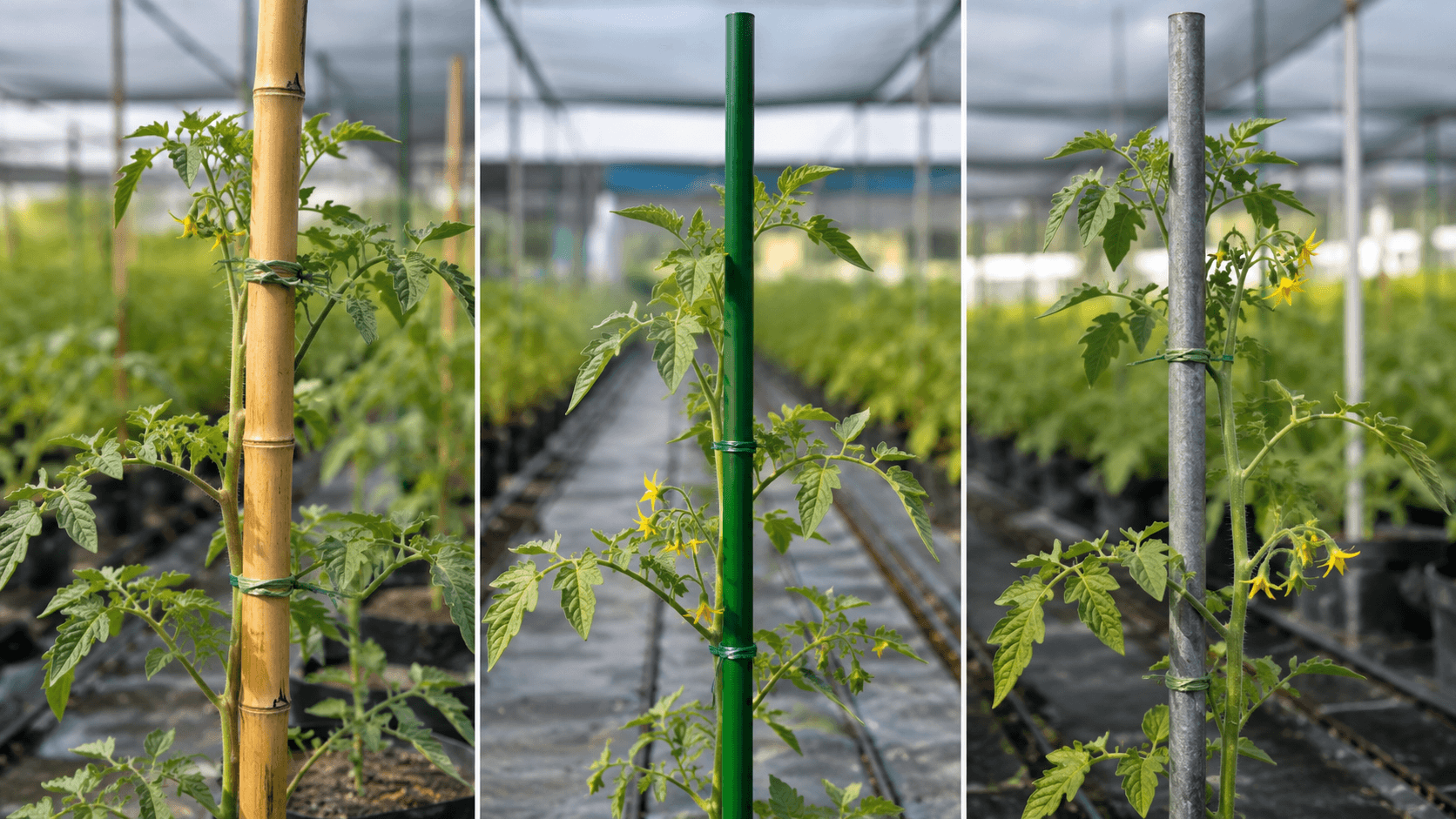
What Are Fiberglass Plant Stakes?
Fiberglass stakes are commonly made by pultrusion. Continuous glass reinforcement passes through resin and a heated die, producing long profiles with repeatable cross sections. Stakes may be solid rods or hollow tubes with smooth, textured, coated, or pointed finishes.
How fiberglass stakes are manufactured
Pultrusion places much of the reinforcement along the profile length. Manufacturers may add mat, surface veil, pigment, and UV inhibitors. Request data for the exact offered stake.
A useful specification defines diameter, length, straightness, surface condition, point geometry, color, and tolerance. It may also prohibit exposed fibers and permanent bow.
Where commercial buyers use fiberglass stakes
Applications include nursery trees, greenhouse vegetables, orchard training, vineyards, landscaping, and restoration planting. Uniform dimensions reduce sorting.
Test representative samples in irrigated soil before approving a large order. Include fertilizer, tying, insertion, and removal.
How long do fiberglass plant stakes last outdoors?
Fiberglass stakes can serve for multiple cycles when the resin, UV package, dimensions, and installation match the site. Life depends on sunlight, chemicals, impact, frost, and storage. Inspect reused stakes for cracks, exposed fibers, damaged tips, and curvature.
UV resistance depends on the complete product system. Pultruded FRP may use UV inhibitors and surface veils, while ASTM D7992/D7992M-23 provides a conditioning practice for elevated temperature and moisture exposure. Neither reference establishes a universal plant-stake lifespan.
Fiberglass Plant Stakes vs Bamboo and Steel
The best material depends on exposure, required stiffness, project duration, and acceptable replacement frequency.
Material performance comparison
The table below summarizes practical purchasing differences:
| Property | Fiberglass | Bamboo | Galvanized Steel | Uncoated Steel |
|---|---|---|---|---|
| Moisture exposure | High resistance with suitable resin | May swell, split, or decay | Good while coating remains intact | High rust risk |
| Dimensional consistency | High | Variable taper and nodes | High | High |
| Handling weight | Low | Low | Higher | Higher |
| Stiffness | Adjustable by profile | Variable | High | High |
| Reuse potential | Good after inspection | Often limited by damage | Good if coating remains sound | Reduced by corrosion |
Bamboo is hygroscopic, and moisture changes can contribute to swelling, deformation, and cracking.
Strength, flexibility, and plant protection
Strength depends on diameter, unsupported length, material grade, and embedment. ASTM D3916-22 can support tensile qualification for certain pultruded rods, while buyers should also request a relevant bend or deflection test.
Use wide, flexible ties with room for movement and stem growth. University of Minnesota Extension recommends loose attachment and flexible materials to reduce plant damage.
Are fiberglass plant stakes stronger than bamboo stakes?
Fiberglass usually provides more consistent strength and deflection than natural bamboo of similar nominal size. A direct ranking still requires profile-specific data. Compare samples under the same span, embedment, tie position, and load.
Durability in Commercial Growing Conditions
Repeated irrigation and handling reveal weaknesses that a one-time load check may miss.
Moisture, fertilizer, and soil exposure
At an anonymized nursery using daily irrigation and seasonal removal, inspectors found split bamboo near ties, rust on scratched steel, and fiberglass tip damage caused by hammering.
The buyer added pilot holes, changed the impact tool, and specified a tougher point finish. Material and installation must be evaluated together.
FRP does not rust, though resin compatibility still matters around fertilizers, salts, cleaners, and unusual soil chemistry. ASTM D7992/D7992M-23 and ASTM D7792/D7792M-23 offer conditioning frameworks for moisture, temperature, and freeze-thaw effects in pultruded composites.
UV exposure and seasonal reuse
Request the resin type, UV method, surface construction, and inspection interval. Store cleaned stakes on level supports under cover.
Reject stakes with exposed glass, sharp splinters, deep cracks, crushed tips, or permanent deformation.
Can fiberglass stakes remain in the ground year-round?
Fiberglass stakes may remain installed year-round when wind, soil movement, frost, equipment traffic, and crop rotation have been considered. Annual inspection is still necessary. Removal is safer where machinery crosses empty rows, freeze-thaw movement loosens supports, or exposed stakes create an impact hazard.
Contract requirements can override preference. One USDA NRCS note for a Virginia tree-shelter application prohibits bamboo, steel rebar, and other non-biodegradable materials, so review the exact local specification.
Installation, Handling, and Worker Efficiency
A durable stake can still underperform when crews struggle to transport or install it.
Transport and installation differences
Fiberglass and bamboo generally weigh less than steel profiles of similar length. Track transport, installation time, driving damage, and removal time.
Steel remains useful where high stiffness, deep driving, or impact resistance controls the decision.
Application suitability by crop and project
| Use Case | Likely Choice | Main Decision Factor |
|---|---|---|
| Greenhouse tomatoes | Fiberglass or bamboo | Light handling and tie compatibility |
| Container nursery trees | Fiberglass | Uniformity and corrosion resistance |
| Vineyard establishment | Fiberglass or galvanized steel | Wind, deflection, and service interval |
| Temporary annual crops | Bamboo | Low initial cost or biodegradability |
| Municipal landscaping | Fiberglass or galvanized steel | Traceability and consistent dimensions |
| Roadside planting | Galvanized steel or robust fiberglass | Stiffness and impact tolerance |
Installation practices that reduce failure
Use pilot holes in difficult soil. Spread impact across the stake end, and stop if a profile splits, crushes, or exposes fibers.
An embedment of roughly 20% to 30% of total length can be an initial trial assumption for light staking. Validate it through soil resistance, pull testing, wind, plant height, and deflection.
For young trees, allow controlled movement and use non-abrasive ties. Agricultural guidance warns that improper staking can injure newly planted trees.
Cost, Maintenance, and Total Ownership
Lifecycle cost includes material, labor, freight, damage, storage, and replacement.
Upfront price versus replacement cost
Use this model:
Lifecycle cost = initial purchase + replacement stakes + replacement labor + additional freight + disposal or recycling.
Consider a hypothetical 1,000-stake program. Bamboo at $1.00 with 30% replacement adds $750 per cycle when replacement labor is $1.50. Fiberglass at $2.20 with 7% replacement adds $259. Replace these illustrative figures with actual quotes and loss rates.
When bamboo or steel may still be the better choice
Choose bamboo for temporary crops, natural appearance, biodegradable requirements, or low-cost seasonal support. Choose steel when high stiffness, repeated impact, established anchoring details, or metal recycling matters most.
Fiberglass is competitive when low weight, corrosion resistance, repeatable dimensions, and multi-season reuse carry more value.
Are fiberglass plant stakes worth the higher initial cost?
Fiberglass stakes can justify a higher purchase price when lower replacement rates, easier handling, corrosion resistance, and repeated reuse reduce total spending. The calculation becomes stronger across several growing cycles. Use your own prices, failure rates, freight, storage, and replacement labor to determine the break-even point.
How to Specify Fiberglass Plant Stakes for Bulk Orders
A clear specification prevents quotes for visually similar products with different performance.
Dimensions and mechanical requirements
State length, diameter, construction, straightness, point geometry, surface condition, and tolerances. Add an agreed deflection and recovery test.
ASTM D3917-23 covers production tolerances for pultruded shapes, while ASTM D3916-22 addresses tensile testing for rods within its scope. Use them as references, then define acceptance values for your stake.
Surface, color, and UV requirements
Specify smooth, textured, coated, or ribbed surfaces according to tie grip and handling. Define color tolerance when stakes support branding, row identification, or visibility.
Ask how the supplier provides UV resistance. Set limits for exposed fibers, cracks, sharp edges, resin-rich defects, and inconsistent points.
Packaging, fabrication, and supply reliability
Confirm bundle count, pallet size, labels, cut length, pointed ends, samples, and OEM packaging. Wellco Industries combines agricultural and FRP supply capabilities with bulk orders, custom specifications, and North American warehousing.
Request an approved sample, drawing revision, lead time, batch identification, and claims procedure.
Procurement Checklist for Comparing Suppliers
Technical documentation to request
Request drawings, tolerances, resin and UV information, mechanical data, chemical guidance, instructions, and warranty limits. Confirm reports apply to the quoted profile.
Commercial details to verify
Check MOQ, sample charges, tooling, custom colors, packaging, freight, lead time, replacement policy, and repeat-order consistency.
Warning signs during supplier evaluation
Watch for unsupported lifespan claims, generic strength values, missing tolerances, unclear resin descriptions, inconsistent samples, and absent batch traceability. Review unusually low quotations for omitted freight, point fabrication, packaging, or tooling.
Conclusion
Fiberglass offers consistent dimensions, low handling weight, corrosion resistance, and strong reuse potential. Bamboo remains useful for temporary or biodegradable applications, while steel suits projects driven by stiffness and impact resistance.
Your best choice depends on crop load, wind, soil, exposure, installation labor, project duration, and contract requirements. Compare exact profiles, test samples under field conditions, and calculate cost across the full service period.
[Request fiberglass plant stake specifications or a bulk quote from Wellco Industries →]