
- May 7, 2026
- Posted by: wellcoindustries
- Category: Fiberglass Stakes
Introduction
Growers and nursery managers across North America commonly report replacing 25–30% of their wood and bamboo stakes every season — not because crops fail, but because the supports do. Rot, splitting, and UV breakdown turn what appears to be a low-cost solution into a recurring labor and materials expense that compounds across every growing cycle. Fiberglass plant and tree stakes eliminate that pattern. This article walks buyers, growers, and procurement managers through exactly why fiberglass outperforms wood and bamboo in the field, which applications generate the strongest return on investment, and how to spec the right product before your next season begins.
Why Wood and Bamboo Stakes Fail in the Field
Most stake failures don’t announce themselves. A bamboo cane looks structurally sound at planting — and snaps under load three months later when a crop needs it most.
The Hidden Costs of Stake Replacement
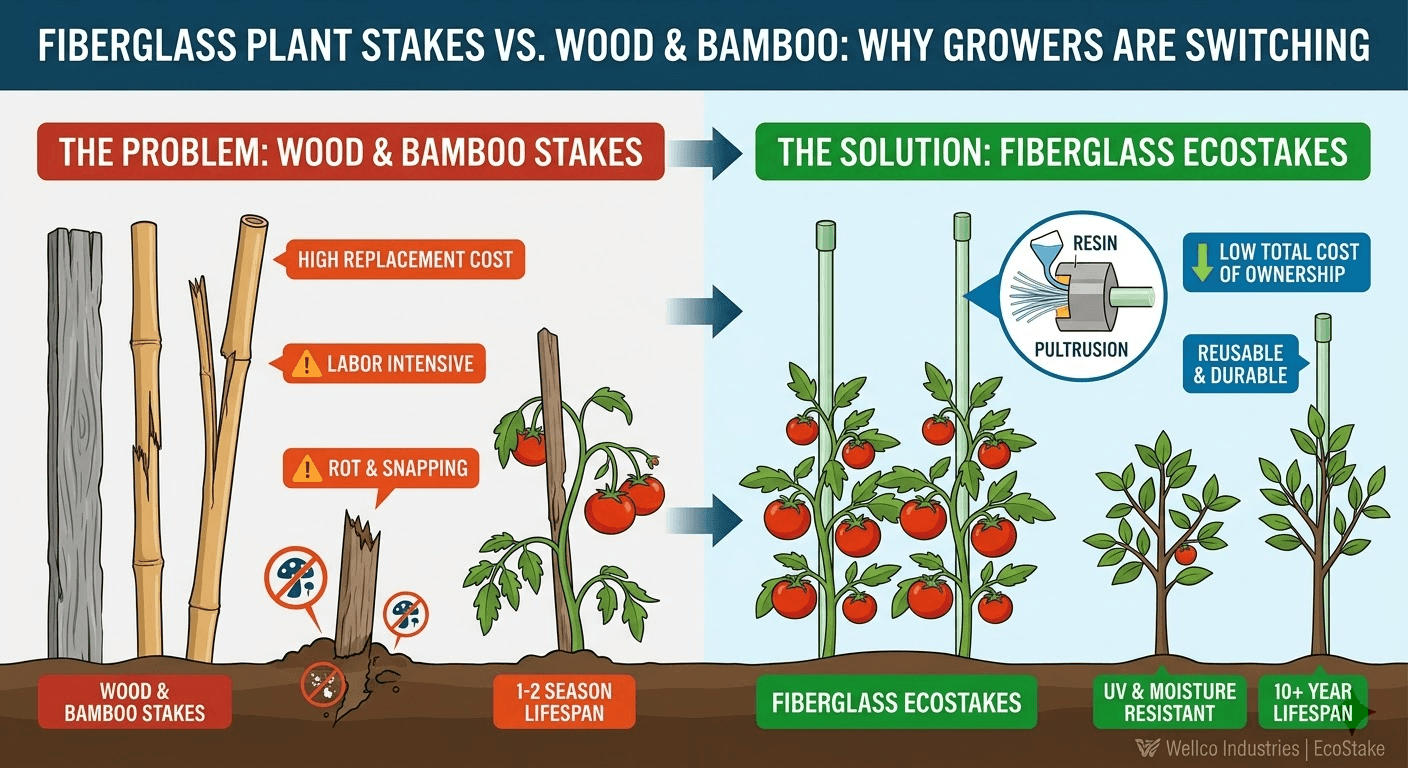
Wood and bamboo stakes typically begin showing structural degradation within one growing season under irrigated or high-humidity conditions. Field contractors consistently observe significant strength loss in bamboo after a single season of soil contact, particularly in drip-irrigated and furrow-irrigated environments where the stake base stays wet for extended periods. Untreated wood stakes can begin visible fungal decomposition in as little as 8–12 weeks in warm, moist soil.
The direct material cost is only part of the problem. Labor for mid-season re-staking on a commercial row crop operation — pulling failed stakes, resetting ties, and re-supporting damaged plants — runs in the range of $200–$400 per acre per incident on California vegetable operations, based on contractor-reported estimates for tomato and pepper production. For nursery and orchard operations with multi-year crop cycles, that figure compounds significantly across seasons.
How Moisture and Soil Chemistry Accelerate Deterioration
Soil pH below 6.0 or above 7.5, combined with consistent irrigation, creates conditions that accelerate fungal breakdown of organic stake materials. In drip-irrigated vineyards and greenhouse tomato operations, the soil immediately surrounding stake bases stays moist for extended periods — exactly the conditions where bamboo and wood degrade fastest.
Contractors working on row crop operations in California’s Central Valley consistently report that bamboo stakes installed in spring often become brittle and unreliable by mid-summer harvest. The combination of irrigation frequency, high soil temperatures, and repeated mechanical stress during cultivation passes accelerates deterioration well beyond what per-unit price comparisons suggest. That field reality is what drives commercial growers toward a longer-lasting alternative.
What Makes Fiberglass Plant and Tree Stakes Different
Durability in the field matters — but understanding why fiberglass performs differently helps buyers make confident procurement decisions rather than simply accepting a supplier’s performance claims.
Material Composition and Core Properties
Fiberglass plant stakes are manufactured through a pultrusion process: continuous glass fiber rovings are pulled through a resin bath and a heated forming die, producing a solid or hollow rod with consistent cross-sectional properties along its entire length. The result is a composite material that combines the tensile strength of glass fiber reinforcement with the chemical resistance of the resin matrix — typically polyester or vinyl ester.
Key performance properties include full corrosion resistance (no rust, rot, or fungal degradation), non-conductivity (relevant for growers using electrostatic pest control systems or working near irrigation controls), and UV-stabilized surface coatings that prevent surface chalking and brittleness over multi-season outdoor exposure. Unlike wood, fiberglass does not absorb moisture — which means its structural properties remain consistent whether the stake is installed in dry sandy loam or waterlogged clay.
Structural Performance Under Load
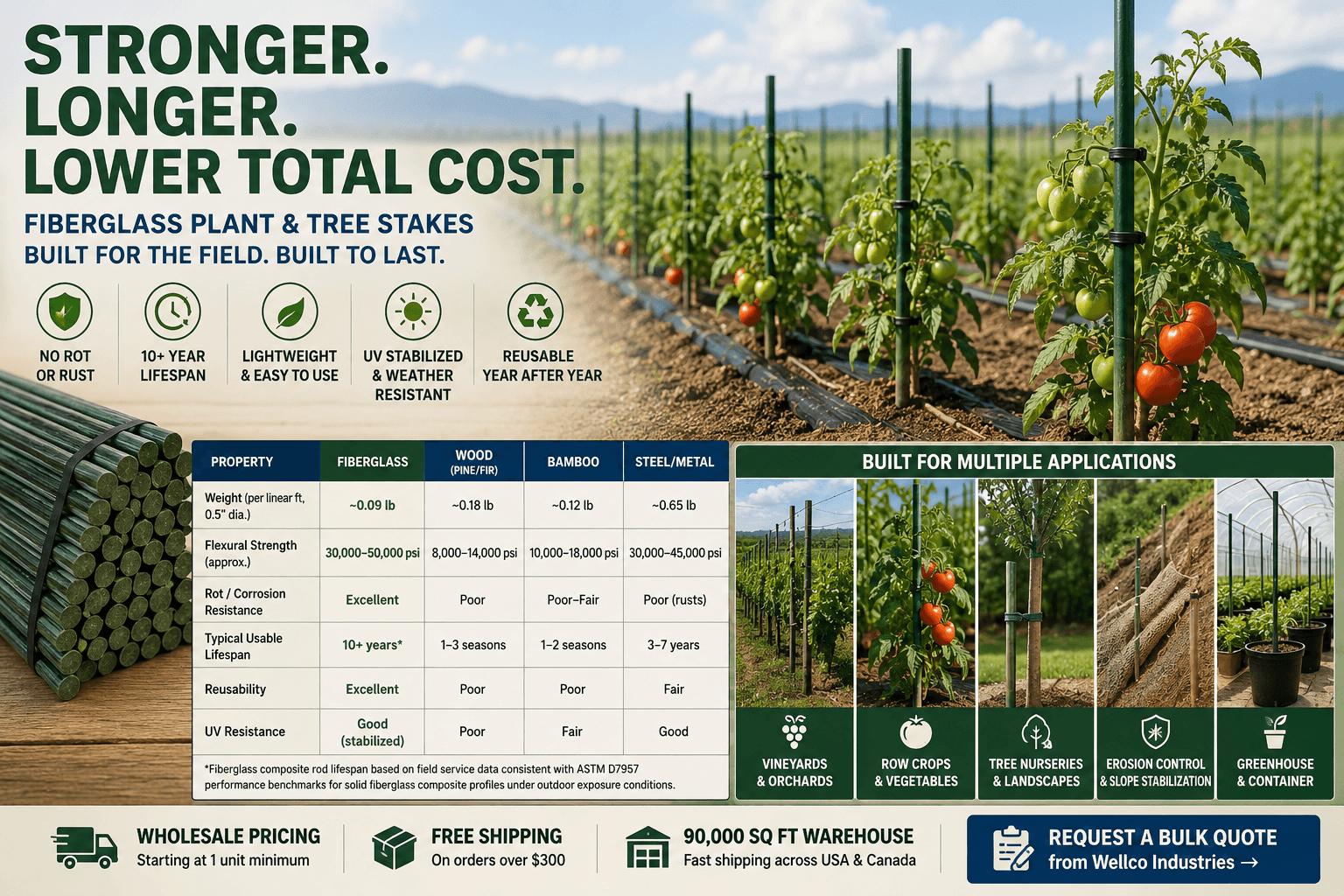
The table below compares the core performance characteristics of common plant stake materials across the criteria that matter most to commercial growers and procurement buyers. Flexural strength values represent approximate ranges for standard commercial profiles at 0.5″ diameter.
| Property | Fiberglass | Wood (Pine/Fir) | Bamboo | Steel/Metal |
|---|---|---|---|---|
| Weight (per linear ft, 0.5″ dia.) | ~0.09 lb | ~0.18 lb | ~0.12 lb | ~0.65 lb |
| Flexural Strength (approx.) | 30,000–50,000 psi | 8,000–14,000 psi | 10,000–18,000 psi | 30,000–45,000 psi |
| Rot / Corrosion Resistance | Excellent | Poor | Poor–Fair | Poor (rusts) |
| Typical Usable Lifespan | 10+ years* | 1–3 seasons | 1–2 seasons | 3–7 years |
| Reusability | Excellent | Poor | Poor | Fair |
| UV Resistance | Good (stabilized) | Poor | Fair | Good |
*Fiberglass composite rod lifespan based on field service data consistent with ASTM D7957 performance benchmarks for solid fiberglass composite profiles under outdoor exposure conditions.
Fiberglass delivers a combination few alternatives can match: low weight, long lifespan, and zero rot risk. Steel is stronger but heavy, rust-prone, and cost-prohibitive at commercial scale. Wood and bamboo are inexpensive per unit but rarely survive more than two seasons under standard commercial use conditions.
Where Fiberglass Stakes Deliver the Most Value
Structural performance data establishes the case for fiberglass — but real-world application fit determines where buyers see the strongest return on investment.
Vineyards, Orchards, and Tree Nurseries
High-reuse environments are where fiberglass stakes pay for themselves most quickly. A vineyard or orchard operation that installs stakes once and reuses them for a decade eliminates 8–9 cycles of material purchasing, delivery logistics, and labor-intensive swap-outs.
In one anonymized case from a 10-acre California wine grape operation, a grower transitioned from 0.5″ bamboo canes to 0.5″ fiberglass stakes at 5-foot spacing along drip-irrigated rows after tracking bamboo replacement costs over three consecutive seasons. The bamboo had been failing consistently at the soil line by August — midway through the critical canopy management period. By year two after the switch to fiberglass, the cumulative material and labor savings had fully offset the higher per-unit cost, and by year four the stakes showed no measurable degradation. Tree nurseries benefit similarly: fiberglass stakes move with container stock through multiple production cycles without the contamination or decomposition risk that comes from degrading bamboo embedded in propagation media.
Row Crops, Tomatoes, and Vertical Garden Systems
For tomato, pepper, eggplant, and other tall vegetable crops grown in commercial field or greenhouse settings, stake weight and handleability matter as much as longevity. Fiberglass stakes at equivalent diameters run roughly half the weight of wood stakes, reducing installer fatigue during high-density planting operations where hundreds or thousands of stakes are set per day.
Fiberglass is also fully compatible with drip tape, trellis wire, and clip-based training systems. Its smooth, consistent surface doesn’t snag or abrade tie materials the way split bamboo can, and it won’t swell or warp in humid greenhouse environments where wood stakes become difficult to drive straight.
Erosion Control and Slope Stabilization Applications
Fiberglass stakes serve a secondary but critical role as anchor points in erosion control installations — particularly for securing jute netting, burlap blankets, and weed barrier fabric on slopes where soil moisture levels are consistently high. This is exactly the environment where wood anchor stakes fail earliest.
On revegetation projects along highway corridors and disturbed slopes in the Pacific Northwest and Mountain West, contractors report that wooden anchor stakes often pull free or break at the soil line within a single wet season. On 3:1 slopes with heavy clay soils, fiberglass anchor stakes at 18–24 inch spacing, driven 10–12 inches with a rubber mallet, maintain structural integrity through saturated conditions and remain fully extractable after vegetation establishment — a meaningful advantage when phased erosion control installations require adjustment or reuse. That extractability and reusability directly reduces cost on multi-phase slope restoration projects.
How to Select the Right Fiberglass Plant Stake for Your Application
Understanding where fiberglass outperforms alternatives is the first step — but selecting the correct spec for your specific crop, site, and load conditions determines whether the product actually performs in the field.
Key Sizing and Load Parameters
Fiberglass plant stakes are specified by three primary dimensions: diameter, length, and (for hollow profiles) wall thickness. Diameter drives load-bearing capacity — 0.25″ stakes handle light annual crops and seedling support, while 0.5″ and larger diameters are appropriate for young trees, heavy-fruiting vine crops, and applications requiring lateral load resistance against wind.
A reliable field rule: stake length should equal approximately two-thirds of the total supported plant height at maturity. For a tomato plant expected to reach 6 feet, a 4-foot stake driven 10–12 inches into the ground provides adequate above-grade support height. For tree staking applications, a minimum of two stakes per tree with cross-bracing tie configurations is standard practice on wind-exposed sites.
Application Suitability Guide
The table below maps common growing and installation scenarios to the recommended fiberglass stake specification and the primary reason for that selection:
| Use Case | Recommended Stake Spec | Key Reason |
|---|---|---|
| Young tree support (nursery / field) | 0.5″–0.75″ dia., 4–6 ft | Lateral load and wind resistance; multi-season reuse |
| Tomato / pepper row crops | 0.375″–0.5″ dia., 4–5 ft | Balance of strength and handleability at high volume |
| Vineyard trellis end-post support | 0.75″–1.0″ dia., 5–7 ft | Trellis wire tension and long-term structural integrity |
| Erosion control / slope anchoring | 0.25″–0.375″ dia., 18″–36″ | Penetration depth in compacted slope soils; moisture resistance |
| Container nursery / greenhouse | 0.25″–0.375″ dia., 12″–36″ | Lightweight handling; no contamination of growing media |
Matching diameter and length to actual load and soil conditions — rather than defaulting to the cheapest available size — is the most common procurement error buyers make when switching from wood or bamboo to fiberglass for the first time.
Sourcing and Procurement: What B2B Buyers Should Know
Once you’ve confirmed the right spec for your application, the next question is whether your supplier can actually deliver it at the volume and timeline your operation requires. Not all fiberglass stake suppliers carry genuine commercial-grade composite profiles — commodity import channels frequently offer lower-grade material without traceable manufacturing standards.
Volume Pricing, MOQ, and Lead Times
Wellco Industries supplies fiberglass plant and tree stakes under the EcoStake product line, sourced through its Ecopultrusion manufacturing partnership — a distinction that gives buyers confidence in consistent composite quality rather than spot-market commodity product. Wellco’s wholesale model is built for commercial buyers: orders start at a single-unit minimum, with free shipping on orders over $300.
That low-MOQ structure is practically valuable for operations switching from wood or bamboo for the first time. Trialing two or three stake specs across different crop blocks before committing to a full-season purchase order is a straightforward risk-reduction step — and Wellco’s entry threshold makes that comparison practical without requiring a large upfront commitment. For buyers with established volume requirements, tiered member pricing and OEM/ODM services cover custom stake lengths, diameters, and color coding. In mixed-crop operations where multiple stake specs are deployed across different blocks, a simple color-coding system prevents mis-deployment during high-speed planting operations — a detail that becomes significant at scale.
Storage, Handling, and Jobsite Logistics
Fiberglass stakes bundle efficiently and stack flat, making them significantly easier to store and transport than wood stakes of equivalent length, which are heavier and prone to warping in outdoor storage. A bundle of 100 half-inch fiberglass stakes at 4 feet weighs approximately 9 lbs — a handling advantage that matters on large-scale operations moving stakes across multiple field blocks.
Wellco’s US-based warehouse network spans 90,000 square feet across multiple locations, supporting fast fulfillment to customers across the continental United States and Canada. For time-sensitive seasonal procurement, that domestic inventory position is a material operational advantage over offshore suppliers carrying 4–8 week ocean freight lead times.
Conclusion
Fiberglass plant and tree stakes consistently outperform wood and bamboo on every metric that drives total cost of ownership: lifespan, structural consistency, rot resistance, and reusability. Here are five takeaways for buyers making a sourcing decision:
- Wood and bamboo stakes cost more than their unit price suggests. Replacement labor and material costs in commercial operations routinely exceed initial savings within two growing seasons.
- Fiberglass lifespan exceeds 10 years under conditions that degrade bamboo in a single irrigated season — the performance gap is widest in high-moisture and high-reuse environments.
- Spec selection is a technical decision, not a commodity choice. Match diameter and length to actual load and soil conditions; undersizing is the most common first-time buyer error.
- High-reuse environments generate the fastest ROI. Vineyards, orchards, and nurseries consistently see payback within two to three seasons at current material pricing.
- Trialing before committing reduces switching risk. Running a mixed-spec comparison across two or three crop blocks before locking in full-season volume is a straightforward way to validate performance under your specific site conditions before scaling up.
[Request a bulk quote from Wellco Industries →]
Frequently Asked Questions
Wellco Industries offers wholesale pricing starting at a single-unit minimum, with no formal MOQ requirement for standard EcoStake profiles. Free shipping applies to orders over $300. This makes it practical to run small trial orders across multiple specs before committing to full-season volume.
Yes. Wellco Industries offers OEM/ODM services for buyers with established volume requirements, covering custom stake lengths, diameters, and color coding. Contact Wellco’s wholesale team directly to discuss specifications, lead times, and tiered pricing for recurring orders.
Fiberglass composite stakes have a usable service life exceeding 10 years under standard outdoor agricultural conditions, consistent with ASTM D7957 performance benchmarks for solid composite profiles. Actual lifespan depends on UV exposure, soil conditions, and handling — but fiberglass does not rot, rust, or absorb moisture, which are the primary failure modes for wood and bamboo alternatives.
Yes. Fiberglass stakes are well-suited as anchor points for jute netting, burlap erosion blankets, and weed barrier fabric on slopes and disturbed sites. Their moisture resistance and structural consistency in saturated soils make them significantly more reliable than wood anchor stakes in high-precipitation or irrigated environments.
Fiberglass stakes require no special storage conditions. Bundle and stack flat in a dry location away from direct UV exposure when not in use. Unlike wood or bamboo, fiberglass will not warp, split, or absorb moisture during off-season storage — which means stakes pulled at the end of one season are fully ready for reinstallation at the start of the next.