
- February 5, 2026
- Posted by: wellcoindustries
- Categories: Burlap, Erosion Control
Introduction
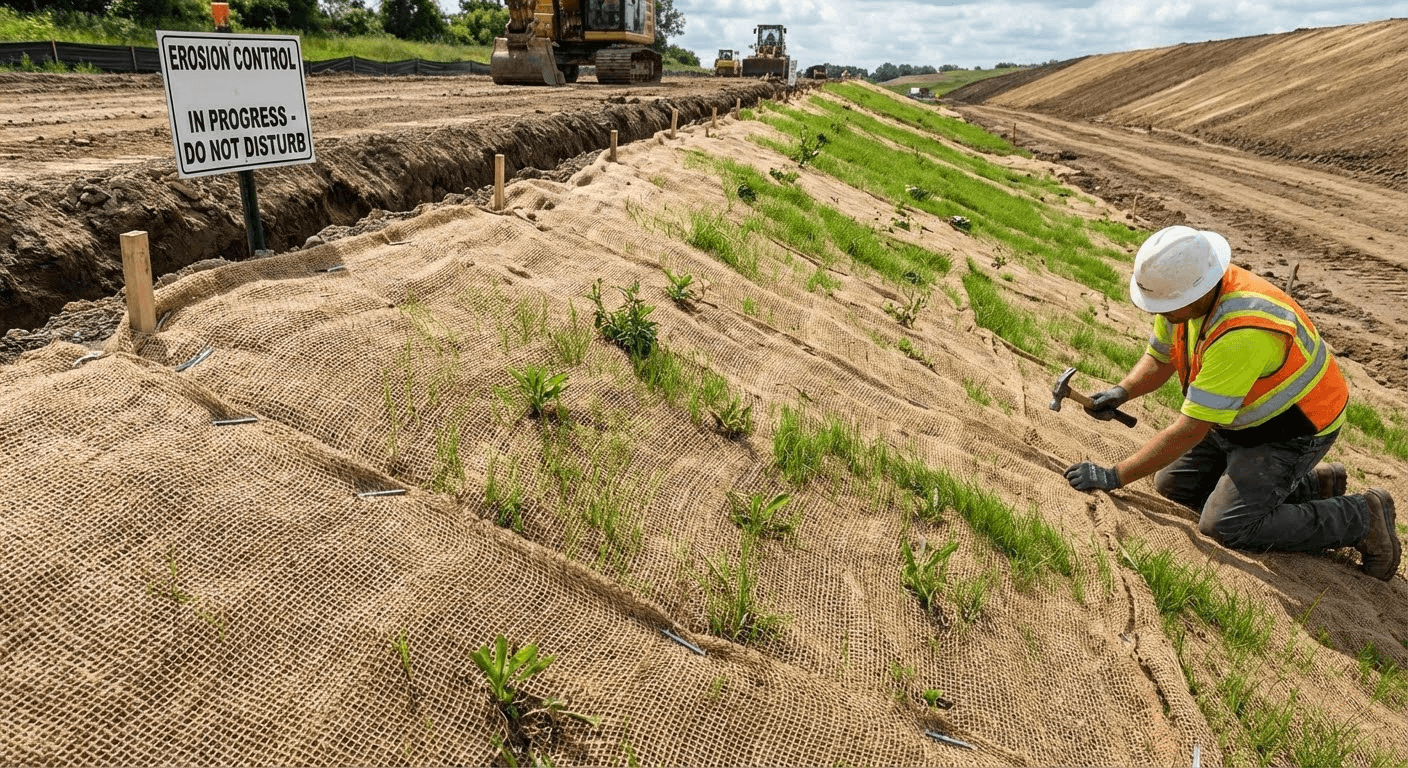
A freshly graded slope can look “done” and still be one storm away from rills, seed washout, and rework. Burlap landscaping fabric (often jute/burlap netting or woven burlap sheeting) is popular because it’s biodegradable, provides immediate surface protection, and helps keep soil and seed in place long enough for vegetation to take over.
This article is built for agriculture, construction, and soil & water conservation buyers and doers—purchasing managers, contractors, distributors, and OEM/private-label teams—who need to spec the right material, install it reliably, and set realistic performance expectations. You’ll also see exactly when burlap is the wrong tool and when to step up to a higher-performance rolled erosion control product (RECP).
Where supplier reliability matters (consistent roll specs, labeling, and availability), vertically integrated suppliers like Wellco Industries can simplify purchasing—especially when erosion control materials are being sourced alongside other agricultural and jobsite-support products.
When Burlap Landscaping Fabric Makes Sense
Burlap shines when the goal is temporary stabilization while vegetation establishes—especially where biodegradability is valued for restoration or where cleanup of synthetic materials is undesirable.
Common fit-for-purpose uses:
- Seedbed protection on mild–moderate slopes to reduce raindrop impact and surface sealing.
- Disturbed soil protection around new plantings, tree lines, and staged grading areas.
- Restoration areas where natural-fiber products align with project constraints.
A helpful way to frame this: burlap is often used as a temporary RECP-like surface cover, but it’s not designed to provide long-term reinforcement the way permanent products are. For context, agencies commonly separate RECPs into temporary erosion control blankets (ECBs) versus long-term turf reinforcement mats (TRMs) that permanently reinforce vegetation.
When burlap is a poor fit
Skip burlap (or only use it as part of a larger system) when:
- You expect concentrated flow (channels, swales that actually carry water).
- You need multi-year weed suppression (burlap biodegrades and seams open with time).
- You need long-duration structural reinforcement—that’s TRM territory, not burlap.
If your site has active flow paths, consider redesign (check structures, wattles, slope breaks) or select an engineered RECP rated for channel conditions.
How to Choose the Right Burlap Landscaping Fabric
Buyers often lose time not on price, but on mismatched specs—too open, too light, wrong roll dimensions, or inconsistent lots. Use this spec-first checklist.
A procurement-ready spec checklist
Ask suppliers for a data sheet and confirm:
- Fiber content: jute/burlap (natural) vs blends (blends may change degradation and performance).
- Weave / openness: tighter weaves generally resist tearing and underflow better; open weaves can be better for through-growth depending on your goal.
- Mass/weight & roll dimensions: ensure width/length matches install logistics to reduce seams.
- Expected service window: short-term vs seasonal; align to vegetation establishment timing.
- Staple/anchor recommendations: the fabric is only as good as the anchoring plan.
If you’re buying jute netting variants, it’s also reasonable to request minimum quality language (uniform open weave, consistent yarn) similar to what some public-facing material specs require.
Treatments and environmental constraints
Some burlap/jute products may be treated to resist rot or extend service life. That can be useful on certain sites—but it can also create compliance issues in sensitive areas.
Include these “submittal package” items in your purchase file:
- Written statement of treatments/additives (or confirmation of untreated natural fiber)
- Intended application (slope protection vs perimeter detail vs seed cover)
- Any available minimum requirements/test references
- Project constraints (waterways, habitat restoration requirements, disposal expectations)
Installation That Holds Up in the Real World
Most “burlap failures” are installation failures: air gaps, poor seam orientation, sparse staples, and skipped anchor trenches.
The jobsite checklist I use before unrolling
- Surface contact: soil should be smooth enough that fabric lays flat—no bridging over clods.
- Debris check: remove sharp sticks/rocks that tear the weave.
- Flow awareness: identify where water will actually move (not where the plan says it should).
- Weather contingency: if rain is forecast, prioritize top-of-slope anchoring and seam fastening first.
That last point is the difference between “temporary protection” and “flapping sail.”
Anchoring, overlaps, and key-ins (with measurable benchmarks)
Treat seams and edges as high-stress zones.
- Shingle your seams so the upslope piece overlaps the downslope piece (think roofing).
- Increase fastener density at overlaps and at the top of slope.
- Use an anchor trench (key-in) at the top of slope so runoff can’t get under the first edge.
Two practical benchmarks from widely used guidance:
- USDA NRCS jute netting specs note staple spacing at the upper end and end overlaps of rolls “should not be greater than 1 foot.”
- A common erosion control blanket installation guide specifies an anchor trench 6 inches wide by 6 inches deep, with the blanket stapled in the trench, backfilled, and compacted.
Even if you’re using burlap rather than a manufactured blanket, these dimensions and seam-fastening behaviors are excellent “don’t-regret-it” practices—especially on wind-exposed slopes or before a rain.
Performance Expectations and Life Cycle
Burlap is temporary. Its job is to buy time for vegetation, not to become permanent infrastructure.
What controls durability:
- Moisture + microbes: warm/wet soils break natural fibers down faster.
- UV exposure: exposed fabric degrades faster than fabric in contact with soil and vegetation.
- Soil contact: good contact improves erosion performance but can accelerate biodegradation.
Many suppliers and installers describe jute netting as typically disappearing within about 1–2 years, but treat that as a planning range—not a guarantee—because climate and site exposure dominate.
Limitations and Site Risk Factors
Use these as your “red flag” list. If you check multiple boxes, escalate to a higher-performing RECP or involve an erosion control specialist:
- Concentrated flow paths or high runoff velocity
- Very steep slopes with poor soil contact
- Sandy soils requiring longer staples/anchors
- Long exposure windows before vegetation can establish
- Sites where failure creates safety or compliance risk (sediment discharge, access road undermining)
It’s also worth remembering that standards and agencies often distinguish between temporary blankets and permanent reinforcement mats (TRMs) for a reason—TRMs exist for conditions where vegetation alone won’t provide long-term stability.
Common Problems and How to Prevent Them
Six frequent failure points
- Fabric selected too light/open for the slope exposure
- Seams overlapped the wrong way (creating a “lip” that catches runoff)
- Staples too sparse at overlaps and edges
- Top-of-slope key-in skipped
- Installed over cloddy/rocky soil → air gaps → underflow
- No plan for flow breaks (wattles/checks) where runoff concentrates
An anonymized mini case study
A grading crew installed burlap on a newly shaped slope late in the week, planning to “finish staples Monday.” A weekend storm hit, runoff got under the un-keyed top edge, and the burlap lifted into a long flap. The slope rilled under the fabric, and the crew had to regrade and re-lay.
What fixed it:
- Regraded the undermined strip for full soil contact
- Cut a proper anchor trench (key-in) and compacted backfill
- Added dense staples at seams and the top edge (using the “tight seam spacing” mindset from NRCS-style guidance)
- Added a small flow-break upstream to prevent sheet flow from accelerating
Supplier and Procurement Considerations
When you’re buying for multiple crews or regions, “same SKU” doesn’t always mean “same performance.” Ask for:
- Lot/roll identification and consistent labeling
- Clear dimensions and any minimum requirements documentation
- Staple/anchor recommendations (and compatible staples available)
- Packaging that survives jobsite handling and storage guidance
If you’re distributing or private-labeling, supplier capability matters beyond the roll itself. This is where a broad, vertically integrated supplier like Wellco Industries can be a value-add: consistent sourcing, repeatable specs, and fewer handoffs when erosion control materials need to ship alongside related agricultural/jobsite products.
Conclusion
Burlap landscaping fabric is a strong option for temporary erosion protection when you need biodegradability and fast deployment—but it performs only as well as the spec + install system behind it. Choose the right weave and roll dimensions, key-in the top edge, shingle seams, and treat overlaps like critical joints—because they are.
If you’re scoping a project, do a quick site risk check (slope, flow paths, soil type, exposure window), request a data sheet/submittal package, and install a short test section to confirm staple pattern and seam behavior before rolling out the full area.
Frequently Asked Questions
Most natural jute/burlap products are temporary and can break down within roughly 1–2 years, but weather, UV exposure, and soil moisture can shorten or extend that window. Plan for variability and prioritize vegetation establishment over “fabric lifespan.”
Not for long-term weed suppression. Burlap may reduce weeds briefly by shading soil, but it degrades and seams can open—so it’s better treated as temporary surface protection than a multi-season weed barrier.
Skipping the top-of-slope key-in and under-fastening seams. A simple anchor trench and dense fastening at overlaps prevents runoff from getting under the fabric and turning it into a flap.
If you have concentrated flow, steep slopes with high runoff stress, or you need long-term reinforcement, use a product category designed for that purpose (e.g., ECBs rated for your slope/channel conditions or TRMs for permanent reinforcement).