
- July 24, 2026
- Posted by: wellcoindustries
- Categories: Burlap, Erosion Control
Introduction
A sudden cold front can turn healthy nursery stock into a replacement order. Newly planted shrubs, young trees, container plants, and exposed evergreens may lose moisture through foliage while frozen or poorly established roots cannot replace it. Winter sun and wind can intensify the damage.
A burlap garden cover reduces exposure without sealing plants inside an airtight layer. This guide explains where it works, how to specify and install it, and what bulk buyers should verify.
Why Burlap Garden Cover Works for Plant Protection
Before choosing a fabric weight, buyers should understand what burlap can realistically do.
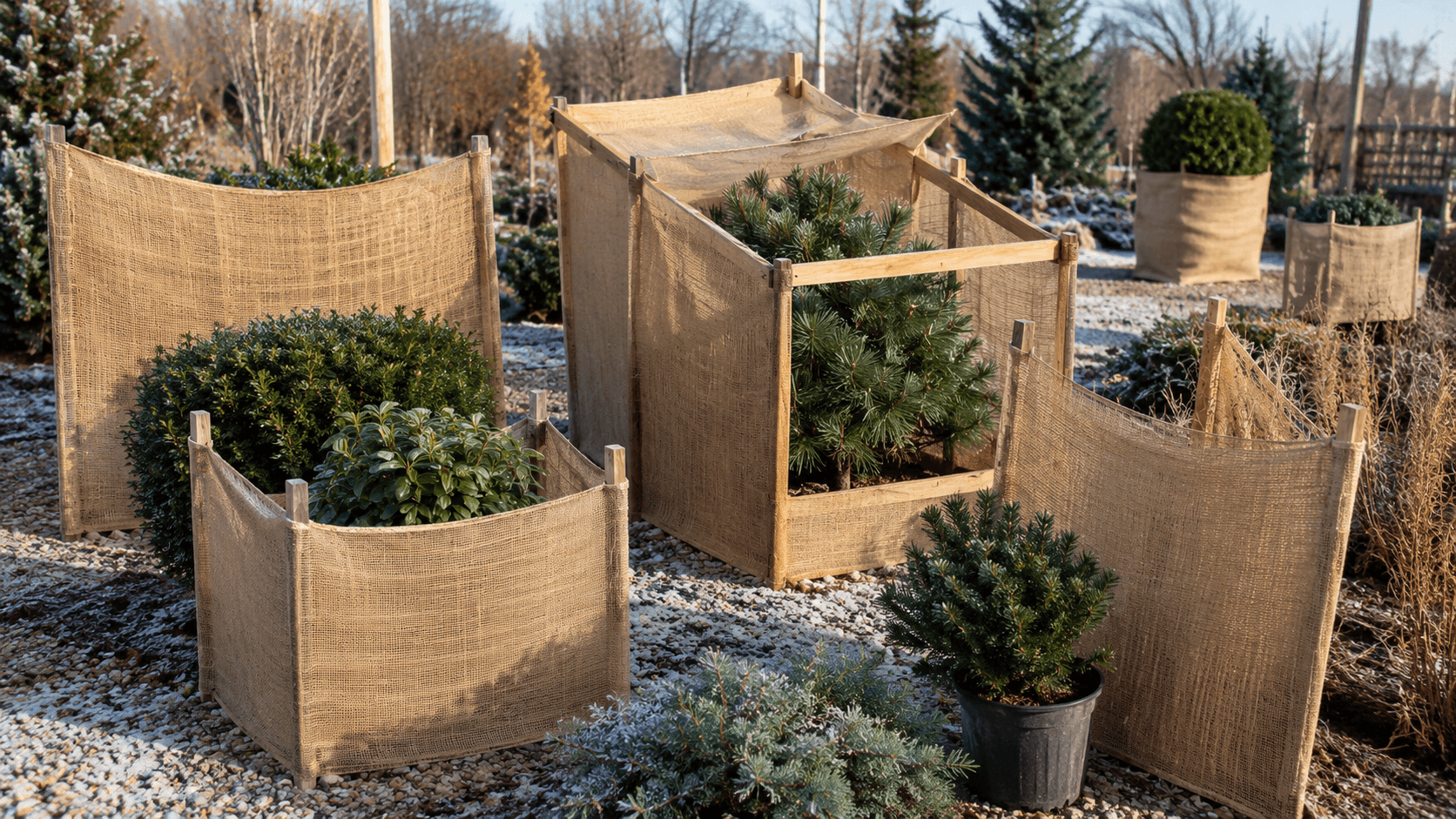
Breathability and Airflow
Natural burlap is an open-weave jute fabric. Its structure allows airflow while reducing direct wind and sun exposure.
University of Minnesota Extension recommends leaving the top of a surrounding barrier open so air and light can enter. This makes burlap well suited to ventilated screens around evergreens and dormant shrubs.
Temperature and Wind Moderation
Burlap moderates the plant’s immediate environment by slowing drying wind and providing partial shade. For newly planted evergreens, screens are commonly positioned on the south, west, and windward sides.
Minnesota Extension recommends this orientation, while Penn State describes barriers supported by 4- to 5-foot stakes placed about 2 feet beyond the drip line.
How Much Cold Protection Does Burlap Provide?
Burlap can reduce wind exposure, winter sun, light frost stress, and moisture loss, but it cannot maintain a guaranteed temperature. Performance depends on plant hardiness, soil moisture, fabric density, layering, wind, and installation. Severe or prolonged freezes may require mulch, frost cloth, or a more insulated enclosure.
For root protection, Iowa State recommends 3 to 4 inches of organic mulch in relevant overwintering applications. Burlap may retain that material, though the insulation comes mainly from the mulch and trapped air.
Use burlap to manage exposure, then add thermal protection when the weather risk demands it.
Best Applications for Burlap Garden Cover
The protection goal determines the most suitable format.
Commercial Nurseries and Container Plants
Nurseries can install perimeter screens around grouped containers and overwintering blocks. Group protection reduces individual wrapping and preserves access for watering and inspection.
Container roots remain highly exposed. Iowa State identifies setting pots into soil as a reliable overwintering method and describes using burlap around cages that retain insulating straw.
Landscape Installation and Tree Protection
New evergreens, broadleaf shrubs, and young ornamental trees benefit most at open, windy, south-facing, or west-facing sites. Supported screens keep wet fabric away from foliage.
Iowa State recommends setting a winter screen at least 6 inches from foliage. Exposed sites may need more clearance to prevent contact when fabric moves.
Agricultural and Garden Uses
Growers can use burlap as temporary shade over transplant zones, a loose raised-bed cover, or a perimeter barrier around sensitive plantings.
| Use Case | Recommended Format | Primary Benefit | Main Limitation |
|---|---|---|---|
| Newly planted shrubs | Stake-supported screen | Reduces wind and sun exposure | Limited insulation |
| Young tree trunks | Loose removable wrap | Shields bark | Can constrict if tight |
| Raised beds | Sheet on supports | Moderates sun and moisture loss | Needs anchoring |
| Nursery containers | Perimeter enclosure | Protects grouped stock | Roots may still freeze |
| High-value evergreens | Open-top frame | Improves coverage and access | Higher labor |
Matching the format to the risk prevents buyers from paying for fabric that cannot solve the underlying problem.
Choosing the Right Burlap Specification
Measurable specifications make repeat orders more consistent.
Fabric Weight and Weave Density
Terms such as “premium” and “heavy duty” are too subjective for procurement. Buyers should state nominal weight, tolerance, fiber content, weave condition, and finished dimensions.
This conversion table supports specification comparisons. It is a unit guide, not a universal product grading system.
| Specified Weight | Approximate GSM | Purchasing Consideration |
|---|---|---|
| 7.5 oz/yd² | 254 GSM | Easier handling for short use |
| 8 oz/yd² | 271 GSM | Balanced handling and coverage |
| 10 oz/yd² | 339 GSM | More body for exposed sites |
| 12 oz/yd² | 407 GSM | Heavier support requirements |
Performance also depends on yarn quality, weave uniformity, edge finish, moisture, and defects.
Roll Size, Sheet Size, and Packaging
Rolls suit long screens and centralized cutting. Pre-cut sheets reduce field measuring and simplify allocation across multiple sites.
For example, a contractor using 12 identical panels at 20 sites needs 240 panels. Saving two installation minutes per pre-cut panel reduces total labor by eight hours, which may offset a higher material price.
Treated Versus Untreated Burlap
Untreated natural jute is often chosen for biodegradability and soil contact. Treated or dyed material may have different service characteristics, so buyers should request documentation covering preservatives, oils, dyes, odor, and intended contact use.
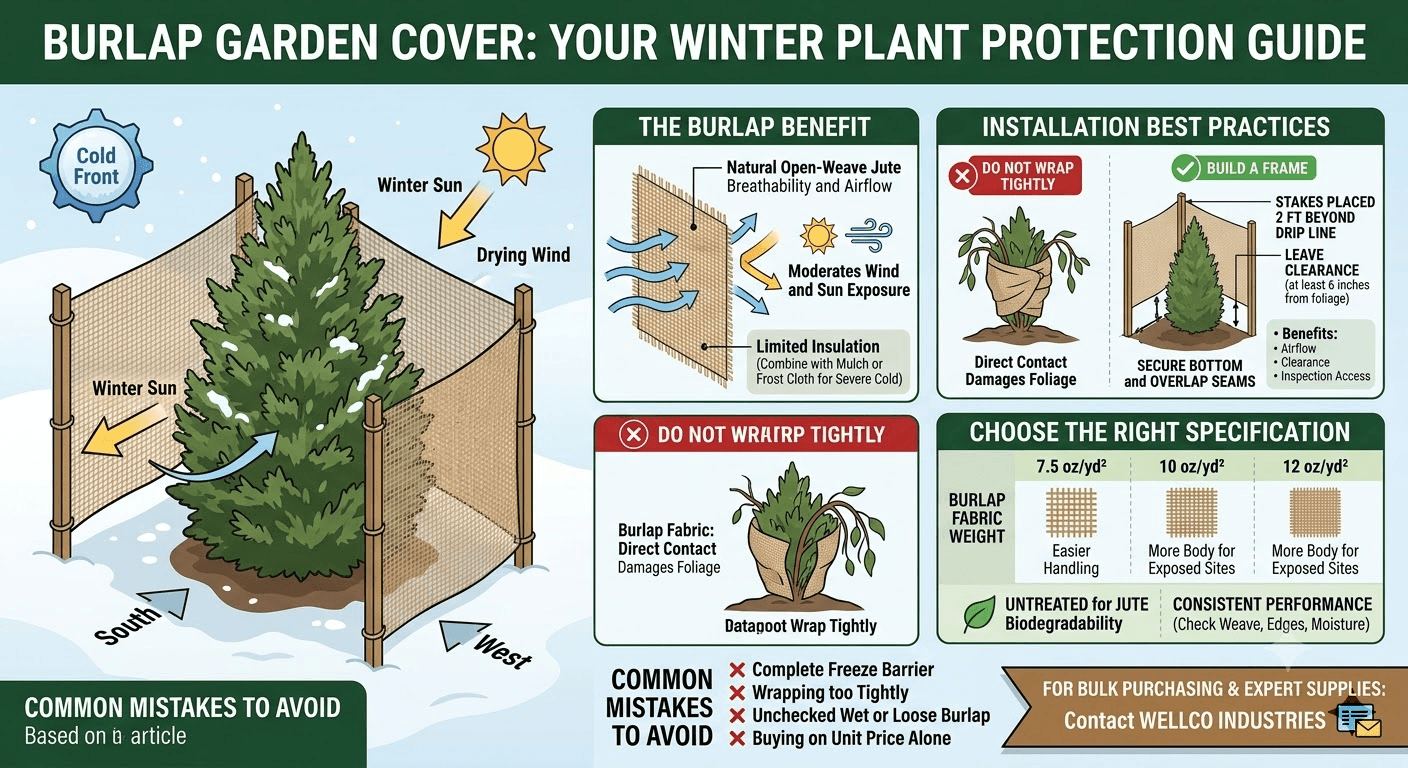
Which Burlap Weight Is Best for Outdoor Plant Protection?
A mid-range specification around 8 to 10 oz/yd² is a practical starting point for seasonal screens. Heavier fabric may suit exposed sites or repeated handling. Final selection should reflect wind, frame spacing, service duration, fastening method, and reuse expectations. Test a production-representative sample before approving volume.
Repeatable performance matters more than selecting the heaviest fabric.
How to Install Burlap Garden Cover Correctly
Installation determines whether the specified material performs as intended.
Build a Frame Instead of Wrapping Foliage Tightly
Contractors should place stakes outside the canopy and fasten burlap as a freestanding barrier. Iowa State cautions that direct wrapping can damage stems and leaves, especially evergreen foliage.
At an exposed site, crews can test one enclosure first. If fabric bows inward, shorten the unsupported span, add a stake, reinforce the edge, or increase clearance.
Secure the Bottom and Overlap Seams
Overlap vertical seams so wind cannot open a direct path. Clips, ties, staples, battens, or landscape fasteners should match the frame and exposure.
A preliminary range of 12 to 18 inches between attachments may suit sheltered screens. It is a planning estimate, not a wind rating. Corners, wide stake spacing, and exposed sites require closer fastening or stronger support.
Leave Ventilation and Inspection Access
A flap or removable panel allows watering and inspection. Check covers after storms, freeze-thaw cycles, and unusually warm sunny periods. Leaving the top open in many screen designs supports airflow and light penetration.
| Installation Method | Best For | Labor | Protection | Reusability |
|---|---|---|---|---|
| Loose drape | Brief frost or shade | Low | Basic | Moderate |
| Stake-supported screen | Shrubs and young trees | Medium | Good | High |
| Full framed enclosure | High-value stock | High | Strongest passive coverage | High |
| Container perimeter screen | Grouped nursery stock | Medium | Good wind reduction | High |
| Removable trunk wrap | Young bark | Low | Targeted | Moderate |
Supported structures improve clearance, ventilation, access, and reuse.
Common Mistakes That Reduce Performance
Most failures come from unrealistic expectations or poor maintenance.
Using Burlap as a Complete Freeze Barrier
A woven layer cannot keep every plant above a safe temperature during prolonged cold. Species hardiness, roots, soil moisture, mulch, exposure, and freeze duration still matter.
Wrapping Plants Too Tightly
Compression can bend branches, restrict airflow, hold moisture against tissue, and constrict trunks. Supported screens provide more tolerance.
Leaving Wet or Loose Burlap Unchecked
Wet burlap becomes heavier and may sag. Wind can loosen seams or pull stakes. Crews should inspect tension, clearance, and anchors after significant weather.
Buying on Unit Price Alone
Inconsistent width, low roll weight, weak edges, odor, contamination, and irregular weaving increase scrap and labor. Incoming inspection protects the installed cost.
Bulk Purchasing and Supplier Evaluation
The application should translate directly into the purchase order.
Key Specifications and Quality Checks
Define fiber content, treatment status, nominal weight and tolerance, roll or sheet dimensions, edge finish, allowable defects, packaging, labeling, and quantity tolerance. Receiving teams should measure dimensions and weight per area, then inspect multiple sections for weave consistency, fraying, odor, stains, moisture, and debris.
A sealed approval sample creates an objective reference for repeat orders. In a 240-panel program, a 2% dimensional shortage affects nearly five panels, so early inspection can prevent multi-site delays.
MOQ, Lead Time, and Customization
Confirm minimum order quantity, custom cutting, private labeling, bundled fasteners, lead time, warehouse availability, and delivery scheduling.
Wellco Industries supplies burlap and jute products alongside plant covers, agricultural support systems, and erosion-control materials. This range can help buyers consolidate compatible fabrics, stakes, netting, and accessories.
Conclusion
Burlap garden cover performs best as a breathable screen against drying wind, winter sun, light frost exposure, and moisture loss. It offers limited thermal protection on its own.
Buyers should define fabric weight and tolerances, keep material clear of foliage, support it with a stable frame, secure seams and edges, and inspect it after weather changes. Severe-freeze protection may also require mulch, frost cloth, or another system.