
- November 12, 2025
- Posted by: wellcoindustries
- Categories: Burlap, Erosion Control
Last updated: November 12, 2025
Introduction
Burlap for plants is a breathable, natural-fiber barrier that protects evergreens and young trees from winter windburn, sunscald, and roadside salt. For municipal foresters, landscapers, and growers, the real wins are fewer spring replacements and smoother crew workflows. This guide shows where burlap is the right choice (and where it isn’t), how to spec grades with confidence, and field-tested ways to install at scale.
Vendor note: Wellco Industries offers erosion-control and agricultural materials—burlap, FRP/bamboo stakes, and jute ties—so purchasing managers can bundle winter protection with related SKUs under one PO.
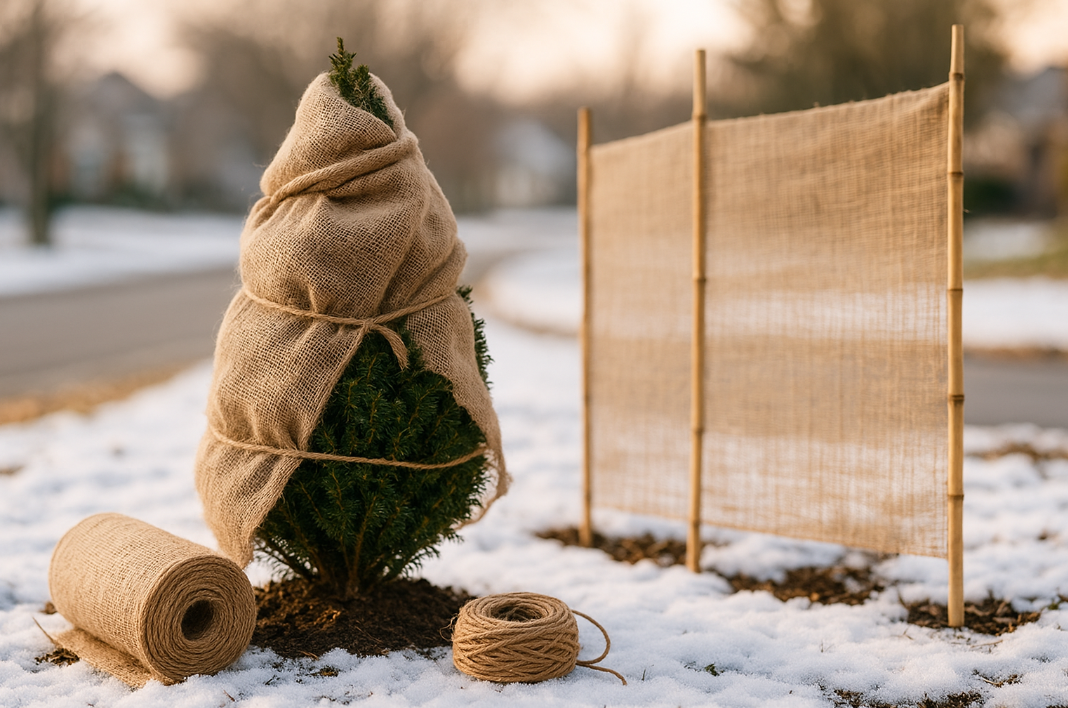
Choosing Burlap vs. Other Covers: A Decision Framework
Burlap excels when wind, sun, and salt spray are the primary threats. Its open weave slows air movement and diffuses light without trapping moisture like plastic films.
Use burlap when
Broadleaf evergreens (boxwood, yew, holly) face exposed wind or south/west sun.
Shrubs and young trees sit along salted roadways.
You need breathability and shade rather than heat gain.
Choose alternatives when
You need temperature lift during freeze events → frost cloth/row cover.
Sites are wet or disease-prone → avoid tight “mummy” wraps; prefer framed screens.
Heavy snow load is likely → use framed covers so weight doesn’t deform plants.
Windbreak principles: expect meaningful wind reduction within 2–5× the barrier height (H), with diminishing effect beyond 10×H—a practical rule for siting burlap screens.
How Burlap Works: Protection Mechanisms & Limits
Wind: Creates a lower-velocity zone that reduces leaf desiccation when roots can’t pull water from frozen soil.
Sun: Diffuses harsh winter light to limit sunscald on southwest exposures.
Salt: Intercepts droplets and splash from road de-icing.
Limits & mistakes to avoid
Burlap provides minimal temperature increase (typically <2–3 °F).
Skin-tight wraps trap moisture; keep a small stand-off.
Remove wraps before budbreak to prevent etiolation and mildew.
Don’t tie into bark; use wide, gentle ties and keep airflow gaps.
Spec & Testing: What Buyers Should Require
Material & weight: Natural jute burlap. Typical ranges 240–340 GSM (≈ 7–10 oz/yd²). Open weaves breathe better; tighter weaves block more wind but reduce airflow.
Common sizes: 36/48/60 in widths; 100-yd rolls for crew efficiency. Untreated for compostability; light UV stabilization only if you plan multi-season reuse.
Testing callout (add to spec):
ASTM D5034 – Grab tensile strength
ASTM D3786 – Hydraulic bursting strength
Report weave count, thickness, moisture content on delivery, and weight tolerance.
Environmental documentation: If claims like “biodegradable/compostable” affect procurement, request substantiation and conditions for degradation (moisture, temperature, microbial activity).
Selection Matrix (match risk to grade)
| Site Risk Profile | Weave Openness | Recommended GSM | Notes |
|---|---|---|---|
| Moderate wind & sun | Open–medium | 240–280 | Best for shrub wraps; high breathability |
| High wind / roadside salt | Medium–tight | 300–340 | Use framed screens; tension without bowing |
| Nursery handling / root balls | Medium | 260–320 | Remove if saturated or contaminated |
Wind-shadow planning: Effective zone extends 2–5×H downwind; place screens on the prevailing-wind and southwest sides of plantings.
Installation Methods: Step-by-Step
Shrub/Tree Wrapping (breathable wrap)
Remove broken twigs; ensure plants are hardened off.
Spiral-wrap loosely from base up, keeping small gaps for airflow.
Secure every 12–18 in with jute twine; avoid constriction.
Tag the install date; schedule a mid-winter check and spring removal.
Crew cue: Maintain roughly ½–1 in of stand-off; never “mummy-wrap.”
Windbreak Screens & Frames
Drive FRP or bamboo stakes; attach burlap with staples/ties.
Height = plant height or slightly above; plan 2–5×H wind shadow.
Overlap at corners; keep tension flat (no piano-string bowing).
Near drives/paths, preserve sightlines and add high-visibility flagging.
Root Balling, Shade & Quick Frost Tents
Burlap root-ball wraps for short moves; keep dry and remove if contaminated.
Temporary shade screens for winter-bright days post-transplant.
Overnight frost tents only when vented by morning; for real heat gain use frost cloth.
Sizing & Cost Planning
Fast takeoffs
Shrub wrap yardage (yd):
((Circumference × 1.10) × Wrap Height) ÷ 3Screen yardage (yd):
(Run Length ÷ 3) × (Panel Height ÷ 3)Add 10–15% waste for overlaps and on-site changes.
Typical labor
10–20 min per shrub wrap; 20–40 min per free-standing screen, depending on soil/frost and access.
Ready-to-use templates:
Crew Field Checklist (print & laminate)
Tools: Burlap rolls, FRP/bamboo stakes, jute twine/staples, mallet, shears, tags, flagging.
Setup: Confirm windward exposure; mark screen lines; clear sharp debris.
Install QC: Loose wrap or flat screen; maintain stand-off; ties every 12–18 in.
Safety: Gloves/eye protection; mark screens near paths; keep away from ignition sources (dry jute is combustible).
Maintenance: Mid-winter checks for sag/tear/salt contamination; remove by early spring.
Comparison Table
| Cover Type | Breathability | Heat Gain | Durability | Best Use |
|---|---|---|---|---|
| Burlap (jute) | High | Low | Moderate | Wind/sun/salt protection for evergreens; breathable wraps and screens |
| Frost cloth/row cover | Medium–High | Moderate | Moderate | Freeze nights and shoulder seasons; temperature lift needed |
| Plastic film | Low | Variable | High | Non-plant uses (equipment, structures); avoid on live foliage in sun |
Case Study (Anonymized) & Method Notes
A streetscape pilot protected 140 boxwoods along a salted boulevard with 48-in burlap screens on bamboo stakes. Year-over-year on the same block, teams recorded:
~40% less visible winter burn,
Survival increase from ~84% to ~96%,
~18% fewer crew hours after standardizing screen modules.
Method notes: Two inspections (late winter, spring leaf-out). Burn severity rated on a 0–3 scale by two crew leads; survival counted at spring removal.
Procurement & Logistics for Professionals
Lead times: Peak season can run 2–6 weeks—pre-book ahead of first frost.
Packaging: Palletized rolls; mixed-SKU options (burlap + stakes + jute netting) to optimize freight.
Specs: Material (jute), GSM/oz-per-yard² range, weave/open area, width × length, tolerances, ASTM D5034/D3786 test data, labeling, and end-of-life notes.
Partner option: Wellco Industries supports private-label programs for distributors/OEMs and can bundle burlap with FRP/bamboo stakes and jute twine.
Safety, Handling & Environmental Stewardship
PPE: Gloves and eye protection when cutting ties/staples.
Visibility: Mark screens near pedestrian routes and driveways.
Fire: Dry jute is combustible; store away from ignition sources.
End-of-life: Reuse clean, dry burlap for 2–3 cycles; compost natural jute where permitted; otherwise landfill as non-hazardous solid waste.
Green claims: Biodegradation depends on moisture, temperature, and microbes—request documentation if claims affect bids.
References
University horticulture extension guidance on winter injury prevention and covering methods (e.g., Minnesota, Michigan, Cornell).
USDA/NRCS windbreak design notes summarizing 2–5×H effective wind-shadow ranges and reduced wind velocities near barriers.
ASTM standards D5034 (grab tensile) and D3786 (burst) for textile/burlap testing.
About the editor: Prepared by Wellco Industries’ technical content team with input from field crews and procurement partners.
Frequently Asked Questions
How do I decide between wrapping a shrub and building a screen?
Wrap when plants are compact and access is easy; build a screen when exposure is extreme, snow load is likely, or you need to protect form and branching.
What GSM should I buy for high-wind, roadside sites?
Target 300–340 GSM with a medium-tight weave, mounted on a framed screen for tension and durability.
Will burlap actually keep plants warmer in a freeze?
Only slightly—typically <2–3 °F. If you need real temperature lift, switch to frost cloth and add night-time covers.
Can I reuse burlap next season?
Yes, if it’s clean and dry. Store off the floor in a ventilated area; discard if moldy, salty, or weakened.
Do I need treated burlap?
Use untreated jute if compostability matters. Consider light UV stabilization only when planning multi-season reuse and you’re not composting the material.