
- July 10, 2026
- Posted by: wellcoindustries
- Categories: Burlap, Erosion Control
Introduction
When projects call for fast, natural stabilization, bulk burlap for erosion control is a dependable, biodegradable workhorse. It calms surface energy, protects seed, moderates temperature, and cuts crusting so vegetation can establish. For purchasing managers, contractors, distributors, and private-label buyers, getting specs, quantities, and QC right prevents callbacks and keeps margins predictable.
Supplier note: Wellco Industries provides erosion-control materials alongside FRP, agricultural, and household product lines—useful if you prefer a one-stop source for blankets, pins, and site consumables without a hard sell.
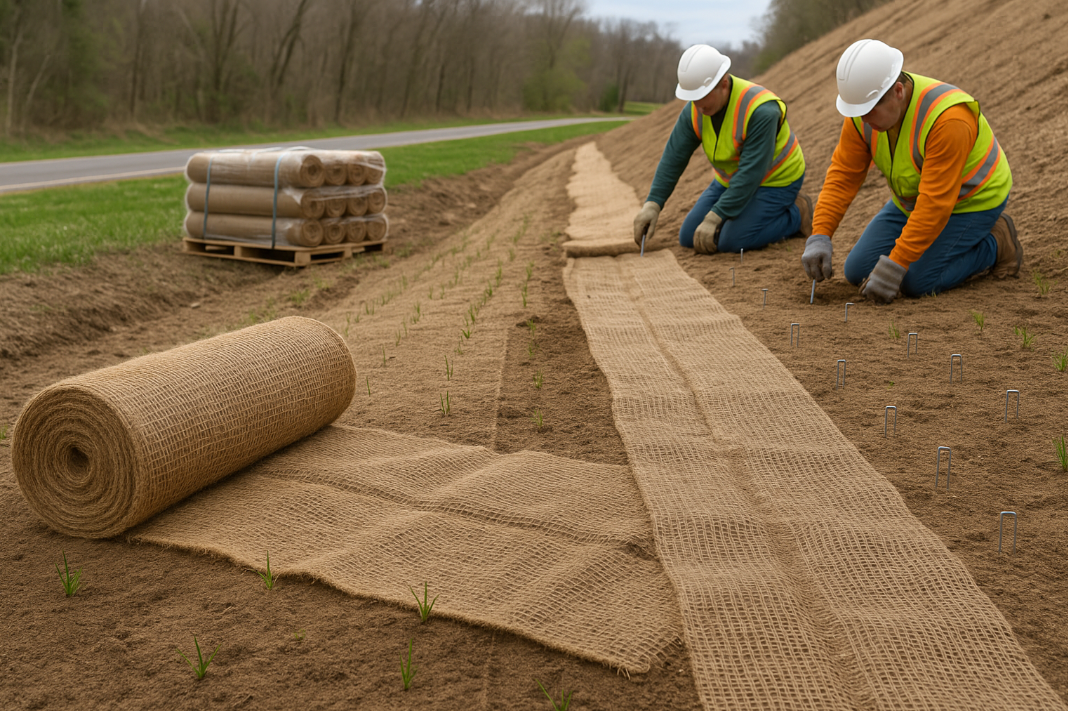
Choosing Burlap: Where It Works—and Where It Doesn’t
Typical Use Cases by Site Condition
Newly seeded slopes and shaded banks
Tree/shrub pits to reduce splash and moisture loss
Streambanks and swales during early plant establishment
Short- to mid-term stabilization ahead of a growing season
Field note: On spring rehab jobs, burlap often buys a forgiving 7–14-day window for seed to pop under intermittent showers and cold nights.
Limitations & Better Alternatives
Use jute or coir when grades are steep, flow velocities are high, or the service window must span multiple seasons. Consider:
Slope gradient and aspect
Flow class (occasional sheet flow vs. frequent concentrated flow)
Soil type/structure and compaction plan
Vegetation method (broadcast, hydroseed, plugs)
Maintenance access and inspection frequency
Quick Comparison (material selection)
| Material | Typical service life | Flow class suitability | Primary advantages | Watch-outs |
|---|---|---|---|---|
| Burlap (plain/open weave) | Weeks–few months | Sheet flow, low-energy swales | Biodegradable, seed/soil contact, cost-effective | Short service window, wind management needed |
| Jute netting | Months | Sheet to moderate flows | Uniform openings aid emergence; easy to staple | Can abrade tender seedlings on windy sites |
| Coir blanket (e.g., 400–700 g/m²) | 6–24 months | Moderate to higher flows | Durable, stable on 2:1 & channels with checks | Higher cost; verify spec alignment |
Specifying Bulk Burlap Correctly
Fabric Weights, Weaves, and Openness
Common weights: ~5–10 oz/yd²
Plain weave retains moisture and shields seed; open weave improves airflow and emergence
Balance moisture retention against damping-off risk in humid microclimates
Roll Sizes, Packaging, and Labeling
Typical widths: 36″ / 48″ / 60″; lengths 100–300 ft
Ask for pallet/bale counts, corner protection, and stretch-wrap standards
Each roll should carry lot #, width, length, nominal weight
Biodegradation & Environmental Considerations
Service life depends on UV, soil biology, and rainfall
Request untreated, natural-fiber burlap for soil-contact applications; avoid synthetic waxes/oils
Confirm compostability intent in writing when required by spec
Documentation & Spec Alignment
Request: spec sheet/COA, fiber content, origin statement, and SDS if any treatments are used.
Spec Alignment Callout: Coordinate weights/tolerances and installation methods with applicable owner standards (e.g., conservation practice standards or DOT erosion-control sections). Clarify acceptance tolerances (commonly ±5% for weight and roll dimensions) in your RFQ.
Estimating Quantities and Budget
Coverage Calculator & Worked Example
Four-step method
Compute plan area.
Convert to surface area (slope factor).
Add overlaps/trenching allowance.
Add waste for cuts and rework.
Example: 10,000 ft² plan area on a 3:1 slope.
Surface factor ≈ 1.054 → 10,540 ft²
Overlaps/trenching allowance +8% → 11,383 ft²
Waste/cuts +8% → 12,294 ft² required
Using 48″ × 200 ft rolls (nominal 800 ft²/roll): 12,294 ÷ 800 = 15.37 → Order 16 rolls
Total Cost of Ownership
Freight on partial pallets can run 10–25% of material; consolidate to full pallets/containers where possible
Heavier weights reduce re-rolls and handling time but may increase per-roll freight—model both scenarios
Consider crew productivity: disciplined overlaps and standard grids cut rework and inspection time
Hidden Line Items to Include
Staples/pins (see anchoring table), edge trenches, tackifiers where specified
Mobilization for windy weather windows
Punch-list rework allowance
Installation Best Practices
Site Prep & Seeding
Grade smooth; rake to key in seed
Pair burlap with hydroseeding or broadcast + light compost/topsoil dressing
Water plan: pre-wet soil if dry; avoid installing into standing water
Overlaps, Anchoring Patterns, and Edges
Lay with the flow and shingle seams downslope
Trench 4–6 in at the crest; backfill and compact
Stagger end laps; avoid four-corner overlaps
Anchoring patterns by condition (verify with project specs):
| Condition | Edge spacing | Field grid | Notes |
|---|---|---|---|
| ≤4:1 slopes | 18–24 in | 24–36 in | Increase density at crest/toe |
| 3:1 slopes | 12–18 in | 18–24 in | Add end-lap pins every 12–18 in |
| 2:1 slopes | 6–12 in | 12–18 in | Wider overlaps (6–8 in) recommended |
| Channels/Swales | 6–12 in | 12–18 in | Add check slots every 10–15 ft |
Slopes, Channels, and Details
For >2:1 slopes, widen overlaps, densify pinning, and add intermediate check rows
Around trees, slit and tuck; pin outside the dripline; avoid girdling
Safety & Environmental Notes
PPE: gloves/eye protection during pinning; use kneeling pads and rotate tasks to reduce strain
Wind management: pre-cut lengths in sheltered areas; stage rolls perpendicular to gusts
Wildlife-safe edges: avoid exposed pin legs and sharp wire; tamp edges flush
Avoid treated/oiled burlap in soil-contact applications intended to biodegrade
Quality Assurance & Vendor Selection
Incoming QC Checklist
Measure width/length; verify ±5% tolerances
Cut-sample weight check for oz/yd² verification
Inspect weave uniformity and defect counts
Confirm labels match PO spec and lot numbers
Pilot Plots & Field Validation
Install a 200–500 ft² pilot to validate emergence and moisture retention
Document anchor density, overlap performance, and adjust before full release
Supplier Traits That Reduce Risk
Reliable capacity and lead times; consistent lot control
Ability to bundle accessories (pins, FRP stakes, silt fence) on one shipment
Private-label and documentation support for multi-region rollouts
Wellco Advantage (value-add, no hard sell): Wellco Industries supports bulk programs across erosion control and FRP/ag products with coordinated freight and documentation packs, simplifying multi-SKU orders for distributors and contractors.
Case Study (Anonymized)
Context: A 2-acre municipal slope at 2:1 grade (loam) required fast green-up before spring storms. Owner required biodegradable fiber and low visual impact.
Approach: Open-weave burlap at ~7 oz/yd²; 48″ × 200 ft rolls; overlaps 6–8 in; dense anchoring at crest/toe; tackifier in swales; pilot plot verified emergence.
Outcomes: By week 6–8, visual transects estimated ≈80% vegetative cover with minimal rilling.
Lessons: Pre-cut roll lengths on windy days, trench deeper at crest, standardize staple counts per 100 ft² to speed QA.
First-person note: “On a gusty 2:1 section, we cut 25-ft lengths behind a windbreak and staged pins every 10 ft. Rework dropped the rest of the week.”
Procurement Templates & RFQ Tips
Spec Language Snippets (copy-ready)
Fabric: Natural burlap, 7–10 oz/yd², plain/open weave as scheduled, untreated, biodegradable
Rolls: 48″ × 200 ft (nominal), labeled with lot #, width, length, nominal weight
Tolerances: Weight & dimensions ±5%; defect limits per project standard
Documentation: COA/spec sheet, fiber content, origin statement; SDS if any treatments
Freight & Lead-Time Clauses
Incoterms: FOB or Delivered; specify liftgate/appointment if needed
Lead time: Required ship window; substitution/over-ship policy in writing
Acceptance: Right to reject lots failing tolerances or labeling; outline return logistics
Who, How, Why (Transparency)
Who: Prepared by a construction content specialist with erosion-control field support; reviewed by a senior estimator with 10+ years installing natural-fiber blankets.
How: Synthesis of field practices, buyer checklists, and common owner requirements; anonymized case metrics from past projects.
Why: Help professionals choose, specify, and install burlap confidently while reducing cost and rework.
Last reviewed: November 5, 2025.
Conclusion
Burlap earns its place wherever a short-term, biodegradable blanket helps seed establish quickly. Specify the right weight and weave, estimate with slope/overlaps in mind, install with disciplined pinning and trenching, and hold vendors to clear documentation and tolerances. If you’re consolidating SKUs or exploring private label, Wellco Industries can bundle burlap, pins, and related erosion-control items on a single PO—share your slope, soil, and coverage target to translate that into rolls, pins, and a clean install plan.
FAQ
1. Is burlap good for erosion control?
Burlap can protect seed, reduce soil surface disturbance and retain moisture during early vegetation establishment. It is most suitable for temporary stabilization and low-energy runoff areas.
2. What burlap weight is suitable for erosion control?
Common project specifications fall around 5 to 10 oz/yd². The appropriate weight depends on slope, rainfall, expected service life and installation method.
3. Should I choose plain-weave or open-weave burlap?
Plain weave provides stronger moisture retention and seed coverage. Open weave allows better airflow and easier plant emergence.
4. How much overlap should burlap have?
Overlap requirements depend on slope and flow conditions. Steeper slopes generally require wider overlaps, tighter anchoring and additional check rows.
5. How many burlap rolls do I need?
Calculate the actual slope surface area, add allowances for overlaps and trenching, then add waste for cuts and rework. Divide the final area by the coverage of each roll.
6. Can burlap be used in drainage channels?
It can be used in low-energy channels with dense anchoring and check slots. More durable materials may be needed for concentrated flow or longer service periods.
7. Is all burlap biodegradable?
Burlap may contain oils, treatments or blended fibers. Buyers should request untreated natural-fiber material and written confirmation of fiber content.
8. What information should be included in a bulk burlap RFQ?
Include fabric weight, weave, roll width, roll length, total quantity, packaging, labeling, tolerances, required documents, destination and delivery schedule.