
- March 27, 2026
- Posted by: wellcoindustries
- Category: Other
Introduction
Here’s a mistake that costs facilities thousands every year: a purchasing manager specifies a thermal curtain based on door width alone, skips the overlap calculation, and ends up with a product that technically fits but leaks conditioned air at every edge. The curtain looks right. The energy bill says otherwise.
It’s the kind of detail that only surfaces after installation — and it’s exactly the type of field-level insight that separates a well-specified thermal barrier from an expensive disappointment.
An industrial thermal curtain is one of the most cost-effective tools available for controlling energy loss, zoning temperatures, and improving worker comfort across warehouses, cold storage facilities, food processing plants, and manufacturing floors. But performance is entirely dependent on choosing the right product for your specific conditions and specifying it correctly.
Wellco Industries works alongside purchasing managers, contractors, and OEM customers across agriculture, construction, and industrial sectors — supplying fiberglass-reinforced composites, agricultural materials, and industrial products from a vertically integrated global operation. The guidance in this article reflects the real specification challenges those customers navigate every day.
What Is an Industrial Thermal Curtain?
How They Work
An industrial thermal curtain is a flexible insulating barrier designed to limit conditioned air exchange between zones while allowing controlled personnel and equipment access. Most designs achieve this through overlapping panel construction and layered materials that trap air — a naturally poor conductor of heat — within or between layers.
The critical distinction from basic PVC strip curtains is engineered thermal performance. Standard strip curtains manage dust, pests, and light airflow. Industrial thermal curtains are built to sustain meaningful temperature differentials — typically between 30°F and 60°F (17°C–33°C) — across a single flexible barrier under real traffic conditions.
Common Materials & Construction
The most widely specified materials include:
- Reinforced vinyl – cost-effective and flexible; appropriate for moderate temperature ranges and general dock applications
- Woven polyester with insulated core – better thermal retention and panel recovery; preferred for cold storage and freezer entries
- Fiberglass-reinforced composites (FRP) – highest durability, chemical resistance, and dimensional stability; the correct choice for demanding environments with chemical exposure, extreme temperature cycling, or sustained UV exposure
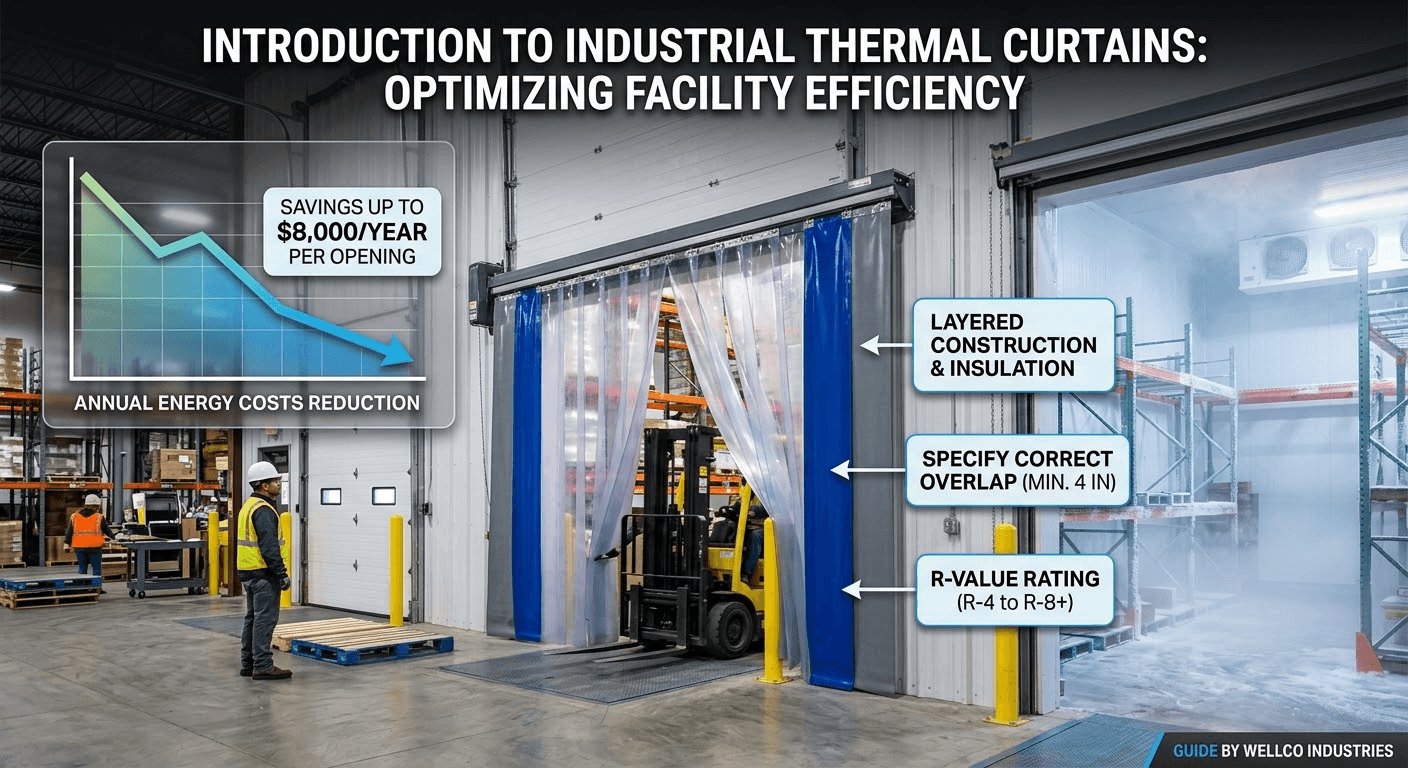
When evaluating any product, request verified R-values or U-factors from the manufacturer. For dock applications, a minimum R-4 rating is a reasonable baseline. For walk-in freezer or blast-chiller entries, specify R-8 or higher. UV stabilization matters for dock-facing or outdoor-adjacent installations, where untreated vinyl degrades visibly within 12–18 months.
Key Benefits for Facilities
Energy Savings & ROI
According to the U.S. Department of Energy’s Building Energy Data Book, loading dock areas are among the highest sources of envelope heat loss in commercial and industrial facilities — with an open dock door producing thermal exchange equivalent to leaving a large window open continuously through the heating season.
Installing an industrial thermal curtain at dock openings, cooler entries, and between production zones directly reduces that loss. Facilities in cold climates (USDA zones 3–5) commonly report payback periods of 12 to 24 months, with annual savings per opening ranging from $1,500 to over $8,000 depending on traffic frequency, climate severity, and curtain specification quality.
The capital cost per square foot for a properly specified thermal curtain system is a fraction of a permanent partition — and it can be reconfigured as your facility layout changes.
Temperature Zoning & Process Control
Industrial facilities rarely operate as a single thermal environment. A food processing plant may need to separate a 35°F (2°C) refrigerated prep zone from a 65°F (18°C) packaging floor. A pharmaceutical distribution center must maintain precise climate conditions in storage areas while allowing ambient conditions in outbound shipping zones.
Thermal curtains enable that zoning without structural renovation and support compliance with:
- FDA 21 CFR Part 110 temperature control requirements for food manufacturing
- NSF/ANSI 2 standards for food equipment environments — confirm any curtain used in direct food-contact adjacency carries this certification
- GMP (Good Manufacturing Practice) requirements in pharmaceutical and nutraceutical facilities
Worker Comfort & Productivity
ASHRAE Standard 55-2020 and OSHA’s thermal comfort guidelines both identify sustained exposure to cold drafts and temperature fluctuations as contributors to reduced manual dexterity, increased error rates, and fatigue — especially in cold-chain logistics and assembly roles.
One anonymized Midwestern distribution center documented a 15% reduction in seasonal absenteeism after installing insulated dock curtains across six loading bays, attributing the result primarily to elimination of persistent cold drafts on the warehouse floor. The facility also reported a measurable reduction in product damage claims linked to temperature excursions near dock entries during peak winter months.
How to Choose the Best Industrial Thermal Curtain for Your Facility
Step 1 – Assess Your Thermal Demands
Begin with three variables that define your minimum product requirements:
- Temperature differential – A 10°F gap between zones requires a different spec than a 50°F gap. The larger the differential, the higher the required R-value and the more critical edge sealing becomes.
- Climate zone – Facilities in USDA hardiness zones 3–5 face substantially greater winter thermal pressure than those in zones 8–10. Factor in both winter heating and summer cooling loads.
- Door traffic frequency – A curtain breached 200 times daily by forklifts needs heavier-gauge material and a more robust header system than one used 20 times daily by personnel.
A common field mistake at this stage: underestimating traffic frequency. If your operation runs two or three shifts, count traffic across all shifts — not just daytime hours.
Step 2 – Match Material to Environment
| Environment | Recommended Material |
|---|---|
| General warehouse / dock | Reinforced vinyl (clear or opaque) |
| Cold storage / freezer entry | Insulated woven polyester core |
| Chemical processing | FRP composite or chemical-resistant vinyl |
| High-UV / outdoor-adjacent | UV-stabilized FRP composite panels |
| High-traffic forklift zones | Heavy-gauge reinforced vinyl (min. 0.080″ thick) |
FRP composite materials are worth the cost premium wherever chemical splash, prolonged UV exposure, or extreme temperature cycling is present. In those environments, standard vinyl typically requires replacement within one to two seasons — eliminating any initial cost advantage.
Step 3 – Measure and Specify Correctly
Size for performance, not just fit:
- Width: door opening width plus 12–18 inches total overlap (6–9 inches per side)
- Height: floor to header, with panels extending 2–3 inches onto the floor to create a passive seal
- Panel-to-panel overlap: minimum 4 inches for standard thermal applications; 6 inches or more for freezer entries
- Header track: select fixed mount, sliding track, or spring-loaded systems based on forklift mast clearance and access pattern — undersized header hardware is the single most common installation failure point in the field
For non-standard openings, custom sizing is the right call. Most vertically integrated suppliers can accommodate it without significant lead time impact; don’t force a standard size into a non-standard opening.
Step 4 – Evaluate Supplier Capabilities
For high-volume or specification-sensitive procurement, supplier capability matters as much as product spec. Key questions to ask:
- Can they accommodate custom dimensions without long lead times?
- Do they offer OEM or private-label options for distributors?
- Is material sourcing vertically integrated, or does quality depend on a multi-tier supply chain?
Wellco Industries’ vertically integrated model — spanning FRP composites, agricultural materials, and industrial products — gives purchasing managers and contractors a single accountable supplier for consistent spec compliance, predictable lead times, and flexible order quantities. For facilities managing multiple openings or facilities across multiple locations, that supply chain stability directly reduces procurement risk.
Installation & Maintenance Best Practices
Installation Tips
Correct installation is what converts a well-specified curtain into a performing thermal barrier. Field observations consistently point to the same failure modes:
- Header track undersizing — always specify track rated for actual panel weight, with a safety margin
- Edge gaps at jambs — install side channel guides or brush seals to eliminate lateral air infiltration; this is frequently overlooked and accounts for significant thermal loss even when center panels are correctly overlapped
- Plumb hang — panels must hang straight with no lateral drift; use panel weights or floor sweeps in high-draft or pressurized environments
- Forklift clearance — confirm mast height and maximum load height before finalizing mounting elevation
Ongoing Maintenance
Build these checkpoints into your facility maintenance schedule:
- Monthly: Visual inspection for tears, panel separation, yellowing, or hardware loosening
- Quarterly: Clean panels with mild detergent solution; inspect header track and mounting hardware for corrosion
- Annually: Verify panel overlap dimensions; assess whether thermal performance has degraded
- Replace when: Panels show cracking, significant stiffness in cold temperatures, visible yellowing through the core, or persistent air gaps at rest position
When a Thermal Curtain May Not Be Enough
An industrial thermal curtain is the right solution for the majority of dock, zoning, and temperature separation applications. However, it is not appropriate for every scenario:
- Fire-rated separation requirements: Where building codes or insurance requirements mandate a fire-rated barrier, a flexible curtain — regardless of material — does not substitute for a rated assembly. Verify NFPA 701 flame-resistance certification for any curtain used near ignition sources, and consult your local AHJ (Authority Having Jurisdiction) for compartmentalization requirements.
- Cleanroom or positive-pressure environments: Facilities requiring ISO-classified cleanroom conditions or sustained positive pressure differentials need rigid, sealed enclosures — not flexible barriers.
- Extreme pressure differentials: In environments where mechanical ventilation creates significant cross-zone pressure differences, flexible panels may not maintain consistent overlap or seal.
Knowing the limits of a product is as important as knowing its strengths. A reputable supplier will tell you when a different solution is the better fit.
Conclusion
The best industrial thermal curtain for your facility is the one that matches your actual thermal demands, survives your operating environment, and is specified with enough overlap and edge sealing to perform — not just to fit the opening.
The decision framework is straightforward: assess your temperature differential and traffic load, select material accordingly, measure for performance rather than nominal fit, and work with a supplier who can support custom specs and consistent delivery at scale.
Wellco Industries offers industrial and agricultural customers a vertically integrated supply chain, a broad product portfolio, and the technical support to help specify the right solution — whether you’re outfitting a single facility or managing procurement across multiple sites.
Contact the Wellco team today for a custom quote or product consultation.
Frequently Asked Questions
For standard dock and warehouse applications, a minimum R-4 rating provides an effective baseline. Cold storage and freezer entries should be specified at R-8 or higher. Always request the manufacturer’s verified thermal data — not just marketing descriptions — before purchasing.
If your environment involves chemical exposure, sustained UV contact, or temperature cycling beyond what standard vinyl is rated for, FRP composite materials offer significantly longer service life. In most general warehouse and dock applications, heavy-gauge reinforced vinyl is sufficient and more cost-effective.
Yes, when correctly specified. Look for NSF/ANSI 2 certification for food-adjacent environments and confirm the product meets any applicable GMP requirements for your facility. Your supplier should be able to provide relevant certifications on request.
Most single-opening installations can be completed in two to four hours with standard hardware. Because thermal curtains mount to a header track above the opening rather than requiring structural modification, most installations can be completed during a scheduled maintenance window without a full operational shutdown.
Replace panels when you observe cracking, significant loss of flexibility in cold temperatures, persistent air gaps at rest, or visible degradation through the panel core. Attempting to extend the life of a compromised panel with tape or patches typically results in continued thermal loss and accelerated hardware wear.