
- September 30, 2026
- Posted by: wellcoindustries
- Categories: Erosion Control, Geogrid
Geogrid is an open grid used for soil reinforcement or aggregate stabilization. Geotextile is a permeable fabric used for functions such as separation and filtration; selected high-strength geotextiles also provide reinforcement. Choose by the required function, not by appearance alone. These material families overlap in some uses without being interchangeable. [1]
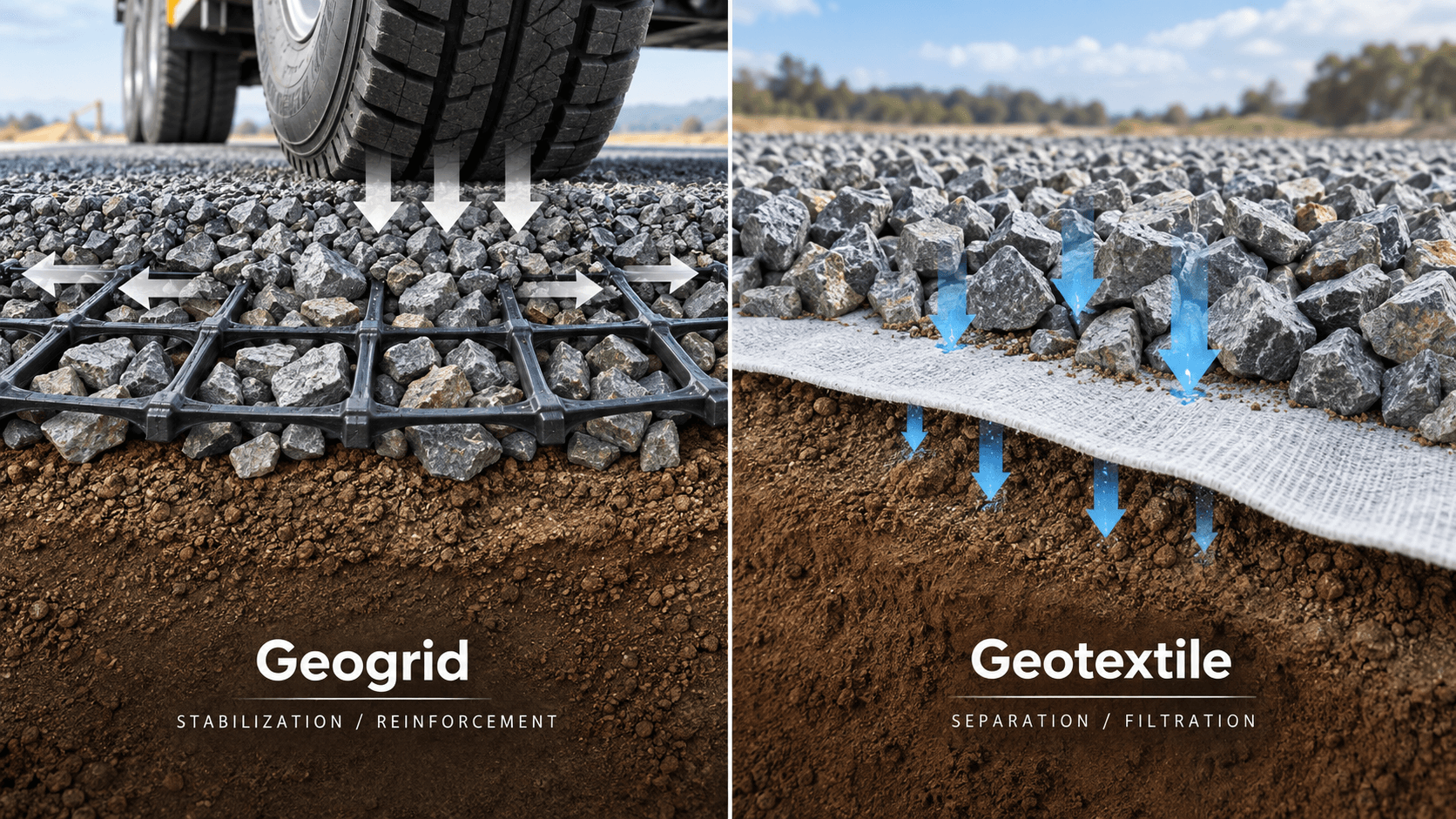
Start with the job the material must do
Before comparing rolls, write down the problem the layer must address. Is aggregate moving under loading? Are fine soil particles mixing into the aggregate? Does a drainage layer need to retain surrounding soil while water passes through? These are different requirements, even when they occur in the same project.
| Required function | Material to evaluate | What needs checking |
|---|---|---|
| Reinforce a soil mass | A specified reinforcement geogrid or reinforcement geotextile | The reinforcement requirements in the design |
| Stabilize an aggregate layer | A geogrid intended for that function | Interaction with the specified aggregate and the system design |
| Separate materials and retain fine soil | A separation or filtration geotextile | Suitability for the adjacent soil and water conditions |
| Address reinforcement or stabilization together with separation | A designed combination or composite system | Whether each required function is covered |
This is a starting point for comparing requirements, not a material approval. The specific product still needs to match the project specification for reinforcement, stabilization, separation or filtration. [1]
Why an open grid does not replace a filter fabric
A geogrid and a geotextile can both appear in a road foundation, but their roles may differ. Aggregate confinement is one mechanism of geosynthetic base reinforcement. A separation geotextile may also be needed alongside geogrid reinforcement, depending on the system design, including certain wet, fine-grained subgrades and open-graded bases. [2]
That distinction changes the buying question. Instead of asking which roll is stronger, ask whether the specification requires stabilization, separation, filtration, or a combination. A quotation for one material does not establish that the other function has been addressed.
For a road or driveway project, put the proposed layer arrangement next to the material list. If the design calls for separate reinforcement and filtration layers, record them separately in the purchase request. If it calls for a composite, identify the specified composite rather than treating any grid-and-fabric combination as equivalent.
Geotextile can also be a reinforcement material
“Geogrid reinforces; geotextile filters” is an incomplete rule. Selected high-strength geotextiles are used for reinforcement, including in embankment foundations and reinforced soil structures. Those applications have different requirements from filtration and separation. [1]
The practical consequence is that a generic fabric description cannot establish a replacement. If a drawing specifies a reinforcement product, compare the proposed substitute against that requirement and obtain the designer’s acceptance before purchasing it.
For a retaining-wall inquiry, distinguish the reinforcement within the soil mass from any fabric associated with drainage or separation. Ask which role the proposed material occupies in the approved design. Avoid replacing the specified reinforcement with a drainage fabric simply because both are sold in rolls.
Once the design calls for geogrid, the next decision concerns grid type and product requirements. Our guide to geogrid types and selection factors covers that separate question.
Build a purchase request around functions and evidence
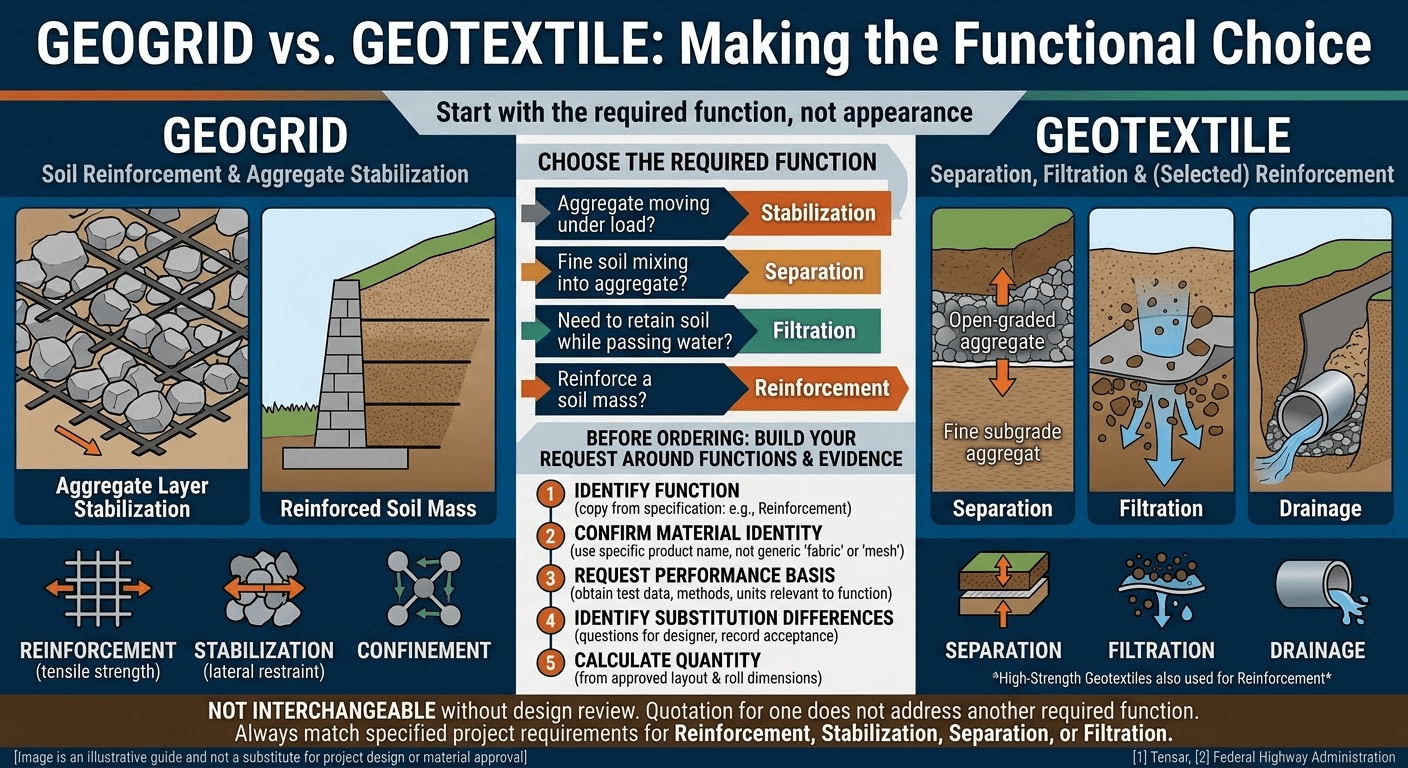
Use the following checks to turn a broad “geogrid or geotextile” inquiry into a material request that can be reviewed. The output of each check should be a requirement or an identified question—not an assumed product capability.
| Check | Action before ordering | Useful output |
|---|---|---|
| Function | Copy the required role from the specification or ask the designer to identify it | Reinforcement, stabilization, separation, filtration, or a specified combination |
| Material identity | Confirm the exact product designation rather than relying on “mesh,” “fabric,” or “ground grid” | A clearly identified product family and proposed item |
| Performance basis | Request the applicable product data and test basis for the specified function | Documents for the proposed item, with methods, units and applicable conditions |
| Substitution | Identify differences between the proposed item and the specified material | Questions for the designer and a recorded acceptance decision |
| Quantity | Calculate the requirement from the approved layout and confirm the roll dimensions | An order quantity that can be checked against the layout |
Do not compare two tensile figures without checking what each figure measures. Ask for the test method, reported units, direction where relevant, and the basis of the stated value. A larger number on one listing does not establish equivalence to the specified material.
Likewise, keep filtration requirements separate from reinforcement requirements. Do not use fabric weight, roll size, or a product name as a shortcut for the performance information the project calls for. These checks help identify missing information; they do not replace design review or demonstrate compliance.
When using both materials needs a closer review
A project can require more than one function. That does not mean every project needs both geogrid and geotextile. Whether a pavement system needs a separation geotextile alongside reinforcement depends on its materials, conditions and design requirements. [2]
Before ordering a combination, resolve three questions:
- Which required function does each layer provide?
- Does the proposed arrangement match the design, or is a specific composite required?
- Who will accept a change to the specified material or arrangement?
Stop treating the inquiry as a simple product comparison if those answers require a change to the design. Have the responsible designer resolve reinforcement layout, material substitution and project-specific installation requirements before the purchase decision.
Prepare a geogrid inquiry
If the material requirement is geogrid, view our geogrid product options. Send us the project type, specified material or function, required roll dimensions, quantity and delivery location. Identify any separate filtration or separation requirement so it is not confused with the geogrid inquiry.
References
- Tensar, Geogrids vs Geotextiles: What’re the Differences?, July 27, 2023. Material functions, high-strength geotextile reinforcement, and application distinctions.
- Federal Highway Administration, Geotechnical Aspects of Pavements, Chapter 7, 2006. Pavement base reinforcement and separation considerations; project-specific design conditions apply.