
- July 23, 2026
- Posted by: wellcoindustries
- Category: FRP grating
Introduction
Fiberglass grating quotations may list the same size and thickness while hiding major differences in resin, reinforcement, curing, load performance, and fabrication accuracy. This guide gives purchasing managers and contractors a practical supplier approval process.
Define Project Requirements Before Contacting Suppliers
Supplier comparison starts with the application. Buyers should define the type, support span, load, exposure, surface, dimensions, fabrication, and delivery schedule before requesting prices.

Match the Grating Type to the Application
Molded grating distributes loads in two directions and often suits platforms and trenches. Pultruded grating uses continuous load bars in one direction and may suit longer spans.
Which Specifications Should Buyers Send to Suppliers? [Q&A]
Buyers should provide the grating type, panel dimensions, thickness, mesh size, support span, design load, resin system, surface, color, fabrication drawings, quantity, required standards, and delivery destination. Complete RFQ data reduces substitutions, dimensional errors, incomplete quotations, and price changes after technical review.
| Requirement | Information to Provide | Why It Matters |
|---|---|---|
| Load | Uniform, concentrated, impact, or vehicle load | Determines construction |
| Span | Clear distance between supports | Controls strength and deflection |
| Exposure | Chemicals, temperature, UV, moisture | Guides resin selection |
| Surface | Meniscus, grit top, covered, or conductive | Affects traction and maintenance |
| Dimensions | Panel size, cutouts, tolerances, bar direction | Prevents fit problems |
An illustrative RFQ might allow ±3 mm for length and width and a 5 mm maximum diagonal difference. Project engineers should set final limits.
A precise specification creates the baseline for every later comparison.
Verify Materials and Manufacturing Controls
With the RFQ defined, buyers should confirm how the supplier converts resin and glass reinforcement into a repeatable product.
Review Resin Systems and Reinforcement
Polyester may suit moderate environments. Vinyl ester is often considered for stronger corrosion exposure, while phenolic systems may be evaluated for specific flame and smoke requirements.
Selection should reflect chemical concentration, temperature, exposure duration, cleaning, and applicable code. Buyers should request resin, reinforcement, UV, and chemical resistance data.
Confirm Process Control
For molded grating, review mixing, fiber placement, curing, cutting, and finishing. For pultruded grating, check fiber alignment, resin impregnation, die temperature, pull speed, and cure stability.
Weak control may cause warping, dry fiber, exposed strands, inconsistent thickness, or poor grit adhesion.
What Documents Demonstrate Reliable Product Quality? [Q&A]
Reliable suppliers should provide product specific data sheets, material certificates, test reports, dimensional inspection records, batch identification, and final inspection documents. Buyers should verify that each document matches the quoted thickness, resin system, mesh pattern, surface, and manufacturing process instead of accepting a generic certificate.
Incoming inspection should record identification, dimensions, defects, grit adhesion, fabrication, packaging, photographs, and lot number.
Documented control turns a sales claim into auditable evidence.
Examine Testing and Performance Evidence
Material claims become useful only when the test method, specimen, and acceptance value are clear.
Match Test Data to the Application
ASTM D790 evaluates flexural properties, while ASTM E84 evaluates surface burning characteristics under defined conditions. Neither method alone confirms suitability for every application.
Buyers should also review load tables, deflection limits, slip evidence when required, and resin specific chemical compatibility data.
| Evidence Type | What Buyers Should Check | Warning Sign |
|---|---|---|
| Data sheet | Product code, resin, thickness, load data | One sheet for unrelated products |
| Laboratory report | Method, specimen, date, laboratory | Missing sample identity |
| Load table | Span, load type, deflection basis | Values without conditions |
| Inspection record | Dimensions, lot, result | No traceability |
| Approved sample | Finish, mesh, measured size | Differs from quotation |
How Can Buyers Identify Unsupported Performance Claims? [Q&A]
Buyers should request the test method, specimen identification, report date, laboratory details, and measured value behind each claim. Terms such as “heavy duty,” “high strength,” and “chemical resistant” remain vague until the supplier defines the span, load, chemical, temperature, duration, and acceptance criterion.
Reports for one construction should not cover a different thickness, resin, mesh, surface, or process. Project specific approvals may still be needed.
Clear evidence separates measurable performance from marketing language.
Evaluate Supplier Capability and Consistency
After reviewing technical evidence, buyers should determine whether the supplier can reproduce the approved product at the required volume.
Assess Capacity and Customization
Check panel sizes, mold inventory, profiles, cutting and drilling equipment, surface options, fabrication, monthly capacity, and workload.
Wellco Industries supplies fiberglass grating and related FRP products alongside agricultural and construction lines. Its North American warehouse network can support mixed orders and regional fulfillment, subject to project verification.
Review Tolerances and Repeatability
Approved drawings should control length, width, thickness, bar direction, holes, notches, radii, and edge treatment.
In an anonymized walkway pilot, several notch locations were outside the drawing. The buyer corrected the CNC program and approved a second sample before bulk production, avoiding field trimming and delays.
| Capability | Basic Trader | General Manufacturer | Project Ready Supplier |
|---|---|---|---|
| Technical support | Product descriptions | Standard guidance | Application review |
| Documentation | Generic files | Product data | Order specific records |
| Fabrication | Outsourced | Basic cutting | Controlled CNC work |
| Quality control | Visual check | Dimensional checks | Documented inspection |
| Corrective action | Informal | Case by case | Root cause and reinspection |
Repeatable controls matter more than an impressive first sample.
Compare Commercial Terms and Total Cost
Technical approval narrows the field, but price comparison should include all costs created before installation.
Look Beyond Unit Price
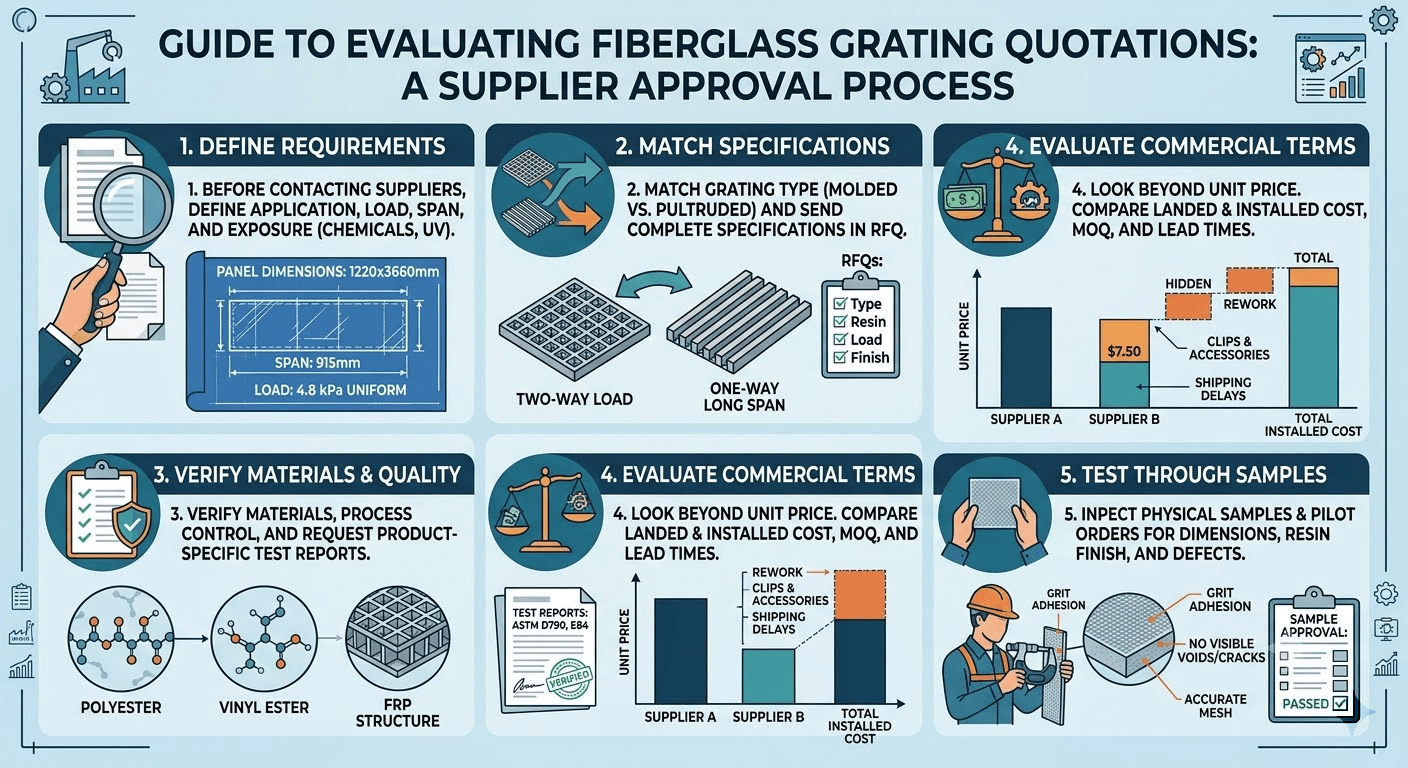
A low quotation may exclude clips, cutting, testing, packaging, transport, or documents. Out of tolerance panels may add site labor, dust control, disposal, and delay risk.
Evaluate MOQ, Lead Time, and Delivery
Buyers should confirm MOQ, sample timing, lead time, payment terms, Incoterms, shipment milestones, and quotation validity. Short lead times need a credible capacity plan.
What Should a Fiberglass Grating Quotation Include? [Q&A]
A complete quotation should identify the specification, quantity, unit price, tooling, fabrication, clips, packaging, testing, lead time, trade terms, payment terms, delivery point, warranty scope, and validity. Itemized pricing helps buyers compare equivalent offers and identify exclusions before issuing a purchase order.
| Cost Factor | Low Price Risk | Qualified Supplier Advantage |
|---|---|---|
| Inspection | Extra incoming checks | Stable records |
| Rework | Poor fit and rough edges | Controlled fabrication |
| Schedule | Errors or missing parts | Verified drawings |
| Freight | Weak protection | Project specific packaging |
| Support | Slow dispute handling | Defined corrective action |
The strongest commercial offer minimizes landed and installed cost.
Test Suppliers Through Samples and Pilot Orders
Commercial promises should be tested through physical evidence before a large order is released.
Use a Structured Sample Approval Process
Inspect dimensions, squareness, mesh, resin finish, exposed fibers, cracks, voids, warping, grit adhesion, color, and edges. Record results on an approval sheet.
What Should Buyers Inspect on a Fiberglass Grating Sample? [Q&A]
Buyers should inspect dimensions, squareness, mesh consistency, resin finish, exposed fibers, cracks, voids, warping, grit adhesion, color consistency, and cut quality. Where structural, fire, slip, or chemical performance is critical, visual inspection should be supplemented with product specific test evidence.
Run a Controlled Pilot Order
The pilot should use the materials, tooling, process, packaging, and documents planned for production. A 10 to 20 panel batch may expose repeated problems, depending on project risk.
A controlled pilot creates a real performance record before financial exposure increases.
Score and Compare Fiberglass Grating Suppliers
With samples and evidence available, buyers can convert impressions into a repeatable approval decision.
Build a Weighted Evaluation Matrix
Use a five point scale: 1 means unsupported, 3 means partly verified, and 5 means fully verified with current evidence.
| Category | Weight | Evidence Required |
|---|---|---|
| Technical compliance | 25% | Specification review, load data, resin confirmation |
| Quality documentation | 20% | Reports, inspection records, traceability |
| Manufacturing capability | 15% | Equipment, samples, capacity plan |
| Commercial terms | 15% | Itemized quotation |
| Delivery reliability | 15% | Schedule and shipment history |
| Communication and support | 10% | Response and corrective action records |
Engineering should review loads, quality should examine evidence, logistics should assess packaging, and installers should confirm fit.
A documented scorecard makes approval easier to explain and audit.
Watch for Supplier Red Flags
The final screen should identify contradictions across the quotation, sample, drawing, evidence, and production plan.
Warning signs include generic reports, unclear resin specifications, changing descriptions, failed samples, unrealistic lead times, weak packaging, vague warranties, and inconsistent answers.
When Should Buyers Reject a Supplier? [Q&A]
Buyers should reject or pause approval when materials cannot be verified, samples fail inspection, documents conflict with the quotation, capacity appears insufficient, or the supplier cannot explain its corrective action process. If an issue seems correctable, buyers should request written clarification and new evidence before proceeding.
Rejecting a weak supplier before mass production usually costs less than correcting defects after delivery.
Conclusion
A dependable supplier evaluation should confirm five points:
- The grating matches the application, span, load, and environment.
- Materials, controls, and product specific evidence can be verified.
- Fabrication, capacity, tolerances, and packaging support the project.
- Commercial comparisons include inspection, freight, rework, and delay risk.
- Samples, pilots, and scorecards demonstrate repeatable performance.
This framework supports supplier screening and procurement planning. It does not replace project specific structural calculations, chemical compatibility review, fire code assessment, or professional engineering approval.
[Send panel dimensions, load requirements, resin preference, fabrication drawings, quantity, and destination to request a fiberglass grating quotation from Wellco Industries →]