
- July 16, 2026
- Posted by: wellcoindustries
- Category: FRP grating
Introduction
A grating panel can meet its load requirement and still create the wrong surface. A solid top may stop tools and liquids from reaching equipment below, while open mesh may prevent standing water.
This guide helps purchasing managers, contractors, and engineers compare both formats by construction, drainage, loading, installation, and lifecycle cost. Final acceptance should follow project drawings, codes, and engineering review.
What Is the Difference Between Covered FRP Grating and Open Mesh Grating?
Surface construction controls how water, debris, wheels, and maintenance traffic interact with the panel.
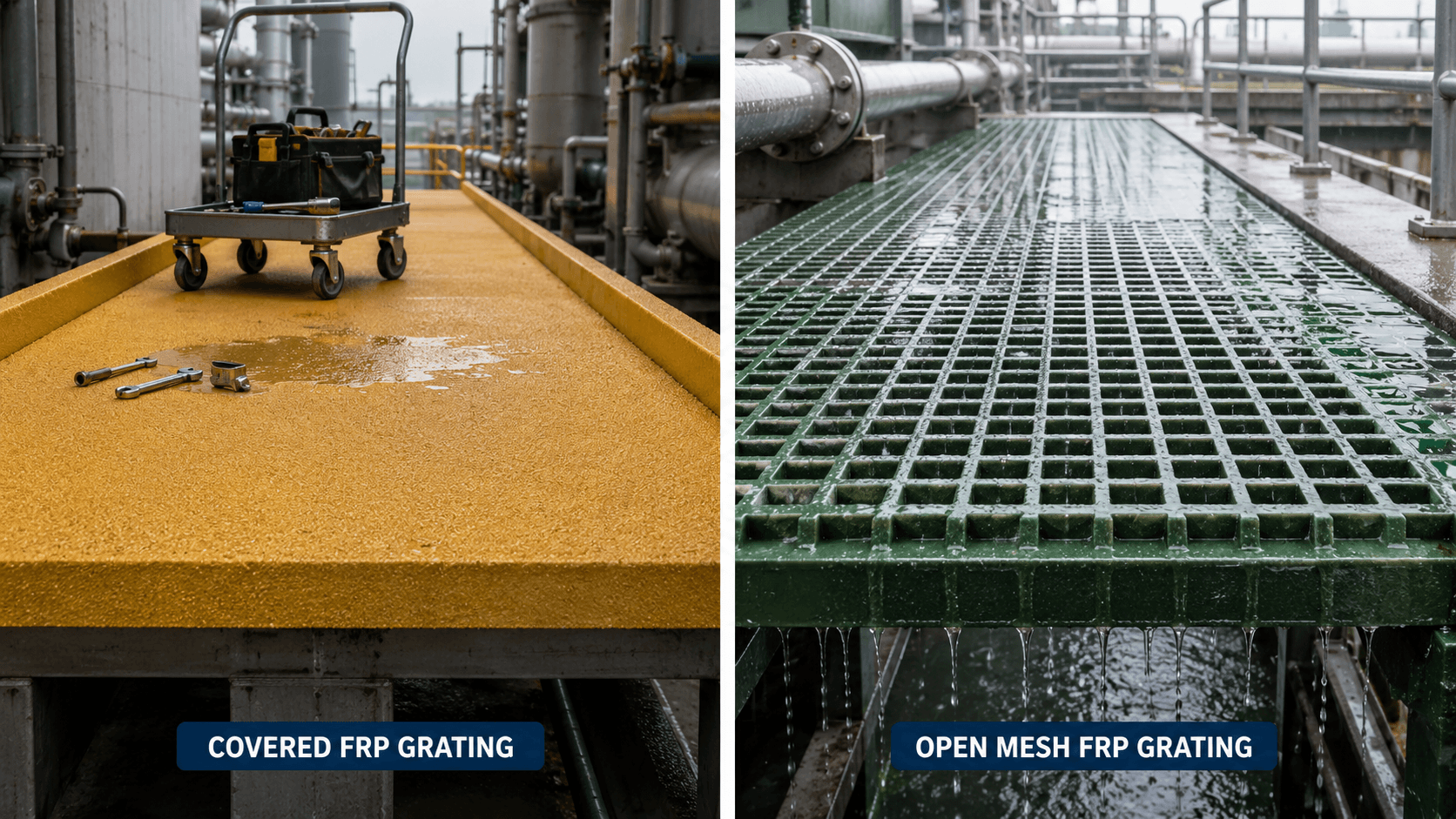
Covered FRP Grating Construction
Covered FRP grating combines a molded or pultruded structural base with a continuous fiberglass plate. Specifications normally identify depth, mesh or bearing-bar configuration, plate thickness, resin, texture, and edge treatment.
Open Mesh FRP Grating Construction
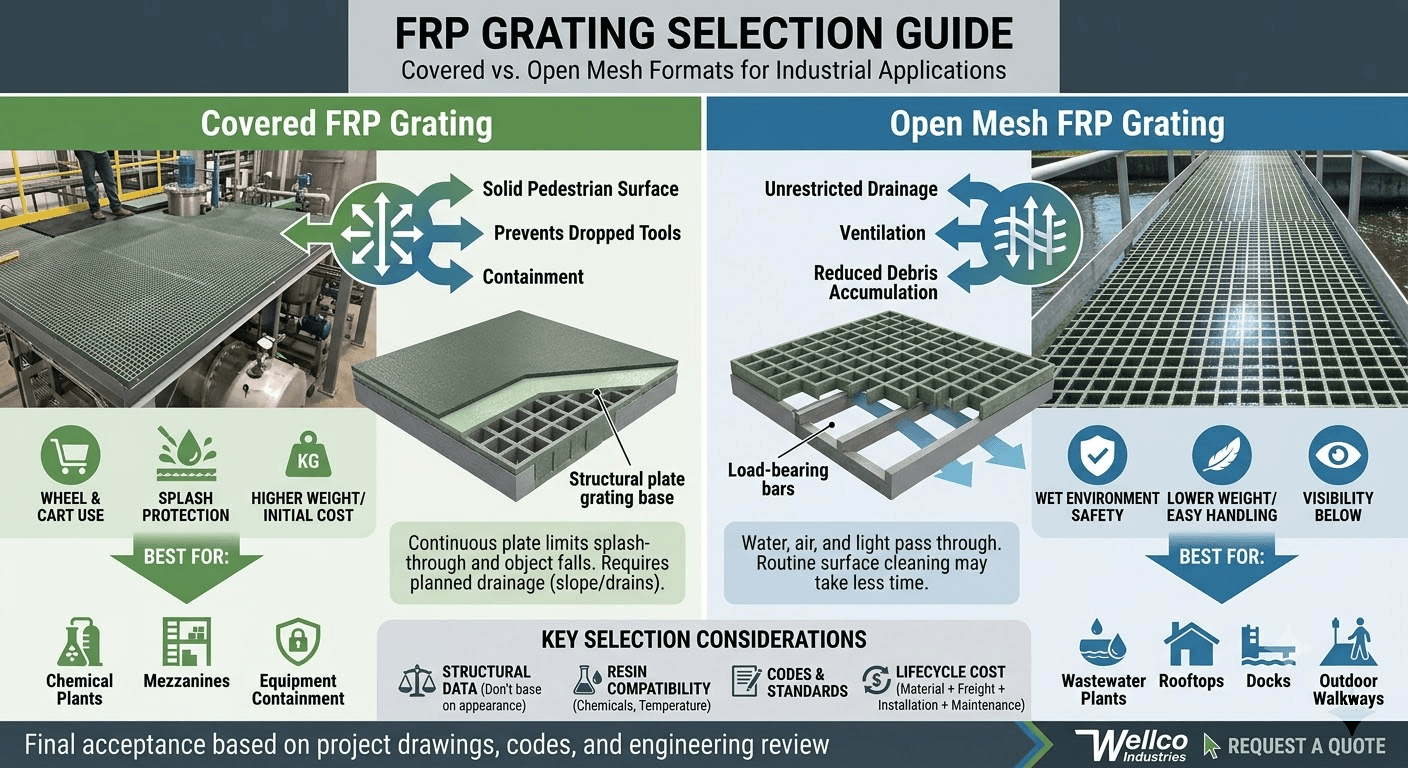
Open mesh grating leaves spaces between load-bearing members so water, air, light, and debris can pass through. Molded square-mesh panels commonly carry load in two directions; pultruded panels have a primary bearing direction.
What does “covered” mean in covered FRP grating?
Covered FRP grating uses a structural fiberglass panel with a solid FRP plate attached across the top. The plate forms a continuous surface for pedestrians and carts, helps retain small tools, and limits splash-through. Because water cannot drain freely, the layout may require slope, drains, or edge discharge.
That distinction leads to the main operating tradeoffs.
Covered FRP Grating vs. Open Mesh Grating: Core Performance
With construction established, buyers can compare daily performance.
Surface, Drainage, and Containment Comparison
The table below summarizes typical characteristics:
| Property | Covered FRP Grating | Open Mesh FRP Grating |
|---|---|---|
| Drainage | Needs planned discharge | Water passes through |
| Small objects | Helps retain tools | Items may fall through |
| Cleaning | Supports sweeping | Lets wash water pass |
| Air and light | Blocks passage | Allows ventilation |
| Handling | Usually heavier | Usually lighter |
| Common use | Containment routes | Wet platforms |
Structural Capacity and Deflection
A cover may reduce deflection, but it does not automatically raise allowable load. Fibergrate directs users to apply a 0.5 multiplier to listed deflection for certain covered panels from 1 to 2 inches deep, while stating that a 1/8-inch plate does not change maximum recommended or ultimate loads. These instructions apply only to the listed products.
Buyers should submit span, loads, support width, bearing direction, and the project deflection limit.
Is covered FRP grating stronger than open mesh grating?
Covered grating may feel stiffer and may distribute pedestrian loads across a wider area. Structural capacity still depends on the base profile, depth, bearing-bar geometry, span, resin, cover construction, and supports. Buyers should require profile-specific uniform, concentrated, and line-load data before approving either configuration.
Surface appearance never replaces structural data.
Where Covered FRP Grating Performs Best
Containment becomes decisive when equipment or personnel below need protection.
Containment and Clean Walking Surfaces
In an anonymized pump-station retrofit, open mesh allowed nuts and tools to reach pumps below. The replacement used gritted covered panels, kick plates, sealed cuts, and removable access sections. It created a cleaner route and improved falling-object control.
Wastewater, Chemical, and Food-Processing Areas
A continuous plate can restrict splash-through, although it may retain residue. Procurement documents should state chemical type, concentration, temperature, exposure duration, cleaning agent, and contact frequency before resin selection.
Accessibility and Pedestrian Use
Solid or closely spaced surfaces generally accommodate canes, narrow wheels, and carts better than wide openings. Designers should verify opening dimensions, transitions, slip resistance, edge conditions, and applicable accessibility rules.
Covered grating earns its added weight where continuous support solves a defined hazard.
Where Open Mesh FRP Grating Has the Advantage
Where runoff, ventilation, and access below dominate, open mesh often provides the simpler layout.
Drainage, Ventilation, and Reduced Debris Accumulation
Open mesh suits outdoor catwalks, docks, cooling towers, rooftops, and wastewater walkways because runoff passes through. Deposits may still collect around clips and supports.
Lower Weight and Easier Field Handling
Without an added plate, open mesh panels are generally easier to lift, cut, and position. This can improve productivity on elevated retrofits.
Uneven framing can cause rocking or unsupported edges in either type.
Does open mesh FRP grating require less maintenance?
Open mesh often drains water and sheds loose debris more readily, so routine surface cleaning may take less time. Maintenance remains necessary around bearing bars, clips, supports, and penetrations. Facilities should inspect grit wear, fasteners, damaged edges, chemical deposits, and support condition during scheduled safety reviews.
Its drainage advantage is strongest where containment is secondary.
Application Suitability by Work Environment
Mixed hazards call for selection by zone.
Matching the Surface to the Hazard
The table below provides a starting point:
| Application | Main Hazard | Typical Choice | Verify |
|---|---|---|---|
| Wastewater walkway | Wetting | Open mesh | Resin, slip, span |
| Chemical platform | Splash below | Covered | Compatibility, drainage |
| Rooftop platform | Rain and wind | Open mesh | Hold-downs |
| Trench cover | Point load | Case-specific | Load, support |
| Food-processing area | Hygiene | Conditional | Cleaning, joints |
| Marine dock | Salt exposure | Open mesh | Marine requirements |
| Equipment mezzanine | Falling objects | Covered | Dead load, kick plates |
ASTM F3059-24 provides testing and performance requirements for FRP grating used for personnel safety in marine construction and shipbuilding. Its scope excludes equipment support during or after fire exposure and does not replace regulations or classification rules.
Hybrid Layouts and Partial Coverage
A hybrid platform can use covered panels near electrical equipment and open mesh in drainage zones. Transitions must address elevation, trip edges, supports, clips, and access sections.
How Buyers Should Compare Specifications Before Ordering
The purchasing package must convert site needs into measurable requirements.
Load, Span, and Support Conditions
Requests for quotation should state span, uniform and concentrated loads, deflection limit, support width, traffic type, cutouts, and bearing direction.
Panel depth alone cannot establish capacity.
Resin, Fire, UV, and Chemical Requirements
Polyester, isophthalic polyester, vinyl ester, and specialty systems serve different environments. No resin resists every chemical and temperature condition.
ASTM E84 reports comparative flame-spread and smoke-developed indices under a defined ten-minute test. ASTM states that it does not classify a material as noncombustible or measure heat transmission. Codes and the authority having jurisdiction determine acceptance.
Surface and Fabrication Details
Specifications should define plate thickness, grit, color, sealed edges, kick plates, cutouts, tolerances, clips, fasteners, and drawings. Factory fabrication can reduce uncontrolled field cutting.
Clear details reduce rework and installation risk.
Installation and Lifecycle Cost Considerations
Installation Labor and Support Framing
Covered panels require more handling and may need slope or drainage outlets. Open mesh is often easier to stage, though both types require correct bearing, support spacing, and restraint.
On retrofits, contractors should verify frame level before delivery.
Cleaning, Inspection, and Long-Term Ownership
Lifecycle cost includes material, freight, labor, downtime, cleaning, inspection, and replacement risk. In one manufacturer case study, a specific 30-year-old, 2-inch vinyl ester pultruded grating sample retained about 85% of its flexural modulus and exceeded its published maximum load. The result covers one sample and service history, so it does not establish a universal lifespan.
Which FRP grating type usually costs more?
Covered FRP grating generally has a higher initial material and freight cost because it adds a fiberglass plate, bonding, finishing, and weight. Total installed cost may still favor it when the surface prevents equipment damage, supports wheeled traffic, improves containment, or eliminates a separate protective layer below.
Lifecycle cost provides a sounder comparison than unit price.
Procurement Checklist for Covered or Open Mesh FRP Grating
The final step is confirming documentation, fabrication, and delivery capability.
Documents Buyers Should Request
Buyers should request product data, profile-specific load tables, a corrosion guide, required fire-test reports, installation instructions, drawings, clip details, tolerances, and quality records. Every document should match the proposed panel.
Supplier Capability and Lead-Time Questions
Procurement teams should confirm stock sizes, cutting, drilling, edge sealing, kick plates, accessories, drawing support, packaging, minimum quantity, and lead time. Wellco Industries supports industrial FRP buyers with grating selection, fabrication discussions, flexible quantities, and North American supply coordination through its product network.
Final Selection Checklist
Before release, buyers should confirm the hazard, drainage, loads, span, supports, resin, surface, fire requirements, fabrication scope, installation plan, documentation, and schedule.
This review prevents substitutions based only on appearance, depth, or lowest price.
Conclusion
Covered FRP grating suits continuous surfaces, falling-object control, wheeled access, and splash containment.
Open mesh grating usually offers better drainage, ventilation, visibility, and field handling.
Structural approval must come from product-specific load and deflection data for the actual span and traffic condition.
Resin, fabrication, fastening, cleaning, and inspection can influence lifecycle performance as much as surface type.
[Request a covered or open mesh FRP grating quote from Wellco Industries →]