
- May 28, 2026
- Posted by: wellcoindustries
- Category: FRP grating
Introduction
A dock surface usually fails slowly. Salt spray, standing water, UV exposure, rolling carts, dropped tools, algae, loose fasteners, and delayed maintenance all work against the decking long before a panel looks unsafe.
That is why the choice between fiberglass dock grating, wood decking, and metal decking should be based on field performance, maintenance access, safety risk, and lifecycle cost. A lower bid price can disappear quickly if the surface needs frequent sealing, coating repair, board replacement, or shutdown time.
This guide compares the three common dock decking options from a practical buyer’s point of view. You will see where FRP grating performs well, where wood or metal may still make sense, and what specifications you should confirm before ordering dock panels in bulk.
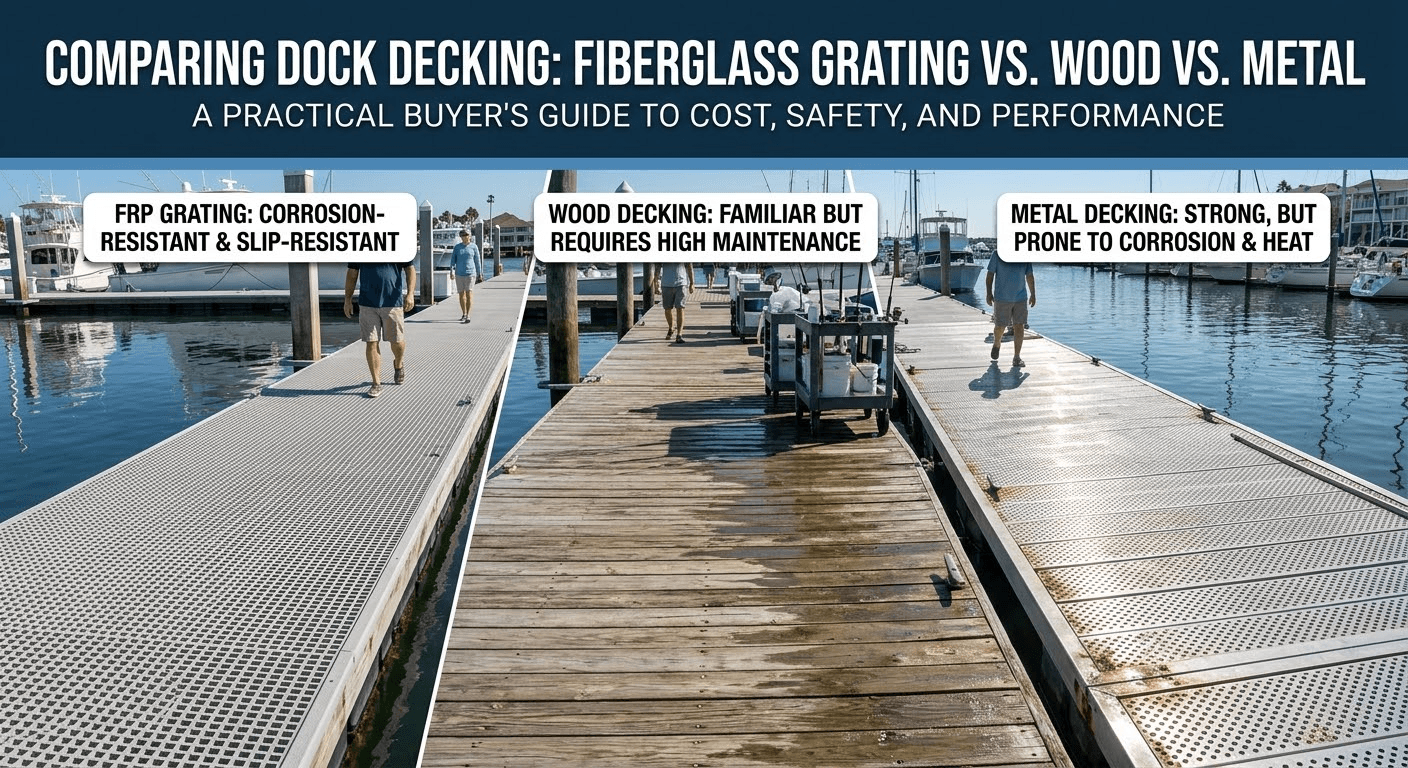
Fiberglass Dock Grating vs Wood and Metal Decking: Quick Comparison
What are the main differences between fiberglass dock grating, wood, and metal decking?
Fiberglass dock grating is commonly selected for wet docks because it resists corrosion, drains water, supports slip-resistant surface options, and reduces routine maintenance. Wood is familiar and can provide a warm appearance. Metal can deliver strong structural performance, though corrosion protection, heat, coating damage, and weight require closer planning.
Marine environments expose weak material choices quickly. Wood boards may split, cup, rot, or loosen around fasteners. Coated steel can rust where the coating wears through. Aluminum resists corrosion better than carbon steel, but buyers still need to evaluate surface traction, heat, stiffness, and cost.
The table below compares the main performance factors buyers should review before choosing a dock decking material:
| Factor | Fiberglass Dock Grating | Wood Decking | Metal Decking |
|---|---|---|---|
| Corrosion or rot resistance | Does not rust and resists moisture damage when properly specified | Can rot, split, splinter, or attract insects | Strong, but coating damage can expose steel to corrosion |
| Wet traction | Textured or grit-top surfaces can improve grip | Can become slick with algae, mildew, or worn sealers | Needs textured design to reduce wet slip risk |
| Drainage | Open mesh lets water pass through | Solid boards hold more surface moisture | Grated or perforated metal drains well |
| Weight | Often lighter than steel grating | Moderate, depending on species and treatment | Aluminum is lighter than steel; steel is heavy |
| Maintenance | Cleaning, debris removal, and fastener checks | Sealing, staining, board replacement, splinter control | Rust checks, coating repair, fastener inspection |
| Best fit | Wet, corrosive, low-maintenance dock areas | Appearance-driven or budget-sensitive projects | Engineered heavy-duty or high-stiffness applications |
The main takeaway is simple: compare the material by operating conditions, not by square-foot price alone.
Why Fiberglass Dock Grating Performs Well in Marine Environments
Once you move beyond the first quote, environmental resistance becomes the first serious filter. Docks face moisture from above, below, and through constant splash-zone exposure.
Corrosion and Moisture Resistance
FRP grating uses glass fiber reinforcement inside a polymer resin matrix. That structure allows it to resist rust, rot, and many moisture-related failure patterns that affect wood and metal decking.
For dock applications, buyers should confirm the resin system, UV package, panel thickness, surface finish, grating type, and support layout. Common FRP grating thicknesses include 1 inch, 1.5 inches, and 2 inches, but thickness alone does not prove suitability. You still need supplier span tables, expected load data, and actual support spacing.
Molded FRP grating usually works well for pedestrian dock areas, irregular layouts, and locations with cutouts around posts, pipes, or cleats. Pultruded FRP grating often fits longer spans or directional load requirements because its bearing bars provide stronger one-way performance.
How long does fiberglass dock grating last in wet environments?
Properly specified fiberglass dock grating can provide long service life in wet and corrosive dock environments when resin, UV protection, panel thickness, load rating, and support spacing match the project. Actual lifespan depends on salt exposure, sun, traffic, impact damage, cleaning practices, and installation quality.
A saltwater marina walkway creates harsher conditions than a freshwater residential dock. In one common field scenario, maintenance teams replace wood boards repeatedly because of splintering, algae buildup, screw loosening, and soft spots near wet fastening points. FRP grating can reduce those recurring failure points when the product is specified correctly.
The key is accurate specification. A grating panel should be selected around the dock’s clear span, traffic type, exposure level, and maintenance schedule.
Safety, Slip Resistance, and User Experience on Docks
Durability matters, but a dock is also a walking surface. Guests, workers, pets, carts, coolers, and service crews all interact with the deck differently.
Walking Surface and Drainage
Open FRP grating allows rain, spray, and washdown water to pass through the walking surface. That can reduce standing water on narrow walkways, gangways, floating docks, fish-cleaning areas, and access platforms.
Textured or grit-top FRP surfaces can improve traction in wet conditions. Some grating designs also provide a high open area, often around 60% to 70% depending on mesh pattern, which helps with drainage and airflow. Buyers still need to balance drainage against foot comfort, heel safety, cart movement, and local project requirements.
When is fiberglass dock grating safer than wood or metal?
Fiberglass dock grating may be safer when the project needs drainage, wet traction, corrosion resistance, and predictable maintenance. Safety still depends on surface texture, opening size, fastening quality, load rating, edge support, cleaning frequency, and whether the selected grating meets local access and safety requirements.
Wood can feel comfortable underfoot, but algae, mildew, splinters, raised fasteners, and worn sealers can create hazards. Metal can carry high loads, yet smooth surfaces can become slippery when wet, and some metal decking can heat up under direct sun.
Accessibility and Foot Traffic Considerations
A public marina walkway may need smaller openings for shoes, pets, carts, and family traffic. A maintenance-only pier may prioritize load rating, drainage, chemical resistance, and easy washdown.
Before purchasing, confirm whether the dock must support pedestrian traffic, service carts, utility crews, marina guests, fishing activity, or industrial maintenance. That user profile should guide opening size, surface texture, panel thickness, and fastening details.
A safer dock surface starts with matching the walking experience to the real users on the site.
Load Capacity, Structure, and Installation Factors
After safety, the next decision is structural fit. A good material can still perform poorly if the panel span, support spacing, or fastening method is wrong.
Molded vs Pultruded Fiberglass Dock Grating
Molded FRP grating distributes load in multiple directions through its grid structure. It is often a practical choice for dock areas with irregular shapes, frequent cutouts, or multi-directional pedestrian traffic.
Pultruded FRP grating uses bearing bars and cross rods. It is often selected for higher stiffness, longer spans, and controlled support layouts where loads run in a predictable direction.
Wood decking depends on board thickness, species, treatment quality, joist spacing, and fastener condition. Metal decking depends on alloy, coating, gauge, structural design, and corrosion exposure. FRP grating also needs disciplined engineering review.
The table below highlights the specification points buyers should confirm before ordering FRP dock panels:
| Specification | Why It Matters | Buyer Checkpoint |
|---|---|---|
| Panel thickness | Affects stiffness, span capacity, and walking feel | Match thickness to supplier span tables |
| Mesh or opening size | Impacts drainage, comfort, debris, and heel safety | Choose based on user type and dock function |
| Resin system | Drives corrosion and chemical resistance | Match resin to saltwater, freshwater, chemicals, and cleaning exposure |
| Surface finish | Affects traction and user safety | Specify grit-top or molded texture for wet areas |
| UV package | Helps outdoor performance and appearance | Confirm suitability for long-term sun exposure |
| Fastening system | Controls movement, uplift, and vibration | Plan clips, edge support, and replacement access |
| Cutting plan | Reduces installation delays and waste | Pre-plan drawings, openings, and panel orientation |
Installation and Handling Advantages
FRP panels are often easier to handle than steel grating because they are lighter. That matters on waterfront sites where crews work from narrow access paths, floating docks, barges, or staged areas with limited lifting equipment.
Field cutting may be possible, but contractors should use proper tools, dust control, personal protective equipment, and edge finishing. Unsupported edges, poor clip spacing, and rushed panel layout can create movement under foot traffic.
The best installation plan starts before the order is placed: confirm support spacing, panel direction, fastener type, edge trim, cutouts, packaging, and unloading access.
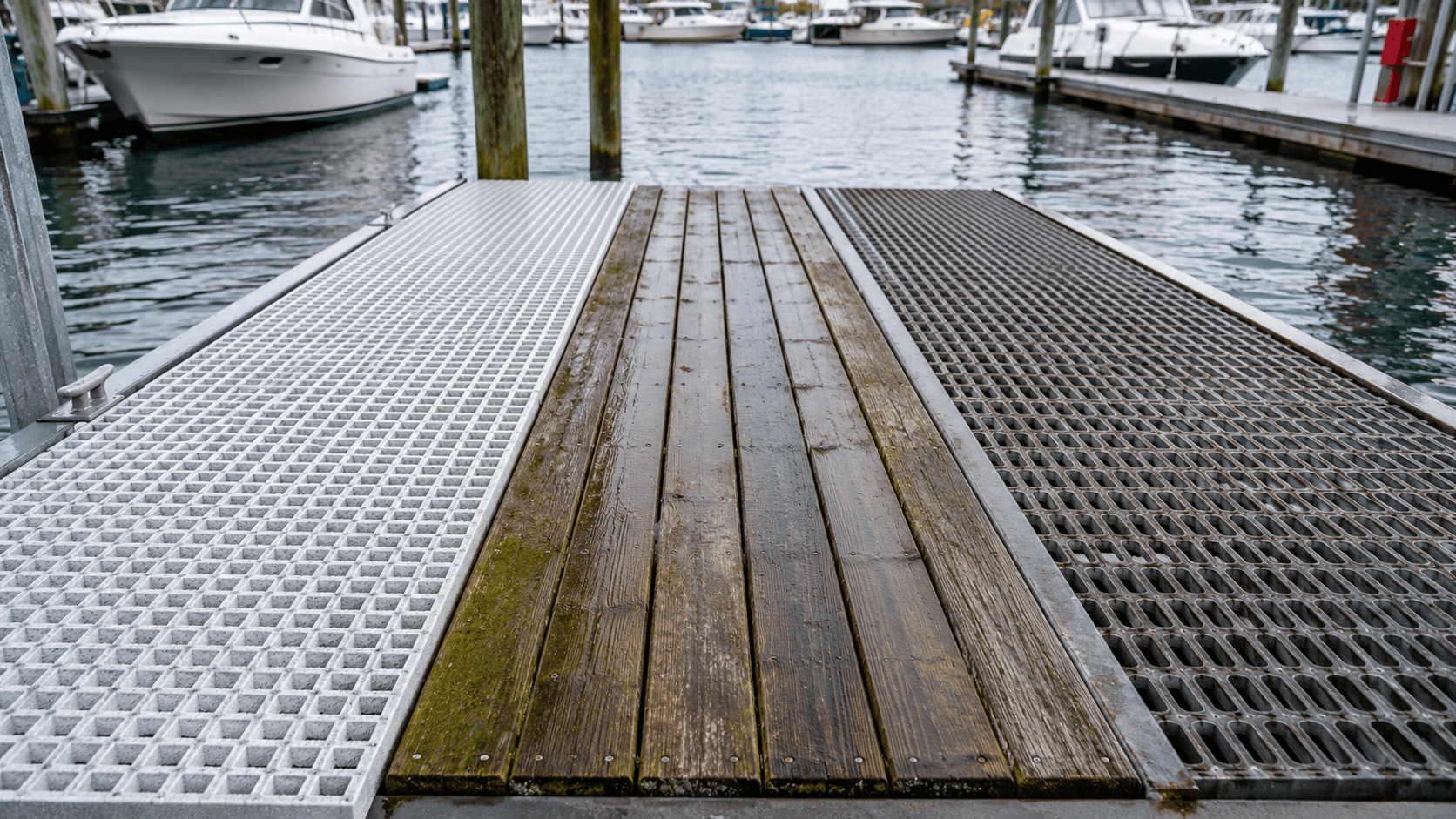
Maintenance and Lifecycle Cost Comparison
After structure and installation, cost over time becomes the real business case. Maintenance labor, shutdowns, safety incidents, and replacement cycles all affect the final number.
Upfront Cost vs Long-Term Cost
Wood decking can work well where appearance, easy local sourcing, or a lower initial price matters. It may suit private docks, low-traffic areas, or projects where owners accept regular sealing and board replacement.
Metal decking can be the right choice for specific engineered load cases, heavy industrial needs, or projects where a structural engineer specifies metal for stiffness or integration with an existing frame. In corrosive marine settings, buyers should plan for coating inspection, repair, and fastener review.
Fiberglass dock grating usually becomes more attractive when corrosion resistance, drainage, reduced maintenance, and easier handling carry high value. The strongest use cases are wet, exposed, hard-to-maintain areas where downtime creates real cost.
What maintenance does fiberglass dock grating need?
Fiberglass dock grating usually needs periodic cleaning, debris removal from openings, inspection of clips or fasteners, and checks for impact damage or unsupported edges. Compared with wood or coated metal, it typically avoids sealing, staining, repainting, rust treatment, and frequent board replacement.
Routine cleaning still matters. Dirt, leaves, fish waste, algae, and salt deposits can reduce traction or block drainage. Maintenance schedules should reflect local exposure, traffic level, and seasonal conditions.
Before approving an order, use this checklist to reduce procurement risk:
| Procurement Check | Why It Reduces Risk | Practical Action |
|---|---|---|
| Load rating and span | Prevents unsafe deflection | Share drawings and expected traffic loads |
| Resin and UV resistance | Matches grating to exposure | State saltwater, freshwater, chemical, and sun conditions |
| Surface texture | Supports wet traction goals | Choose grit-top or textured surfaces where needed |
| Panel dimensions | Reduces cutting waste | Plan layout before purchasing |
| Lead time and stock | Protects project schedule | Confirm availability before crew scheduling |
| Replacement consistency | Simplifies future repairs | Standardize thickness, mesh, color, and fastening system |
Repeat buyers should standardize specifications across similar dock projects. That makes quotes easier to compare and replacement orders easier to manage.
How to Choose the Right Fiberglass Dock Grating Supplier
With the technical requirements defined, supplier selection becomes the final filter. The right supplier should help you match product, schedule, packaging, and reorder needs.
Key Buying Questions for B2B and Pro Buyers
Ask direct questions before placing a bulk order. Can the supplier provide molded and pultruded options? Can they support the required panel thickness, mesh size, resin, color, surface finish, and fastening system? Can they help with bulk pricing, flexible MOQ, OEM support, project-based recommendations, or repeat ordering?
Also ask about packaging, warehouse availability, lead time, replacement consistency, and technical documentation. For contractors and purchasing managers, a delayed dock material shipment can affect labor scheduling, equipment rental, and project handover.
Wellco Industries Inc. supplies FRP grating as part of its industrial fiberglass product range, along with related FRP products such as rebar, handrails, ladders, and structural profiles. Its U.S. warehouse capacity, wholesale service, and OEM/ODM options support B2B buyers who need repeat supply, flexible ordering, and practical product sourcing for North American projects.
Application Fit: Marina, Boat Ramp, Pier, Floating Dock, or Industrial Waterfront
Different dock applications need different priorities. A marina walkway may emphasize slip resistance, comfort, and appearance. A boat ramp access platform may need drainage, UV resistance, and easy washdown. An industrial waterfront site may require higher load ratings and stronger chemical resistance.
The table below connects common dock applications with practical specification priorities:
| Application | Recommended Grating Focus | Key Reason |
|---|---|---|
| Marina walkway | Textured molded FRP with user-friendly openings | Supports drainage and pedestrian traction |
| Floating dock | Lightweight panels with secure fastening | Reduces handling load and panel movement |
| Boat ramp access | Grit-top surface and corrosion-resistant resin | Handles wet traffic and frequent washdown |
| Fishing pier | Open mesh with easy-clean surface | Reduces standing water and debris buildup |
| Industrial waterfront | Pultruded or heavy-duty FRP option | Supports higher load and directional strength needs |
The best supplier should help you specify by application, support spacing, traffic type, and exposure level before quoting only by square footage.
Conclusion
Fiberglass dock grating is strongest where corrosion resistance, drainage, wet traction, and lower maintenance matter. Wood can still fit appearance-driven or budget-sensitive projects if owners accept regular upkeep. Metal can suit engineered heavy-duty conditions when corrosion control, coating maintenance, weight, and heat are properly managed.
Before you buy, confirm load rating, clear span, resin system, UV resistance, surface texture, opening size, panel dimensions, fastening method, lead time, and replacement availability. These details decide how well the dock surface performs after installation.
Share your dock dimensions, span requirements, and application environment to get a practical material recommendation. [Request a bulk quote from Wellco Industries →]