
- May 21, 2026
- Posted by: wellcoindustries
- Category: FRP grating
Introduction
Wet floors, rusted panels, standing water, and heavy grating create real safety exposure. In industrial plants, greenhouses, livestock areas, municipal sites, and outdoor access platforms, flooring performance can affect crew movement, drainage, cleaning speed, animal comfort, and maintenance cost.
Fiberglass reinforced plastic grating gives buyers a practical flooring option for wet, corrosive, and repeat maintenance environments. It combines corrosion resistance, drainage, lighter handling weight, and slip resistant surface options in one material system.
This article explains where FRP grating works best, what specifications matter, and how procurement teams can avoid costly mismatches before placing a bulk order. Wellco Industries supports B2B and pro prosumer buyers across agriculture, gardening, industrial FRP, and outdoor product categories, including FRP grating and related composite products for North American customers. Its product breadth, wholesale support, and warehouse based supply model help repeat buyers manage flooring, agricultural, and site protection needs through one supplier network.

What Makes Fiberglass Reinforced Plastic Grating Safer for Flooring?
Safety begins with how a floor performs under actual site conditions. A dry panel sample can look fine in an office, yet the real test happens when the surface faces washdown water, fertilizer, salt air, oils, mud, manure, or chemical residue.
Slip resistance and open area design
Fiberglass reinforced plastic grating is commonly supplied as molded or pultruded panels. Molded FRP grating often uses a square mesh pattern and commonly available open area ranges vary by panel design, mesh size, and bar thickness. Many open mesh panels allow a large share of water and debris to pass through instead of collecting on the walking surface.
Pultruded FRP grating typically provides stronger load performance in the main bearing direction, so buyers often consider it for longer spans or more demanding industrial walkways. Molded grating can work well where multidirectional strength, drainage, and cut flexibility matter.
Surface finish matters just as much as panel type. Concave top grating may suit moderate slip risk areas. Grit top surfaces usually provide stronger traction for wet platforms, trench covers, greenhouse aisles, and maintenance walkways. Covered grating can help when buyers need a more closed walking surface, although it may reduce drainage compared with open mesh panels.
Corrosion resistance in wet and chemical environments
FRP grating does not rust like carbon steel, which makes it useful in wet, salty, fertilized, and mildly chemical environments. Resin selection drives much of that performance. General purpose polyester resin can suit many ordinary wet areas, while vinyl ester resin is often selected for stronger chemical resistance.
In field replacement projects, procurement teams often find a familiar failure pattern. Steel panels may still support traffic, yet coatings fail at cut edges, welds, corners, and impact points. Rust follows. The surface becomes rough, harder to clean, and less predictable over time.
FRP helps buyers reduce corrosion related maintenance, but it still requires correct specification. Chemical exposure, cleaning agents, UV exposure, temperature, load, and support design all affect long term performance.
Why does FRP grating reduce slip risk in wet areas?
FRP grating can reduce slip risk because its open structure allows water, mud, and washdown liquid to drain through the floor instead of pooling on top. Grit top or textured surfaces add traction, while corrosion resistant construction helps the panel maintain surface condition in wet environments.
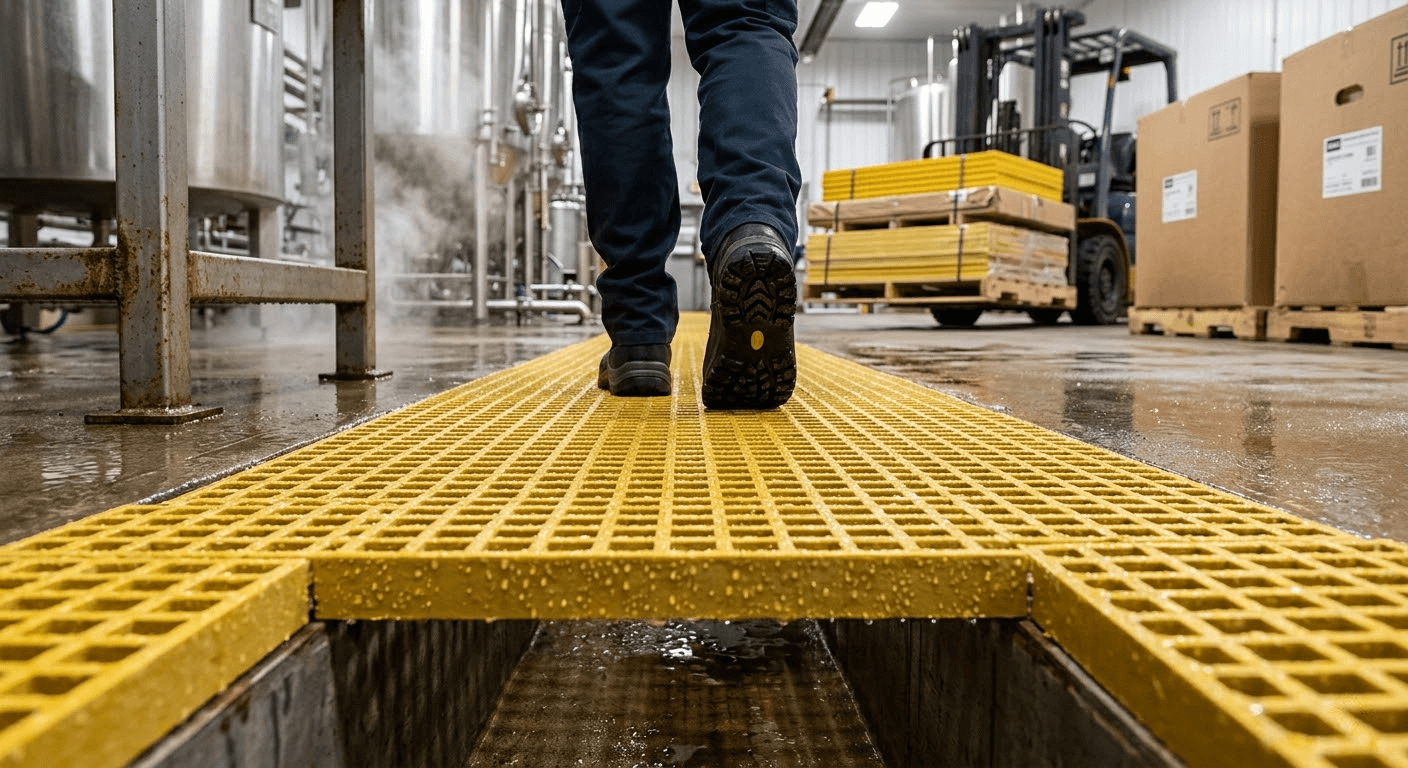
This is why FRP grating often appears in drainage trenches, greenhouse walkways, livestock wash areas, and industrial platforms. The open structure helps the top surface dry faster, while the texture gives boots or work shoes a better contact point.
Slip performance still depends on cleaning practices, footwear, slope, contaminants, lighting, and site specific safety review. Buyers should treat FRP as part of a safer flooring system, along with proper drainage, housekeeping, and installation.
The practical takeaway is simple: safer flooring comes from drainage, surface texture, corrosion resistance, and correct application matching.
FRP Grating vs Steel, Wood, and Plastic Flooring
After buyers understand the safety function, the next decision is material comparison. The lowest unit price rarely shows the real cost of flooring because replacement labor, downtime, coating repair, and handling risk all affect the project budget.
Performance comparison by flooring material
The table below compares common flooring materials across practical safety and maintenance factors:
| Flooring material | Slip performance | Corrosion resistance | Handling weight | Maintenance need | Best fit |
|---|---|---|---|---|---|
| FRP grating | Strong when specified with grit top or textured surface | High in wet and corrosive settings when resin is matched correctly | Light compared with many steel panels of similar coverage | Low to moderate | Wet platforms, trench covers, greenhouse aisles, wastewater walkways |
| Galvanized steel grating | Good when clean and properly serrated | Moderate because coating can fail at cuts, welds, and impact points | Heavy | Moderate to high | Heavy duty dry areas or mildly exposed industrial floors |
| Wood boards | Variable and often slick when wet | Poor in long term wet exposure | Moderate | High | Temporary walkways, low budget garden or farm uses |
| Plastic panels | Variable by design and surface texture | Good against rust | Light | Low to moderate | Light duty layouts with limited load demand |
FRP does not automatically replace every material. Steel may still be preferred for extreme heat, special impact conditions, or certain heavy load requirements. Wood may suit temporary or low budget garden use. Plastic panels may work for light duty layouts.
For wet, corrosive, and repeat maintenance environments, FRP often gives buyers a stronger balance of safety, handling, and lifecycle value.
Lifecycle cost and maintenance considerations
FRP grating often costs more than basic wood or low grade plastic panels at purchase. The value becomes clearer when teams calculate service life, labor, replacement frequency, downtime, coating repair, and crew handling.
Depending on panel design and thickness, FRP grating can weigh much less than steel grating covering a similar floor area. That difference matters when crews lift panels over trenches, carry sections through greenhouse aisles, or remove elevated platform flooring for inspection.
Lower handling weight can help crews install faster and reduce strain during routine maintenance. Buyers should still request product data because weight varies by thickness, mesh size, resin system, and panel construction.
When should buyers choose FRP instead of steel grating?
Buyers should choose FRP instead of steel grating when the floor faces water, chemicals, salt air, fertilizer, electrical exposure, or frequent manual handling. FRP offers corrosion resistance, lighter weight, and strong traction options, making it practical for wet platforms, trench covers, washdown zones, and outdoor access areas.
The decision should consider span, load, fire requirements, temperature, traffic type, and local safety rules. If forklifts, carts, livestock, or concentrated maintenance loads will cross the floor, buyers should request load and deflection data before confirming span.
Material choice only works when the panel matches the site. That leads directly into application selection.
Best Applications for Safe FRP Flooring
After material selection, buyers need to match FRP grating to the actual site. A greenhouse aisle, wastewater trench, and livestock floor all need drainage, yet each one has different load, opening size, cleaning, and comfort requirements.
Application suitability by site type
The table below shows where FRP grating commonly adds value and what buyers should check before specifying panels:
| Site type | Flooring challenge | Recommended FRP grating feature | Buying check |
|---|---|---|---|
| Industrial platforms | Wet traffic, chemical exposure, worker safety | Grit top surface with resin matched to exposure | Confirm pedestrian load, cart load, clear span, and clip package |
| Wastewater facilities | Corrosion, washdown, odor control areas | Vinyl ester resin and open mesh design | Check chemical exposure, cleaning method, and support material |
| Greenhouse aisles | Standing water, fertilizer, carts | Lightweight molded grating with drainage openings | Confirm aisle width, cart wheels, support spacing, and UV exposure |
| Livestock flooring | Drainage, ventilation, animal comfort | Smaller openings or covered options where needed | Match opening size to animal type, weight, hoof or foot safety |
| Trench covers | Frequent lifting, wet conditions, edge support | Lightweight FRP panels with textured surface | Confirm clear span, bearing width, edge support, and lifting frequency |
| Marine or coastal access areas | Salt air, weathering, wet footwear | UV resistant and corrosion resistant FRP | Check fasteners, clips, resin type, and outdoor exposure rating |
This table helps buyers prepare better supplier conversations. It does not replace engineering review for critical loads, but it helps procurement teams ask the right questions before they request pricing.
Field application example: wet processing walkway
Consider an anonymized wet processing facility with narrow access walkways beside drainage channels. Crews washed the area several times per week and lifted grating panels regularly to clean beneath the walking surface. The original galvanized steel grating had rust around cut edges, impact points, and corners where the coating had worn away.
The buyer wanted better drainage, easier handling, and a surface that stayed more stable in wet conditions. The replacement specification used grit top FRP grating with a resin system matched to the washdown environment. Before ordering, the team confirmed walkway width, panel span, support layout, clip type, traffic profile, and cleaning chemical exposure.
The change reduced manual handling weight and helped the walkway shed washdown water more effectively. It also gave the maintenance team a cleaner inspection routine because corrosion at cut edges no longer drove the replacement cycle.
How does FRP grating help in livestock or agricultural floors?
FRP grating helps agricultural and livestock floors by improving drainage, airflow, washdown efficiency, and corrosion resistance in wet environments. Properly selected opening size and surface texture can support animal comfort, reduce standing moisture, and help farms maintain cleaner flooring zones with less rust related maintenance.
For livestock areas, opening size matters as much as material. Large openings may drain well, yet they can create foot or hoof concerns for smaller animals. Buyers should match mesh size, bar spacing, surface feel, and support structure to animal type, weight, and cleaning routine.
The right application match turns FRP grating from a generic panel into a safer working surface.
Key Specifications Buyers Should Check Before Ordering
Durability in the field depends on specification accuracy. Many flooring problems begin before installation because buyers order based on panel size alone.
Load rating, span, and support layout
Safe flooring starts with load and span. Buyers should confirm whether the floor will support pedestrians, maintenance workers, carts, livestock, equipment, or occasional concentrated loads. Common panel thicknesses may include 1 inch, 1.5 inch, and 2 inch options, but thickness alone does not prove suitability.
Support spacing and bar direction matter. Pultruded panels usually carry load most strongly in one direction, while molded panels distribute load through an interwoven structure. Buyers should request load tables, deflection data, and recommended support spacing before finalizing an order.
For safety critical floors, FRP grating selection should follow project load requirements, applicable codes, engineering review, and site specific slip risk assessment. The supplier can support product selection, but the project team should confirm that the final flooring system fits the application.
Surface finish and opening size
Surface finish should match the slip risk. Concave top panels may suit lower risk areas, while grit top panels usually make more sense for wet industrial walkways, trench covers, and outdoor platforms. Covered grating may help when smaller objects, wheels, or foot comfort are concerns.
Opening size affects drainage and usability. A larger open area can move liquid and debris quickly, while smaller mesh can improve foot comfort and animal safety. Buyers should review who or what will cross the floor each day.
Resin system and UV exposure
Resin choice affects chemical resistance, weathering, and long term appearance. General purpose resin can work in many ordinary wet applications. Vinyl ester resin often fits harsher chemical zones, wastewater exposure, or stronger corrosive conditions.
Outdoor projects should also consider UV exposure. FRP grating used in sunlight should be specified with suitable resin, additives, or surface treatment for weathering resistance. Fasteners, clips, and support frames should also match the environment so the full flooring system remains reliable.
What information should buyers send before requesting a bulk quote?
Buyers should send panel dimensions, quantity, load requirement, clear span, support layout, traffic type, chemical exposure, surface finish, mesh size, resin preference, cutting needs, packaging requirements, and delivery location. These details help suppliers recommend safer FRP grating and avoid quoting panels that do not match the project.
Photos, drawings, and short site notes can reduce confusion. For repeat buyers, standardizing a preferred panel size, resin, surface finish, and clip package can simplify future orders and improve consistency across multiple sites.
Specifications protect both safety and budget, so procurement teams should settle them before price negotiation begins.
Installation and Procurement Tips for Safer Floors
A strong specification still needs clean installation and reliable supply planning. Contractors and procurement teams should treat FRP grating as part of a flooring system that includes supports, clips, edges, cutting, inspection, and maintenance.
Confirm field dimensions before cutting panels
Field dimensions should be checked before final cutting. Trench widths, platform openings, and support frames often vary from drawings, especially in retrofit projects. A small measurement error can create unsafe gaps, unsupported edges, or panels that move under foot traffic.
Installers should trim panels with suitable tools, seal exposed cut areas when recommended, and use proper clips or fasteners. Support bars should sit flat, and panels should stay stable during use. After installation, crews should walk the area and check for movement, sharp edges, uneven transitions, and drainage performance.
Balance MOQ, lead time, and customization
Bulk buyers need more than a safe product. They also need predictable availability, packaging, and delivery. A municipal contractor, nursery operator, agricultural agency, or industrial maintenance team may order repeat volumes across several sites, so stable specifications and lead times help control project risk.
Wellco Industries offers wholesale service models, flexible ordering support, and OEM or ODM options across product categories, including industrial FRP products. For buyers managing seasonal demand, project based purchasing, or multi location delivery, supplier capability can matter as much as the panel itself.
Inspect panels before and after installation
Receiving inspection should check panel count, size, thickness, surface condition, resin or color requirements, and included hardware. Damaged corners, missing clips, or mismatched surface finishes should be resolved before crews begin installation.
After installation, routine checks should look for loose clips, support movement, damaged surfaces, chemical residue buildup, and blocked openings. FRP grating needs less corrosion related maintenance than steel in many wet environments, yet every safety floor still needs inspection after installation.
Procurement, installation, and maintenance all contribute to floor safety, so buyers should manage the full process rather than focusing only on panel price.
Conclusion
Fiberglass reinforced plastic grating helps create safer floors in wet, corrosive, and high maintenance environments when buyers match the panel to the site. The strongest projects usually begin with clear load data, accurate dimensions, correct resin selection, suitable surface texture, and a support layout that fits the actual installation.
Key takeaways are straightforward. FRP grating can improve drainage and traction in wet areas. It can reduce corrosion related maintenance compared with steel in many exposed environments. It can lower manual handling burden because panels are commonly lighter than steel. It can also support safer agricultural, industrial, municipal, and commercial flooring when specified and installed correctly.
Before ordering, buyers should prepare a practical checklist: drawings or photos, panel sizes, quantity, clear span, support spacing, load requirement, traffic type, chemical exposure, surface preference, mesh size, clip needs, packaging, and delivery location. That information gives suppliers a stronger basis for accurate pricing and safer recommendations.