
- May 9, 2026
- Posted by: wellcoindustries
- Category: FRP grating
Introduction
Slip-and-fall accidents on stair treads account for a disproportionate share of industrial workplace injuries — and corroded or worn metal treads are a leading contributing factor. For procurement managers and contractors specifying stair systems in chemical plants, wastewater facilities, marine structures, or agricultural buildings, the choice of tread material directly affects worker safety, maintenance budgets, and long-term structural reliability.
Drawing on Wellco Industries’ direct experience supplying FRP grating systems across chemical, agricultural, and municipal infrastructure projects in North America, this article delivers a spec-level comparison between fiberglass grating stair treads and steel alternatives — carbon and stainless — across the performance dimensions that matter most to B2B buyers: weight, corrosion resistance, slip resistance, installation complexity, and 10-year cost of ownership. By the end, you’ll have a clear framework for making the right material call for your specific operating environment.
1. What Are Fiberglass Grating Stair Treads?
1.1 Construction and Material Composition
Fiberglass grating stair treads are manufactured through one of two primary processes: pultrusion or molded (open-mold) fabrication. Pultruded treads offer consistent fiber alignment along the length of the tread, delivering predictable load performance. Molded FRP treads provide bi-directional strength and are more common in standard grating panel applications cut to tread dimensions.
The resin matrix determines chemical and temperature resistance. Polyester resin suits general industrial environments. Vinyl ester resin is specified for chemical exposure or marine splash zones. Phenolic resin meets fire-rated requirements — ASTM E84 Class 1 flame spread ratings are achievable with phenolic systems, making them the standard choice for offshore platforms and transportation infrastructure. The top surface typically features either an embedded aluminum oxide grit layer or a raised concave-button profile, both engineered to maintain grip when wet, oily, or contaminated.
Standard tread widths run 9–12 inches with depths of 1–1.5 inches. Load ratings for industrial-grade FRP treads typically reach 500–1,000+ lbs per linear foot at a 12-inch clear span, depending on resin system and fiber architecture.
1.2 Where They’re Commonly Specified
FRP stair treads appear most frequently in environments where steel’s susceptibility to corrosion creates unacceptable maintenance burdens or safety risks. Chemical processing plants, municipal wastewater treatment facilities, marine dock structures, food and beverage processing lines, and large-scale agricultural buildings all represent high-volume application environments.
The shift from steel to FRP is not limited to new construction. On a wastewater treatment expansion project in the Southwest U.S., a retrofit contractor switched from galvanized steel treads to vinyl ester FRP mid-project after the first inspection cycle — conducted just 18 months into installation — revealed measurable surface oxidation on newly installed steel units. The corroded surface had already compressed what was budgeted as a 10-year maintenance cost into a single project cycle. That pattern, accelerated corrosion forcing premature maintenance spend, drives a significant share of the FRP retrofit market across North America.
2. Steel Stair Treads: Strengths and Limitations
2.1 Why Steel Has Been the Default
Steel stair treads carry a long specification history for good reasons. Carbon steel offers high load capacity per unit cost at point of purchase, is widely understood by fabricators and installers, and fits within established building codes and structural engineering conventions. For dry, climate-controlled interior environments with low corrosion exposure, carbon steel treads remain a cost-effective choice.
Stainless steel extends that performance envelope into moderate corrosion environments and carries a cleaner aesthetic for architectural or food-grade applications. Its significantly higher material cost, however, shifts the lifecycle economics substantially — and even stainless loses its advantage in aggressive chloride or acid environments without a specialized alloy grade.
2.2 Where Steel Underperforms
The limitations of steel become operationally expensive in any environment involving moisture, chemicals, salt air, or repeated wash-down cycles. Carbon steel begins surface oxidation within months of installation in coastal or wet-process environments, and corroded tread surfaces directly reduce the coefficient of friction — creating a slip hazard that compounds over time.
Maintenance requirements for steel treads in corrosive environments are non-trivial. Facilities typically budget for annual inspection cycles, periodic abrasive blasting, and repainting — costs that rarely appear in initial procurement comparisons but accumulate significantly over a 10-year asset life. OSHA data on walking-working surface incidents consistently identifies corroded, worn, or poorly maintained metal surfaces as a primary contributing factor in stair-related injuries. Beyond safety, the weight of steel treads — typically 3–5× heavier than equivalent FRP — creates real structural loading considerations on elevated mezzanines or aging platforms.
3. Head-to-Head Performance Comparison
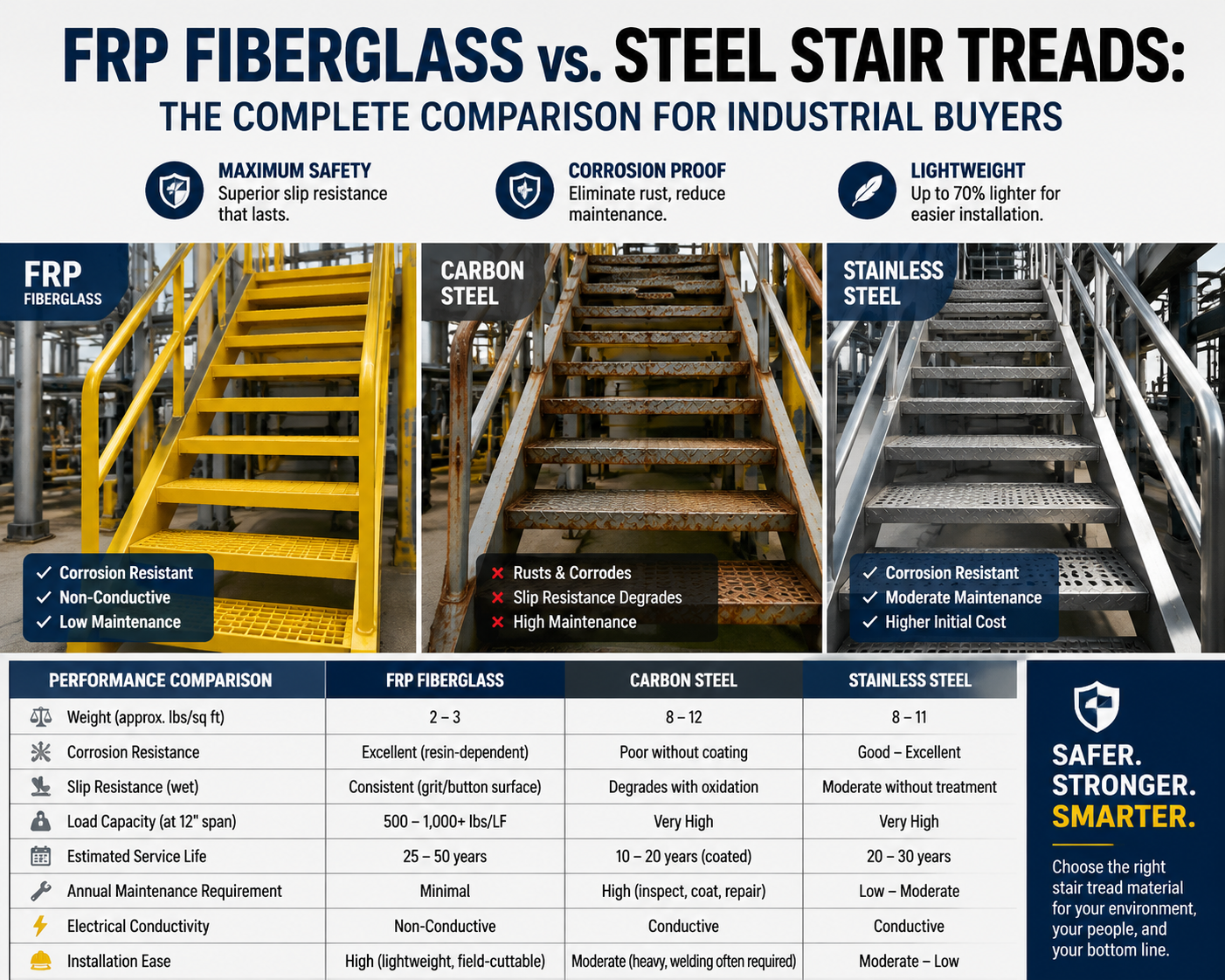
For procurement professionals evaluating both materials simultaneously, a direct attribute comparison cuts through vendor claims and surfaces the decision-critical differences. The table below compares FRP fiberglass grating stair treads against carbon steel and stainless steel across eight performance dimensions relevant to industrial and commercial buyers:
| Performance Attribute | FRP Fiberglass | Carbon Steel | Stainless Steel |
|---|---|---|---|
| Weight (approx. lbs/sq ft) | 2–3 | 8–12 | 8–11 |
| Corrosion Resistance | Excellent (resin-dependent) | Poor without coating | Good–Excellent |
| Slip Resistance (wet) | Consistent (grit/button surface) | Degrades with oxidation | Moderate without treatment |
| Load Capacity (at 12″ span) | 500–1,000+ lbs/LF | Very High | Very High |
| Estimated Service Life | 25–50 years | 10–20 years (coated) | 20–30 years |
| Annual Maintenance Requirement | Minimal | High (inspect, coat, repair) | Low–Moderate |
| Electrical Conductivity | Non-conductive | Conductive | Conductive |
| Installation Ease | High (lightweight, field-cuttable) | Moderate (heavy, welding often required) | Moderate–Low |
Three attributes consistently drive material selection in industrial retrofit and new-build projects: corrosion resistance, electrical non-conductivity, and weight. In environments where any of these three factors is a primary constraint, FRP outperforms both steel variants by a margin that typically justifies the higher initial unit cost within the first maintenance cycle. For high-load, dry interior applications, carbon steel remains a competitive option — the performance gap narrows significantly when corrosion is not a factor.
4. Slip Resistance and Safety Compliance
4.1 Surface Options and Anti-Slip Ratings
Slip resistance is not a secondary specification — it is the primary safety performance criterion for any stair tread under OSHA 1910.23 (Walking-Working Surfaces) and ANSI A14.3. FRP grating treads address this through engineered surface profiles that maintain friction performance across the tread’s entire service life.
Three surface types are standard in FRP tread manufacture. Gritted nosing strips concentrate slip resistance at the leading edge — the highest-risk contact zone. Concave button surfaces provide consistent grip across the full tread face, preferred for environments with omnidirectional foot traffic. Meniscus (raised flat-top) profiles suit environments where drainage is secondary and flat-footing stability is primary. Unlike steel, which relies on paint or galvanizing coatings that degrade with surface oxidation, FRP’s grit is embedded in or bonded to the resin matrix — its slip resistance does not diminish proportionally with age or wet exposure.
4.2 Electrical Non-Conductivity as a Safety Factor
In electrical substations, utility maintenance corridors, battery storage facilities, and industrial control rooms, the non-conductive property of FRP grating treads eliminates an entire category of electrical hazard. Steel treads in these environments require careful grounding management and create arc-flash exposure risk during maintenance activities.
The switch to FRP in electrical environments is frequently driven not by procurement teams but by facilities’ electrical safety engineers following an incident review or insurance audit. In one documented pattern across utility maintenance facilities, a mandated safety review following a near-miss incident identified conductive steel stair treads as a contributing exposure — triggering full tread replacement across multiple access platforms within a single maintenance cycle. Wellco Industries’ Ecopultrusion-sourced FRP treads carry dielectric strength properties typical of structural fiberglass composites: tested at 40–60 kV/mm under dry conditions per ASTM D-229, they provide a robust electrical isolation barrier without additional treatment or modification.
5. Installation and Long-Term Maintenance
Durability in the field matters — but so does how a product performs during installation and across the full ownership period.
5.1 Installation Considerations
FRP grating stair treads arrive on-site ready to install. Field cutting uses standard carbide-tipped circular saw blades — no welding, grinding, or hot-work permits required. On elevated structures, retrofits, or projects with restricted crane access, the weight differential is operationally significant: a crew can hand-carry FRP treads to elevation that would require lifting equipment for equivalent steel units.
Carbon steel treads typically require field welding or bolted steel angle bracket systems, adding both labor time and equipment requirements. On retrofit projects where existing stringer structures have limited residual load capacity, FRP’s weight advantage can eliminate the need for structural reinforcement entirely — a cost saving that procurement comparisons routinely undercount when evaluating unit price alone.
5.2 Lifetime Cost of Ownership
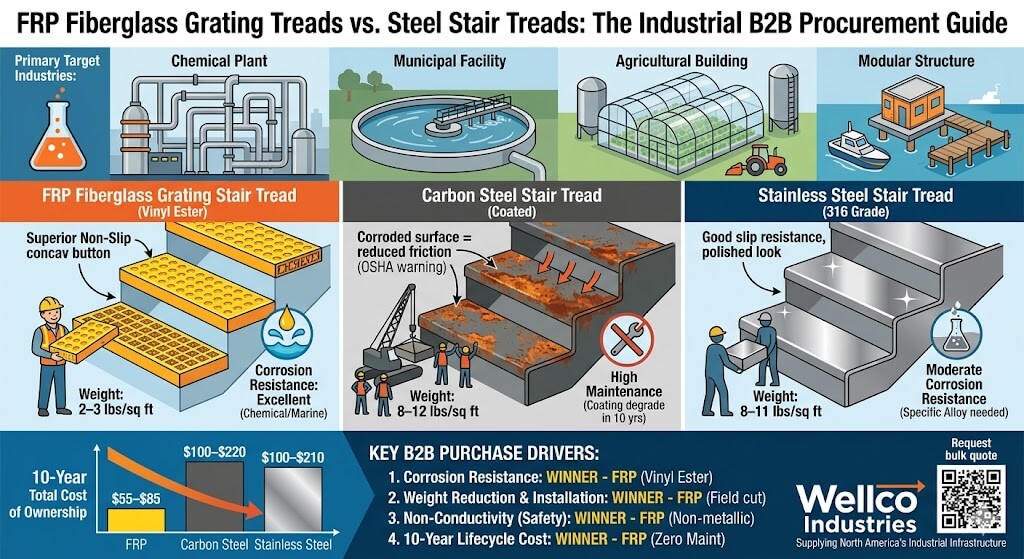
Initial material cost is one line item. Ten-year total cost of ownership is the number that matters for facilities managers and capital project teams. The table below estimates lifecycle costs for a representative 20-tread industrial stair installation across three material options, drawing on RSMeans labor cost benchmarks and ACMA-published FRP lifecycle data for the maintenance and replacement figures:
| Cost Category | FRP Fiberglass | Carbon Steel | Stainless Steel |
|---|---|---|---|
| Initial Material Cost (per tread, approx.) | $35–$65 | $20–$40 | $80–$150 |
| Installation Labor (relative) | Low | Moderate–High | Moderate–High |
| Annual Maintenance Cost (per tread) | $0–$2 | $8–$18 | $2–$6 |
| Expected Replacement Cycle | 25–50 years | 10–15 years | 20–30 years |
| Estimated 10-Year Total Cost (per tread) | $55–$85 | $100–$220 | $100–$210 |
Actual costs vary by facility size, environment, and regional labor rates. The directional conclusion, however, is consistent across environments with any corrosion exposure: FRP’s higher upfront unit cost is typically recovered within 3–5 years through eliminated maintenance spend, with replacement cycle extension delivering compounding savings through year 10 and beyond.
6. Selecting the Right FRP Tread for Your Application
6.1 Resin Selection by Environment
Resin selection is the critical specification variable — not all FRP treads perform equally across all environments. Polyester resin systems cover the broadest range of general industrial applications: moderate chemical exposure, standard temperature ranges, and dry-to-moderately-wet conditions. Vinyl ester resin extends chemical resistance significantly, making it the standard choice for chemical processing, marine splash zones, and aggressive wash-down environments. Phenolic resin systems are specified where fire resistance is a code or insurance requirement, with ASTM E84 Class 1 flame spread performance achievable — common in offshore platforms, transportation hubs, and petrochemical facilities.
Mismatching resin to environment is one of the most common specification errors in FRP procurement. A polyester-resin tread installed in a chlorine-exposure environment will degrade faster than a properly specified vinyl ester unit — and in some aggressive environments, faster than the carbon steel it replaced. If your environment involves moisture, chemicals, electrical hazard, or elevated and retrofit structures, verifying resin specification against exposure class before purchase is non-negotiable.
6.2 Wellco Industries’ FRP Grating Tread Offering
For buyers ready to move from specification to procurement, Wellco Industries stocks the full range of resin profiles described above through its Ecopultrusion manufacturing partnership — a relationship built on supplying FRP grating systems to industrial, agricultural, and municipal buyers across North America. Standard tread profiles ship from a 90,000 sq ft U.S. warehouse network for fast fulfillment to customers throughout the continental United States and Canada. Custom sizing, surface profile selection, and OEM configuration are available for large-format or specification-driven projects.
Wellco’s wholesale structure is flexible: orders start from single units, orders above $300 qualify for free shipping, and long-term volume buyers access tiered pricing and dedicated account support. For procurement teams evaluating a full stair system installation or requiring application-specific resin and surface profile guidance, Wellco’s Ecopultrusion design team provides direct technical consultation.
Conclusion
For environments that check any of the following boxes — moisture, chemicals, electrical hazard, or elevated and retrofit structures — FRP fiberglass grating stair treads deliver a clear and defensible performance advantage over steel alternatives. For high-load, dry interior applications with no corrosion exposure, carbon steel remains competitive on a unit-cost basis. The specification decision is environmental, not categorical.
Four concrete takeaways for procurement managers finalizing a material decision:
- Corrosion resistance — In wet, chemical, or coastal environments, FRP eliminates the maintenance cycle that makes carbon steel’s low purchase price misleading over a 10-year asset life.
- Electrical safety — Non-conductive FRP, tested at 40–60 kV/mm per ASTM D-229, is the only technically appropriate choice in electrical or arc-flash sensitive environments.
- Lifecycle cost — FRP’s 10-year total cost of ownership is consistently lower than carbon steel in any environment with corrosion exposure, with payback typically achieved within the first 3–5 years.
- Resin specification — Match resin type to exposure class before purchasing. Polyester for general industrial, vinyl ester for chemical or marine, phenolic for fire-rated environments.
[Request a bulk quote from Wellco Industries →]
Frequently Asked Questions
Q1: What is the minimum order quantity for FRP grating stair treads from Wellco Industries? Wellco Industries offers flexible ordering with no enforced minimum unit quantity — you can purchase individual replacement treads or full stair system quantities. Orders exceeding $300 qualify for free shipping across the continental U.S. and Canada. Long-term volume buyers are eligible for tiered wholesale pricing and account-level support.
Q2: Can FRP stair treads be custom-sized for non-standard stair configurations? Yes. Through Wellco’s Ecopultrusion manufacturing partnership, custom tread lengths, widths, and surface profiles are available for specification-driven or retrofit projects. Standard profiles can also be field-cut on-site using carbide-tipped circular saw blades without requiring specialized equipment or hot-work permits.
Q3: Which resin system should I specify for a coastal marine or chemical plant environment? Vinyl ester resin is the standard specification for chemical processing, marine splash zones, and aggressive wash-down environments. It provides significantly higher chemical and moisture resistance than polyester resin. For fire-rated environments — offshore platforms, petrochemical facilities, transportation hubs — phenolic resin with ASTM E84 Class 1 flame spread performance is the appropriate choice.
Q4: What certifications or compliance standards apply to Wellco’s FRP grating stair treads? FRP grating stair treads supplied through Wellco’s Ecopultrusion partnership are engineered to meet OSHA 1910.23 walking-working surface requirements and are tested for dielectric strength per ASTM D-229. Surface profiles are available in OSHA-compliant anti-slip configurations. Buyers with project-specific code requirements should contact Wellco’s technical team to confirm applicable certifications for their installation environment.
Q5: What is the expected service life of FRP stair treads, and does the warranty cover corrosion? Industrial-grade FRP grating stair treads typically deliver 25–50 years of service life in corrosive environments — significantly longer than coated carbon steel, which requires recoating and replacement on a 10–15 year cycle in similar conditions. Specific warranty terms vary by product line and order volume. Contact Wellco Industries directly to confirm warranty coverage for your application and resin specification.