
- April 29, 2026
- Posted by: wellcoindustries
- Category: Fiberglass Stakes
Every growing season, thousands of growers across North America pull rotted wood stakes and snapped bamboo poles out of the ground — only to buy replacements and repeat the cycle. A 500-stake vegetable operation spending $0.50–$1.00 per bamboo stake annually can burn through $2,500–$5,000 in staking costs over five years without even realizing it. That money disappears into the compost pile along with the failed stakes.
This article puts fiberglass, wood, and bamboo plant support stakes side by side across durability, field performance, safety, and total cost of ownership. The data draws on ASTM testing protocols, university extension research, and field observations from commercial growing operations. Wellco Industries, a California-based supplier partnered with Ecopultrusion for FRP manufacturing and operating 90,000 square feet of warehouse space across the US, provides product-level context where relevant. By the end, you will have the data you need to decide which material belongs in your next bulk order.
Why Stake Material Matters More Than You Think
Stake selection rarely gets the attention it deserves during pre-season planning. Most buyers default to whatever they used last year. That habit costs more than it should.
The Real Cost of Frequent Replacement
Bamboo stakes typically last one to two seasons before cracking, splitting, or degrading beyond reuse. Untreated wood stakes fare slightly better at two to three seasons but still succumb to moisture, insects, and ground-contact rot. Fiberglass plant support stakes, by contrast, routinely deliver seven to ten years of service with zero chemical treatment required.
Run the numbers on a modest 1,000-stake operation. At $0.75 per bamboo stake replaced every 1.5 seasons, you spend roughly $2,500 over five years on stakes alone — not counting the labor to pull, dispose, and re-install. A fiberglass plant support stake at $1.50–$2.50 upfront (2025 US wholesale pricing), replaced zero times in that same window, costs $1,500–$2,500 total. The break-even point often arrives before the end of year two.
Impact on Plant Health and Yield
Stake failure is not just a budget problem — it is a crop risk. Wood stakes that absorb moisture become breeding sites for fungal pathogens like Fusarium and Botrytis. Bamboo is especially prone to mold colonization in humid climates. Growers in the Southeast United States consistently report finding gray mold transfer from degraded bamboo stakes to tomato and pepper stems at the tie-in point — an observation supported by university extension guidance recommending non-porous staking materials in high-humidity production systems.
Splintered stakes also wound plant tissue, creating entry points for bacterial infection. Fiberglass eliminates both risks: its non-porous surface does not absorb water, harbor fungi, or splinter under load. Healthy stakes mean healthier plants — and fewer losses at harvest.
Material Properties: Fiberglass vs Wood vs Bamboo
The plant health advantages of fiberglass trace directly back to measurable material differences. Understanding the physical characteristics of each staking material removes guesswork from the purchasing decision.
Durability and Weather Resistance
Fiberglass reinforced polymer (FRP) stakes resist UV radiation, moisture, insects, and chemical exposure. Quality FRP stakes include UV inhibitors that prevent surface degradation even after years of direct sun exposure. Per ASTM D4329 accelerated weathering protocols, well-manufactured FRP retains over 90% of its flexural strength after the equivalent of ten years of outdoor exposure.
Wood, even pressure-treated varieties, absorbs moisture and swells. Over freeze-thaw cycles, this leads to cracking and structural weakening. Bamboo, while naturally strong when fresh, loses roughly 30–40% of its flexural strength within 18 months of outdoor ground contact, as measured under ASTM D7264 three-point bend testing conditions. Once that degradation begins, failure under wind or fruit load becomes unpredictable.
Strength-to-Weight Ratio
A standard 4-foot fiberglass plant support stake (3/8-inch diameter) weighs approximately 2–3 ounces and supports lateral loads that would snap a bamboo pole of equal diameter. Fiberglass delivers a tensile strength in the range of 100,000–150,000 psi depending on resin and glass fiber content — roughly five to six times higher than most hardwoods on a per-weight basis.
This matters at scale. A pallet of 1,000 fiberglass stakes weighs significantly less than the wood equivalent, cutting freight costs and reducing physical strain during installation. One crew member can carry a bundle of 50 fiberglass stakes with one hand. Try that with oak or pine.
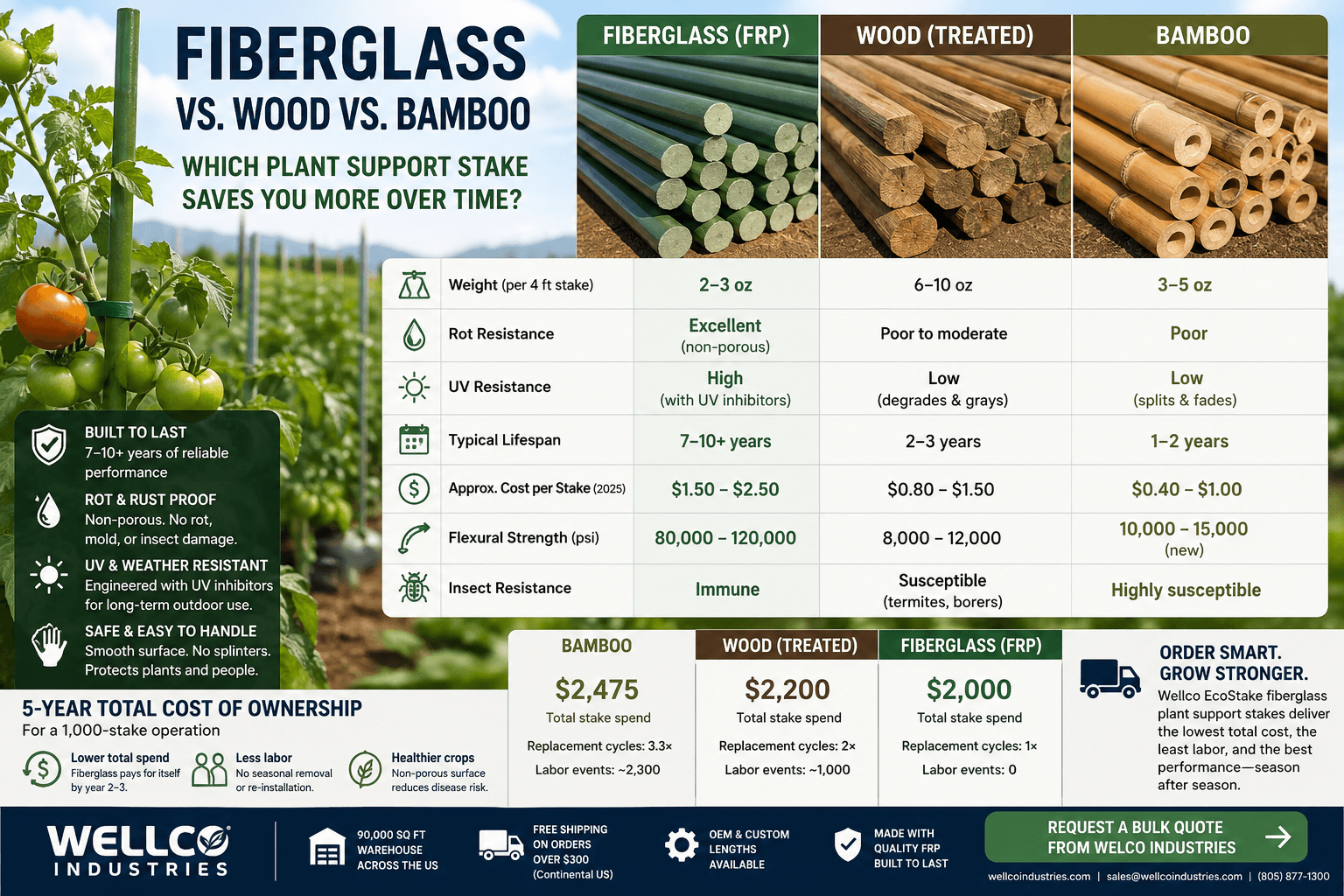
The table below compares the core performance characteristics of fiberglass, wood, and bamboo plant support stakes at 2025 wholesale pricing for the continental US:
| Property | Fiberglass (FRP) | Wood (Pine/Oak) | Bamboo |
|---|---|---|---|
| Weight (per 4 ft stake) | 2–3 oz | 6–10 oz | 3–5 oz |
| Rot Resistance | Excellent — non-porous | Poor to moderate | Poor |
| UV Resistance | High (with UV inhibitors) | Low — degrades and grays | Low — splits and fades |
| Typical Lifespan | 7–10+ years | 2–3 years (treated) | 1–2 years |
| Approx. Cost per Stake | $1.50–$2.50 | $0.80–$1.50 | $0.40–$1.00 |
| Flexural Strength (psi) | 80,000–120,000 | 8,000–12,000 | 10,000–15,000 (new) |
| Insect Resistance | Immune | Susceptible (termites, borers) | Highly susceptible |
Fiberglass leads in every durability and strength metric. Wood and bamboo hold an advantage only on initial purchase price — an edge that disappears once replacement cycles enter the equation. One area where fiberglass does require attention: FRP can be brittle under sharp lateral impact at acute angles, so it is not the best choice for applications involving repeated mechanical bending. For straight vertical or slightly angled staking — which covers the vast majority of horticultural use cases — this limitation is rarely relevant.
Field Performance: Where Each Material Wins and Fails
The table above quantifies what each material can do in a lab. What follows is what actually happens across real growing seasons, in real soil, under real weather.
Vegetable Gardens and Row Crops
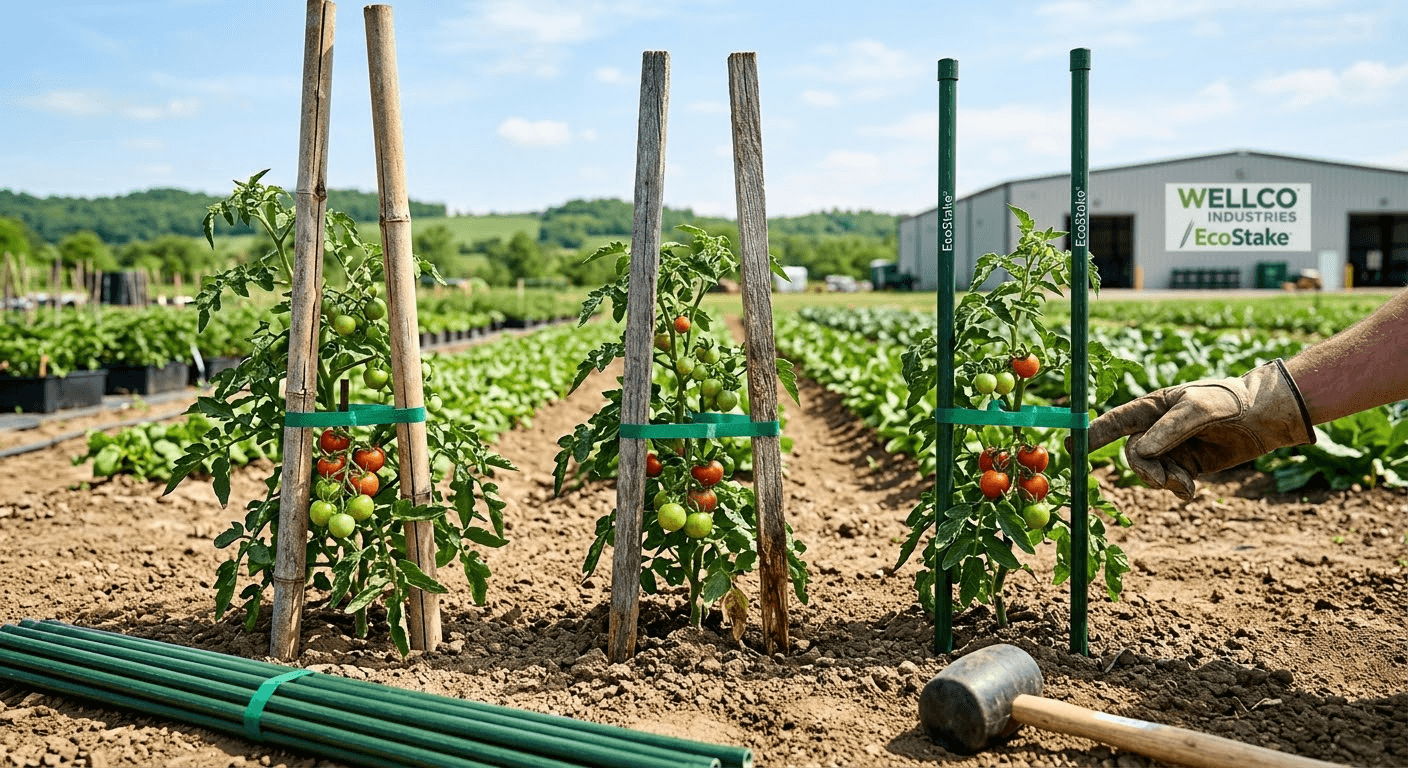
Tomato staking is the single largest use case for plant support stakes in North American agriculture. A commercial tomato grower running 5,000 row feet needs stakes that hold up under fruit load, wind, and daily contact with irrigation water. Fiberglass handles all three without degradation.
Experienced growers who switched from bamboo to fiberglass plant support stakes report that their re-staking labor dropped to near zero after the first season. One large-scale pepper operation in California’s Central Valley eliminated mid-season stake replacements entirely after transitioning — a task that had previously required two crew members for a full day every six weeks.
Vineyards and Orchards
Permanent and semi-permanent trellis installations in vineyards demand stakes that last as long as the vines themselves. A grapevine planted today will produce for 20–30 years. Replacing bamboo stakes every two years in a vineyard is not practical — it risks damaging established root systems and disrupts trellis wire tension.
On a 15-acre Pinot Noir planting in Oregon’s Willamette Valley, the vineyard manager found that fiberglass stakes maintained trellis wire tension through three consecutive wet winters without a single post failure. The same site had previously required replacing 8–10% of its wooden posts each spring due to ground-level rot — a maintenance cycle that disrupted canopy management timing and added unplanned labor costs every year. Fiberglass is increasingly specified in new vineyard plantings where corrosion resistance matters (metal posts rust) and where lightweight handling speeds up installation across hilly terrain.
Nurseries and Greenhouse Operations
Nurseries cycle stakes through hundreds of containers per season. Sanitation is non-negotiable — stakes must withstand cleaning with quaternary ammonium compounds or dilute bleach solutions between uses. A typical nursery sanitation protocol involves soaking stakes in a 10% bleach solution for ten minutes, rinsing, and air-drying before reuse. Wood and bamboo absorb these chemicals, break down faster, and cannot be reliably sanitized across more than two or three cycles. Fiberglass wipes clean, resists chemical attack at standard horticultural concentrations, and returns to service immediately with no absorption or residue concerns.
The table below matches each material to its strongest use case and realistic replacement timeline:
| Use Case | Recommended Material | Key Reason | Typical Replacement Cycle |
|---|---|---|---|
| Annual vegetable rows | Fiberglass | Zero rot, full reuse each season | 7–10 years (none during use) |
| Backyard hobby garden | Bamboo | Low upfront cost acceptable for small scale | 1–2 seasons |
| Vineyard / orchard trellis | Fiberglass | Longevity matches vine lifespan | 10+ years |
| Greenhouse / nursery | Fiberglass | Chemical-safe, fully sanitizable | 7–10 years |
| Temporary or single-season display | Wood | Moderate cost, adequate for one use | 1–3 seasons |
Bamboo and wood still make sense for small-scale, short-term, or budget-limited situations. For any operation where stakes stay in the ground or cycle through containers across multiple seasons, fiberglass wins on both performance and economics.
Installation, Handling, and Safety
Strong field performance only matters if a stake is practical to install. Material differences show up quickly on the job site — especially at volume.
Ease of Driving and Positioning
Fiberglass stakes drive cleanly into loam and sandy soils with a rubber mallet or by hand pressure. In heavy clay, a pilot hole or slim dibble speeds things up. The stakes do not bend permanently or mushroom at the top when struck — unlike bamboo, which tends to split at the driving end after a few mallet hits.
Wood stakes handle clay soils reasonably well but require more force due to higher friction from their rough, porous surface. Sharpened tips help, but they also weaken the stake at the point of greatest ground-contact stress.
Worker Safety Considerations
Bamboo splinters are a persistent workplace hazard. Small fiber fragments embed in hands and are difficult to remove, sometimes leading to infection. Wood stakes, especially after a season of weathering, develop rough grain and sharp edges that catch skin during handling.
Fiberglass plant support stakes have a smooth, consistent surface that eliminates splinter risk entirely. A mid-Atlantic nursery operation reported a measurable drop in hand injury incidents after switching its entire 8,000-stake inventory from bamboo to fiberglass — a change that also reduced the need for heavy work gloves during summer installation, improving crew comfort and speed during peak planting weeks.
Total Cost of Ownership: A 5-Year Comparison
Initial price per unit is the number buyers see first. Total cost of ownership is the number that actually matters. The comparison below assumes 2025 wholesale pricing, zero accidental breakage, and does not include tie materials or disposal fees — all of which would further favor fiberglass.
The following table summarizes total stake expenditure for a 1,000-stake operation over five years:
| Cost Factor | Bamboo | Wood (Treated) | Fiberglass |
|---|---|---|---|
| Unit cost | $0.75 | $1.10 | $2.00 |
| Purchase cycles (5 years) | 3.3× | 2× | 1× |
| Total stake spend | ~$2,475 | ~$2,200 | $2,000 |
| Replacement labor events | ~2,300 removals/reinstalls | ~1,000 removals/reinstalls | 0 |
| Break-even vs. fiberglass | — | Year 3 | — |
Fiberglass reaches cost parity with bamboo by year two and with treated wood by year three. Every year beyond that is pure savings. For operations running 5,000 or 10,000 stakes, the difference compounds into thousands of dollars retained.
Factor in reduced crop loss from healthier stakes, lower injury rates, and eliminated disposal fees, and the return on investment strengthens further.
How to Source Fiberglass Plant Support Stakes in Bulk
Selecting fiberglass is the first decision. Selecting the right supplier is the second. When evaluating vendors, prioritize these factors: UV inhibitor quality and documentation, resin type (polyester vs. vinyl ester), available diameter and length options, compliance with relevant ASTM standards, and minimum order flexibility.
Wellco Industries offers the EcoStake line of fiberglass plant support stakes in diameters from 5/16″ to 1/2″ and lengths from 2 ft to 8 ft, with bulk pricing starting at a single case — no high-MOQ barrier for smaller operations. Orders over $300 ship free within the continental United States, fulfilled from a warehouse network totaling 90,000 square feet for fast delivery across North America. OEM and custom length options are available for commercial growers with specific field requirements, and the Ecopultrusion manufacturing partnership ensures consistent FRP quality across production runs.
Whether you are staking a 200-plant hobby greenhouse or outfitting a 10,000-row commercial operation, buying the right stake material at the right price point starts with a conversation.
[Request a bulk quote from Wellco Industries →]
Conclusion
The fiberglass vs. wood vs. bamboo decision is not about which stake is cheapest on day one. It is about which material delivers the lowest total cost, the least labor, and the healthiest crops over the life of your operation.
Fiberglass plant support stakes last 7–10+ years, resist rot, UV, insects, and chemical cleaning agents, and eliminate the seasonal replacement cycle that drains budgets and crew time. Bamboo is the cheapest per-unit option upfront but becomes the most expensive over a five-year window for any operation above hobby scale. Wood sits in between but still degrades, splinters, and demands replacement every two to three years. Total cost of ownership crosses in favor of fiberglass by year two or three — and the savings widen every season after that.
For growers, nursery operators, and procurement managers ready to stop replacing stakes and start compounding savings, fiberglass is the specification that pays for itself.
[Request a bulk quote from Wellco Industries →]
Frequently Asked Questions
Wellco Industries offers bulk pricing starting at a single case, with no high minimum order requirement. This makes fiberglass stakes accessible for both small nurseries testing the product and large commercial operations placing volume orders. Orders exceeding $300 qualify for free shipping within the continental US.
Yes. Fiberglass stakes can be cut with a standard rotary tool or fine-toothed saw. However, cutting generates fine glass fiber dust, so wearing a dust mask and eye protection is recommended. For operations needing non-standard lengths at volume, Wellco offers OEM custom sizing to eliminate on-site cutting entirely.
FRP composites do not absorb water, so they are not subject to the freeze-thaw cracking that destroys wood and bamboo stakes in northern climates. Fiberglass retains its structural integrity across a temperature range of approximately −40°F to 300°F, making it suitable for year-round use in any USDA hardiness zone.
Fiberglass is an inert material — it does not leach chemicals into soil or water. Unlike pressure-treated wood, which may contain copper or other preservatives restricted under organic certification standards, FRP stakes introduce no substances that conflict with USDA National Organic Program requirements. Confirm specific certifier guidelines for your operation.
Under normal horticultural use — vertical staking, standard soil contact, outdoor UV exposure — EcoStake fiberglass stakes are expected to last 7–10 years or longer. Contact Wellco Industries directly for current warranty terms and bulk pricing tiers for your specific order volume.