
- April 22, 2026
- Posted by: wellcoindustries
- Category: Fiberglass Stakes
Introduction
Farming operations in the U.S. spend an estimated $2–4 billion annually on crop support materials — and a significant portion of that budget disappears into stakes that rot, snap, or splinter before the season ends. For growers managing hundreds or thousands of rows, stake failure isn’t a minor inconvenience. It’s a labor event: crews pulled from productive work to reset collapsed trellises, replace broken supports, and salvage crop damage mid-season.
The material you choose for plant stakes determines more than upfront cost. It shapes your labor schedule, your replacement frequency, and your total input spend over multiple growing seasons. This article gives procurement managers and farm operators a direct, data-backed comparison between fiberglass and wood stakes across the metrics that matter most — durability, handling, cost of ownership, and field performance.
What Makes a Good Farming Stake?
Core Performance Criteria
Not all stakes are created equal, and the wrong spec can cost more in labor than it saves in materials. A reliable farming stake must deliver on four fronts: structural load capacity, flexibility under wind and crop weight, resistance to UV degradation, and the ability to withstand prolonged soil moisture contact without breaking down.
Load capacity matters most in high-density vine crops, tomatoes, and orchard training systems where stakes carry significant lateral and vertical pressure throughout the season. Flexibility is equally critical — a stake that shatters under a stress load creates a hazard and a replacement call; one that flexes and recovers keeps the row intact. UV and moisture resistance determine whether a stake survives one season or ten.
Buyers who overlook these criteria and purchase on unit price alone typically discover the real cost in their second or third season, when replacement rates climb and labor hours multiply.
How Farmers Typically Source Stakes Today
Most mid-to-large scale operations source stakes through agricultural distributors, wholesale suppliers, or direct from manufacturers — often in pallet quantities. Volume purchasing is standard, and procurement managers increasingly evaluate suppliers on lead time reliability, bulk pricing tiers, and the ability to supply consistent dimensions across large orders.
Wood stakes — pine, hardwood, and bamboo — have historically dominated the market due to low upfront cost and wide availability. However, growers running multi-season operations are shifting toward engineered alternatives. Wellco Industries’ fiberglass plant stakes represent this shift: purpose-built for agricultural use, consistent in dimension, and engineered to eliminate the single-season replacement cycle that drives up total input costs.
Fiberglass vs. Wood Stakes: A Side-by-Side Comparison
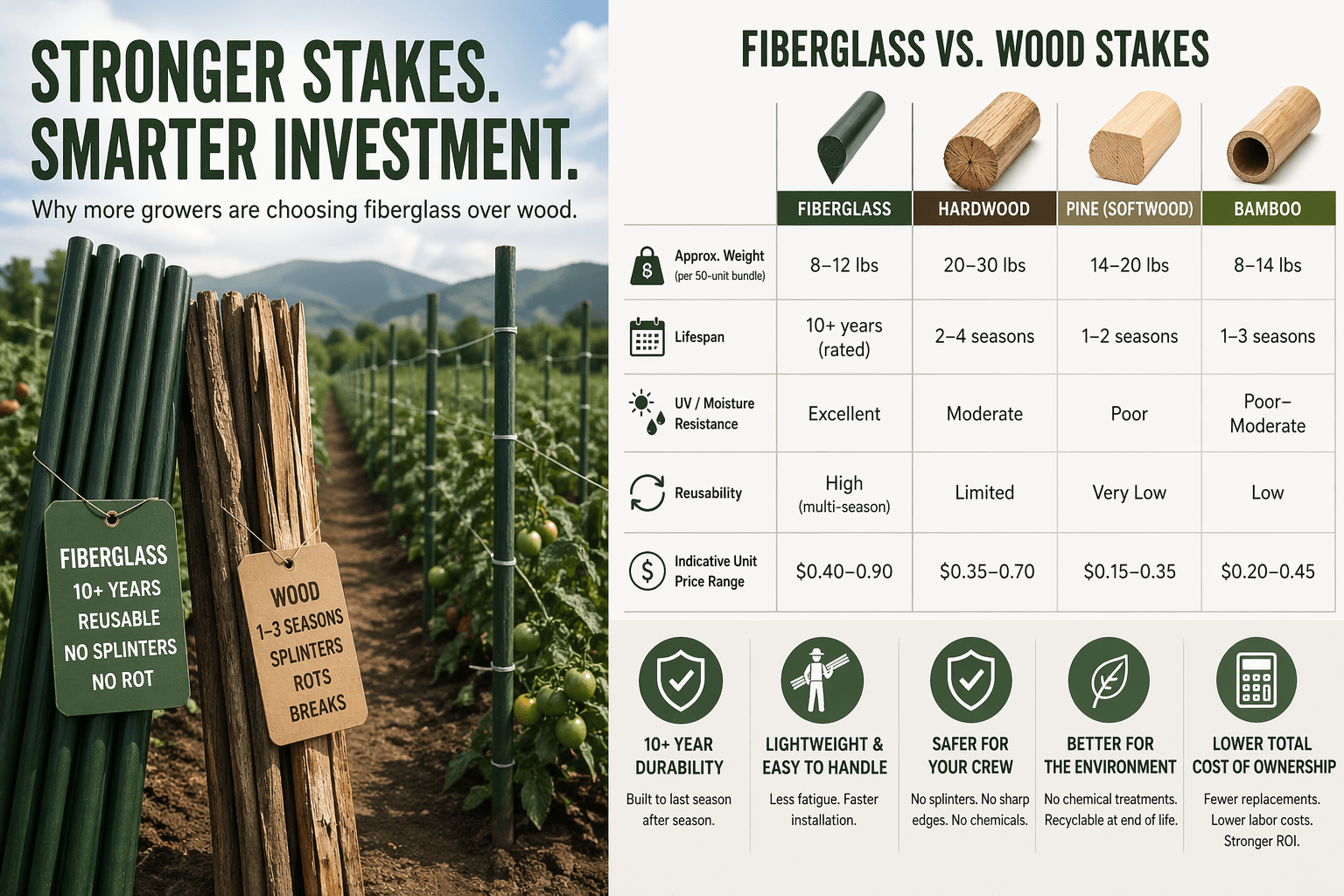
Material selection looks straightforward on a price sheet — but unit cost tells only part of the story. The table below compares fiberglass, hardwood, softwood pine, and bamboo stakes across the performance dimensions that matter most to field operators and procurement teams:
| Material | Approx. Weight (per 50-unit bundle) | Lifespan | UV/Moisture Resistance | Reusability | Indicative Unit Price Range |
|---|---|---|---|---|---|
| Fiberglass | 8–12 lbs | 10+ years (rated) | Excellent | High (multi-season) | $0.40–0.90 |
| Hardwood | 20–30 lbs | 2–4 seasons | Moderate | Limited | $0.35–0.70 |
| Softwood (Pine) | 14–20 lbs | 1–2 seasons | Poor | Very Low | $0.15–0.35 |
| Bamboo | 8–14 lbs | 1–3 seasons | Poor–Moderate | Low | $0.20–0.45 |
Fiberglass carries a higher unit price than pine and bamboo — but that comparison collapses once replacement frequency enters the calculation. An operation replacing pine stakes every one to two seasons will exceed the per-unit cost of fiberglass within the first two to three growing cycles, before accounting for the labor cost of each replacement event.
Durability and Lifespan in Real Field Conditions
Durability claims mean little without field context. The conditions stakes face in agricultural environments — saturated soil, freeze-thaw cycles, UV exposure, fungal pressure, and mechanical stress from harvesting equipment — separate marketing specs from real-world performance.
How Wood Degrades in Agricultural Environments
Wood begins degrading the moment it enters the soil. Moisture absorption triggers cellular breakdown; fungal colonies establish in softwood within one to two seasons under humid conditions; UV exposure bleaches and dries the surface, accelerating cracking and splitting. Treated wood extends these timelines but introduces chemical residues that some certification bodies flag in organic and GAP-compliant operations.
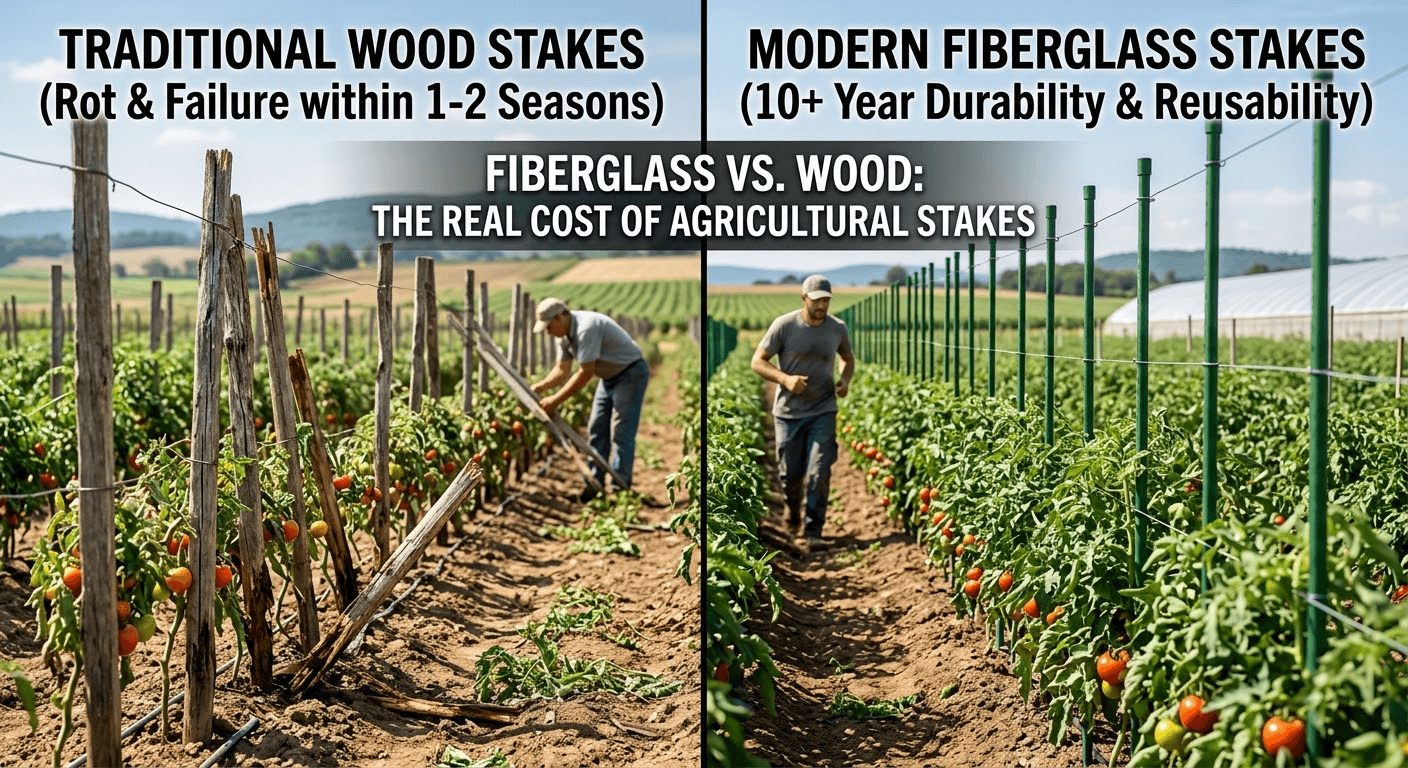
Growers in high-humidity regions report the sharpest degradation rates. On one indeterminate tomato operation in a coastal California county — running approximately 18-inch row spacing across 12 acres — a farm manager documented pine stake failure rates exceeding 30% before the end of a single season, based on field observations logged during mid-cycle scouting. The failure mode was consistent: moisture-driven splitting at the soil line, causing trellis wire to lose tension and requiring full row resets across affected blocks. The labor cost of that reset — two crews over three days — exceeded the original stake purchase price for the affected rows.
Why Fiberglass Outlasts Wood Season After Season
Fiberglass stakes are non-porous by construction. Moisture cannot penetrate the material matrix, eliminating the rot and fungal pathways that degrade wood. UV-stabilized resin systems prevent surface degradation under prolonged sun exposure, and the composite structure maintains dimensional stability across the freeze-thaw cycles that crack and split wood year over year.
Wellco Industries’ fiberglass plant stakes are manufactured to withstand repeated flexural loading and are rated for long-term UV exposure under accelerated weathering conditions consistent with ASTM G154 test protocols. Field-rated service life exceeds 10 years under normal agricultural use — compared to one to three seasons for untreated softwood and two to four for hardwood under comparable exposure. Growers who have transitioned to fiberglass consistently report stakes returning from the field at the end of a season in reusable condition: shaft integrity intact, no surface cracking, ready for re-bundling and next-season deployment.
Installation, Handling, and Labor Considerations
Durability in the field matters — but the total cost of a staking program includes every hour your crew spends handling, driving, and replacing materials across the season. Weight, flexibility, and worker safety all factor into that calculation at scale.
Weight, Flexibility, and Ease of Use
Fiberglass stakes are significantly lighter than hardwood alternatives of equivalent diameter. Crews running 8-hour installation days across 20-acre blocks or more report meaningfully less hand and arm fatigue handling fiberglass bundles compared to equivalent hardwood stake quantities — a practical efficiency gain that compounds across large planting operations.
More importantly, fiberglass flexes under load rather than snapping. In high-wind events or under the weight of heavily fruiting plants, a fiberglass stake bends and recovers; a wood stake of comparable spec often splits or fractures at the point of maximum stress. Worker safety is a factor procurement managers frequently underweight until an incident occurs. Wood stakes splinter during installation and under breaking load — a recognized hand and eye hazard in field crews. Fiberglass stakes present no splinter risk and carry no chemical treatment residues, making them compatible with organic certification requirements and reducing PPE friction across installation crews.
Installation Comparison
The table below breaks down the key installation and handling factors across the three most common stake materials:
| Factor | Fiberglass Stakes | Hardwood Stakes | Bamboo Stakes |
|---|---|---|---|
| Weight per 50-unit bundle | 8–12 lbs | 20–30 lbs | 8–14 lbs |
| Drive-in ease | Easy (smooth, uniform shaft) | Moderate (surface variation) | Moderate (node resistance) |
| Snap/break risk | Very Low (flexible composite) | Moderate | Moderate–High |
| Surface safety | No splinters, no treatment residue | Splinter risk | Splinter and crack risk |
| Reusability | High | Low | Very Low |
For large-scale operations, the cumulative labor advantage of lighter, safer, reusable stakes compounds across every planting cycle — particularly in perennial crops where the same staking infrastructure is reset annually.
Cost Analysis: Upfront Price vs. Total Cost of Ownership
The most common objection to fiberglass stakes is unit price. On a per-stake basis, fiberglass costs more than pine — sometimes by a factor of two or three at the low end of the pine price range. That comparison, however, is structurally misleading when replacement frequency and labor costs enter the model.
One orchard operation in California’s Central Valley tracked its stake spend across four seasons after transitioning from pine to Wellco fiberglass plant stakes. In their final pine season, replacement rates ran at 25–35% mid-cycle, requiring a secondary purchase and approximately two and a half days of crew labor for reset across affected rows. In the three fiberglass seasons since, their replacement rate has held under 2% per season — attributable almost entirely to mechanical damage from equipment contact, not material failure. Their procurement lead calculated a positive ROI on the fiberglass investment within 18 months of switching, factoring in both material and avoided labor costs. This represents a single operation’s experience and outcomes will vary by crop type, soil conditions, and installation practice — but the directional cost argument holds across most high-replacement-rate wood stake scenarios.
Wellco Industries has supplied fiberglass agricultural products to growers across North America through its U.S. warehouse network, operating 90,000 square feet of distribution capacity for consistent lead times to domestic and Canadian buyers. Bulk wholesale pricing applies to orders over $300 with free shipping, OEM and ODM customization is available for non-standard sizing, and a 1-unit minimum order policy allows procurement teams to run material trials before committing to volume.
Environmental and Compliance Considerations
Environmental sourcing is an increasingly active factor in agricultural procurement, particularly for operations pursuing organic certification, GAP compliance, or sustainability reporting requirements. Wood stakes — especially pressure-treated variants — can introduce chemical residues into the soil and carry deforestation-linked sourcing concerns depending on region of origin.
Fiberglass stakes require no chemical treatment to achieve their performance characteristics. They generate no chemical soil inputs across their service life, and their 10-year-plus rated lifespan means significantly fewer units manufactured, shipped, and disposed of per acre per decade compared to annual or biennial wood replacement cycles. At end of life, FRP composite materials are recyclable through appropriate industrial processing channels, supporting circular procurement goals for operations with documented sustainability targets.
For procurement managers documenting material inputs for certification audits, fiberglass stakes offer a cleaner compliance profile than treated wood alternatives — with no soil-active chemical concerns to disclose.
Conclusion
The fiberglass vs. wood comparison resolves clearly once you move beyond unit price and account for the full season-over-season cost picture:
- Lifespan: Fiberglass stakes are field-rated for 10+ years; softwood rarely survives two seasons under humid or high-moisture field conditions.
- Labor cost: Lower replacement rates translate directly to fewer crew hours diverted from productive field work — a compounding advantage in perennial and multi-cycle crops.
- Safety: No splinters, no chemical treatment residues, no mid-season structural failure hazards for installation crews.
- Compliance: Compatible with organic certification and GAP requirements due to the absence of chemical soil inputs.
- Total cost: On a per-season, per-acre basis, fiberglass consistently undercuts wood within two to three growing cycles when replacement and labor costs are included in the model.
If your operation is still running a one-to-two season replacement cycle with pine or bamboo, run the numbers on your last three seasons of stake spend — then [request a bulk pricing sheet for fiberglass plant stakes from Wellco Industries →].
Frequently Asked Questions
Wellco offers a 1-unit minimum order, making it straightforward for new buyers to run a field trial before committing to volume. Bulk wholesale pricing and free shipping apply to orders over $300, with member discount tiers available for long-term volume accounts.
Wellco fiberglass plant stakes are available in a range of standard lengths and diameters suited to common crop support applications. For non-standard dimensions or large-volume custom requirements, OEM and ODM options are available — contact Wellco Industries directly to discuss specifications for your operation.
Fiberglass stakes contain no chemical treatments or soil-active residues, making them broadly compatible with organic certification requirements. Buyers should confirm compliance with their specific certifying body, as program standards vary — but fiberglass presents no chemical input concerns that treated wood stakes may raise.
Wellco Industries sells through its own website, Wellco Store, and third-party platforms including Amazon and Walmart. Volume buyers can access wholesale pricing, and long-term accounts are eligible for member discount pricing and custom OEM/ODM orders. With 90,000 sq ft of U.S. warehouse capacity, Wellco ships consistently to buyers across the continental U.S. and Canada.
Wellco fiberglass plant stakes are rated for 10-plus years of service under normal agricultural use. Actual outcomes depend on soil conditions, installation method, and mechanical exposure — but unlike wood, fiberglass does not degrade through moisture absorption, fungal attack, or UV surface breakdown, which are the primary failure modes for wood stakes in field environments.