
- April 15, 2026
- Posted by: wellcoindustries
- Categories: Erosion Control, Sandbag
Introduction
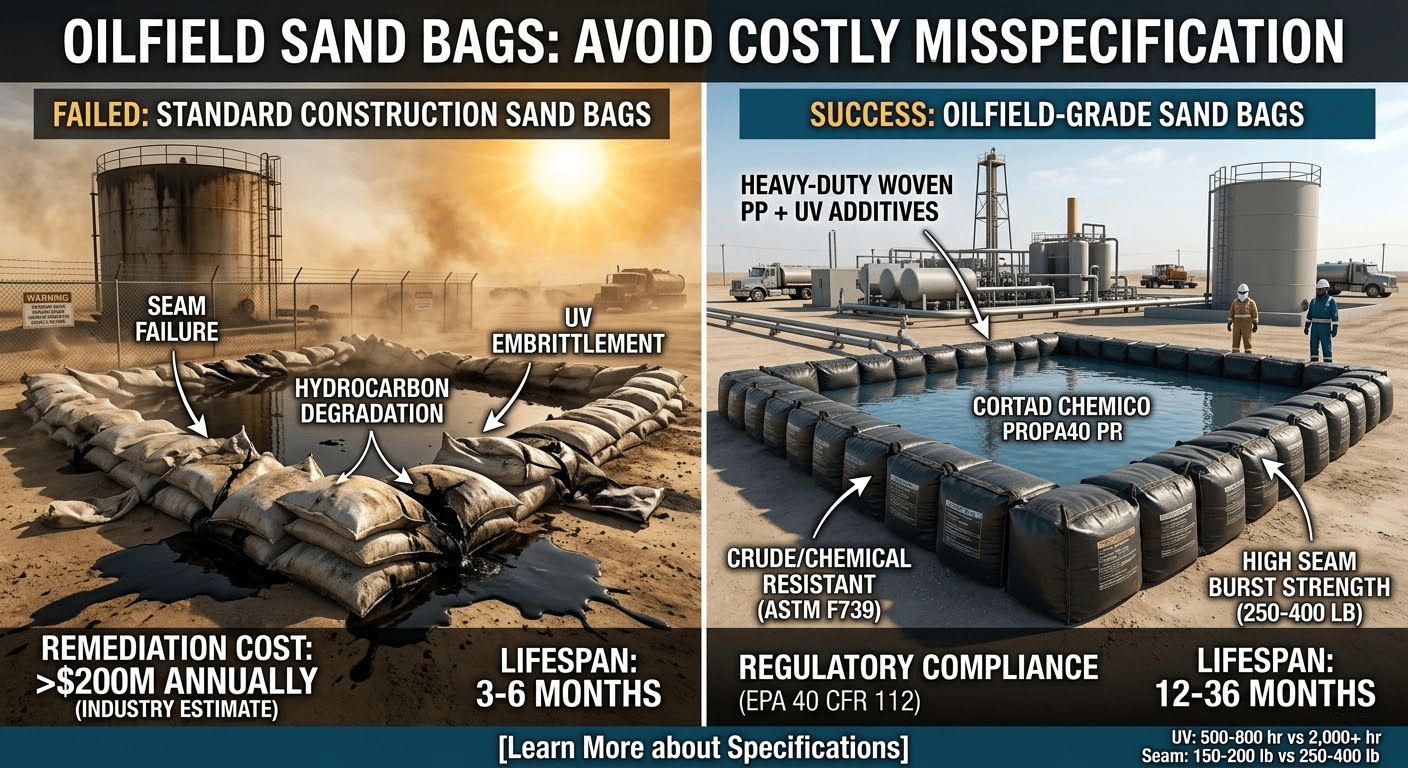
EPA enforcement data and industry remediation cost benchmarks suggest that secondary containment failures cost the US oil and gas industry more than $200 million annually — and misspecified sand bags are a contributing factor that rarely surfaces in incident reports until after the cleanup bill arrives. When a wellpad berm collapses or a pipeline spill barrier saturates and fails, the question that follows is almost always the same: were the right bags specified for this environment?
The answer, in oilfield applications, is frequently no.
Standard construction sand bags dominate procurement catalogues because they are cheap, widely available, and adequate for the conditions they were designed for — seasonal flood control, civil site drainage, and temporary ballast.
Oilfield environments are none of those things. Hydrocarbon exposure, UV radiation, chemical saturation, and year-round outdoor deployment create a failure profile that standard woven polypropylene simply was not engineered to handle. This article breaks down exactly where the specifications diverge, which applications demand oilfield-grade bags, and what buyers and HSE procurement managers need to verify before placing an order.
What Makes Oilfield Environments Different from Standard Construction Sites
The gap between a highway flood barrier and a wellpad secondary containment berm is not just a matter of scale — it is a matter of chemistry, duration, and consequence.
Exposure to Hydrocarbons, Chemicals, and High-Pressure Fluid
Standard woven polypropylene bags degrade rapidly when saturated with crude oil, produced water, or drilling fluids. Hydrocarbon absorption weakens the fiber matrix, reduces tensile strength, and accelerates UV-driven oxidation. In active oilfield environments, this process does not take seasons — it takes weeks.
On a multi-well pad completion project in the Permian Basin, an HSE supervisor documented seam failures in standard polypropylene bags within 45 days of deployment alongside an active separator. The bags had absorbed produced water with high total dissolved solids concentration, softening the fiber matrix and causing lateral seam separation under berm load pressure. The containment berm required emergency replacement mid-operation — at significantly higher cost than an oilfield-grade specification would have carried from the start.
Oilfield-grade bags require a UV stabilization package rated to withstand prolonged hydrocarbon exposure and must maintain seam integrity under the lateral pressure of a contained fluid volume — not just the static weight of dry fill material.
Temperature Extremes and Outdoor Duration
A standard construction sand bag is typically rated for seasonal deployment — spring flooding, a summer civil works project, a winter ballast application. It is not engineered for continuous outdoor exposure across a full annual temperature cycle.
Oilfield operations run year-round and span dramatically different climate zones. A bag deployed on a North Dakota wellpad in January faces −30°F temperatures that embrittle standard polypropylene and cause seam cracking under load. The same bag type deployed in a West Texas summer endures sustained surface temperatures above 140°F, which accelerates UV oxidation and fabric softening.
Oilfield-grade bags must maintain structural performance across this full range — a requirement that standard bags cannot reliably meet, and that buyers must verify through supplier specification sheets and third-party test documentation before procurement.
Material Comparison: Oilfield vs Standard Sand Bags
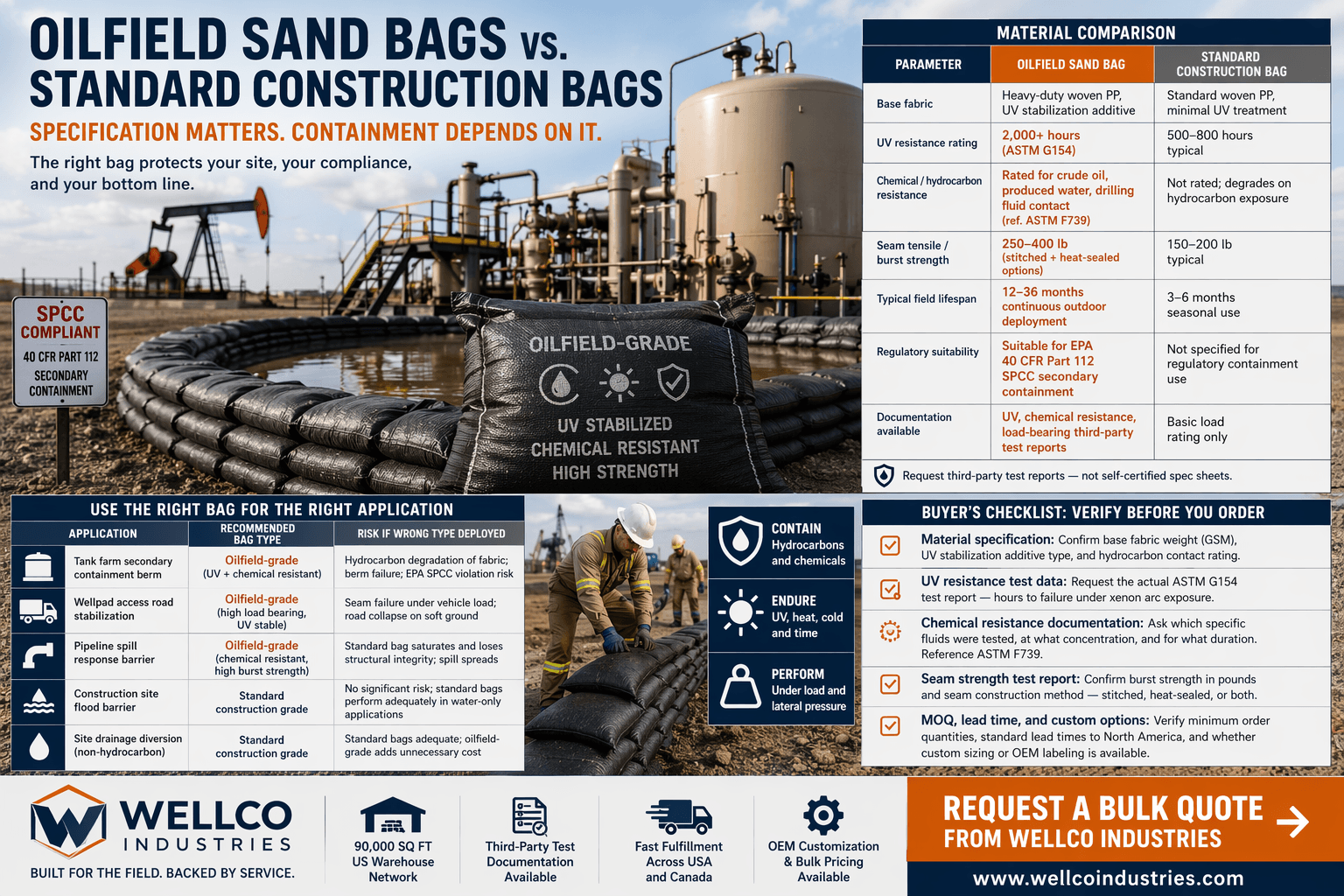
The specification differences between oilfield and standard construction sand bags are not subtle. The table below compares the two product types across the performance dimensions that matter most in field deployment. All lifespan figures reflect typical performance under the stated deployment conditions and will vary with UV exposure intensity, fill material, and hydrocarbon contact frequency.
| Parameter | Oilfield Sand Bag | Standard Construction Sand Bag |
|---|---|---|
| Base fabric | Heavy-duty woven PP, UV stabilization additive | Standard woven PP, minimal UV treatment |
| UV resistance rating | 2,000+ hours (ASTM G154 xenon arc) | 500–800 hours typical |
| Chemical / hydrocarbon resistance | Rated for crude oil, produced water, drilling fluid contact (ref. ASTM F739 permeation standard) | Not rated; degrades on hydrocarbon exposure |
| Seam tensile / burst strength | 250–400 lb (stitched + heat-sealed options) | 150–200 lb typical |
| Typical field lifespan | 12–36 months continuous outdoor deployment | 3–6 months seasonal use |
| Regulatory suitability | Suitable for EPA 40 CFR Part 112 SPCC secondary containment | Not specified for regulatory containment use |
| Documentation available | UV, chemical resistance, load-bearing third-party test reports | Basic load rating only |
Buyers sourcing for oilfield applications should request third-party test reports — not self-certified spec sheets — for UV resistance, seam strength, and chemical compatibility before committing to a bulk order.
Key Application Differences: Where Each Bag Type Belongs
Understanding the performance gap is useful. Knowing exactly which application demands which specification is what prevents costly misdeployment in the field.
Oilfield-Specific Uses
Oilfield-grade sand bags serve three primary functions on active production sites. First, secondary containment berms around above-ground storage tanks, separator vessels, and wellheads — where the bag must contain potential hydrocarbon spills and resist prolonged fluid contact without structural failure. Second, rapid spill response deployment along pipeline corridors, where bags must be positioned quickly, hold under lateral fluid pressure, and survive until remediation is complete. Third, temporary access road stabilization on soft or saturated ground near rig sites, where load-bearing performance under vehicle traffic is the primary requirement.
In all three scenarios, the bag is working continuously, in direct contact with hydrocarbons or chemically contaminated soil, and exposed to ambient UV radiation for months at a time. Standard bags are not designed for any of these conditions.
Standard Construction Uses
Standard construction sand bags perform reliably within their intended envelope. Flood and erosion barriers on civil construction sites, temporary drainage diversion channels, ballast applications for anchoring site equipment and temporary structures — these are seasonal, low-chemical-exposure applications where the lower cost and wide availability of standard bags make them the appropriate choice.
The problem arises when procurement decisions treat these two product categories as interchangeable. They are not.
The Crossover Risk
Mixed-use site environments create the highest misdeployment risk — where a procurement manager sources one bag type for the entire site to simplify purchasing. The table below maps common field applications to the correct bag type and identifies the specific failure mode when the wrong specification is deployed:
| Application | Recommended Bag Type | Risk if Wrong Type Deployed |
|---|---|---|
| Tank farm secondary containment berm | Oilfield-grade (UV + chemical resistant) | Hydrocarbon degradation of fabric; berm failure; EPA SPCC violation risk |
| Wellpad access road stabilization | Oilfield-grade (high load bearing, UV stable) | Seam failure under vehicle load; road collapse on soft ground |
| Pipeline spill response barrier | Oilfield-grade (chemical resistant, high burst strength) | Standard bag saturates and loses structural integrity; spill spreads |
| Construction site flood barrier | Standard construction grade | No significant risk; standard bags perform adequately in water-only applications |
| Site drainage diversion (non-hydrocarbon) | Standard construction grade | Standard bags adequate; oilfield-grade adds unnecessary cost |
On oilfield sites with both civil construction activity and active production infrastructure, a single-SKU procurement approach consistently results in misdeployment at the containment-critical locations — which is precisely where failure consequences are highest.
Performance Specifications Buyers Must Verify Before Ordering
Choosing the right supplier starts with knowing which numbers to request — and which claims to push back on.
UV Stabilization Rating and Chemical Resistance
UV stabilization is the most commonly misrepresented specification in sand bag procurement. A standard bag may list “UV resistant” on its label while carrying a rating of only 500 hours — adequate for a three-month flood season, inadequate for a 24-month wellpad deployment.
Buyers sourcing for oilfield applications should require a minimum UV stabilization rating of 2,000 hours tested to ASTM G154 (xenon arc lamp method). For chemical resistance, ask specifically which substances were tested and at what exposure duration — crude oil, produced water, diesel, and drilling mud are the relevant media for oilfield use. Reference ASTM F739 (standard test method for permeation of liquids and gases through protective clothing materials) as the benchmark for chemical resistance documentation, and ask suppliers to confirm whether their bags have been tested to this standard or an equivalent.
Load Bearing, Fill Weight, and Seam Strength
Standard sand bags are typically rated for 30 to 50 lb dry fill. In secondary containment applications, bags are filled to capacity and then subjected to lateral hydrostatic pressure from contained fluids — a significantly different load profile from a static flood barrier.
Oilfield-grade bags should carry a seam burst strength of at least 250 lb, with stitched and heat-sealed seam options available for high-pressure containment applications. Buyers should request the seam tensile strength test report specifically — not just the bag’s fill weight rating — before approving a supplier for containment applications.
Regulatory and Compliance Considerations
Oilfield secondary containment is governed at the federal level by EPA 40 CFR Part 112 — the Spill Prevention, Control, and Countermeasure (SPCC) rule. Facilities storing more than 1,320 gallons of oil above ground must maintain secondary containment capable of holding the volume of the largest single container plus a precipitation allowance.
Sand bags used as part of an SPCC-compliant containment system must demonstrate performance under hydrocarbon contact — which means buyers need third-party documentation, not just a product description. OSHA 1910.119 (Process Safety Management) may also apply at facilities handling highly hazardous chemicals. Procurement managers should involve their HSE compliance team in the specification process, not just the purchasing department.
How to Source Sand Bags for Oilfield Applications: A Buyer’s Checklist
What separates a compliant oilfield containment setup from a liability risk comes down to three procurement decisions made before the bags leave the warehouse: the right material specification, verified by third-party test data, from a supplier with the volume capacity and documentation to support your compliance file.
Before placing a bulk order, verify these five points with every potential supplier:
- Material specification: Confirm base fabric weight (grams per square meter), UV stabilization additive type, and whether the bag carries a rating for hydrocarbon contact.
- UV resistance test data: Request the actual ASTM G154 test report — hours to failure under xenon arc exposure, not a marketing claim.
- Chemical resistance documentation: Ask which specific fluids were tested, at what concentration, and for what duration. Reference ASTM F739 as your benchmark.
- Seam strength test report: Confirm burst strength in pounds and seam construction method — stitched, heat-sealed, or both.
- MOQ, lead time, and custom options: Verify minimum order quantities for bulk pricing, standard lead times to North American sites, and whether custom sizing or OEM labeling is available for your operation.
Wellco Industries supplies oilfield and construction-grade sand bags factory-direct, with bulk pricing, OEM customization, and a 90,000 sq ft US warehouse network that supports fast fulfillment to sites across the USA and Canada. Oilfield-grade bags are available with third-party UV and chemical resistance test documentation suitable for SPCC compliance files. Samples are available before bulk commitment.
[Request a bulk quote from Wellco Industries →]
Conclusion
The difference between an oilfield sand bag and a standard construction sand bag is not a marketing distinction — it is an engineering one, with real consequences for site safety, regulatory compliance, and operational cost.
Specification matters at the material level. Standard polypropylene degrades under hydrocarbon and UV exposure on a timeline measured in weeks, not seasons. Oilfield environments demand UV-stabilized, chemically resistant fabric with documented third-party test data — not a label claim.
Seam strength determines containment integrity. Fill weight ratings tell you how much a bag holds when filled with dry sand. Seam burst strength tells you whether that bag will hold when it is part of a secondary containment berm under lateral hydrostatic pressure. Only one of those numbers matters in an SPCC compliance context.
Documentation is not optional in regulated environments. EPA 40 CFR Part 112 requires demonstrable secondary containment performance. Procurement managers who cannot produce test documentation for their containment materials face enforcement exposure that no cost saving on bag specification can justify.
Misspecification does not just risk a failed containment event. It risks an EPA notice of violation, a costly emergency remediation, and the operational disruption that follows. Getting the specification right at the procurement stage costs nothing. Getting it wrong costs significantly more.
[Request a bulk quote from Wellco Industries →]
Frequently Asked Questions
Wellco Industries offers flexible MOQ structures designed for both project-based and ongoing site supply needs. Bulk pricing tiers apply at higher volumes, and the US warehouse network supports partial-pallet orders where project phasing requires staged delivery. Contact the Wellco team with your site requirements for a tailored quote.
Yes. Wellco offers OEM customization including custom bag dimensions, fill opening configurations, and company branding. Custom orders require a minimum lead time and volume threshold — contact Wellco Industries directly to discuss your specification and timeline.
Under typical oilfield deployment conditions — continuous outdoor exposure with intermittent hydrocarbon contact — oilfield-grade bags with 2,000+ hour UV ratings typically perform for 12 to 36 months before requiring inspection and replacement. Actual lifespan depends on UV intensity, contact frequency, and fill material. Wellco can provide third-party test data to support your site-specific assessment.
For EPA 40 CFR Part 112 compliance, request third-party UV resistance test reports (ASTM G154), chemical resistance documentation specifying the test media and duration (reference ASTM F739), and seam burst strength test data. Wellco’s oilfield-grade bags are available with this documentation package to support your SPCC compliance file.
Wellco Industries operates a 90,000 sq ft US warehouse network designed for fast North American fulfillment. Standard lead times for bulk orders vary by volume and destination — contact the Wellco team for a site-specific delivery estimate. Expedited options are available for time-sensitive project requirements.