
- April 2, 2026
- Posted by: wellcoindustries
- Category: Fiberglass Stakes
Introduction
Stake failure costs commercial orchard operations an estimated 15–25% of annual establishment labor budgets — not from a single catastrophic event, but from the slow accumulation of leaning posts, split shafts, and mid-season replacements that pull crews away from higher-value work (based on orchard establishment cost analyses from cooperative extension research). For purchasing managers and orchard contractors sourcing plant stakes at scale, the material decision is not a minor line item. It shapes tree training outcomes, replacement frequency, and total cost per planted acre across the full life of an orchard block.
Modern high-density systems — Tall Spindle, Geneva Y-trellis, Bibaum — demand consistent, reliable stake support through the first 3–5 years of establishment. A stake material that underperforms in that window does not just cost money. It costs canopy uniformity and yield potential that cannot be recovered in subsequent seasons.
This article gives you a direct, data-grounded comparison of FRP and wood plant stakes across the dimensions that matter most to B2B buyers: structural performance, environmental durability, labor implications, and total cost of ownership. By the end, you will have a clear framework for specifying the right stake material for your operation — and the right questions to put to any supplier.
Why Stake Material Choice Matters More Than Most Growers Realize
Material selection often gets treated as a procurement afterthought — a commodity decision made on unit price alone. In commercial orchards, that approach is expensive.
The Hidden Costs of Stake Failure in Commercial Orchards
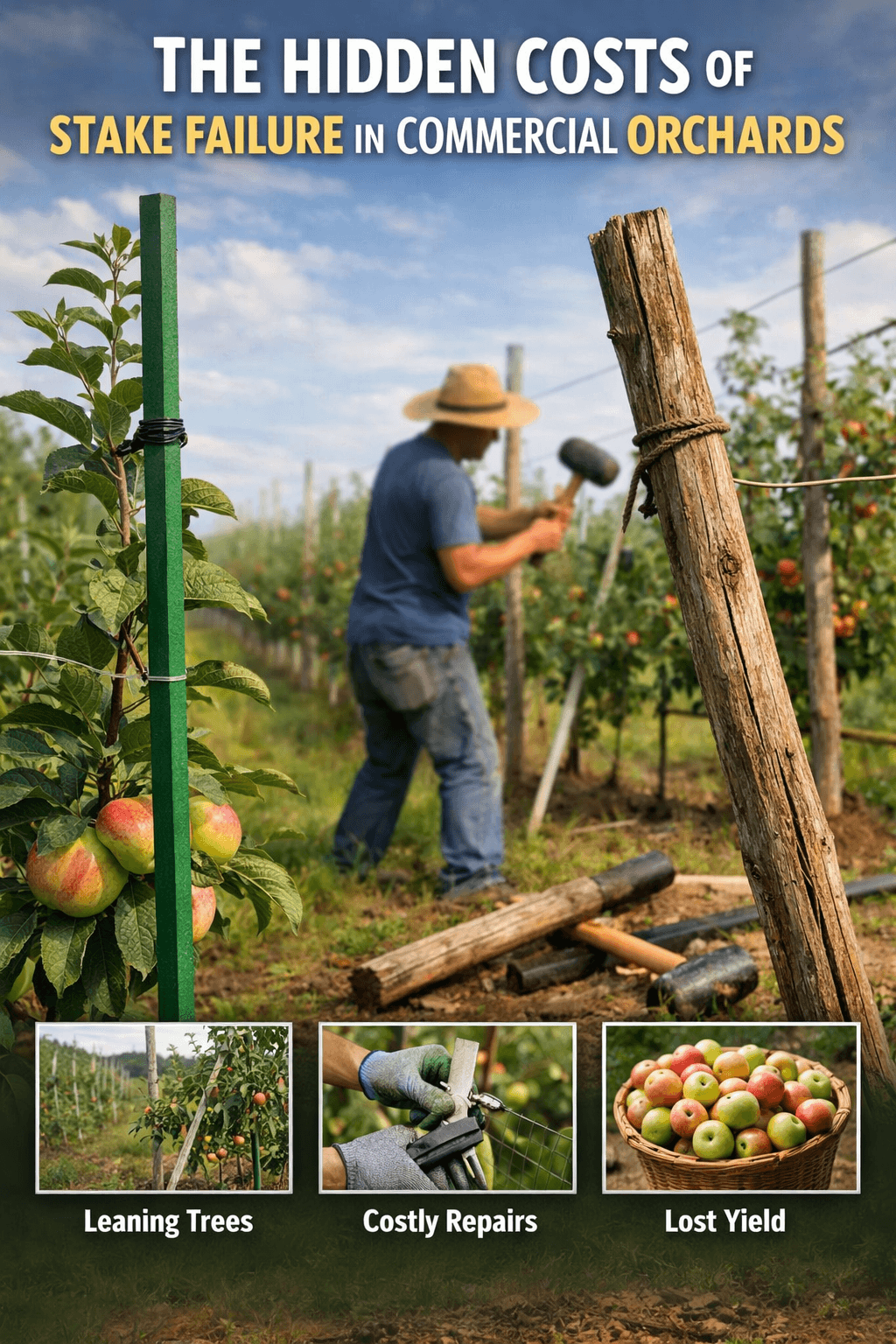
A stake that fails mid-season does not just need replacing. It triggers a cascade: a crew deployment, possible tree damage if the leader has already been tied, and the administrative cost of tracking which rows have been addressed. In high-density apple or pear plantings running 800–1,200 trees per acre, even a 5% stake failure rate represents 40–60 replacement events per acre block.
Contractors working large-scale orchard establishment projects consistently report that labor — not materials — is the dominant cost in stake replacement. At typical orchard labor rates, each replacement event including travel, removal, re-driving, and re-tying runs $3–6 per stake (based on contractor-reported replacement workflows in commercial stone fruit operations). Across a 50-acre block, a 5% annual failure rate on wood stakes can generate $6,000–$18,000 in avoidable labor expense per year.
How Stake Performance Affects Tree Training and Yield Outcomes
Beyond replacement cost, stake performance directly influences canopy development. Modern high-density orchards rely on precise leader training — vertical, consistent, and supported through the first 3–5 years until the tree is self-supporting. Systems like Tall Spindle and Geneva Y-trellis are particularly sensitive to stake variability: the entire planting geometry depends on uniform vertical support across thousands of trees per block.
A stake that leans, twists, or degrades unevenly introduces variability into that training process. Inconsistent stake rigidity across a row translates to inconsistent leader angles, which affects light interception and ultimately yield per acre. Stake reliability, in this context, is an agronomic input — not just an infrastructure detail.
Knowing these compounding costs upfront is what separates a value-based sourcing decision from a unit-price decision — which brings us directly to the material comparison.
FRP Plant Stakes: Properties, Performance, and Field Behavior
Fiber reinforced plastic stakes have moved from specialty product to mainstream orchard input over the past decade, and the reasons are largely structural.
Material Composition and Structural Characteristics
FRP stakes are manufactured from continuous glass fiber strands embedded in a thermoset resin matrix — typically polyester or vinyl ester — and produced through a pultrusion process that aligns fibers longitudinally for maximum tensile strength along the stake’s working axis. Typical tensile strength values for orchard-grade FRP stakes range from 350–550 MPa (tested per ASTM D638 or equivalent tensile test protocol), depending on fiber volume fraction and resin system.
Unlike steel, FRP does not corrode. Unlike wood, it does not absorb moisture, swell, or support fungal growth. The material is chemically inert to the pesticide and fertilizer applications common in commercial orchard management — an important consideration in operations running regular spray programs. UV stabilizers are typically compounded into the resin or applied as a surface coating to prevent photodegradation over multi-season use.
Longevity and Environmental Resistance in Orchard Conditions
Under standard orchard conditions — drip or micro-sprinkler irrigation, seasonal temperature cycling, and routine agrochemical exposure — FRP stakes reliably deliver 10–15 years of functional service life without structural degradation. Wood stakes in the same environment typically require replacement every 3–5 years, and often sooner in high-humidity or high-rainfall regions where ground-line rot accelerates.
Reusability compounds the longevity advantage. When an orchard block is replanted or retrained, FRP stakes can be pulled, cleaned, and redeployed. Wood stakes, particularly softwood varieties, rarely survive extraction intact enough for reuse. Over a 15-year orchard cycle, a grower using wood may purchase and install the equivalent volume of stakes three to four times — each cycle carrying its full labor burden.
Handling, Installation, and Labor Considerations
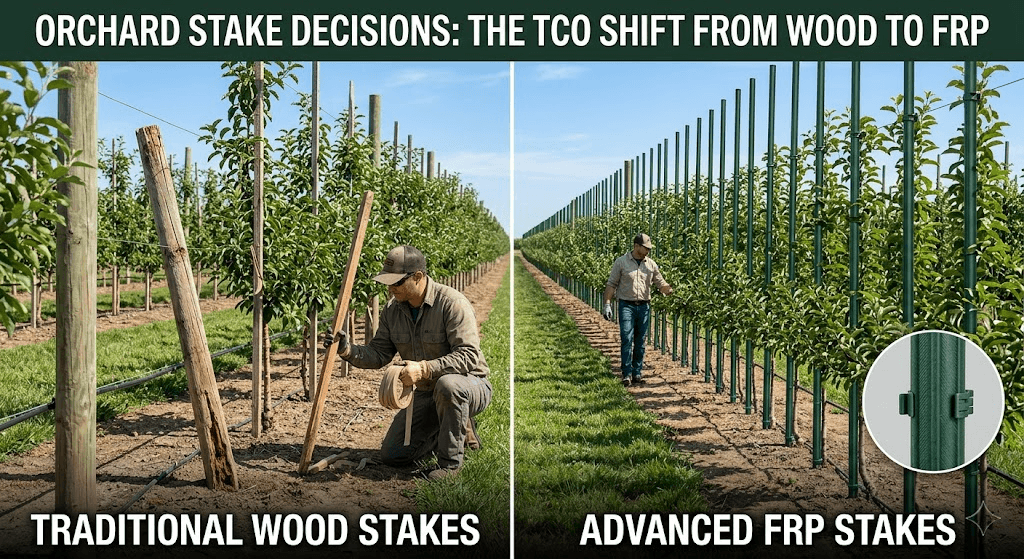
On a 15-acre high-density apple planting in a mid-Atlantic growing region, an installation crew averaged 18% more stakes driven per day with FRP compared to hardwood — attributed primarily to weight reduction and consistent drive-in behavior in clay-loam soil. FRP stakes weigh approximately 30–40% less than equivalent hardwood stakes of the same diameter and length, and that advantage compounds across a 10-hour installation day on large crews.
Drive-in behavior is smooth and consistent — FRP does not split on impact the way wood grain can, particularly in rocky or compacted soils. The ribbed or textured surface of pultruded FRP provides reliable grip for standard tie tape and clips without the bark irregularity sometimes encountered with wood.
The material’s key installation limitation: FRP does not accept staples or nails for trellis wire attachment. Operations requiring stapled wire ties need to account for this in their trellis design or use clip-based attachment systems instead.
The table below compares FRP and wood plant stakes directly across the performance dimensions most relevant to commercial orchard procurement. Cost figures reflect standard commercial volumes and vary by region and order size:
| Property | FRP | Hardwood | Softwood / Pine |
|---|---|---|---|
| Tensile Strength | 350–550 MPa | 50–100 MPa | 30–60 MPa |
| Unit Weight (1.2m stake) | ~0.3–0.5 kg | ~0.7–1.0 kg | ~0.5–0.8 kg |
| Expected Service Life | 10–15 years | 5–8 years | 3–5 years |
| Corrosion / Rot Resistance | Excellent | Moderate (treated) | Poor–Moderate |
| Reusability | High | Low | Very Low |
| Agrochemical Resistance | Excellent | Low–Moderate | Low |
| Typical Unit Cost (1.2m)* | $1.50–$3.00 | $0.80–$1.80 | $0.40–$1.00 |
*Cost ranges reflect standard commercial order volumes; regional pricing and custom dimensions will vary.
Wood Plant Stakes: Where They Still Have a Role
Wood is not obsolete — but the conditions where it delivers genuine value to commercial buyers are narrower than the unit price suggests.
Types of Wood Commonly Used and Their Baseline Properties
Hardwood stakes — typically oak, chestnut, or acacia — offer higher density and greater resistance to ground-line decay than softwood alternatives. Pressure-treated softwood stakes extend lifespan but introduce chemical treatment considerations: buyers operating under GAP certification or organic programs should confirm treatment class against compliance requirements. The AWPA UC4A classification covers ground-contact treatment for wood in agricultural use — a relevant standard when evaluating treated wood stakes for long-term orchard deployment.
Untreated pine and poplar are the lowest-cost entry point but offer the shortest functional life. Most commercial hardwood stakes used in orchards run 25–35mm in diameter at lengths of 1.0–1.8m, with tensile strength figures in the 50–100 MPa range — well below FRP but adequate for standard single-leader support in low-wind environments.
Conditions Where Wood Remains a Practical Choice
Wood stakes make operational sense in three specific scenarios: short-duration nursery plantings where stakes will be removed within 12–18 months, low-volume trial blocks where upfront capital cost is the binding constraint, and regions where FRP supply chains add significant lead time or freight cost that erodes the TCO advantage.
For operations transitioning from wood to FRP, a blended approach — FRP in permanent production blocks, wood in nursery or temporary plantings — can be a practical intermediate step that manages capital outlay without sacrificing long-term performance where it counts most.
Failure Modes and Total Cost of Ownership Over Time
Wood stake failure follows a predictable pattern: surface checking and end-grain moisture uptake begin within the first season, ground-line softening develops by year 2–3, and structural failure — snapping or leaning under tree load — typically peaks in years 3–5. In high-density plantings under drip irrigation in humid climates, the timeline compresses further.
Consider an anonymized example from a mid-scale stone fruit operation in a warm, humid growing region: an initial planting of 20,000 softwood stakes at $0.60/unit represented a $12,000 materials outlay. By year 4, cumulative replacement and re-staking labor had added $22,000 in costs (based on contractor-reported workflows). A comparable FRP installation at $2.20/unit would have cost $44,000 upfront but required significantly reduced replacement labor — limited to incidental damage rather than material degradation — over the same period, closing the TCO gap to roughly $8,000 while delivering 10+ additional years of residual service life.
That TCO math is what drives procurement managers in established commercial operations toward FRP as block size and planting cycles extend.
Sourcing and Specification Considerations for B2B Buyers
The TCO case for FRP is clear — but realizing that advantage in the field depends on specifying the right product and sourcing from a supplier who can deliver it consistently at volume.
Key Specifications to Require from Suppliers
Vague product descriptions (“heavy duty FRP stake”) are not a specification. Buyers sourcing at commercial scale should require documented values for each of the following parameters before committing to a supplier or SKU.
The table below outlines the core specification checklist for orchard-grade FRP stakes:
| Specification | Recommended Value / Range | Why It Matters |
|---|---|---|
| Diameter | 8–16mm (application-dependent) | Undersized stakes flex under tree load; oversized add unnecessary cost |
| Length | 1.0m–1.8m ± 5mm tolerance | Tight tolerance ensures consistent row appearance and uniform leader height |
| Tensile Strength | ≥ 350 MPa | Minimum threshold for single-leader support under Tall Spindle planting densities at standard wind exposure (ASTM D638) |
| UV Stabilization | Confirmed additive or coating | Prevents surface degradation in multi-season outdoor use |
| Surface Texture | Ribbed or textured | Required for reliable grip of tie tape and clip systems |
| Load-Bearing Rating | Supplier-documented | Enables direct comparison across SKUs and suppliers |
| Color / Visibility | Green, black, or brown | Minimizes visual disruption; aids row alignment during installation |
Bulk Purchasing, OEM Options, and Supply Consistency
For purchasing managers sourcing across multiple orchard blocks or distributing to grower networks, supply consistency matters as much as unit specification. Stake diameter and length variation between production batches creates installation inefficiencies and inconsistent tree support — problems that rarely appear in samples but emerge at scale.
Wellco Industries supplies FRP stakes alongside a broad range of complementary agricultural and composite inputs — including erosion control materials — as a vertically integrated source designed for B2B buyers who need consistent product across large volume orders. For distributors and co-ops building house-brand product lines, OEM and private label options are available, with custom sizing to match existing orchard trellis specifications.
When evaluating any supplier at volume, buyers should confirm: minimum order quantities per SKU, production lead times for custom dimensions, batch-to-batch consistency documentation, and whether the supplier can support blanket purchase orders with scheduled releases.
Conclusion
The FRP vs wood decision in commercial orchards comes down to five clear takeaways:
- Unit price is the wrong comparison metric. Total cost of ownership over a 5–10 year orchard cycle consistently favors FRP once replacement labor is factored in — and the gap widens with block size.
- FRP delivers structural performance wood cannot match — higher tensile strength, consistent rigidity, and resistance to the moisture, agrochemicals, and temperature cycling that degrade wood in orchard environments.
- Wood still has a defined role in short-term nursery plantings, trial blocks, and capital-constrained early-stage operations — but as a deliberate, time-limited choice, not a default.
- Specification rigor protects your investment. Require documented tensile strength (≥ 350 MPa per ASTM D638), UV stabilization confirmation, and dimensional tolerances from any supplier — not just a product category name.
- Supplier consistency at volume is non-negotiable. Batch variation in diameter or length creates downstream installation and agronomic problems that erode the performance advantage of any premium material.
[Request a bulk quote or custom specification review from Wellco Industries →]
Frequently Asked Questions
A: MOQ varies by supplier and whether custom dimensions are required. For standard sizes, commercial MOQs typically start at 500–1,000 units per SKU. Contact your supplier directly to confirm MOQ thresholds for non-standard lengths or diameters, as custom production runs generally carry higher minimums.
A: Yes. FRP stakes are chemically inert and do not leach treatment chemicals into the soil, making them compatible with organic certification requirements. If your certifier requires documentation of resin system composition, request a material data sheet from your supplier before purchase.
A: Most commercial FRP manufacturers support custom sizing for volume orders. Lead times for non-standard dimensions typically run 4–8 weeks depending on production scheduling. Distributors and co-ops should discuss blanket order arrangements to reduce lead time variability across the season.
A: In compacted clay or rocky soils, a rubber mallet or pneumatic post driver with a fitted cap is preferred — steel hammer contact on bare FRP can damage the stake tip and compromise surface integrity. Pre-drilling a pilot hole in very rocky conditions extends stake life and protects the fiber matrix at the ground-line entry point. Avoid direct steel-on-FRP percussion without a protective cap.
A: Store horizontally on flat surfaces or vertically in bundled racks to prevent bowing. UV-stabilized stakes tolerate outdoor storage for reasonable pre-season durations, but covered storage in a shed or under tarping is recommended for multi-season inventory. Avoid point-loading during stacking, as concentrated pressure over extended periods can induce minor surface deformation in smaller diameter profiles.