
- March 18, 2026
- Posted by: wellcoindustries
- Category: Rebar
Introduction
If you are searching for fiberglass rebar price, you are likely preparing a budget, comparing suppliers, or trying to move an internal approval forward. In that moment, a long educational article is less useful than a page that helps you estimate costs, understand what changes the quote, and contact a supplier quickly with the right information.
This page is designed for purchasing managers, contractors, distributors, and OEM or private label buyers who need a more practical pricing view. Instead of forcing buyers to dig through general product claims, it focuses on four things that directly support buying decisions: price range structure, lifecycle cost comparison, quotation variables, and fast-response inquiry options.
From a sourcing perspective, one of the most common problems is that two quotes look different even when both say “fiberglass rebar.” In practice, the difference often comes from details such as diameter, length, MOQ, packaging, certification, freight assumptions, and trade terms. That is why a good pricing page should help buyers compare like for like before they ask, “Which supplier is cheaper?”
As a global supplier with a broad FRP portfolio, Wellco Industries can be introduced here in a practical way: not as a hard sell, but as an example of the kind of vertically coordinated supplier many buyers prefer when they need product consistency, export handling, and one-stop support across FRP and related industrial product categories.
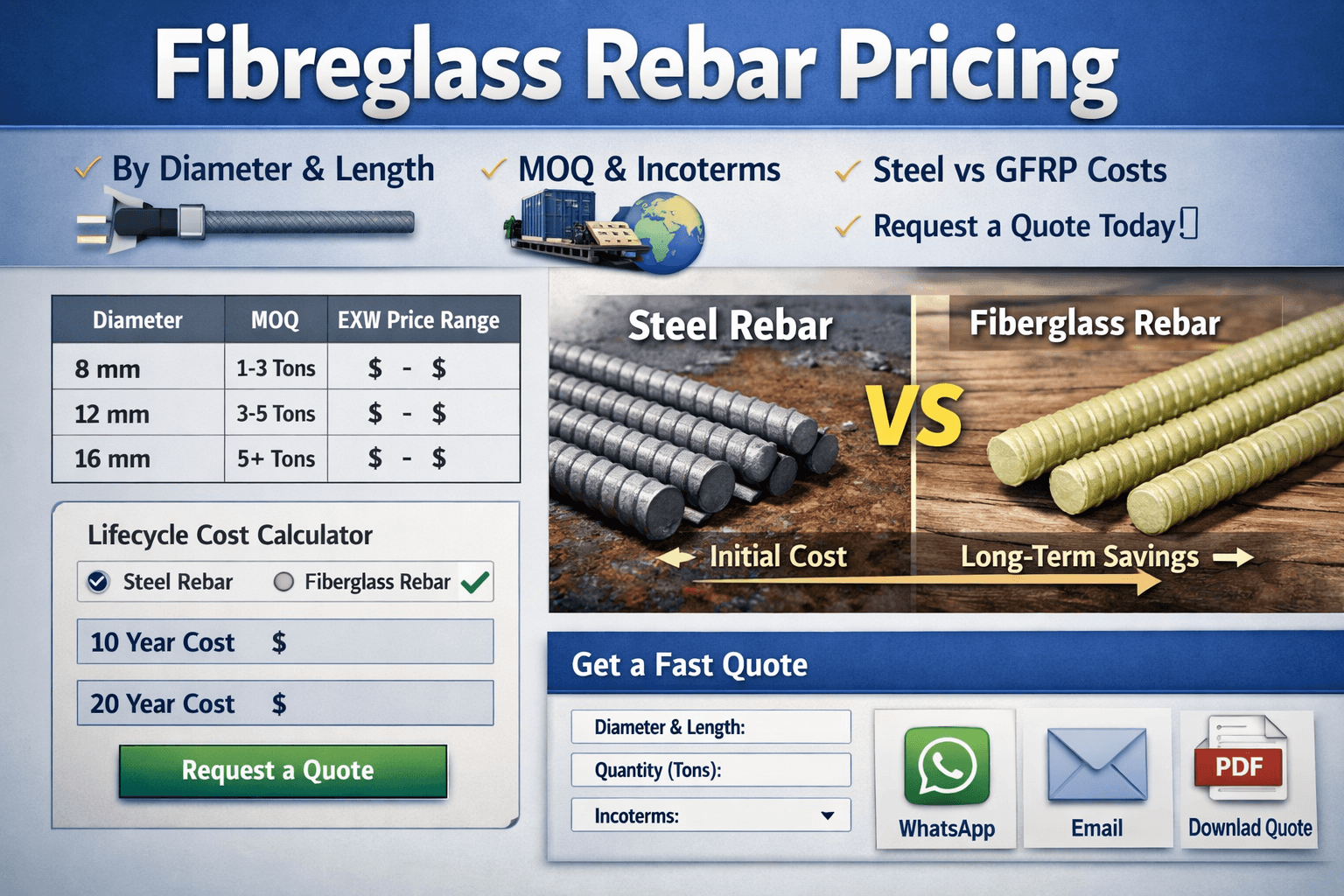
Fiberglass Rebar Price Range at a Glance
A usable price page should give buyers a fast budgeting framework. The table below is best treated as a planning structure for RFQs, internal approvals, and supplier comparison.
Price Range Table by Diameter, Length, MOQ, and Incoterms
| Diameter | Standard Length | MOQ | EXW Price Range | FOB Price Range |
|---|---|---|---|---|
| 6 mm | 6 m / custom | 1-3 tons | Budgetary quote | Budgetary quote |
| 8 mm | 6 m / custom | 1-3 tons | Budgetary quote | Budgetary quote |
| 10 mm | 6 m / 12 m | 3-5 tons | Budgetary quote | Budgetary quote |
| 12 mm | 6 m / 12 m | 3-5 tons | Budgetary quote | Budgetary quote |
| 16 mm | 6 m / 12 m | 5+ tons | Budgetary quote | Budgetary quote |
| 20 mm | 6 m / 12 m | 5+ tons | Budgetary quote | Budgetary quote |
For serious procurement use, the table should sit beside an inquiry form rather than pretend to be a fixed online catalog price. A practical rule used by many industrial buyers is simple: if the quote does not clearly define diameter, length, quantity, and delivery term, it is not ready for internal comparison.
How Buyers Usually Interpret This Table
In real purchasing workflows, buyers often compare at least three things at the same time:
- Product specification
- Volume commitment
- Delivery basis
An anonymized example makes this clearer. A contractor may first request 12 mm bars on a small trial quantity using custom packaging and ask for CIF delivery. Later, after confirming project demand, the same buyer may shift to a larger MOQ, standard export packaging, and FOB terms. The second quote is often materially more competitive, even though the product name stays the same. That kind of change is normal in FRP procurement and is one reason buyers should avoid treating first-round offers as final market truth.
A useful procurement benchmark is to request quotations on the same basis from each supplier. Comparing FOB from one factory and DDP from another almost always creates confusion during internal review.
Quote Page Features That Turn Budgeting into Action
High-intent pages should help buyers move from browsing to inquiry with minimal friction. The best performing industrial quote pages usually combine price logic with clear response channels.
Instant RFQ Form: What It Should Ask
A good inquiry form only asks for information that directly affects the offer. That usually includes:
- Diameter
- Length
- Quantity or annual volume
- End use or application
- Requested Incoterms
- Destination port or country
- Packaging requirement
- Certification or test document needs
- Required lead time
From a practical sourcing standpoint, incomplete RFQs are one of the biggest causes of slow quotation turnaround. When a buyer sends only “Please send fiberglass rebar price,” the supplier still has to ask several follow-up questions before issuing anything comparable. When the first message already includes the variables above, pricing becomes faster and more accurate.
WhatsApp, Email, and PDF Quote Sheet CTA
Not every buyer wants to engage in the same way. Procurement teams often split into three common behaviors:
- Buyers who want a rapid message exchange through WhatsApp
- Buyers who need a formal email thread for records
- Buyers who need a downloadable PDF quote sheet for internal review
That is why a strong price page should include a visible Request a Quote button, a one-click WhatsApp CTA, a direct sales email CTA, and a downloadable PDF quotation format. The PDF option is especially helpful when the purchasing team needs to share preliminary pricing with finance, project managers, or sourcing leadership before requesting a final commercial offer.
Steel Rebar vs GFRP Lifecycle Cost Calculator
Buyers with strong purchase intent often move beyond unit price quickly. The better question is not only “What does it cost today?” but also “What is the likely cost over the service life?”
Why Lifecycle Cost Often Changes the Discussion
A common procurement lesson in corrosive or high-moisture environments is that lower initial material price does not always mean lower project cost over time. When maintenance, replacement cycles, and downtime risk are considered, GFRP can become more attractive in the right application.
The comparison should look at:
- Initial purchase cost
- Freight and handling
- Installation assumptions
- Maintenance frequency
- Replacement interval
- Expected service life
A practical way to structure this is over a 10-year, 20-year, or 30-year planning horizon. That gives procurement teams something more useful to discuss with engineering and finance than a narrow per-ton comparison. It also reflects an important market reality: total ownership cost often matters more when corrosion resistance is part of the specification.
Recommended Inputs for the Calculator
A helpful calculator can ask the buyer to enter:
- Material type: steel or GFRP
- Quantity required
- Freight distance or destination
- Installation labor assumptions
- Maintenance interval
- Replacement cycle
- Project design life
The calculator can then show:
- Initial material cost
- Estimated logistics cost
- Maintenance cost
- Replacement cost
- Total projected lifecycle cost
This tool should be presented with a clear note: it supports procurement planning, not final structural engineering validation. That one sentence materially improves trust because it sets the right expectation and avoids overselling the calculator.
What Affects Fiberglass Rebar Price Most
One of the fastest ways to improve quote quality is to understand which variables move the offer. Buyers often assume price differences come only from supplier margin, but in industrial composites that is rarely the whole story.
Product and Manufacturing Variables
Several technical factors influence fiberglass rebar price:
- Resin type
- Fiber content
- Pultrusion process stability
- Surface profile or coating
- Diameter tolerance
- Mechanical performance level
These details matter because two bars with the same nominal diameter may not be identical in material composition, process discipline, or supporting documentation. This is also where supplier capability becomes commercially relevant. Wellco Industries can credibly position itself here by emphasizing a broad FRP product base, coordinated manufacturing support, and the ability to align product supply with export and documentation requirements for agriculture, construction, and soil and water conservation markets.
Commercial and Delivery Variables
On the commercial side, the biggest quote drivers usually include:
- MOQ
- Packaging standard
- OEM or private label requirements
- Testing reports or certifications
- Production lead time
- Freight method
- Destination market
- Selected Incoterms
In export business, four variables frequently create the biggest pricing misunderstandings: packaging, certification, shipping, and trade terms. A low headline offer may stop looking low once pallet requirements, compliance files, or inland delivery charges are added.
For buyers, the best habit is to standardize the RFQ basis before requesting multiple quotes. That improves both speed and comparability.
How to Get a More Comparable Quote Faster
A better RFQ does not just help the supplier. It also protects the buyer from misleading comparisons and approval delays.
RFQ Checklist Before Contacting Suppliers
Before requesting pricing, prepare the following:
- Required diameter and length
- Quantity or expected annual demand
- Application scenario
- Needed Incoterms
- Destination port or delivery region
- Packaging preference
- Certification or testing needs
- Delivery timeline
This kind of checklist often reduces back-and-forth and helps the supplier respond with a more realistic first offer. In purchasing terms, that means less wasted time and a faster path to a decision-ready quotation.
How to Avoid “Cheap but Not Comparable” Offers
Buyers should be cautious when:
- One quote is based on sample quantity and another on bulk volume
- Freight is included in one offer but excluded in another
- Fiber content or resin type is not defined
- Packaging standards differ
- Certification support is assumed but not listed
A better comparison combines price with lead time, specification clarity, communication responsiveness, and documentation readiness. That is usually a more reliable indicator of supplier value than focusing on a single low number.
Pricing Transparency Note
For industrial buyers, transparency often matters as much as speed. Any listed price bands on a fiberglass rebar price page should be treated as budgetary guidance only.
Final quotations depend on confirmed specifications, quantity, packaging, testing requirements, shipping destination, and trade terms. Lifecycle cost estimates should also be presented as planning tools, not as engineering guarantees. This kind of clear boundary improves trust because it explains exactly what the page can do and where a formal commercial and technical review is still required.
Conclusion
A strong fiberglass rebar price page should help buyers do real procurement work, not just read product marketing. The most useful version combines a structured price range table, a lifecycle cost calculator, a transparent explanation of quote drivers, and fast contact options through form, WhatsApp, email, and PDF quotation download.
For contractors, distributors, and OEM buyers, the fastest way to get a usable offer is to submit the core variables from the start: diameter, length, quantity, MOQ expectation, packaging, destination, and Incoterms. That one step usually improves response speed and makes supplier comparisons much cleaner.
If your team is evaluating supply partners with broader FRP capability, Wellco Industries is well positioned to support discussions that go beyond a single product line, especially where buyers value stable sourcing, export coordination, and one-stop support. Use the instant quote form, contact sales by WhatsApp or email, or download the PDF quote sheet to move your budgeting process forward.
Frequently Asked Questions
Send the diameter, length, quantity, destination, packaging preference, and Incoterms. If you also need certifications, OEM labeling, or a strict delivery schedule, include those details in the first message.
The diameter alone does not define the final offer. Resin system, fiber content, MOQ, packaging, certification scope, and shipping terms can all change the quoted price.
Not always. In some environments steel may have a lower initial cost, but in corrosion-sensitive applications GFRP may reduce maintenance and replacement expenses over time.
Only after normalizing the commercial basis. Comparing different Incoterms without adjustment can make one supplier look cheaper when the difference is really in freight or delivery responsibility.
Usually no. A price table is useful for budgeting and supplier screening, but final approval should rely on a formal quote tied to confirmed specifications and commercial terms.