
- February 26, 2026
- Posted by: wellcoindustries
- Category: Jute Mesh
Introduction
Erosion problems don’t just “mess up the slope”—they hit budgets through sediment cleanup, reseeding, inspection delays, and the dreaded second mobilization. Construction-site runoff can be especially sediment-heavy: EPA notes sediment runoff rates from construction sites are typically 10–20x greater than agricultural lands (and far higher than forest lands).
Jute matting erosion control is a practical, short-term stabilization approach when you need protection long enough for vegetation to establish—without paying for a permanent turf reinforcement system you don’t need. It’s biodegradable, rough-textured, and widely used on slopes and disturbed soils where sheet flow dominates.
For distributors, contractors, and purchasing managers, the best outcomes come down to three levers:
- Match the jute spec to the site risk (slope, soil, flow concentration, exposure time).
- Install it like a system, not a fabric (trench + overlaps + anchoring density).
- Procure consistently (uniform weave, traceable lots, documented specs).
(If you source multiple categories, companies like Wellco Industries position themselves as global suppliers spanning erosion control materials as well as FRP, agricultural, and household product lines—helpful for consolidated procurement and OEM/private label programs where supply consistency matters.)
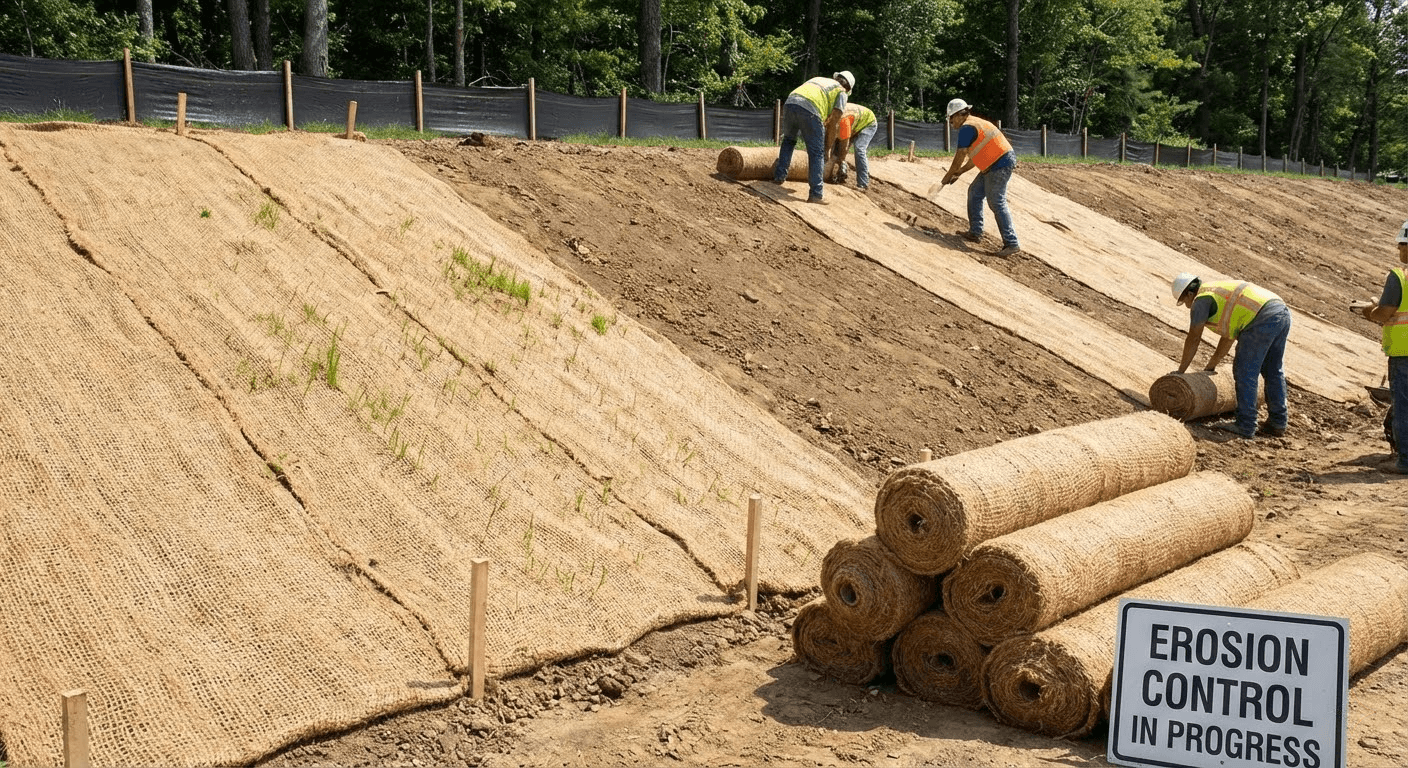
How Jute Matting Erosion Control Works
The erosion problem it solves (runoff, rills, seed loss)
Disturbed soils erode quickly because raindrop impact detaches particles, then sheet flow carries them downslope. That’s why stormwater programs emphasize early stabilization: uncontrolled runoff can seriously harm waterbodies, including smothering habitat and reducing sunlight penetration.
Jute helps by:
- Cushioning raindrop impact (less particle detachment)
- Increasing surface roughness (slower sheet flow, less transport)
- Holding seed/soil fines in place (better germination conditions)
What makes jute effective (fiber structure, roughness, biodegradability)
Jute’s coarse fibers create micro-pockets that trap soil fines and keep seed where you put it. USDA-NRCS notes erosion control blankets can reduce erosion while creating favorable conditions for seed germination and establishment on disturbed sites.
Because jute is biodegradable, it’s often selected where the goal is “protect until green-up,” then let the vegetation become the long-term solution.
Where it performs best (and where it doesn’t)
Jute is usually a strong fit for:
- Moderate slopes with predominantly sheet flow
- Areas expected to vegetate within a typical growing window
- Projects favoring biodegradable materials
It’s not the right tool for sustained high-velocity concentrated flow or long-duration exposure—those conditions often call for longer-lasting coir systems or permanent TRMs.
Costs: What You’ll Actually Pay For
Material cost drivers (what moves the price)
The biggest cost levers are:
- Mass/weight per area (heavier typically costs more, tends to stay put better)
- Weave design (open vs tighter weave affects handling and soil/seed contact)
- Roll dimensions and packaging (seams, waste, and labor)
Price it as installed, performing coverage—not just “$/roll.”
Installed cost drivers (what blows the budget)
Labor jumps when you have:
- poor access/staging
- skipped or shallow trenching
- under-anchoring that fails after the first storm
- excessive patching from tears or wrinkles
A useful reality check: many standard details emphasize trenching and fastening as core requirements, and they explicitly tell you to follow manufacturer fastening guidance because conditions change job to job.
Total cost of ownership (rework vs doing it right once)
The cheapest mat is rarely the cheapest solution if it peels back and forces rework. When the first storm arrives, failure costs can include reseeding, sediment cleanup, and schedule impacts tied to stormwater inspections—exactly the risks buyers are trying to reduce.
Specs That Matter for Performance
A spec cheat sheet buyers can put in an RFQ
Request these items on every datasheet:
- Mass/weight per area (and tolerance)
- Weave type and netting details (if any)
- Tensile strength (machine and cross direction, test method if available)
- Roll width/length and packaged roll weight
- Recommended installation pattern (overlaps, staple spacing by condition)
- Expected functional longevity range for typical climates (state assumptions)
Weight and weave: what it means on the slope
Field translation:
- Open weave: good soil contact and vegetation emergence, but needs disciplined anchoring to prevent flutter and seam lift.
- Heavier/tighter systems: generally tolerate handling and short-term forces better, but can bridge over ruts if site prep is sloppy.
Tensile strength and elongation: hidden labor multipliers
If crews are tearing the mat at staple points or stretching it into wrinkles, labor climbs fast. That’s usually a mismatch between product robustness and install conditions—especially in wind-prone corridors or on rough, rocky subgrades.
Longevity: align the mat to the vegetation timeline
Jute is typically chosen for short-term stabilization, so it’s crucial to align selection with the seeding plan and expected establishment window. If vegetation may be delayed (season, irrigation limits, shade, poor soils), consider longer-lived alternatives rather than hoping jute lasts longer than intended.
Selecting the Right Jute Mat for the Job
Match slope + flow type first
A simple decision filter:
- Sheet flow + moderate slopes → jute is often appropriate
- Concentrated flow paths / channels → consider higher-performance blankets/TRMs and structural controls
- Very steep slopes / long exposure → coir or permanent reinforcement is typically safer
Soil type and project goal (stabilize vs establish)
- Sandy soils: increase anchoring density and pay attention to seam details.
- Silty soils: prioritize drainage corrections—rills under the mat usually signal flow concentration issues, not just blanket choice.
- Goal = fast vegetation: soil contact and seedbed prep matter as much as the blanket.
Installation Best Practices (Contractor-Ready)
Site prep that prevents failures
Many standard details stress clearing rocks, clods, roots, and debris so the blanket can sit in direct contact with the slope.
Practical rule: if the mat is bridging over ruts, water will find the void and start undercutting.
Trenching + overlap direction + sequencing
A reliable workflow:
- Cut the top anchor trench and secure the leading edge.
- Install top-to-bottom so gravity and runoff work with you.
- Overlap “shingle style” so water flows over seams, not into them. Standard guidance also calls out overlaps in relation to wind direction and manufacturer recommendations.
Anchoring patterns (practical guidance)
Staple density should tighten with risk. Many installation references use ~12-inch staple spacing across seams/width as a common baseline, then adjust for conditions.
Use more fasteners at:
- seams and overlaps
- slope breaks and transitions
- wind-prone edges
- areas where sheet flow starts to concentrate
A quick, real-world vignette (anonymized)
On a roadside embankment project, the blanket looked fine at walk-through—but after the first significant rain, the top edge peeled back about a foot in two locations. The fix was straightforward: crews re-cut a proper anchor trench, re-laid the leading edge, and added seam pins at tighter spacing near the slope break. After the next two rain events, the repaired sections showed no seam lifting and vegetation established without needing rework. The takeaway: trenching and seam pinning are “cheap insurance,” and failures usually start at edges and overlaps—not the middle of the roll.
Compliance, Safety, and Environmental Considerations
Tie jute into a complete stormwater plan
Jute is surface stabilization—not a full sediment program. Pair it with perimeter and inlet controls, and correct drainage paths that concentrate flow. EPA’s construction BMP guidance emphasizes how sediment impacts aquatic systems and why layered controls are standard practice.
Wildlife and material considerations
Some agencies encourage wildlife-friendly erosion control selections (often favoring natural fibers and minimizing problematic netting types). If the project is in sensitive habitat, confirm requirements and approved products early.
Handling and site safety
- Use PPE for stapling/pinning and slope work.
- Stage rolls to prevent damage and reduce carry risk.
- Treat staples as a worksite hazard—plan pickup/visibility, especially in public-right-of-way areas.
Supplier & Procurement Considerations for Buyers
Quality consistency (what to verify on delivery)
Ask for:
- uniform weave (no thin lanes or weak spots)
- clear roll labeling (size, lot/batch)
- documentation (spec sheet, install guidance, storage/handling)
Lead times and documentation
Confirm lead times and packaging (palletization/containerization). For regulated or DOT work, keep records of product specs and install guidance tied to the project file.
Quality & acceptance checklist (fast, practical)
On delivery:
- Rolls match specified dimensions and labels.
- No moisture damage, rot odor, or crushed cores.
- Batch/lot info recorded for traceability.
During install:
- Anchor trench completed before rolling down-slope.
- Overlaps are shingle-style and pinned.
- Pin density increased at seams, transitions, and slope breaks.
After the first rain:
- No top-edge peel-back.
- No seam undercutting.
- No rilling beneath the mat (if present, fix drainage concentration and re-stabilize).
Conclusion
The best jute results are predictable: choose the right spec for slope and flow conditions, install with disciplined trenching and seam control, and verify performance after the first storm. If you treat jute as a system—with clear procurement specs and field QA—you reduce rework risk and improve vegetation establishment.
CTA: Share your slope angle, soil type, and whether you expect sheet flow or concentrated flow, and you can narrow down the right jute specification, anchoring approach, and documentation package for your bid or procurement file.
Frequently Asked Questions
Jute is generally used as short-term stabilization intended to protect soil until vegetation establishes. Actual functional life varies with moisture, UV exposure, soil contact, and climate, so align selection with your planting window and local specifications.
It can work in mild conditions, but concentrated flow often demands higher-performance systems and added structural controls. If you expect higher velocities or sustained channel flow, consider coir-based blankets or a TRM and confirm project-specific limits.
Skipping or under-building the top anchor trench and under-pinning seams are frequent causes of peel-back and seam undercutting. Clean trenching, correct overlap direction, and increased seam pinning usually prevent most early failures.
At minimum: weight per area (with tolerance), weave/netting details, tensile strength data or test references, roll dimensions/weights, recommended fastening guidance by condition, and labeling/traceability. Clear documentation makes field QA and compliance much easier.
Yes, as long as you can maintain consistent specs, labeling, and documentation across shipments. Buyers typically look for uniform weave quality, predictable lead times, and traceability—especially when supplying multiple job sites or regulated projects.