
- February 6, 2026
- Posted by: wellcoindustries
- Categories: Erosion Control, Jute Mesh
Introduction
A freshly graded slope can look perfect at 4:00 p.m.—and be rilled, muddy, and out of spec after one night of heavy rain. Best jute netting erosion control isn’t about buying the “strongest” roll; it’s about matching a biodegradable, temporary surface cover to the real runoff conditions so seed can germinate and roots can take over.
This guide is written for agriculture, construction, and soil & water conservation pros—especially purchasing managers, contractors, distributors, and OEM/private label buyers—who need a reliable way to select, specify, and install jute netting without expensive rework.
Where it fits naturally: Wellco Industries supplies erosion control materials alongside FRP, agricultural, and household product lines, which can help organizations that prefer consolidating suppliers while keeping documentation and specs consistent.
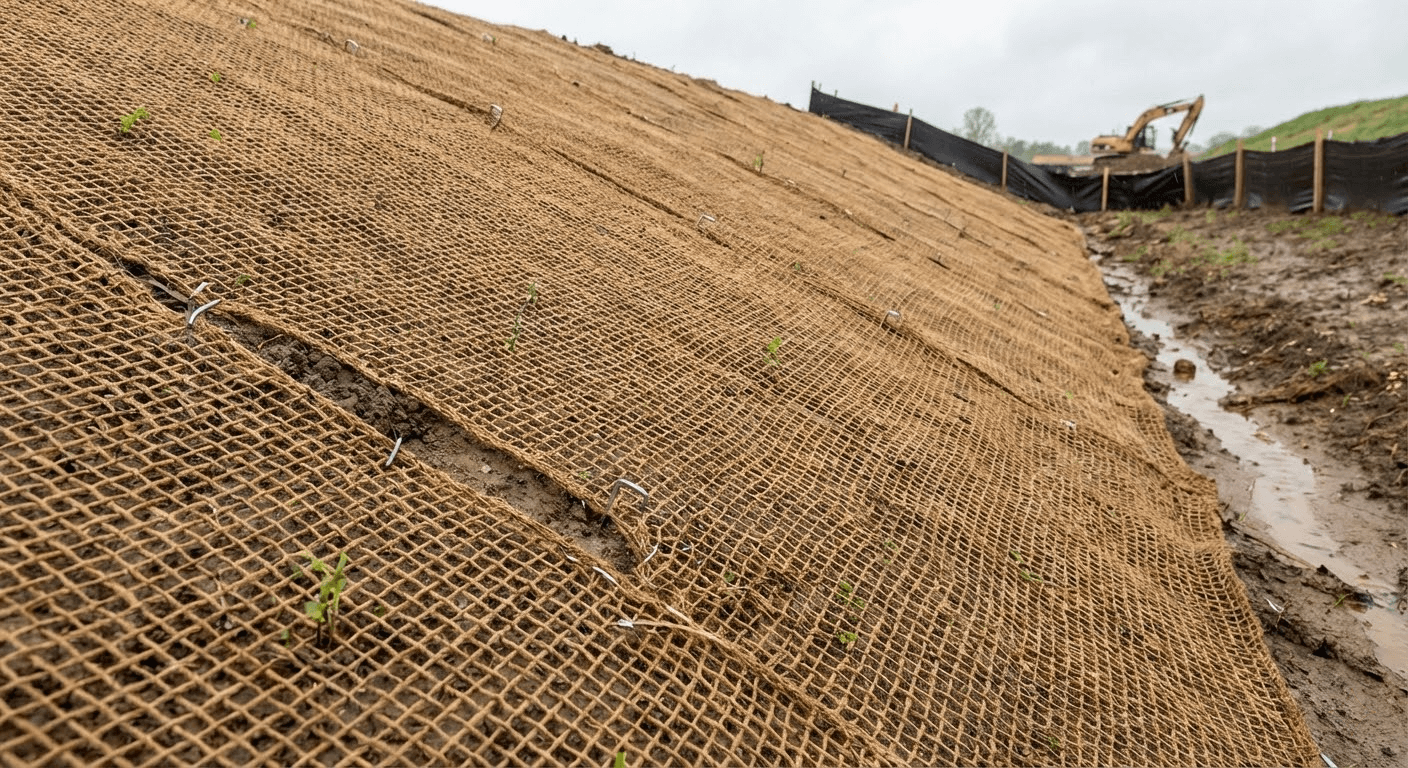
How to Choose the Best Jute Netting Erosion Control
Match the netting to site conditions
Jute netting is a surface treatment that helps reduce raindrop impact, slow sheet flow, and protect seed while vegetation establishes. It’s typically a good fit for:
- Cut/fill slopes where runoff is mostly sheet flow (water moving as a thin layer)
- Projects designed to revegetate quickly (seed + soil contact + moisture plan)
- Sites where you want biodegradability and no plastic cleanup
A practical benchmark from Caltrans’ toolbox for Rolled Erosion Control Product (Jute Mesh) lists functional longevity of 12 months and a maximum slope of 2:1 (H:V) for jute mesh in that selection context.
Where jute is usually not the best choice: areas with concentrated flow (water forming rills, channels, swales, or at outlets). Caltrans’ guidance also notes that the engineer should evaluate use in stream/channel contexts and highlights limitations like debris lifting the blanket off the soil surface.
Understand the specs that actually change performance
When buyers say “best,” they often mean “least likely to fail on my site.” Focus on:
- Open area / mesh size: higher openness helps seedlings emerge, but too open can reduce protection in splash-prone areas.
- Weave and tensile behavior: tighter weaves tend to resist tearing during installation and in wind.
- Unit weight & roll dimensions: affects handling speed, overlap waste, and freight/pallet efficiency.
- Expected functional life: many spec sheets and supplier guides commonly describe jute as protecting vegetation for roughly 6–12 months, but field life varies with UV, rainfall, soil moisture, and microbial activity.
A quick selection framework (plain language)
Use this as a first pass:
- Moderate slopes + mostly sheet flow + fast vegetation plan → jute
- Steeper slopes, longer duration needs, or higher hydraulic stress → upgrade (often coir netting or a higher-performing mat, depending on design)
Caltrans explicitly notes jute mesh for cut/fill slopes between 4:1 and 2:1, and indicates using a different rolled netting option on steeper slopes.
Installation Best Practices That Keep Jute Working
Pre-job walk checklist (the 10-minute habit that prevents callbacks)
In field inspections, the jute itself rarely “fails” first—installation details do. Before you unroll anything, walk the slope and confirm:
- Water will stay as sheet flow (no hidden swales, wheel ruts, or outlets dumping onto the face)
- The surface is fine-graded (no rocks/clods creating air gaps)
- You have a plan for transitions (top of slope, toe of slope, and edges)
Experience note: On projects where crews “saved time” by rolling over micro-ridges, I’ve seen water sneak under the bridged sections and peel the netting upslope during the next storm—while adjacent areas held because the netting stayed tight to soil.
Anchor trenches, overlaps, and fastening—do the unglamorous parts right
If you only remember three rules, make them these:
- Bury the top edge in an anchor trench. NRCS guidance for using erosion control blankets/jute netting on slopes calls for the upper end to be buried in a trench at least 8 inches deep.
- Install up-and-down the slope (not across the contour). NRCS also emphasizes applying rolls up and down the slope.
- Overlap edges and secure them like water is aiming for that seam. NRCS calls out overlapping roll edges by at least 6 inches across the slope.
Practical fastening guidance:
- Increase staples/pins at edges, overlaps, transitions, and concentrated-stress points
- In softer soils, expect to need more fasteners and potentially longer pins than in firm, cohesive soils
- After the first storm, re-check overlaps and the top trench—fixing a 2-foot loose edge early is far cheaper than repairing a 40-foot rill later
Seeding and soil contact for faster establishment
Most crews seed first, then install jute so it protects seed from splash and wash. The key is seed-to-soil contact:
- If seed sits on loose fluff, jute can hold the fluff in place—but you still won’t get good germination
- If wind is your main issue, some teams place jute first and broadcast seed, but you must ensure seed is incorporated or lightly dressed so it contacts soil
Performance Realities: Durability, Weather, and Biodegradation
What “functional longevity” really means in the field
Functional longevity is a planning tool, not a promise. Caltrans lists jute mesh at 12 months functional longevity in its toolbox summary, but your site can shorten that window with heavy UV or constant wetting/drying cycles.
Many woven jute mesh references describe 6–12 months of protection for new vegetation—again, highly dependent on conditions.
The practical takeaway for buyers: if the project schedule needs protection beyond one growing season, or you expect repeated storm impacts before vegetation establishes, plan on upgrading materials rather than hoping jute lasts longer than your site will allow.
The most common failure modes (and the fastest fixes)
- Undercutting at the top trench → deepen/compact the trench and add fasteners
- Bridging/gapping → re-grade the hump/void and re-staple so netting contacts soil
- Edge lift → add fasteners and ensure overlap direction sheds water
- Debris lifting the net off the soil → remove the culprit rock/clod and reset; Caltrans notes this limitation directly.
Storm inspection cadence that keeps problems small:
- Inspect within 24 hours after major rainfall (or the next safe access window)
- Prioritize the top anchor line, edges, overlaps, and any place runoff converges
Jute vs. Coir vs. Synthetic: Practical Buying Guidance
When jute is the best fit
Use best jute netting erosion control when you need:
- Quick, biodegradable stabilization
- Good seedling “shoot-through”
- A solution aligned to moderate slopes and sheet flow conditions
Caltrans positions jute mesh on slopes up to 2:1 (H:V) in its toolbox selection summary.
When to upgrade
Upgrade when any of these are true:
- The slope is steeper than your jute guidance allows
- You anticipate concentrated flow, repeated storms, or long exposure before vegetation
- The project is in a channel/stream context requiring engineering review
Caltrans’ toolbox indicates different rolled netting options and explicitly flags stream/channel usage as an engineering decision.
Supplier and Quality Considerations for Professional Buyers
Questions to standardize in your RFQ or submittal packet
For crews and customers, consistency matters more than marketing claims. Ask for:
- Product data sheet: mesh size/open area, roll dimensions, unit weight
- Installation guidance aligned with recognized practices (anchor trench + overlap requirements)
- Lot traceability and labeling so disputes don’t become detective work
- Packaging/pallet configuration that fits your receiving and jobsite handling
- Sampling option for a short field trial on your soil type
How Wellco Industries can fit (without turning this into a sales pitch)
If you source across multiple categories (erosion control + related agricultural/jobsite items), a broad-line supplier can simplify procurement—especially for distributors and OEM/private label programs that value repeatable specs and documentation. Wellco Industries positions itself in that “one-stop” lane while focusing on erosion control materials among other product lines.
Conclusion
The fastest way to get value from best jute netting erosion control is to treat it like a system:
- Choose jute for the right conditions (moderate slopes, sheet flow, fast revegetation)
- Install with discipline (8-inch top trench, tight soil contact, correct overlaps, adequate fastening)
- Inspect after storms and fix tiny issues before they become repairs
CTA: If you’re buying for multiple sites or need OEM/private label consistency, request a spec-based recommendation and a sample roll so your team can validate handling and performance on your soil and slope before committing to volume.
Frequently Asked Questions
Start with slope ratio and whether water will stay as sheet flow. If you see rills forming or expect concentrated flow, plan to upgrade materials or redesign drainage instead of relying on jute alone.
A weak top anchor and poor soil contact. Burying the upper edge in an adequate trench and keeping the netting snug to soil prevents undercutting and edge lift.
Many projects treat jute as a one-season, temporary cover; common references describe roughly 6–12 months, and some guidance tables list 12 months as a planning figure. Weather, UV, and soil biology can shorten that window.
It can be risky where flows concentrate. Engineering review is often recommended/required for stream or channel applications, and stronger systems may be needed depending on design conditions.
At minimum: clear product specs, installation guidance, labeling/traceability, and documentation suitable for submittals. Consistency across lots helps distributors and contractors reduce rework and receiving errors.