
- February 4, 2026
- Posted by: wellcoindustries
- Category: Rebar
Introduction
Choosing between fiberglass concrete vs rebar isn’t a “material preference” debate—it’s a risk decision: corrosion exposure, serviceability requirements, inspection comfort, and lifecycle cost.
Who this is for: purchasing managers, contractors, distributors, and OEM/private-label buyers supporting agriculture, construction, and soil & water conservation projects.
How this guide was built: I’m leaning on common field failure modes (corrosion spalls, crack control complaints, schedule risk) plus widely used standards/code pathways and acceptance documentation (ACI/ASTM/ICC-ES).
Why it matters: if corrosion is predictable, repairs are predictable—and so are the long-term costs.
Quick clarity: “fiberglass concrete” can mean GFRP rebar, FRP mesh/grids, or fibers in the mix. “Rebar” usually means steel.
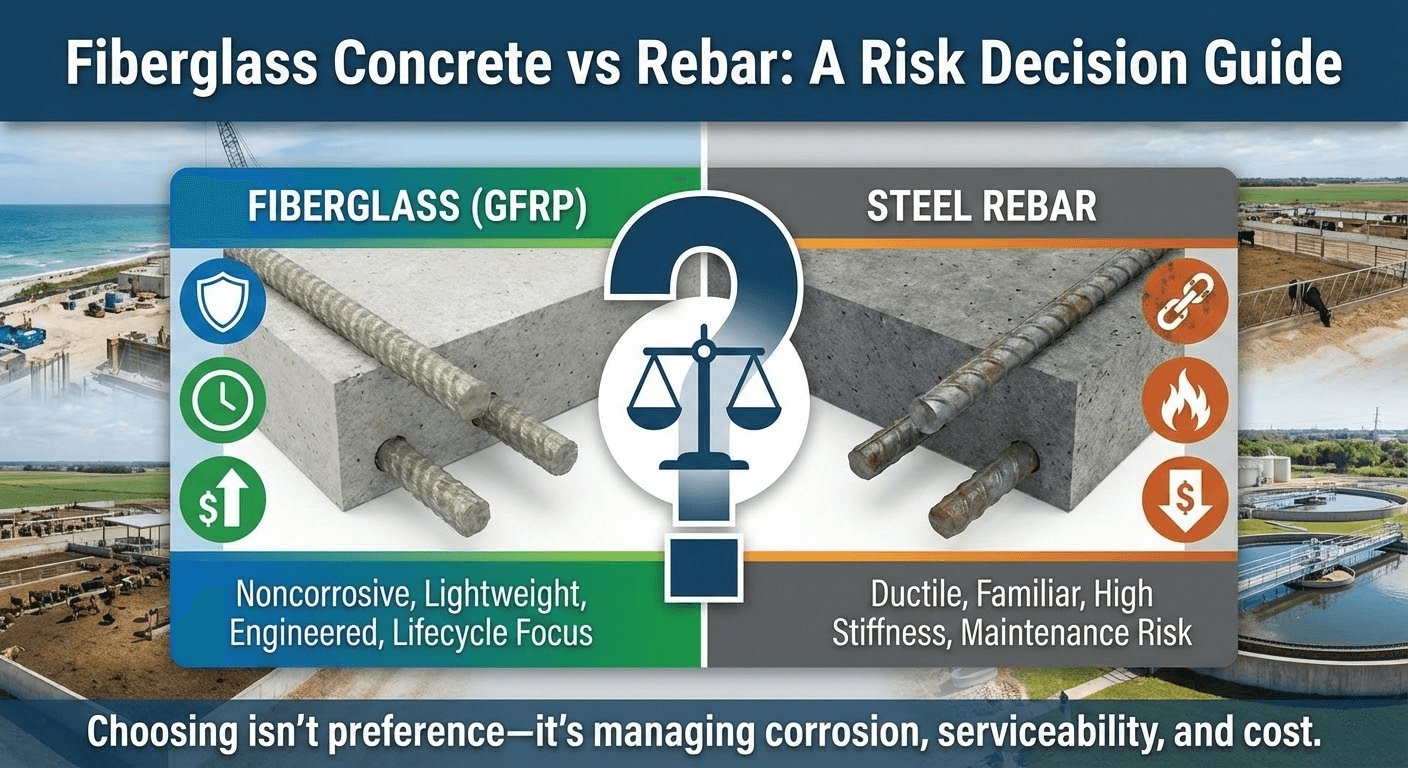
Fiberglass Concrete vs Rebar: Quick Definitions (and What People Mean)
GFRP rebar vs steel rebar (what changes in practice)
- Steel rebar is ductile and familiar: it yields, crews know how it behaves, and detailing conventions are mature.
- GFRP rebar (glass fiber–reinforced polymer) doesn’t yield like steel; it’s engineered and detailed with FRP-specific guidance because its mechanical behavior is different. ACI’s FRP guide notes that “unique guidance…is necessary” due to differences versus steel.
Experience vignette (anonymized): On a coastal slab rehab, the spec said “add fiberglass,” and the batch plant assumed fiber additive. The engineer actually intended noncorrosive bars in the splash zone. The fix wasn’t dramatic—just a clarified submittal—but it cost a week. Lesson learned: always write (and buy) the form factor: fibers vs bars vs grid.
FRP mesh/grids and fiber additives (where buyers get tripped up)
- FRP mesh/grids are commonly used for distributed reinforcement (overlays, slabs, corrosion-prone zones) and can be attractive where handling speed matters.
- Fiber additives can improve crack control and toughness, but they are not automatically a structural replacement for rebar unless a licensed design professional explicitly designs it that way.
One data anchor: ACI’s building code for GFRP-reinforced structural concrete exists specifically to define minimum requirements for “materials, design, and detailing” in that system—because assumptions aren’t interchangeable.
Strength and Structural Performance Comparison
“Stronger” vs “stiffer” (serviceability is where projects get won or lost)
If someone says “GFRP is stronger than steel,” they’re usually pointing at tensile strength. But crack widths and deflection are heavily influenced by modulus (stiffness).
A simple, buyer-friendly benchmark: reinforcing steel’s modulus is commonly taken as 29,000 ksi.
Many GFRP bars have a lower modulus, so designs can require different spacing or bar area to meet the same serviceability targets.
Procurement implication: if your contract is crack-width-sensitive (watertight containment pads, liquid-exposed agricultural slabs, long-span serviceability), ask for the modulus and serviceability checks, not just “tensile strength.”
Bond, creep, and long-term behavior (what changes on submittals)
GFRP bond depends on surface treatment and detailing (development/splices). For sustained load, FRP design typically uses reduction factors to account for long-term behavior and durability.
A practical code quote to keep teams aligned: ACI’s GFRP code describes itself as providing minimum requirements for design and detailing and explicitly frames the role of the licensed design professional and building official in acceptance.
Durability and Corrosion: Usually the Deciding Factor
Corrosion resistance (where steel rebar loses the lifecycle argument)
In chloride- or chemical-exposed concrete, steel’s corrosion products expand, cracking cover concrete and accelerating spalls and patch cycles. This is why owners with harsh exposure care about noncorrosive reinforcement strategies.
A macro-level statistic that helps justify lifecycle thinking: AMPP’s well-known corrosion cost work (often cited from a major U.S. study) puts corrosion costs in the hundreds of billions of dollars per year scale—highlighting how big the corrosion problem is economically.
Where FRP typically earns its keep: coastal splash zones, wastewater-adjacent slabs, chemically aggressive agricultural environments, and soil & water conservation structures that stay wet or see salts/fertilizers.
Temperature and fire (don’t ignore this late in the project)
This is a common “late-stage surprise.” ACI’s GFRP code notes that recommendations for increasing fire resistance are included in the Commentary.
Net: if a fire-resistance rating is required, expect additional engineering justification, detailing, or testing documentation versus a conventional steel design.
Cost, Labor, and Total Cost of Ownership
Upfront cost vs installed + lifecycle cost (the buyer math that actually sticks)
GFRP often costs more per unit than steel, but it is lightweight and can reduce handling effort. Whether that pays off depends on access, crew productivity, and corrosion risk.
Mini lifecycle example (anonymized): If a coastal pad is likely to need major patching within the design life due to rebar corrosion, the “cheaper bar” can become the more expensive structure once repair labor, downtime, and mobilization are priced in. (This is the conversation corrosion-cost studies are meant to enable.)
Supply chain and acceptance paperwork (where projects get delayed)
Two avoidable risks:
- Spec risk: product chosen without recognized qualification paths.
- Schedule risk: unclear lead times or incomplete submittals.
A concrete way to de-risk FRP buys is to request ICC-ES evaluation evidence aligned with AC454 acceptance criteria (or equivalent documentation), since many ESRs explicitly state compliance testing and quality-control requirements.
Where Wellco Industries fits (value-add, not a hard sell): A vertically integrated supplier with a broad FRP portfolio plus adjacent erosion-control and agricultural product lines can simplify procurement—fewer vendors, consistent documentation expectations, and better alignment between reinforcement choices and field realities.
Property Snapshot: What Usually Matters to Buyers
| Attribute | Steel Rebar | GFRP / FRP Reinforcement |
|---|---|---|
| Corrosion in chlorides | Susceptible | Noncorrosive (no rust mechanism) |
| Modulus (stiffness) | High (≈29,000 ksi) | Lower (often drives serviceability detailing) |
| Magnetic / conductive | Magnetic, conductive | Often nonmagnetic; some systems nonconductive |
| Code pathway | Mature (ACI 318) | Dedicated code now exists for GFRP bars |
| Acceptance docs | Standard mill certs | Often uses AC454-style evaluation + QC plans |
Where Each Option Makes Sense (and a Hybrid Often Wins)
Best fits for steel rebar
Steel tends to be the cleaner choice when you need:
- High stiffness/serviceability with the most familiar workflows
- Straightforward fire-rating compliance paths
- Low-corrosion exposure and easy future access
One grounding quote: ACI’s GFRP code is a “dependent code on ACI 318,” reinforcing that steel remains the baseline system in many jurisdictions.
Best fits for fiberglass reinforcement
FRP tends to win when:
- Corrosion is the dominant, predictable failure mode
- Maintenance access is difficult (remote soil/water structures)
- The owner values reduced corrosion-driven repair cycles
Hybrid approach (common in real projects)
Even though ACI’s GFRP structural code focuses on all-GFRP members, many projects still use zoned strategies (FRP where exposure is worst, steel where it’s benign) with clear engineering separation. The key is aligning the design method with the reinforcement system being counted in calculations.
Limitations and Risk Controls
This is the section that prevents expensive surprises.
Design responsibility and approval
ACI’s GFRP code repeatedly emphasizes the role of the licensed design professional and acceptance by building officials within the adopted building code framework.
Translation for buyers: if your team is swapping materials, treat it as an engineered change, not a “like-for-like” substitution.
Handling, PPE, storage, and paperwork (buyer checklist)
- PPE + cutting: plan for dust control and appropriate eye/respiratory protection during cutting.
- Storage: keep FRP reinforcement covered and protected from prolonged UV exposure before placement (follow supplier instructions).
- Acceptance documents: request traceability, QC documentation, and evaluation evidence aligned with AC454/ESR-style reporting.
Red flags
- No clear test basis for properties (or unclear resin/fiber system)
- Claims that fibers “replace rebar” without stamped design
- Fire-rating requirements discovered after procurement
Conclusion
The cleanest way to decide fiberglass concrete vs rebar is a 3-step filter:
- Environment: Will corrosion likely drive repairs?
- Performance: Are crack-width/deflection limits tight (serviceability)?
- Lifecycle + documentation: Can you justify the choice with code/acceptance paperwork and a realistic maintenance plan?
If your work spans agriculture, construction, and soil & water conservation structures, bringing an FRP-capable supplier into the conversation early can reduce spec risk and help you select the right FRP format (bars vs mesh/grids vs complementary materials) with the documentation purchasing teams need.
Frequently Asked Questions
Is GFRP rebar a direct drop-in replacement for steel rebar?
Not usually. The mechanical behavior and detailing assumptions differ, so engineers often adjust spacing, bar area, and serviceability checks using FRP-specific methods and accepted documentation pathways.
When does FRP reinforcement pay off financially?
Most often when corrosion-driven repair is likely within the design life—coastal, chemical, wastewater-adjacent, or persistently wet/aggressive environments. The lifecycle case is stronger when access and downtime are expensive.
What paperwork should I require when buying GFRP bars?
Ask for traceability and evidence aligned to recognized acceptance criteria (commonly AC454-style evaluation and QC documentation) and verify the design method aligns with the product specification.
How do fire-resistance requirements affect the choice?
If a fire rating is required, expect extra review—either design provisions, protective detailing, or test-backed justification—because FRP systems can require additional demonstration versus conventional steel detailing.
Can fibers replace rebar in structural slabs?
Sometimes they can reduce conventional reinforcement in specific designs, but it must be explicitly engineered. Fibers are commonly used for crack control and toughness, while bars handle primary tensile reinforcement unless the stamped design states otherwise.