
- July 9, 2026
- Posted by: wellcoindustries
- Category: FRP handrails
Introduction
In industrial safety systems, the most critical failure point is often where the structure meets the floor. We have all seen the warning signs: a galvanized steel stanchion that looks solid at eye level, but at the base, the mounting plate is pitted, the anchors are seizing, and the concrete is stained with orange runoff. This isn’t just an aesthetic maintenance issue; it is a structural liability known as galvanic corrosion, and it compromises the integrity of your entire guardrail system.
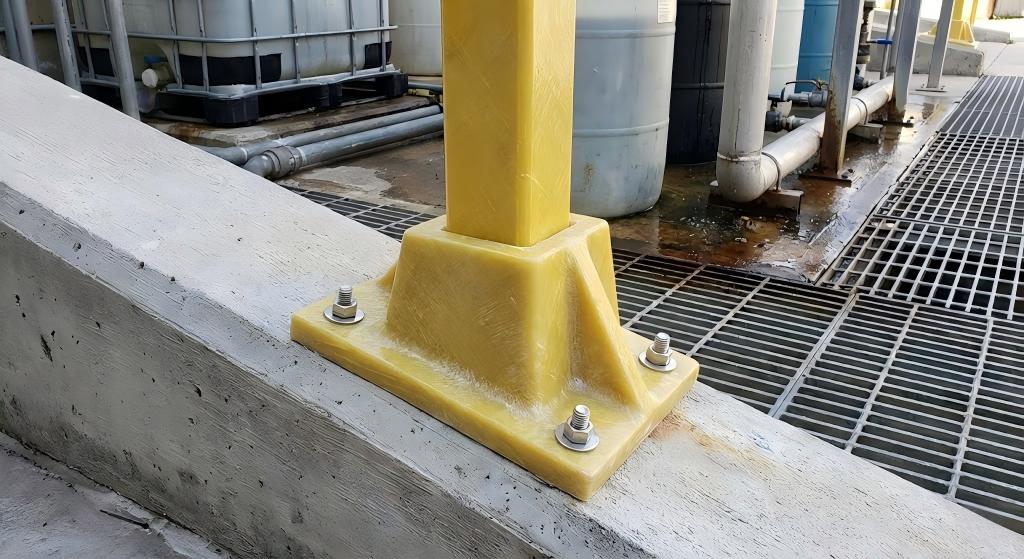
For facility managers and procurement officers in corrosive sectors, standard metal fittings are increasingly becoming a sunk cost. This is why the industry is pivoting toward the customized fiberglass handrail foot base. Unlike off-the-shelf metal components, a customized Fiber Reinforced Polymer (FRP) solution offers precise adaptability to complex site geometries and a material composition engineered to outlast the facility itself.
The Engineering Edge: Why Switch to FRP?
Moving from steel to fiberglass isn’t just a material swap; it’s a technology upgrade. The superiority of a customized fiberglass handrail foot base lies in its chemical architecture.
Beyond Rust: Chemical Resistance
Metal relies on surface coatings (like zinc galvanization) for protection. Once that coating is scratched—whether during installation or by daily wear—oxidation begins immediately. FRP is different. It is a composite matrix, typically using Isophthalic Polyester or Vinyl Ester resins. These resins provide resistance throughout the entire cross-section of the part, not just the surface.
Acid/Alkali Immunity: Essential for chemical processing plants where splashes occur.
Non-Conductive: A critical safety feature for electrical substations, eliminating the need for grounding the handrail system.
Strength Standards (ASTM)
A common hesitation for new adopters is strength. However, modern pultruded and molded FRP products are tested rigorously. A high-quality foot base meets specific ASTM D638 (Tensile Properties) and ASTM D790 (Flexural Properties) standards, ensuring that despite being 75% lighter than steel, it provides the necessary structural rigidity to meet OSHA load requirements (200 lbs force).
The ROI of Customization
“One-size-fits-all” is rarely true in industrial retrofits. Standard big-box suppliers often fail when a project involves unique pipe diameters or non-standard slopes. This is where a customized fiberglass handrail foot base delivers real value.
Solving Geometric Challenges
Slope Adaptation: Installing handrails on wheelchair ramps (1:12 slope) or conveyor inclines often requires ugly shims or on-site welding if using standard bases. Customized bases can be molded with the exact angle required, ensuring the post remains vertically plumb without field modification.
Tube Compatibility: Whether your facility utilizes 1.5″ square tubes or 2″ round pipes, the base socket must fit precisely to prevent “play” or wobble. Custom tooling ensures a friction-fit that maximizes stability.
Compliance and Safety Visibility
Safety isn’t just about holding weight; it’s about signaling.
OSHA 1910.144 Compliance: We can customize the resin pigment to match “Safety Yellow” explicitly. Unlike painted metal that chips and reveals grey steel underneath, FRP color is integral. If it gets scratched, it remains yellow.
Fire Retardancy: For offshore or enclosed applications, bases can be customized with additives to achieve a Class 1 fire rating (ASTM E84).
Strategic Sourcing: The Wellco Advantage
Sourcing customized industrial components requires a partner with robust supply chain capabilities, not just a catalog.
Wellco Industries leverages a unique position in the global market. While we are known for a diverse portfolio—ranging from erosion control materials to agricultural and household products—the core competency connecting these lines is material science and logistics.
Vertical Integration: Because we manage high-volume supply chains for agricultural inputs, we apply the same rigorous QA and logistics efficiency to our FRP division.
OEM & Private Label: For distributors, this means we can handle the tooling for a proprietary customized fiberglass handrail foot base design, manage the mold production, and deliver consistent batches without the volatility often seen in spot-market sourcing. We understand that for our OEM partners, the product needs to arrive on time and strictly within tolerance, every time.
Installation: Cutting Costs, Not Corners
The purchase price of a foot base is only a fraction of the total installed cost. FRP changes the economics of installation.
The “No Hot Works” Benefit
Installing metal bases often requires welding to secure the post to the plate. This triggers a cascade of costs: “Hot Works” permits, fire watches, and area shutdowns. FRP bases utilize mechanical connections:
Epoxy/Rivets: The tube is secured to the base using structural epoxy or stainless steel rivets.
Anchor Bolts: The base is secured to concrete using standard Hilti-style anchors or stainless steel threaded rods. This process requires only standard hand tools—drills and wrenches—meaning your maintenance crew can install them without specialized welding certification.
Lifespan Comparison
Consider the Total Cost of Ownership (TCO) over 20 years:
Galvanized Steel: Likely requires repainting every 3-5 years and full replacement by year 10 in corrosive zones.
FRP: Installed once. Zero painting. Estimated service life of 20+ years.
Conclusion
In demanding environments, the “cheapest” option is usually the one you don’t have to replace. A customized fiberglass handrail foot base represents a shift from reactive maintenance to proactive engineering. It solves installation headaches through geometric customization and eliminates the budget-draining cycle of corrosion repair.
Whether you are an engineer designing a wastewater facility or a distributor looking for a reliable private label partner, the quality of the composite matters. At Wellco Industries, we combine global logistics power with niche material expertise to deliver solutions that stand the test of time.
Don’t let a rusted base compromise your safety rating. Contact us today to discuss your specific dimensional needs and receive a quote for a solution built to last.
FAQ
Q1: What is an FRP handrail foot base?
A: It is the base component used to connect a fiberglass handrail post to concrete, platforms, walkways, or other installation surfaces.
Q2: Can FRP handrail bases replace steel bases?
A: In many corrosive or non-conductive environments, FRP bases can be a practical alternative when properly designed, anchored, and matched with the handrail system.
Q3: What information is needed for a custom FRP base quote?
A: Buyers should provide tube size, base dimensions, mounting hole layout, color, resin requirements, application environment, quantity, and drawings if available.
Q4: Are custom colors available?
A: Yes. FRP bases can be made with pigmented resin, including safety yellow and other project-specific colors.
Q5: What industries use fiberglass handrail foot bases?
A: Common applications include wastewater treatment, chemical processing, coastal facilities, electrical substations, industrial platforms, and walkways.
Q6: Do FRP bases require welding during installation?
A: Usually no. FRP handrail bases typically use mechanical fasteners, bolts, rivets, set screws, or adhesive systems depending on the design.
Q7: Is there an MOQ for custom FRP foot bases?
A: Custom dimensions may require mold or tooling setup, so MOQ depends on the design, size, material, and production method.