
- September 18, 2026
- Posted by: wellcoindustries
- Category: Fiberglass fire blanket
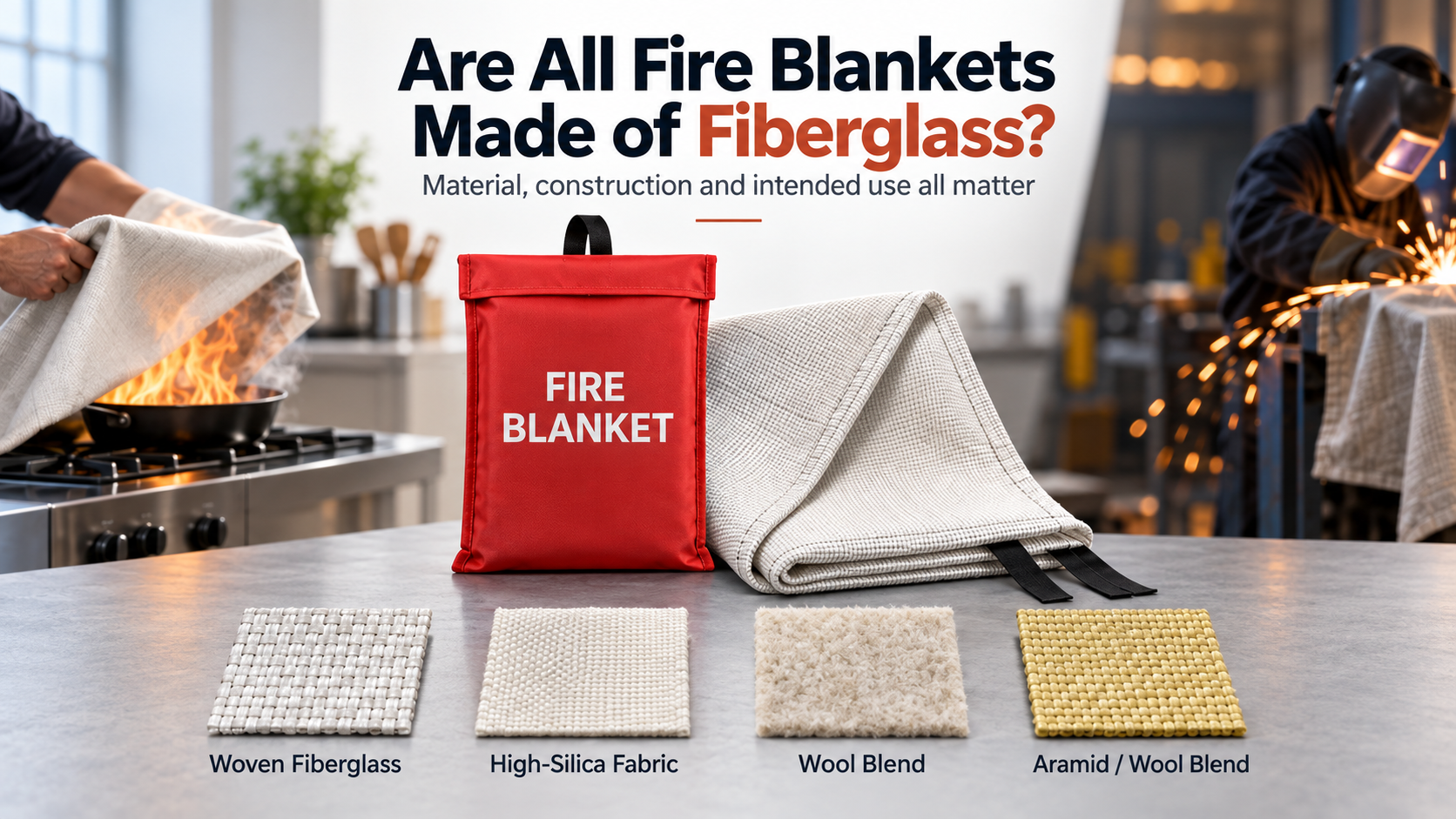
Not all fire blankets are made of fiberglass. Fiberglass-based fabrics are common in the market, but other material families are also used for different product types and exposure conditions. The right comparison is not just the fiber name. It is the finished blanket, its intended use, its size and construction, and the documentation that applies to that specific product.
Quick answer: material and intended use must be read together
Materials found in fire blankets and related heat-protection products include the following. Their intended uses differ, so they should not be treated as interchangeable:
| Material construction | May appear in | What it does not prove |
|---|---|---|
| Woven fiberglass fabric | Finished fire blankets and some heat-protection products; a Firechief product identifies K40 woven glass-fibre cloth | It does not by itself prove cooking-fire performance or certification for another product |
| High-silica fabric | Welding blankets, curtains and equipment-protection products such as Newtex Z-Sil | It does not make the product an emergency or cooking-fire blanket |
| Wool blends | Specific fire and first-aid blanket products, such as Singer Safety’s 70% wool / 30% synthetic blanket | It does not establish suitability for cooking-oil suppression |
| Aramid/wool blends | Specific personal-protection blankets, such as Creswick’s R2 product | It does not make a personal-protection blanket the same product as a kitchen fire blanket |
These are examples of documented constructions, not a ranking of materials. A material label cannot by itself prove that a finished blanket meets a particular fire-suppression, electrical-resistance or hot-work requirement.
How a textile becomes a finished blanket
For a finished product, the material description normally has several layers: fibers form yarns; yarns are woven or otherwise formed into a base fabric; the fabric may receive a coating or finish; and the finished item may then be cut, edged, stitched and fitted with handles, packaging or other components. Davlyn’s industrial product literature, for example, describes a woven fiberglass substrate with a silicone-rubber coating for molten-splash and heat-shielding use; that is an industrial example, not evidence about Wellco models or cooking-fire performance.
What the material name does—and does not—tell you
Material is one part of a finished product specification. Buyers should also check:
| Checkpoint | Why it matters |
|---|---|
| Intended use | An emergency fire blanket, cooking-fire blanket, hot-work shield and heavy-duty industrial blanket address different hazards. |
| Finished form | A finished blanket, fabric roll, curtain or pad may have different construction and handling requirements. |
| Weave, edges and seams | Construction affects how the product is handled and how documentation applies to the finished item. |
| Coating or finish | A coating can change handling, surface behavior and the applicable product description. |
| Nominal size and range | Test evidence may be tied to specific sizes or a defined size range; do not extend one sample to every size. |
| Label, instructions and packaging | Marking, storage, access and use instructions are part of a responsible selection review. |
BS EN 1869:2019 describes requirements for non-reusable fire blankets intended for use by one person to control certain small fires. Its overview covers performance, construction, marking, packaging and preservation, and notes that testing is tied to the fire blanket material and the smallest and largest available size. That scope explains why a material name or a single laboratory result should not be copied across an entire product range. See the BSI overview of BS EN 1869 for the standard’s published scope.
For cooking-fire suppression blankets, ASTM F1989-05(2020) covers physical and performance requirements such as size and shape, mass, hand-holding devices, resistance to fraying or tearing, ease of removal, electrical resistance and fire performance. It is a cooking-fire specification, not a general approval for welding, vehicle, industrial or every household-fire application. The ASTM F1989-05(2020) scope should be checked against the product and intended use.
Textile test methods also have limits. ASTM D6413/D6413M-22 measures afterflame time, afterglow time and char length after a specified vertical-flame exposure. Those results describe a textile response under stated laboratory conditions; they do not by themselves establish that a finished blanket meets a cooking-fire suppression specification. Read the test method together with the finished-product documentation.
Cooking-Fire Blankets, Welding Blankets and Other Protective Products
The word “fire” does not make every blanket the same product. Emergency and cooking-fire blankets are selected around a small-fire response and safe access. Hot-work shields are selected around sparks, slag, radiant heat and nearby combustibles as part of a broader worksite control plan. Heavy-duty industrial blankets may involve different construction, exposure duration and handling requirements.
OSHA’s hot-work requirements address the work system—removing combustibles where possible, using guards or shields where needed, maintaining firefighting equipment and applying fire-watch or permit controls. They do not turn a particular blanket into an OSHA-certified product. For a hot-work request, provide the expected sparks, slag, heat exposure, contact conditions and site documentation so the product type can be reviewed separately.
Protective clothing is another separate entity. A standard written for garments or other personal protective equipment should not automatically be used as a certification claim for a blanket. Keep the product form, hazard and evidence aligned.
A practical checklist for comparing fire blanket materials
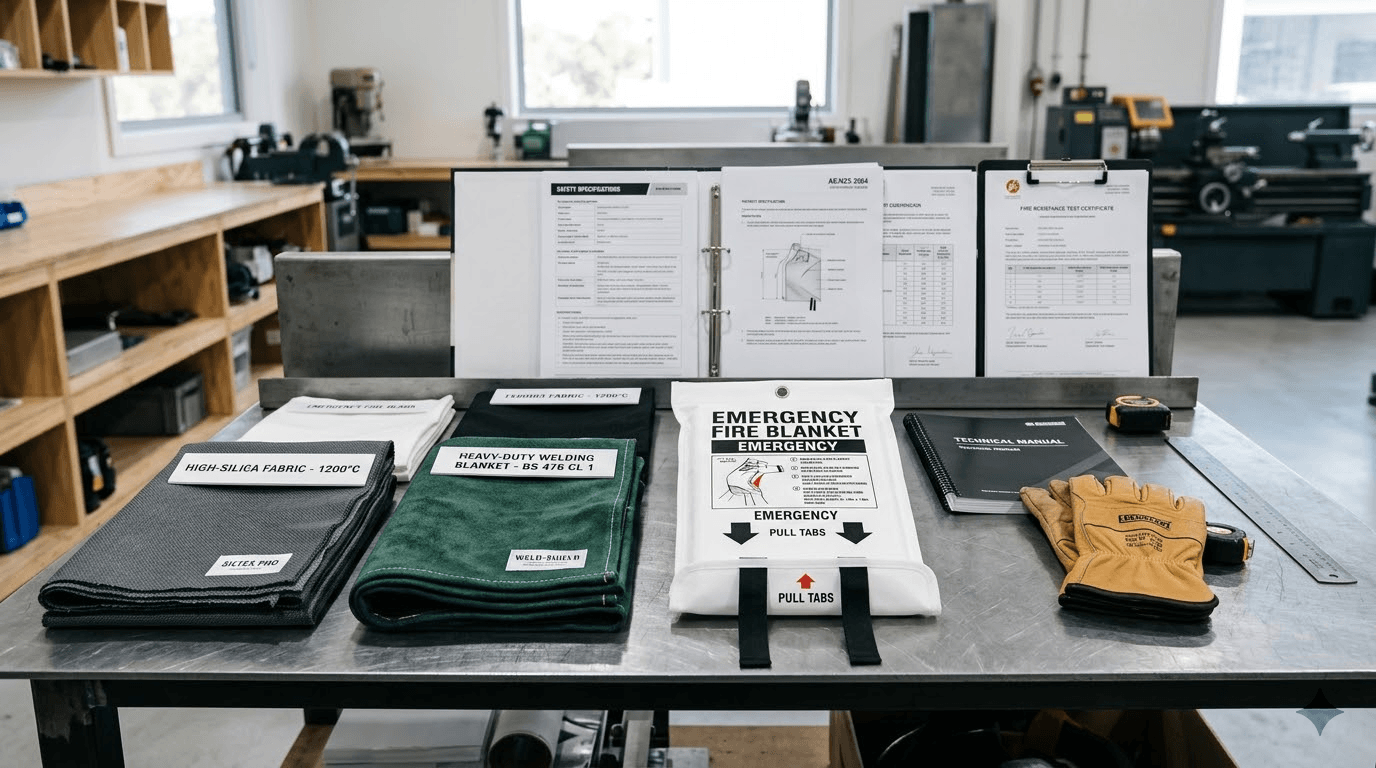
Use this sequence when reviewing a supplier datasheet, quotation or sample:
- Name the hazard first. State whether the request concerns a small cooking fire, an emergency kit, hot work, thermal shielding or another task.
- Identify the finished form. Confirm that the document describes a finished blanket rather than fabric sold by the roll or a different protective textile.
- Record the material and finish. Capture the fiber family, weave, coating or finish, edge treatment and any stated limitations.
- Match the size. Ask which nominal size or size range is covered by the documentation and whether the sample represents the requested configuration.
- Match the test to the claim. A textile flame-response method, a cooking-fire specification and a hot-work requirement are not interchangeable evidence.
- Check the label and instructions. Confirm handling, storage, access, inspection and replacement information before placing the product into a safety program.
Wellco fiberglass model references
Our Fiberglass Fire Blanket page presents two model references for buyers comparing fiberglass fabric options:
| Model reference | Product-page size | Product-page fabric description |
|---|---|---|
FRPFB5656W | 1.5 m × 1.5 m | 100% fiberglass fabric, without silicone coating |
FRPFB7272W | 1.8 m × 1.8 m | 100% fiberglass fabric, without silicone coating |
These descriptions identify the stated fabric and size information for the two model references. They do not, by themselves, establish finished-product certification or suitability for a particular fire scenario. They are starting points for a product discussion, not a complete statement of every fire blanket, coating, package or application. For a project request, include the intended use, size, quantity, required documents and destination market so the applicable configuration and documentation path can be reviewed.
Frequently asked questions
Are all fire blankets made of fiberglass?
No. Fiberglass is one material family. Wool blends, aramid/wool personal-protection blankets and high-silica industrial fabrics are documented in other product lines. The finished product documentation is more useful than the fiber name alone.
Is a fiberglass fire blanket the same as a welding blanket?
Not automatically. A welding blanket can also be made from fiberglass. The shared fiber material does not establish the same intended use or performance requirements. Emergency fire blankets, cooking-fire blankets, hot-work shields and heavy-duty industrial blankets can have different construction, instructions and evidence requirements, so select the product form for the actual hazard.
Does a material name prove that a blanket is certified?
No. Certification or conformity depends on the applicable product standard, the tested configuration and the responsible documentation. A test report, a supplier declaration and a third-party product certificate are different types of evidence. When certification is claimed, verify the issuing body, certificate scope and covered model. Ask for documentation that identifies the material, size range, product and intended use.
What information should I provide when comparing options?
Start with the intended use, finished form, nominal size, quantity, material or coating preference, exposure conditions, destination market and required documentation. This gives the review team enough context to separate a suitable fire blanket from a different heat-shielding product.
Use the checklist above when comparing materials. If you are reviewing the two fiberglass model references, see our Fiberglass Fire Blanket page for the model details and the next information to provide.
References
- BSI — BS EN 1869:2019 Fire blankets
- ASTM — F1989-05(2020) Standard Specification for Cooking Fire Suppression Blankets
- ASTM — D6413/D6413M-22 Vertical Flame Test
- Firechief — K40 woven glass-fibre fire blanket example
- Singer Safety — Fire and First Aid Blankets
- Creswick — R2 Personal Protection Aramid Wool Fire Blanket
- Newtex — Z-Sil Silica Fabric
- Davlyn — Silco Shield Fireblanket product literature
- OSHA — 29 CFR 1910.252 General requirements