
- October 20, 2026
- Posted by: wellcoindustries
- Categories: Erosion Control, Jute Mesh
Jute netting helps control surface erosion by supporting a temporary protective cover while vegetation establishes. An open woven net can hold mulch against the ground and help keep exposed soil and seed in place. Its performance depends on contact with the ground, secure installation, and water conditions that suit the selected product. It is a surface treatment, not a repair for an unstable slope. [1, 2, 3]
The useful question is not simply whether the area has been covered. It is whether the net, soil, mulch, and developing vegetation are working together.
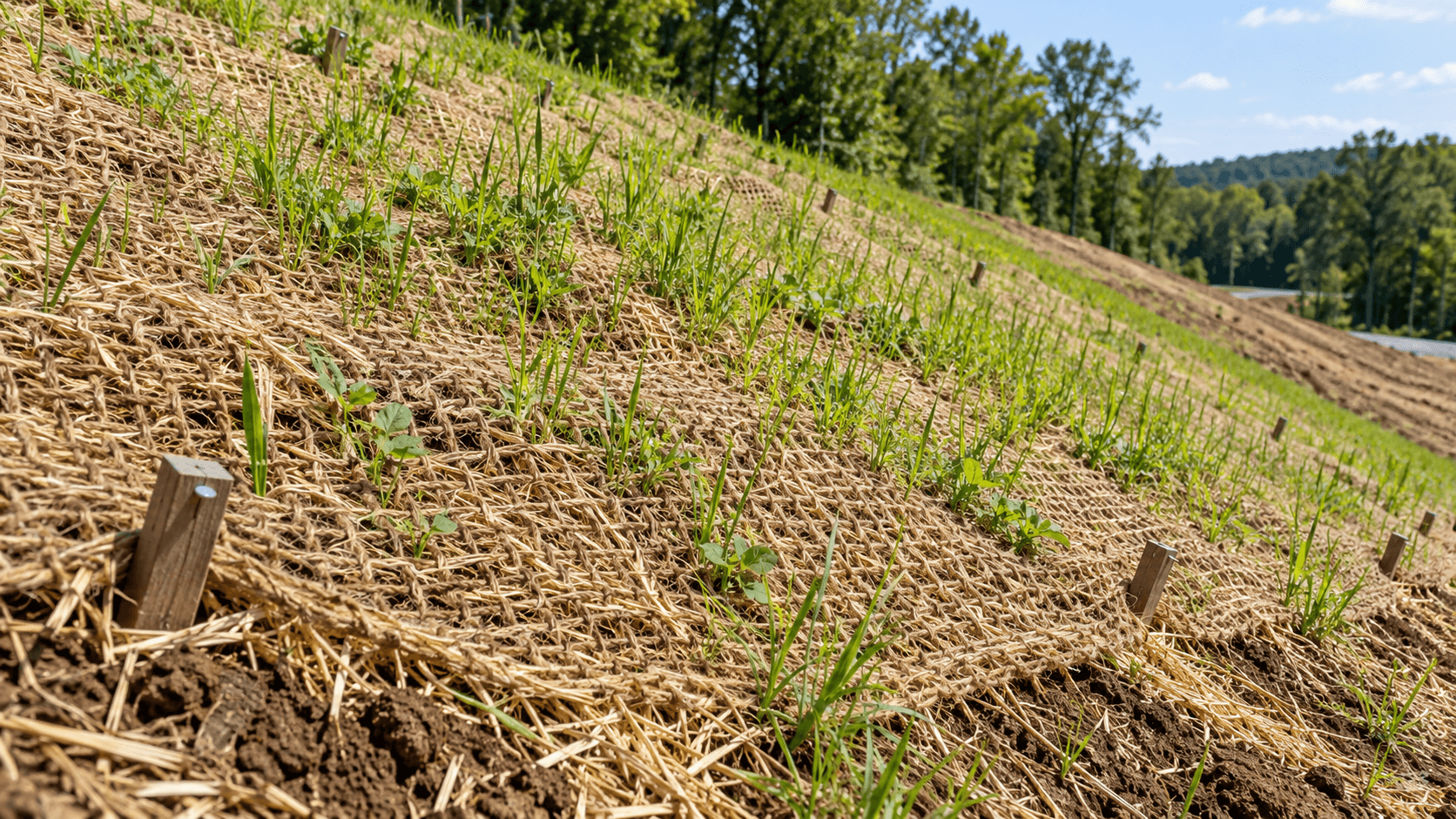
The net and the mulch have different jobs
Open-mesh jute netting has visible spaces between the yarns. It is different from a filled erosion-control blanket, in which a layer of straw or other fibers sits between supporting nets.
Where the specified treatment includes loose mulch, the mulch provides cover and the net helps retain it. NRCS describes anchored jute netting placed over straw or other mulch to limit displacement by wind and water. EPA likewise identifies holding mulch and matting against the ground as a function of netting. [2, 3]
This distinction matters when reviewing a proposed treatment. A roll of open mesh does not contain a built-in mulch layer. Check whether the plan calls for netting alone or a net-and-mulch combination before comparing coverage or ordering materials. Adding either component changes the treatment being evaluated.
Ground contact makes the protection work
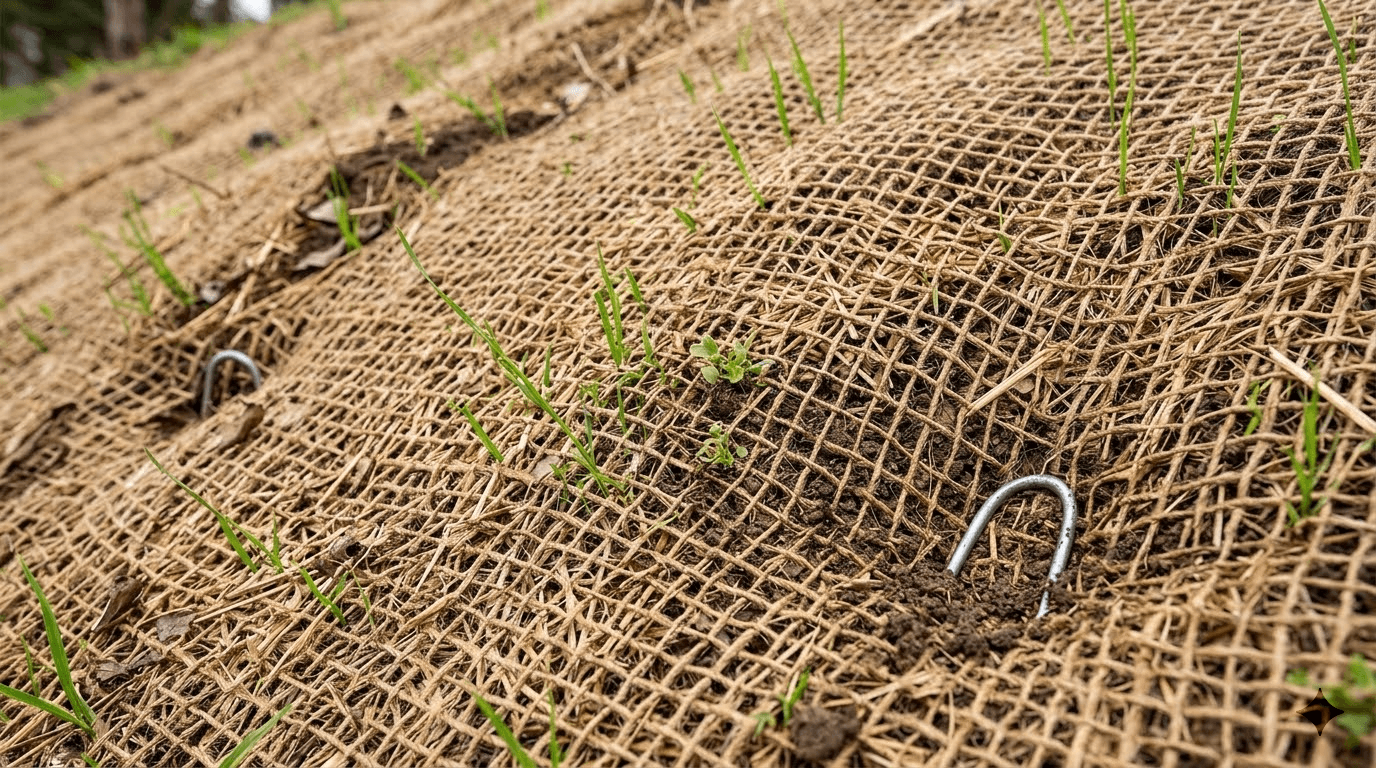
The net needs to follow the prepared surface rather than bridge above it. Caltrans warns that rocks and debris can lift the material and allow erosion underneath. EPA also identifies firm, continuous soil contact as an installation requirement. [1, 3]
A net may look evenly spread from a distance while leaving gaps underneath. During a site check, look at the surface below the mesh as well as the condition of the yarns. An intact net above an eroding pocket is not evidence that the ground is protected.
Anchors help keep the selected treatment in position, but an anchor count alone does not demonstrate good contact. Surface irregularities, loose edges, and the product’s installation requirements all need attention. Follow the project detail for orientation, overlaps, edges, and anchoring. Our jute netting installation guide covers that separate construction task.
Vegetation provides the continuing cover
Jute mesh is used as temporary support during vegetation establishment. Caltrans describes moisture retention and an open structure compatible with seeding; EPA describes matting and netting as helping retain seed and topsoil during this period. [1, 3]
The planting plan still has to work. Ask how seed will reach the seedbed, whether seedlings can emerge through the chosen construction, and how moisture will be managed. Covering an area does not establish that the seed has germinated or that the vegetation has developed adequate cover.
Treat the transition as an observation to verify, rather than a fixed number of months. Record whether the intended vegetation is establishing across the treated area, including patches where soil remains exposed. A calendar date or the gradual breakdown of the yarn is not, by itself, proof that vegetation is ready to provide the required protection.
Water conditions can exceed what surface netting can do
Netting does not remove the need to understand where water enters and crosses the site. NRCS cautions against using jute netting alone where runoff quantities are expected to be high. Caltrans requires responsible engineering input for its specified stream or channel applications. [1, 2]
If water collects into a defined path, cuts beneath the treatment, or repeatedly washes material away, review the runoff arrangement and product suitability before adding more mesh. For a channel, drainage outlet, streambank, or visibly moving slope, obtain the applicable design assessment rather than assuming that a heavier roll will solve the problem.
Soil conditions matter too. Caltrans identifies jute mesh as a surface treatment that does not correct compaction, nutrient depletion, or poor drainage. [1] If vegetation is failing because of the seedbed, replacing the cover alone may leave that cause unresolved.
Slope and surface conditions also affect suitability. In its wildfire-recovery guidance for southeast Washington, NRCS identifies steep sandy slopes and steep slopes with extensive surface rock as unsuitable situations for jute netting. These conditions warrant a suitability review, even when the mesh can be secured against the ground. [2]
Use visible conditions to guide the next check
The following framework connects what can be seen on site with a useful investigation. The observations are prompts for checking the treatment, not proof of a single cause.
| What you observe | What to investigate | Decision it informs |
|---|---|---|
| Mesh bridges above rocks, clods, or a hollow | Contact beneath the net and the surface preparation | Whether the treatment needs correction to follow the ground [1, 3] |
| Mulch has shifted out from under otherwise intact mesh | The specified mulch arrangement, contact, anchoring, and incoming water | Whether the cover system is staying in place [2, 3] |
| New erosion appears beneath the net or along a water path | Where runoff enters, how it concentrates, and whether the product fits the exposure | Whether the runoff or treatment design needs review [1, 2] |
| Mesh remains in place, but vegetation is patchy | Seed placement, soil condition, moisture, and the planting plan | Whether establishment needs attention as well as surface protection [1, 3] |
| Edges lift or the material is torn or displaced | Installation condition and the project’s repair requirements | What needs correction before further exposure [3, 4] |
For construction-site erosion and sediment controls, EPA’s inspection guidance distinguishes routine inspections from checks before and after rain. Use the inspection schedule and repair requirements applicable to the project; do not assume one universal interval. [4]
Keep a short record of the location, visible condition, change since the previous check, and follow-up action. Repeat photographs from the same viewpoint can help show whether a gap, erosion path, or bare patch is growing. This is a practical observation record, not a substitute for a specified performance test.
Define the treatment before requesting product options
A useful product request describes the whole surface-cover task. Identify whether the net is intended to retain mulch, support a seeded area, or form part of another specified treatment. Then connect that purpose to the site conditions and the protection needed while vegetation establishes.
For product details, see our Jute Netting Rolls for Erosion Control. Send us the application, coverage area, slope and soil conditions, expected runoff, mulch and vegetation plan, required protection period, quantity, and delivery location. Include any project specification so our team can review the product request.
References
- Caltrans — Rolled Erosion Control Product: Jute Mesh.
- USDA NRCS and WSU Extension — Wildfire Recovery Tips: Southeast Washington, Jute Netting and Straw Mulching sections (August 2005).
- U.S. EPA — Geotextiles, Matting and Netting (December 2021).
- U.S. EPA — Erosion and Sediment Control Inspection and Maintenance (December 2021).