
- August 21, 2026
- Posted by: wellcoindustries
- Categories: Burlap, Erosion Control
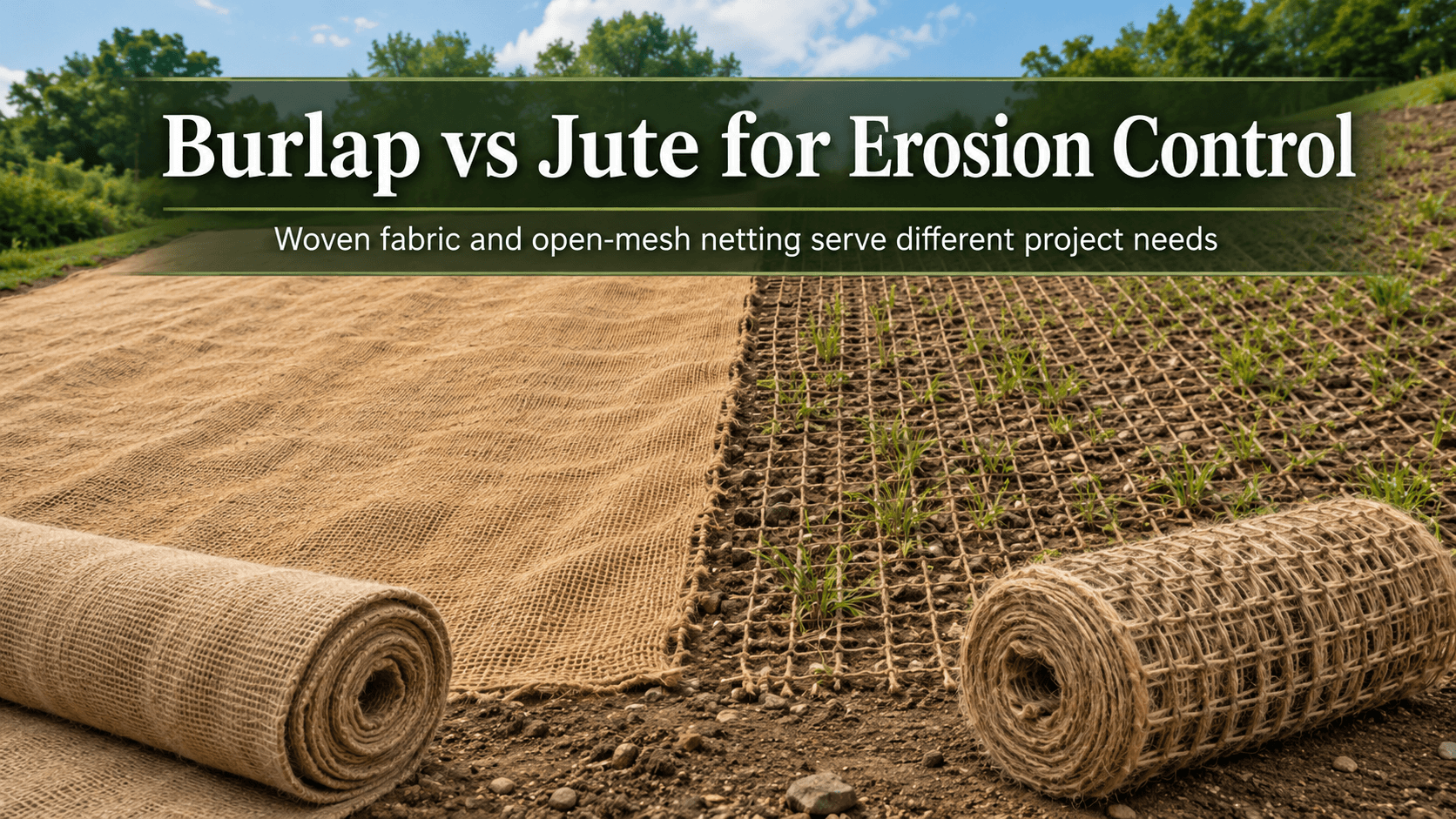
Burlap and jute are not two directly competing materials: jute is a natural plant fiber, while burlap is a coarse woven fabric commonly made from jute. For erosion-control work, the practical choice is usually between woven burlap fabric, open-mesh jute netting, or another product form required by the project specification.
The product form matters more than the label alone. Compare surface coverage, open area, material composition, weave or mesh construction, treatment, anchoring requirements, functional duration, and the project specification before choosing a roll.[1][2]
Quick Answer: What Is the Difference Between Burlap and Jute?
| Term | What It Describes | What to Confirm for an Erosion-Control Project |
|---|---|---|
| Jute | A natural plant fiber that can be spun into yarn and made into cloth, mesh, sacks, geotextiles, and other products | Fiber content, yarn construction, treatment, and the finished product form |
| Burlap or hessian | A coarse woven cloth, commonly made from jute | Composition, fabric weight, weave, open area, treatment, roll dimensions, and intended use |
| Jute netting or jute mesh | An open-weave textile made from jute yarn | Mesh opening, yarn construction, roll dimensions, anchoring method, functional longevity, and approved site conditions |
| Erosion-control blanket | A manufactured rolled product that may combine fibers, netting, stitching, or other components | Complete construction, performance category, installation instructions, and project acceptance requirements |
FAO materials describe jute as a fiber used to make yarn, hessian cloth, sacks, and geotextiles. A Government of India technical-textile report also identifies hessian, or burlap, as a jute fabric.[1][2] The terms overlap, so a buyer should not assume that a product called “jute” is automatically lighter, weaker, cheaper, or faster to break down than a product called “burlap.”
Woven Burlap Fabric vs Open-Mesh Jute Netting
The following comparison describes product form, not a universal performance ranking.
| Selection Factor | Woven Burlap Fabric | Open-Mesh Jute Netting |
|---|---|---|
| Construction | A more continuous woven cloth surface | An open grid made from jute yarn |
| Surface exposure | Covers more of the soil surface, depending on weave | Leaves a high percentage of soil and vegetation exposed through the openings |
| Common project question | Is continuous fabric coverage required or accepted? | Is an open-weave netting treatment required or accepted? |
| Vegetation interface | Seed and emerging vegetation interaction depends on weave, installation, and project design | Openings can allow vegetation to emerge through the mesh; seeding sequence depends on the specification |
| Key specification fields | Composition, fabric weight, weave, treatment, roll size, seams, overlaps, and anchors | Mesh opening, yarn construction, treatment, roll size, overlaps, anchors, and functional longevity |
| Main limitation | A generic burlap roll is not automatically an approved rolled erosion-control product | Jute netting is a surface treatment and is not appropriate by itself for every slope or runoff condition |
Caltrans describes jute mesh as a lightweight, biodegradable, open-weave textile and lists defined use conditions and limitations for that treatment. Its construction manual treats jute mesh, netting, erosion-control blankets, and turf-reinforcement mats as distinct types of rolled erosion-control products.[3][4] This is why product names should not be used as substitutes for project specifications.
When Each Product Form May Be Considered
When Woven Burlap Fabric May Be Considered
Woven burlap fabric may be considered when the project requires or accepts a more continuous woven surface. Depending on the specification, it may be evaluated for temporary soil or seed coverage, landscape protection, or other applications where the weave, fabric weight, treatment, roll dimensions, and anchoring details can be confirmed.
When Open-Mesh Jute Netting May Be Considered
Open-mesh jute netting may be considered when an approved open-weave surface treatment is required for mulch or seed retention and vegetation establishment under suitable site conditions. Confirm the mesh construction, required ground contact, anchoring method, runoff conditions, and accepted product category. It should not be assumed to work alone in concentrated-flow or high-runoff areas.
When Another Product Form May Be Required
A manufactured erosion-control blanket, turf-reinforcement mat, or another specified system may be required when the site conditions, functional duration, flow conditions, or governing documents are outside the accepted use of woven fabric or jute netting. These categories describe different finished constructions and should not be treated as interchangeable.
Choose by Product Form and Site Requirements
1. Start With the Project Specification
If a contract, agency detail, landscape plan, or erosion-and-sediment-control plan names a product category, use that requirement as the starting point. Confirm whether it calls for:
- woven natural-fiber cloth;
- open-weave jute mesh or netting;
- a manufactured erosion-control blanket;
- a turf-reinforcement mat;
- another temporary or permanent stabilization measure.
Do not replace one category with another because both contain jute. Any substitution should follow the project approval process.
2. Identify the Erosion Mechanism
Define what the surface treatment must address:
- raindrop impact and surface disturbance;
- protection of seed or mulch;
- sheet flow on a prepared slope;
- wind displacement;
- concentrated runoff, rills, channels, or another higher-energy condition.
Jute netting can help anchor mulch and support vegetation establishment in suitable applications. USDA Natural Resources Conservation Service guidance also warns that jute netting should not be used alone where high water-runoff amounts are expected.[5] Concentrated flow or engineered channels may require a different system rather than a simple change from netting to cloth.
3. Compare the Finished Construction
Ask for enough information to compare actual products:
- natural-fiber, synthetic, or blended composition;
- woven fabric, open mesh, stitched blanket, or composite construction;
- fabric weight or mass per area and the unit basis;
- weave density, mesh opening, or open-area information;
- treatment, coating, reinforcement, and stitching;
- roll width, roll length, packaging, and handling requirements;
- manufacturer installation instructions and required accessories.
Two jute-based rolls can behave differently when their yarn, weave, mesh, treatment, or finished construction differs. A material name alone does not establish strength, permeability, durability, or suitability.
4. Match Functional Duration to Vegetation and Maintenance
For temporary natural-fiber treatments, the required period of surface protection should be considered alongside vegetation establishment and inspection plans. Do not assign a universal lifespan to burlap or jute. Moisture, temperature, sunlight, soil contact, fiber composition, treatment, installation, and site stress can all affect condition over time.
Use the approved product documentation or project requirements to define functional longevity. If the project requires a longer-duration synthetic solution, review our separate guide to burlap and synthetic erosion-control materials rather than treating “synthetic” as another name for jute or burlap.
5. Verify Installation and Inspection Requirements
Both woven fabric and open mesh need contact with the prepared surface and an anchoring layout suited to the approved product and site. Overlap direction, trenching, anchor type, anchor spacing, seam treatment, and inspection frequency should come from the project detail and product instructions.
This comparison page does not replace the installation plan. For installation and maintenance decisions, record the slope, soil condition, drainage pattern, expected weather exposure, vegetation method, and any concentrated-flow areas before selecting a product.

Assumptions to Avoid
“Burlap Is Always Stronger Than Jute”
This comparison is misleading because burlap is often made from jute. Strength depends on the finished construction, including yarn, weave, mesh, fabric weight, treatment, and reinforcement.
“Jute Always Breaks Down Faster”
The word “jute” identifies a fiber, not one fixed product. A jute cloth, jute mesh, and composite blanket can have different constructions and service conditions. Compare documented functional longevity instead of assigning a universal ranking.
“Any Natural-Fiber Roll Works on a Steep Slope”
Slope ratio alone does not define suitability. Runoff concentration, soil condition, surface preparation, anchoring, vegetation plan, and the accepted product category also matter. Follow the governing project specification.
“All Burlap Products Can Be Marketed as Biodegradable”
Composition, blends, treatments, coatings, and customary disposal conditions affect environmental claims. The U.S. Federal Trade Commission advises marketers not to make broad environmental claims without substantiation and sets conditions for unqualified degradable claims.[6] Confirm the specific product before using a biodegradability or compostability statement.
Burlap and Jute Selection Checklist
Use this checklist when comparing rolls or preparing a purchasing inquiry.
| Requirement | Information to Provide or Confirm |
|---|---|
| Project application | Slope surface, seed or mulch protection, landscape installation, channel, or another defined use |
| Governing requirement | Drawing, agency detail, material specification, accepted product category, or approval process |
| Site conditions | Slope, soil, drainage, runoff pattern, wind exposure, and concentrated-flow areas |
| Product form | Woven burlap fabric, open-mesh jute netting, blanket, mat, or another specified form |
| Material | Fiber composition, blend, treatment, coating, reinforcement, and required documentation |
| Construction | Fabric weight, weave, mesh opening, open area, stitching, and backing or carrier net |
| Functional requirement | Required protection period, vegetation-establishment plan, inspection, and maintenance |
| Installation | Surface preparation, overlaps, trenches, anchors, seams, accessories, and installer instructions |
| Quantity | Required coverage area, waste allowance, roll count, and packaging needs |
| Delivery | Destination, required timeline, and any receiving constraints |
The checklist keeps the comparison tied to a defined product and project. It also prevents a woven burlap roll, jute netting roll, and manufactured blanket from being treated as interchangeable.
Frequently Asked Questions
Are burlap and jute the same material?
Not exactly. Jute is a plant fiber. Burlap is a coarse woven fabric that is commonly made from jute, although the composition and treatment of a particular product should still be confirmed.
Is burlap the same as hessian?
The terms are commonly used for similar coarse woven fabrics, particularly in different markets. However, fiber composition, weave, fabric weight, and treatment should still be confirmed for the specific product.
Is jute netting the same as burlap fabric?
No. Jute netting is an open-mesh product, while burlap is generally a more continuous woven fabric. They differ in surface coverage, construction, installation details, and the project specifications they may satisfy.
Which is better for erosion control: burlap or jute?
Neither name is universally better. First determine whether the project requires woven fabric, open netting, a blanket, or another system. Then compare the actual construction, site limits, installation requirements, documentation, and functional duration.
Can burlap fabric replace jute netting?
Only when the project requirements and approval process permit that substitution. Sharing a fiber source does not make two finished product forms interchangeable.
When should synthetic erosion-control material be considered?
Consider the specified synthetic category when the project requires construction or functional duration that a proposed natural-fiber product does not document. Compare the complete system and approved specifications, not only “natural” versus “synthetic” labels.
Request Product Details for Your Project
We provide woven burlap fabric rolls and list burlap and jute netting separately because the two product forms serve different specification needs.
Send us the required product form, roll dimensions, quantity, application details, project specifications, packaging needs, and delivery location. Our team can review the request and confirm which current product options match the stated requirements. Contact us at [email protected].
References
- FAO: Proceedings of the Symposium on Natural Fibres
- Office of the Textile Commissioner, Government of India: Baseline Survey of the Technical Textile Industry
- Caltrans: Rolled Erosion Control Product — Jute Mesh
- Caltrans Construction Manual, Section 4-21: Erosion Control
- USDA NRCS: Recovery Tips — Jute Netting
- Federal Trade Commission: Environmental Claims — Summary of the Green Guides