
- September 28, 2026
- Posted by: wellcoindustries
- Categories: Erosion Control, Jute Mesh
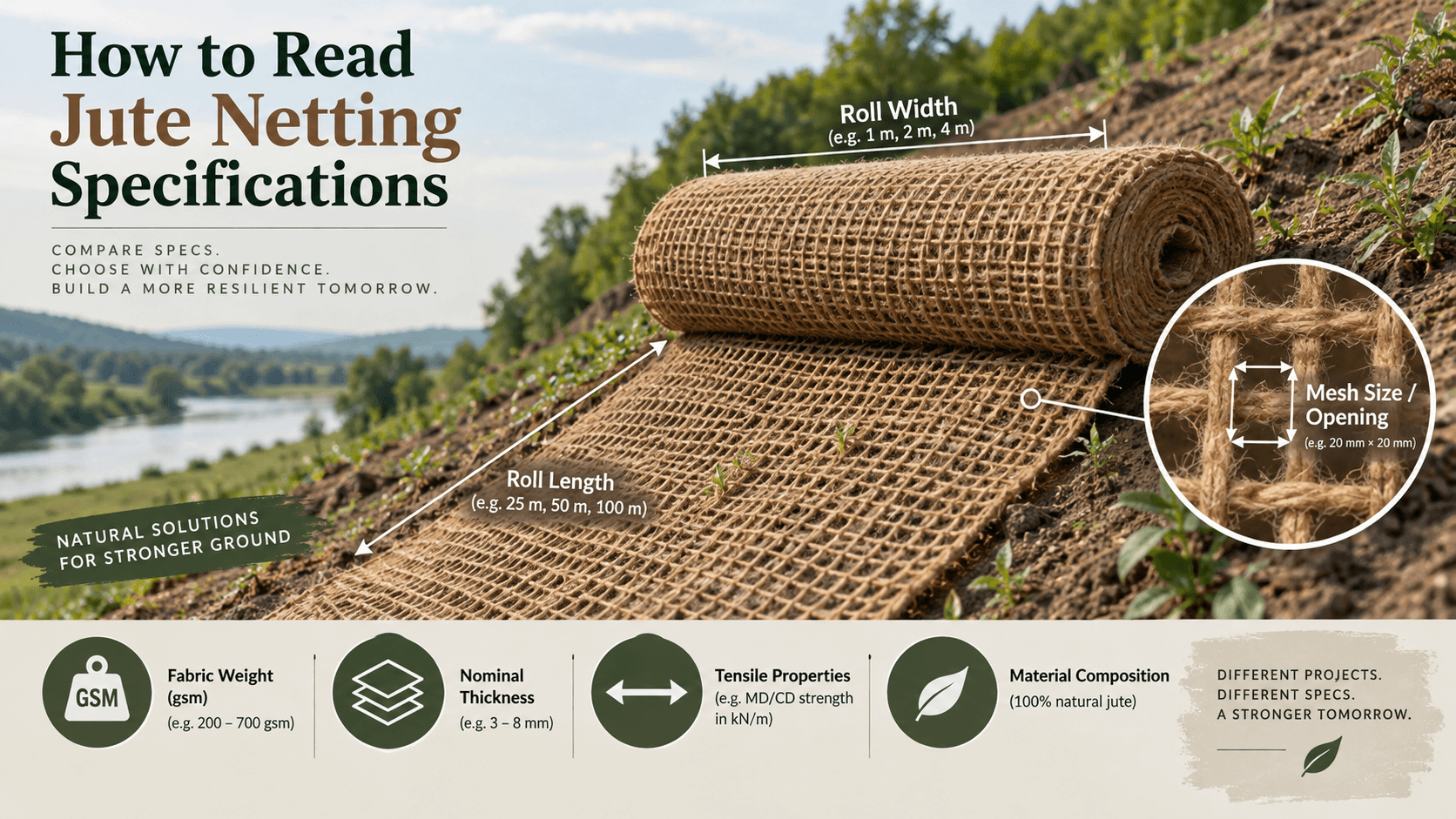
Jute netting specifications describe the roll dimensions, mesh construction, material composition, and measured properties of a particular product. To compare two options, match the units, measurement methods, and product identity before comparing the numbers. A heavier roll or a smaller opening alone does not establish that a netting will perform better on your site.
This guide explains how to read specifications for open-mesh jute erosion-control netting. It is not a product data sheet or a set of installation requirements.
Start with the field and its measurement basis
Use this table to identify what a product sheet actually tells you. If a field is missing, leave that comparison open rather than filling it with a value from another product.
| Specification field | What to establish | Comparison mistake to avoid |
|---|---|---|
| Product and document identity | Manufacturer or supplier, product reference, sheet revision/date, and relevant report reference | Combining values from different products or document revisions |
| Roll width and length | Dimensions, units, and stated tolerances for the identified roll | Treating nominal roll area as installed coverage |
| Mesh or weave | What is measured, in which direction, and under what condition | Comparing an opening dimension with a yarn count |
| Fabric mass per unit area | Full unit, such as g/m² or oz/yd², and measurement basis | Using shipping weight as fabric weight |
| Nominal thickness, if reported | Test method and measurement conditions | Reading nominal thickness as a guaranteed minimum |
| Tensile properties | Method, direction, units, and reported property | Treating a laboratory tensile result as a slope or flow rating |
| Composition and service description | Components covered by the claim and relevant exposure conditions | Assuming the product name proves every component is biodegradable |
Also distinguish a nominal value, a measured average, and an acceptance limit. A product sheet stating an average does not, by itself, establish a minimum acceptable value for every delivery.
Roll width and length: calculate gross area first
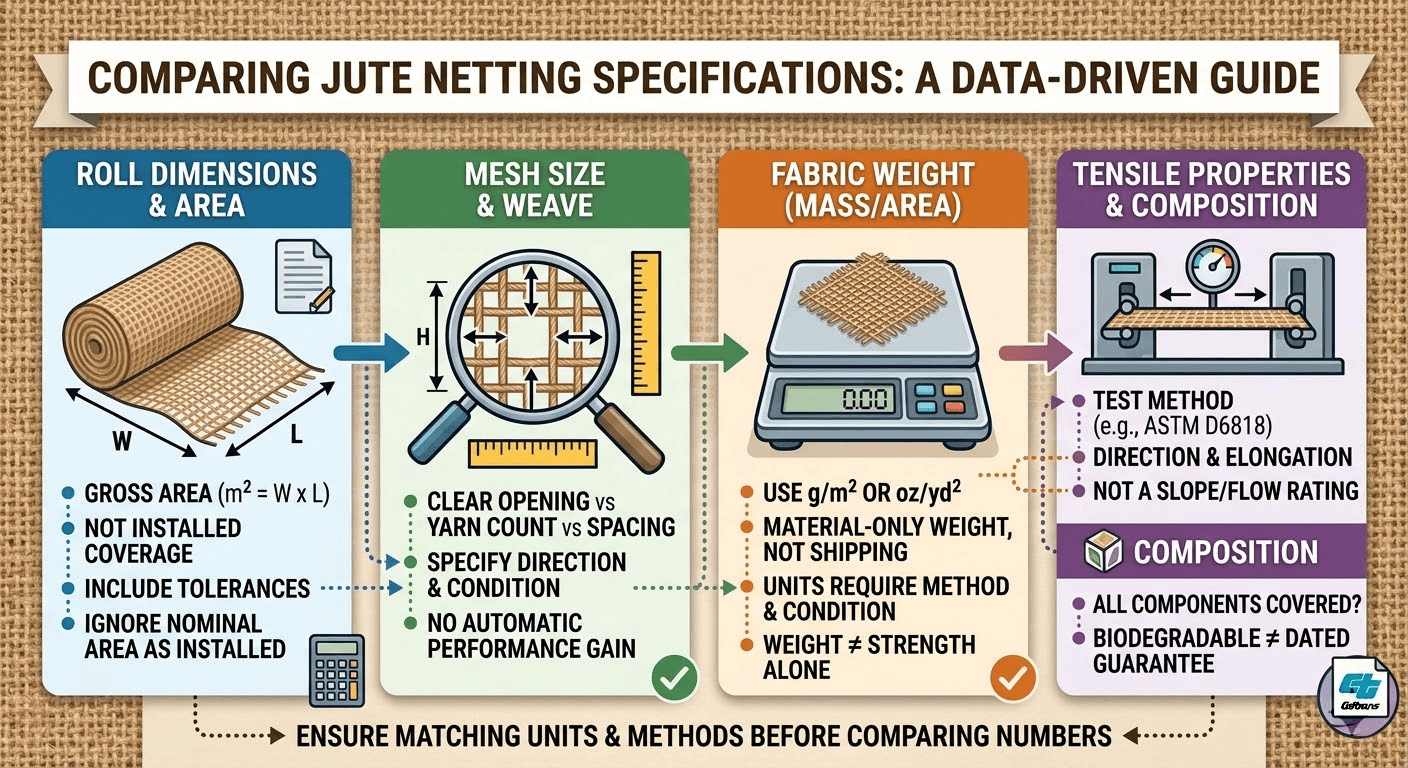
Roll dimensions describe the material supplied. For a rectangular roll, multiply the stated width by the stated length using the same unit system:
Nominal gross roll area (m²) = width (m) × length (m)
For example, a hypothetical roll measuring 2 m × 20 m has a nominal gross area of 40 m². These dimensions are an arithmetic example, not a listed product size.
Gross area is not the same as installed coverage. Material used in overlaps, terminations, and cuts does not add an equal amount of new covered ground. Base an order quantity on the project layout and its specified installation details, rather than applying a universal waste percentage. If the layout already accounts for overlaps and terminations, do not add a second allowance for the same material.
Keep dimensional tolerances separate from the coverage calculation. Where acceptance depends on roll size, the order documents need the permitted variation as well as the nominal dimensions.
Mesh size: ask what the number measures
A label such as “mesh size” needs a measurement description. Ask whether the supplier means the clear opening between yarns, the spacing between yarn centers, or a count of yarns over a stated distance. These are different measurements and cannot be compared as interchangeable values.
For an open woven net, request the measurement in both directions. A useful drawing identifies the measured edges or centers and states how the material is laid out during measurement. A photograph without a scale and measurement basis cannot establish an exact aperture.
These questions form a document-comparison checklist, not a prescribed laboratory test. Do not assign a pass/fail mesh limit unless the applicable product or project specification defines one. Nor should a smaller opening automatically be treated as better erosion protection. Caltrans describes jute mesh within a particular erosion-control application and identifies site-related limitations, illustrating why the material must be evaluated in context. [1]
Fabric weight: separate area, length, and package measurements
Fabric weight is meaningful only when its basis is stated. Grams per square meter, often written as gsm or g/m², describe mass divided by area. Ounces per square yard, oz/yd², describe the same type of quantity in a different unit system. Mass per linear yard and total roll mass describe different quantities.
For an explicitly stated avoirdupois ounce-per-square-yard value:
Mass per area (g/m²) = mass per area (oz/yd²) × 33.90575
This conversion follows the NIST mass-per-area factor. It changes the unit, not the test method or product performance. A bare label such as “12 oz” does not identify an area basis, so it cannot safely be converted to gsm. [2]
Similarly, a shipping weight can include packaging or a roll core. Dividing that gross weight by roll area does not establish fabric mass per unit area. Use a material-only mass and a defined area measured on a consistent basis if a calculation is needed.
For comparisons, record the reported method and material condition as well as the unit. A weight difference without those details is not enough to infer strength, erosion-control effectiveness, or service life.
Thickness and tensile results need test context
Nominal thickness is not a minimum-thickness guarantee
ASTM D6525/D6525M-18(2023) addresses nominal thickness of rolled erosion-control products. Its public scope distinguishes nominal from minimum thickness, and its guidance explains that applied measurement pressure affects the result. It also cautions against using thickness as a general indicator of field performance. [3]
Where thickness is reported, use it for the stated measurement or quality-control purpose, with the method and edition identified. Compare values only on a consistent measurement basis; do not introduce a thickness requirement as a shortcut for field performance. [3]
Tensile properties do not establish a site rating
ASTM D6818-21 describes strip testing for tensile properties of rolled erosion-control products. Where the method applies, a result can support checking a shipment against a specified tensile requirement. The result remains tied to the tested material and procedure, not to all products described as jute netting. [4]
Read the report for the tested direction, specimen identification, conditioning, reported property, and units. Force and force per unit width are not interchangeable without the relevant width and reporting basis. Elongation is a separate reported property, not another name for tensile strength.
Do not use a tensile number alone to approve a slope, a channel, or a flow condition. Site suitability requires the applicable design criteria and product-specific evidence. Neither a test-method reference on a sheet nor the general jute material category establishes project approval. [1, 4]
Composition and service life are separate questions
Identify what a composition statement covers: the open mesh itself, any stitching, or other components of the supplied product. A jute label does not establish the composition of every component. The U.S. Fish & Wildlife Service’s erosion-control guidance considers both material composition and net construction when discussing wildlife-related risks. [5]
A statement that a fiber is biodegradable is not a dated guarantee of useful erosion protection. If a service period is claimed, look for the product, exposure conditions, and performance endpoint behind it. Do not substitute a generic decomposition range for the duration required by the project.
For a requirement such as no plastic components, seek an explicit whole-product composition statement. Do not infer compliance from a photograph, fiber name, or a general environmental claim.
Check the standard edition before accepting a match
A complete standard reference includes its designation and edition. Its scope also needs to match the material and property being assessed.
Use conversions to understand the data, while preserving the unit system and any rounding rules specified by the applicable method for reporting and acceptance. Matching units alone does not make two test results comparable. [3, 4]
For example, as checked in September 2026, ASTM lists D6475-17, a mass-per-unit-area method for erosion-control blankets, as withdrawn in 2026 with no replacement. An older sheet may still cite it. Ask the project specifier which method and edition govern acceptance rather than silently substituting a different test. Withdrawal alone is not a determination that an existing contract or test report is invalid. [6]
Keep three statements separate: a test was performed using a method, its result meets a specified threshold, and the product has project approval. Evidence for the first statement does not automatically establish the other two.
Put comparable specifications into your inquiry
A useful inquiry connects the product sheet to the requirement it must address. Send us the product reference or sheet, required roll dimensions and quantity, and delivery location. For project procurement, include the application and coverage area, relevant slope and soil or water conditions, and any specified material, test, or documentation requirements.
You can use our Jute Netting Rolls for Erosion Control page as the product starting point. Keep an undefined weight label, missing tolerance, or unmatched test method as a specific question in the inquiry rather than assuming that two products are equivalent.