
- September 16, 2026
- Posted by: wellcoindustries
- Categories: Burlap, Erosion Control
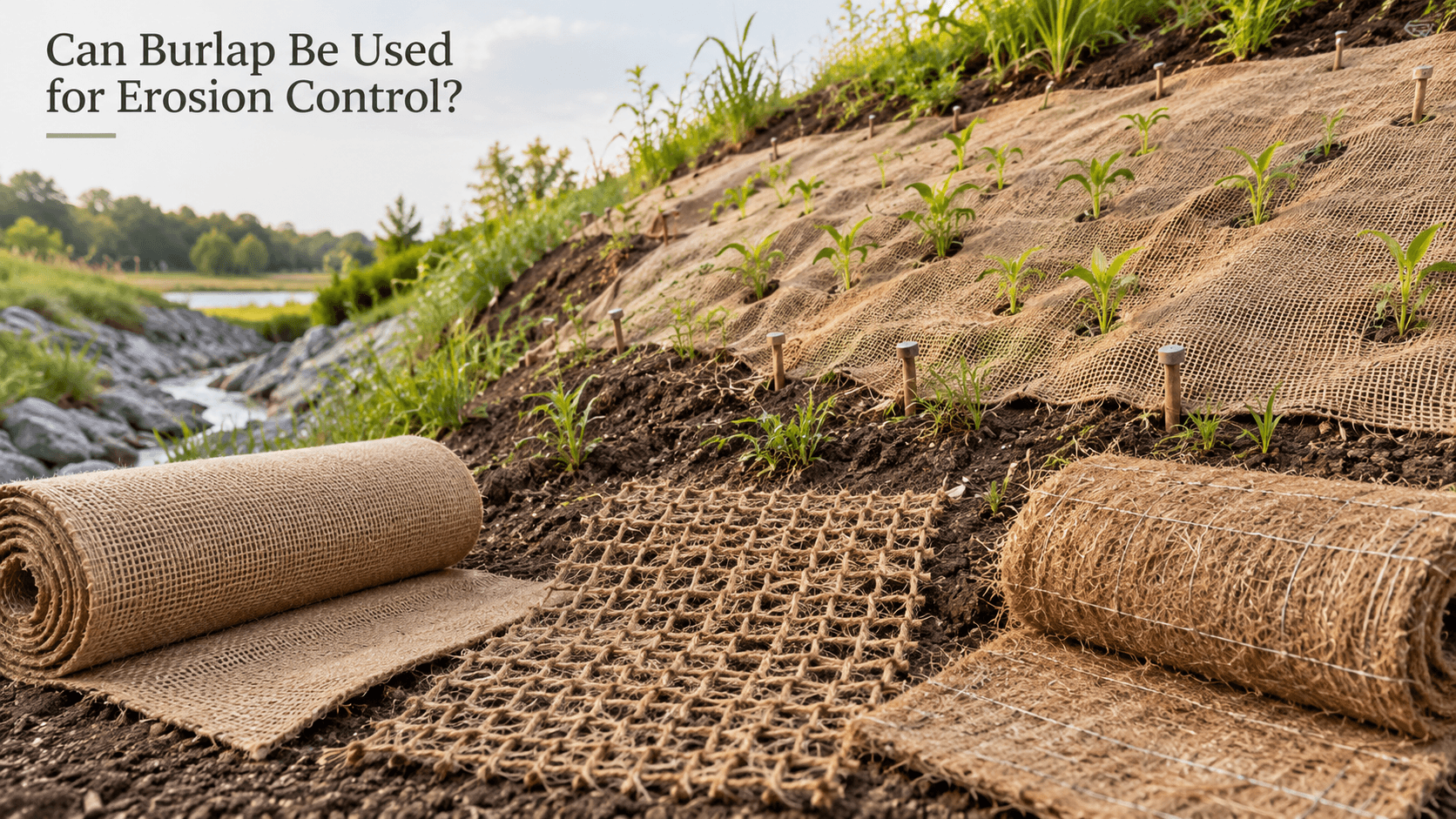
Burlap may be used as a temporary soil or seedbed cover in suitable conditions, but it is not a universal erosion-control solution. The right material depends on the slope, runoff, soil, vegetation plan and project requirements. Ordinary woven burlap, open-weave jute netting or jute mesh, and erosion-control blankets are different constructions. Some specification-defined jute mesh or netting products are classified as rolled erosion-control products (RECPs), while an ordinary woven burlap roll is not automatically an RECP. Do not treat these materials as interchangeable.
This guide explains how to evaluate burlap for erosion control, when a different product may be more appropriate, and what information to prepare before requesting product details. It is general information, not a project design or a substitute for state, local or engineer-approved requirements.
Start With the Site, Not the Fabric
Erosion control is a site problem before it is a material choice. Rainfall, concentrated runoff, wind, slope, soil condition and the planned vegetation all affect whether a temporary cover can perform its intended role.
A burlap or jute-based cover may be considered for situations such as:
- A small seeded area that needs temporary protection from rain splash, wind or light surface movement.
- A garden, nursery or landscape area where the cover can remain close to the soil while vegetation establishes.
- A relatively simple slope where the material, anchoring and vegetation plan are compatible with the expected runoff.
- A short-term soil-cover application where the project documents allow a natural-fiber fabric or mat.
Use additional caution when the site includes:
- Concentrated flow, drainage channels, swales or streambanks.
- A steep slope with sandy soil, heavy rock or debris, instability or significant runoff.
- Runoff from an upper area that could flow underneath or around the cover.
- Road, utility, bridge, building or other work governed by contract documents.
- A formal erosion and sediment control plan, permit, stormwater requirement or engineer’s detail.
USDA Natural Resources Conservation Service guidance emphasizes that erosion-control practices must be adapted to local soil, climate, topography and regulatory conditions.[5] A material that is reasonable for a small seedbed may be unsuitable for a high-flow slope or a project with defined performance requirements.
Ordinary Burlap, Jute Netting and Erosion-Control Blankets Have Different Constructions
Market listings sometimes use burlap, jute, mesh, mat and blanket terms loosely. Confirm the actual construction before making an installation decision.
Ordinary woven burlap fabric
Woven burlap is a fabric that may be used as a temporary cover over a seeded or landscaped area when the site and product instructions support that use. It may help reduce direct soil disturbance or seed movement, but its weave or opening, weight, treatment and strength can vary by item.
Open-weave jute netting
Jute netting or jute mesh is an open-mesh product used in some temporary soil-cover and revegetation applications. For a broader explanation of what jute netting is used for, see the dedicated support article. Some specification-defined jute mesh or netting products are classified as RECPs, while public conservation guidance also discusses jute netting as a material used with mulch and vegetation rather than as a universal stand-alone solution.[3][4] It may have different openings, anchoring requirements and site limits from ordinary burlap fabric.
Erosion-control blankets and other RECPs
RECP is a broad category for rolled erosion-control products that can include specification-defined netting, blankets, mats and other rolled products. An erosion-control blanket is one possible construction within that category. FHWA describes erosion mats as products laid over disturbed soil and anchored after seeding, with construction and porosity affecting seedling emergence.[2] The product must be selected for the site rather than assumed to be equivalent to a general burlap roll.
If the specification calls for jute mesh, an erosion-control blanket or another rolled erosion-control product, use that named product category and follow its approved installation detail. Do not substitute an ordinary burlap roll merely because both products are sold in rolls.
How to Choose a Temporary Burlap or Jute Cover
1. Record the site conditions
Before choosing a product, record:
- Approximate area and slope dimensions.
- Flat ground, slope, swale, channel or bank conditions.
- Soil texture, rocks, debris and areas that need grading.
- Expected rainfall, irrigation, wind and runoff direction.
- Whether water flows across the surface or concentrates in a channel.
- The vegetation or seed mix to be established.
- Any permit, plan, drawing or project specification that applies.
For a larger or regulated project, have the responsible designer confirm the required product category and installation method.
2. Match the product to the exposure
For a small seedbed, a suitable burlap cover may be considered when the main need is temporary protection from rain or wind. For a slope with more significant runoff, compare the requirement with open-weave jute netting or an erosion-control blanket designed for that type of site. For concentrated flow, channel work or high-consequence locations, a project-specific system may be required.
The key questions are not only “Is burlap natural?” or “What is the cheapest roll?” They are:
- Can the material stay in close contact with the soil?
- Can it be anchored without creating gaps or flow paths beneath it?
- Will it allow the planned vegetation to emerge and establish?
- Is its construction appropriate for the expected water and wind exposure?
- Does it match the project’s required material and documentation?
3. Calculate usable coverage
Measure the surface that actually needs protection. For an irregular area, divide it into manageable sections and record the length and width of each section. Allow for seams, edge anchoring, trenches or other installation details required by the product or project plan.
Do not use a universal waste percentage or assume the label width equals usable coverage. A roll that is easy to carry and anchor may be more practical than one large piece that creates folds, unsupported spans or difficult seams.
On a slope, plan the direction of each strip before cutting. For specified jute-netting or erosion-control blanket installations, some NRCS guidance specifies installing rolls up and down the slope rather than along the contour. The approved product instructions and project detail control the final method.[3]
4. Confirm the product information
Before ordering, confirm the specific item’s:
- Product form: woven burlap, jute netting, erosion-control blanket or another fabric.
- Usable width and length.
- Fabric weight basis, weave or opening, if specified.
- Material composition and any treatment.
- Pack format and quantity.
- Recommended slope, flow or application limits.
- Anchoring, overlap and removal instructions.
Do not infer composition, treatment, service life or project compliance from the word “burlap” alone.
How to Install the Selected Temporary Cover
The installation route depends on the product form. A removable ordinary-burlap seedbed cover is not installed or removed in the same way as a specified jute-netting or RECP system. The exact installation must follow the selected product’s instructions and the applicable project plan.
Temporary removable seedbed cover
For a small seedbed, a burlap or loose-mesh cover may be placed over the seeded area and secured with stakes or rocks while the seedbed is protected from rain washout and evaporation. Monitor germination and remove or adjust the cover promptly as germination begins so emerging seedlings receive light.[1] This is a temporary seedbed method, not a universal installation detail for slopes or engineered erosion-control work.
Anchored jute netting or specified RECP
Where the selected product or project plan calls for jute netting, an erosion-control blanket or another RECP, the installation may include a smooth surface, a defined seed or mulch sequence, close soil contact, specified overlaps, trenches, anchors and runoff controls. The numbered framework below is primarily for this specified system. Do not copy its trenching, overlap or anchor details to ordinary burlap unless the product instructions specifically call for them.
Step 1: Prepare a smooth, stable surface
Remove rocks, debris and raised obstructions that could hold the fabric above the soil. Grade or smooth the surface where appropriate so the cover can maintain close, even contact. A gap beneath a mat or fabric can allow water to concentrate and erode the soil underneath.[2][3]
Do not disturb a slope unnecessarily to force a fabric onto a surface that is unsuitable for the product. If the site cannot be prepared as required, select another treatment with the responsible designer.
Step 2: Seed and mulch according to the plan
Use the selected seed, soil amendment and mulch plan for the site. For a removable seedbed cover, place the seed so it has contact with the soil and apply the cover without washing or burying it. Penn State Extension notes that burlap or loose-mesh covers can help reduce seed washout and evaporation, but they should be removed promptly as germination begins so light can reach seedlings.[1]
For specified jute netting or an erosion-control blanket, the product plan may call for mulch beneath the netting, seeding before installation or another sequence. Do not reverse that sequence based on a generic burlap method.
Step 3: Lay the material smoothly
For an anchored jute-netting or RECP system, place the fabric or mat in the direction required by the project or product instructions. Keep it loose enough to follow the terrain without stretching, bridging or creating large folds. Make sure the material reaches the intended edges and does not leave exposed strips between sections. For a removable ordinary-burlap cover, follow the simpler placement and securing method specified for that product; do not assume that slope anchoring details apply.
Where adjacent sections meet in an anchored system, use the specified overlap and secure the seam as directed. Do not copy a fixed overlap dimension from another product, state or project.
Step 4: Anchor the upper edge, lower edge and sides
For a specified jute-netting or RECP system, secure corners, edges, seams and transitions with the pins, staples, stakes, trenches or other method specified for the material and soil. The upper edge of a slope may require a keyed or trenched installation so runoff cannot enter beneath the cover. The lower edge and side edges also need a stable termination. A removable seedbed cover may use a different securing method.
Anchoring is not a cosmetic step. Wind, animals and surface water can lift a loose edge, and a lifted edge can create a new erosion path. Keep anchors flush and safe for people, equipment and maintenance access.
Step 5: Keep concentrated runoff away from the cover
A cover is not a substitute for drainage control. Divert or manage concentrated flow according to the project plan so water does not discharge onto the upper edge, run underneath the fabric or collect at a seam. For channels and streambanks, use the product and installation detail designed for that flow condition.
Watering and Vegetation Establishment
Temporary fabric does not establish vegetation by itself. Keep the seedbed or planting surface within the moisture range required by the seed and soil conditions, using a gentle application that does not wash out seed or undermine the cover.
Inspect after watering, heavy rain and strong wind. If the fabric is lifted, torn or separated from the soil, correct the anchoring or surface problem. If water is flowing beneath the cover, address the runoff path rather than simply adding more fasteners.
As plants emerge, check that the material does not restrict light, seedlings or planned maintenance. Some covers are intended to remain until vegetation is established; others must be adjusted or removed earlier. Follow the product instructions and the project plan.
Maintenance and Removal
Inspect the installation after significant storms and at the intervals required by the project. Look for:
- Open seams, lifted edges or displaced anchors.
- Gaps between the material and the soil.
- Undercutting, rills or sediment moving beneath the cover.
- Standing water or concentrated flow at the upper edge.
- Torn fabric, exposed seed or blocked seedlings.
- Wildlife, equipment or pedestrian hazards created by anchors or netting.
Repair or replace damaged material and correct the cause of failure. Do not assume that adding another layer will solve poor grading, concentrated runoff or an unsuitable product choice.
Remove or adjust the cover when the vegetation and site no longer need temporary protection, when the product instructions require it, or when the material begins to interfere with emergence or maintenance. There is no universal service life or removal date for every burlap, jute or erosion-control product.
When Burlap Is Not Enough
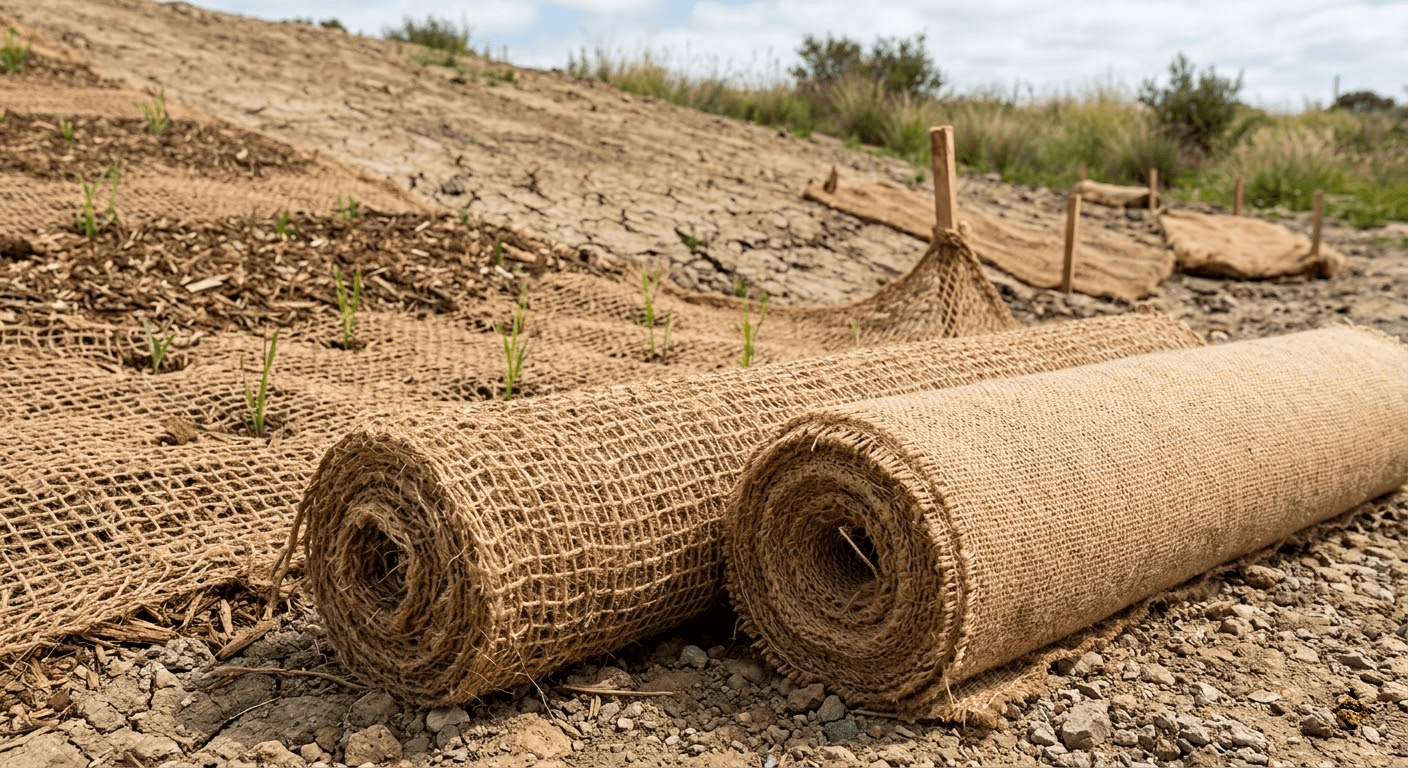
Use a more specific erosion-control design when the site has high runoff, a channel, a steep or unstable slope, important downstream assets or a formal compliance requirement. Natural-fiber materials can be part of an erosion-control system, but the system may also require mulch, vegetation, drainage controls, check structures or an engineered erosion-control blanket.
NRCS explains that national conservation practice standards are baseline references and that state standards may be more restrictive for local soils, climate, topography and regulations.[5] For construction, transportation, streambank or permitted stormwater work, follow the applicable state or local standard and the project documents.
Burlap and Jute Product Inquiry Checklist
Before requesting product details, prepare:
- Application and the reason temporary cover is needed.
- Area dimensions, slope dimensions and a simple sketch if irregular.
- Soil, runoff and drainage conditions.
- Seed, planting or revegetation plan.
- Required product category: woven burlap, jute netting, erosion-control blanket or another fabric.
- Required width, length, coverage and quantity.
- Fabric specification, composition, weave, opening or treatment requirements.
- Packaging, delivery destination and required timeline.
- Project specifications, drawings, standards or documentation that must be reviewed.
We can review natural burlap fabric roll requirements for plant protection, gardening, landscaping and selected erosion-control applications. Product form, dimensions, fabric specification, packaging and quantity should be confirmed for the specific requirement. Start with our burlap fabric roll product page or our burlap and jute netting page and send the application, site conditions, quantity and delivery location for review.
FAQ
Does burlap prevent erosion?
Burlap may provide temporary surface or seedbed protection in suitable conditions, but it does not guarantee erosion prevention. Performance depends on the material, soil contact, anchoring, runoff, vegetation and site design. High-flow, channel and regulated projects require a product and installation method selected for those conditions.
Can burlap be used on a slope?
It may be appropriate on some simple or low-risk slopes, provided the surface, runoff, material and anchoring method are compatible. Do not assume that ordinary burlap is suitable for a steep slope with sandy soil, heavy rock or debris, instability or significant runoff. Check the applicable product instructions and project requirements.
Is burlap the same as jute netting?
No. Burlap generally refers to a woven fabric, while jute netting is an open-mesh product with different construction and installation requirements. An erosion-control blanket is another product category. Confirm the actual product rather than relying on the name used in a listing.
Should jute netting be installed by itself?
Not automatically. NRCS guidance for disturbed slopes commonly recommends jute netting with underlying mulch, while separate NRCS wildfire-recovery guidance allows jute netting without mulch on selected flat sites for dust control or seed-germination enhancement. That exception is site-specific and should not be extended to high-runoff or engineered erosion-control projects.[3][6]
What overlap and anchor spacing should I use?
There is no universal number for every burlap, jute or erosion-control product. Use the overlap, trench and anchor requirements supplied for the selected product and project. Fixed dimensions from another installation detail should not be copied without confirming that the material and site are the same.
How long does burlap last for erosion control?
Service life varies with composition, weave, treatment, weather, soil contact and the application. Confirm the expected service period and removal requirements for the specific product. Do not treat a general burlap description as a guaranteed service-life statement.
Can I buy burlap or jute netting for a project?
Yes, you can send us the application, site conditions, required product form, dimensions, quantity and delivery destination for review. We can then confirm the applicable product details for the requirement. Use the relevant product inquiry path in the checklist above.
References
- Penn State Extension: Sowing Annual Seeds
- Federal Highway Administration: Roadside Revegetation – Seed Covering and Erosion Mats
- USDA Natural Resources Conservation Service: The Use of Erosion Control Blankets or Jute Netting on Fire Damage Slopes
- Caltrans: Erosion Control Toolbox – Rolled Erosion Control Product (Jute Mesh)
- USDA Natural Resources Conservation Service: Conservation Practice Standards
- USDA Natural Resources Conservation Service: Wildfire Recovery Tips