
- September 3, 2026
- Posted by: wellcoindustries
- Categories: Burlap, Erosion Control
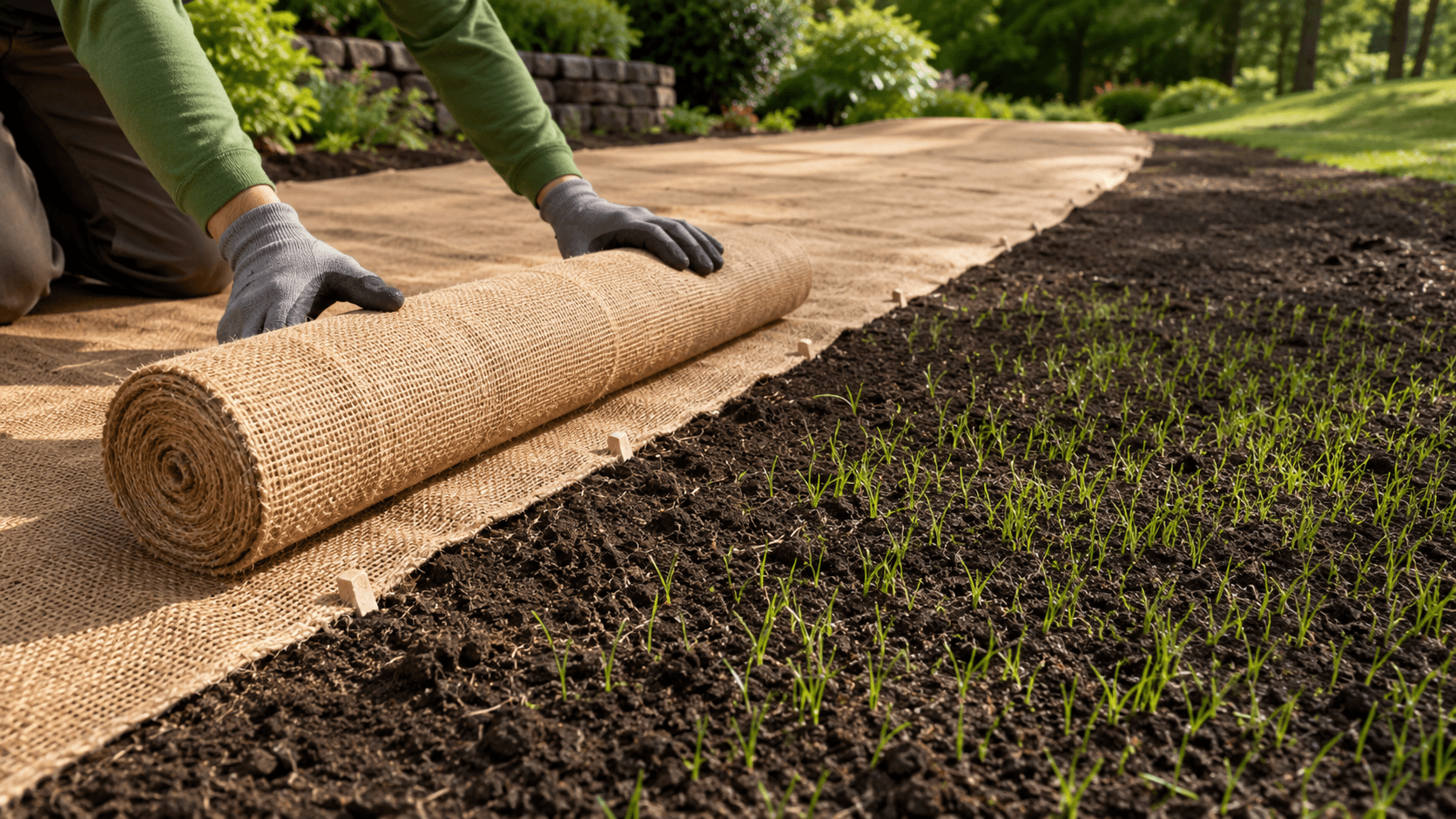
Does Burlap Make Sense for Your Grass-Seed Project?
Burlap is most useful when the seedbed needs temporary surface protection and the fabric can stay in close contact with the soil. University of Minnesota Extension guidance identifies burlap as one cover option on slopes where erosion or washing may move seed.[1] On a well-prepared lawn seedbed, light raking, seed-to-soil contact and consistent moisture remain essential whether or not a temporary cover is used. Oregon State University Extension notes that good seedbed preparation, light raking and careful irrigation can achieve rapid, uniform germination without relying on a thick mulch layer.[2]
Use a burlap cover when the site has a clear reason for it, such as:
- A small repair area that is exposed to wind, birds or light surface runoff.
- A seeded garden or landscape area where you need temporary protection while seedlings establish.
- A slope where temporary surface protection is suitable and the expected runoff, soil condition and anchoring method are compatible with the selected fabric.
Do not assume that any burlap roll is an engineered erosion-control blanket. Slopes with concentrated water flow, drainage channels, unstable soil, road work or project specifications may require a designed erosion-control netting or blanket system. Federal and local guidance emphasizes selecting the product for the site and installing it according to the manufacturer or project requirements.[3][4]
How to Choose the Right Burlap Roll Size
The right size is the size that covers the seeded area with manageable seams and enough material to secure the edges. Start with a simple coverage plan before selecting a product.
1. Measure the area that actually needs cover
Record the length and width of each seeded section. For an irregular area, divide it into rectangles or strips and measure each section separately. Note slopes, curves, planting edges, drainage paths and any area that should remain uncovered.
Your coverage calculation should include:
- The full seeded surface, not just the bare spots that are easiest to see.
- Extra material needed for seams, edges and anchoring.
- A practical allowance for cutting and handling.
For a rectangular section, divide the required coverage width by the usable width of the roll and round up to the next whole strip. Then total the length of those strips. Usable width is more important than the label width when part of the fabric must overlap another section or extend beyond the seedbed for anchoring.
For a quick planning estimate:
- Number of strips = coverage width / usable roll width, rounded up.
- Approximate fabric length needed = total strip length + material needed for edges, seams and handling.
Use the estimate to compare roll formats, then confirm the final quantity after checking the actual layout and installation method. Do not add a fixed waste percentage to every project because seam, edge and cutting requirements vary.
2. Match roll width to the layout
For a narrow patch or short repair, a smaller section or narrower roll is often easier to place and secure. For a long rectangular bed, a roll width that follows the shorter dimension can reduce the number of seams. For a broad area, several manageable strips may be easier to place, anchor and inspect than one oversized piece.
The goal is complete coverage without creating loose fabric, excessive overlap or a piece that cannot be anchored around its perimeter. If the area is irregular, plan the cuts first and label each section so the fabric can be placed without dragging it across the seedbed.
3. Consider the fabric construction, not only the dimensions
Grass seed needs contact with the soil, moisture and enough space for shoots to emerge. The Federal Highway Administration describes erosion mats as products that should protect seed while allowing light and room for seedlings to grow; it also cautions that a mat that is too thick can restrict emergence.[3]
When comparing burlap options, confirm:
- Product form: woven burlap fabric, open-mesh jute netting or another erosion-control product.
- Usable width and length for your layout.
- Fabric specification, including the stated weight basis, weave and any treatment.
- Whether the fabric is intended for temporary seed covering or a more specific erosion-control use.
- Pack format and the number of rolls needed for the project.
Do not convert a listed gram or ounce value into another unit unless the measurement basis is clearly defined. Product composition, weave, dimensions and treatment can vary by item.
4. Allow for weather and site handling
Wind, rain, slope and soil texture affect the way the fabric must be placed and anchored. A very large piece may reduce seams but become difficult to keep flat. Several smaller pieces may be easier to repair, but every seam and edge becomes another place where runoff or wind can lift the material.
For a site with repeated runoff or a significant slope, compare the project requirements with a product designed for erosion control. The City of Tacoma’s construction guidance stresses close ground contact, correct anchoring and installation according to the selected product’s instructions.[4]
How to Install Burlap Over Grass Seed
The cover is only one part of grass establishment. Prepare the seedbed first, then place the fabric so it protects the surface without disturbing the seed.
Step 1: Prepare the soil and seedbed
Remove debris, loosen compacted surface soil where appropriate, and create a reasonably even seedbed. Spread the selected grass seed according to its label. Lightly rake or otherwise press the seed into the surface so it has contact with the soil. Do not bury the seed under a heavy layer of soil or cover.
Step 2: Place the fabric after seeding
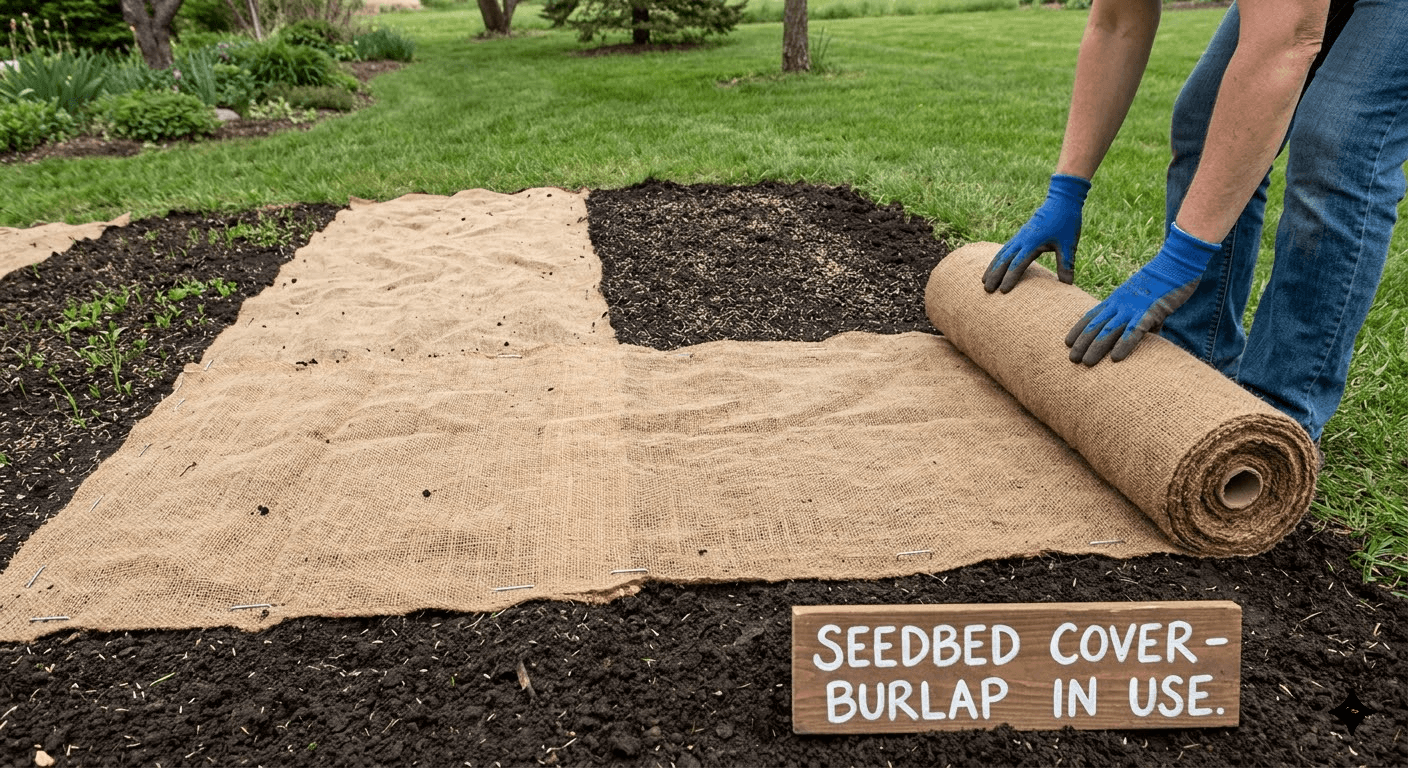
Lay the burlap gently over the seeded area. Keep the fabric in close contact with the soil, but do not stretch it so tightly that it pulls seed out of place or lifts when the soil settles. Avoid large folds and unsupported gaps beneath the fabric.
For ordinary woven burlap used as a temporary lawn cover, lay and secure the material according to the product instructions and local conditions. If the project uses a specified erosion-control mat or netting system, follow that product’s approved seeding, orientation and anchoring detail rather than applying a generic lawn-cover method.[3][4]
Step 3: Secure the edges, seams and transitions
Anchor the perimeter and any seams with a method suitable for the soil and expected weather. Check the upper edge, lower edge, corners and places where two pieces meet. A loose edge can let wind get underneath the fabric; a gap beneath a sloped cover can allow runoff to concentrate under it.
Do not use rocks, staples or stakes in a way that creates a hazard or damages the seedbed. For a construction or erosion-control project, follow the approved installation detail rather than adapting a lawn-cover method.
Step 4: Water gently and inspect the surface
Water with a fine spray so the surface remains moist without washing seed away or creating puddles. Oregon State University Extension recommends keeping the seedbed moist but not waterlogged and adjusting irrigation as the grass emerges.[2] Watering needs vary with soil, weather, shade and seed type, so inspect the soil rather than relying on a fixed schedule.
After heavy rain or wind, check whether the fabric is still in close contact with the ground. Re-secure lifted edges, repair damaged areas and correct any visible runoff path. If water is flowing beneath the material, fix the drainage or surface problem instead of simply adding more staples.
Step 5: Adjust or remove the cover as seedlings develop
There is no single removal date or seedling height that fits every product and site. Monitor the cover and the emerging grass. Follow the product instructions and adjust, loosen or remove the fabric before it restricts the shoots, traps excess moisture or becomes damaged. Continue watering and early lawn care after the cover is no longer needed.
Burlap Fabric, Jute Netting and Erosion-Control Blankets
These terms should not be treated as interchangeable. Burlap commonly refers to a woven fabric. Jute netting is an open-mesh product, while an erosion-control blanket is a product category with its own construction, anchoring and performance requirements.
For a lawn patch or garden seedbed, a suitable burlap fabric may be enough for temporary cover. For a slope, swale, ditch or project with defined erosion-control requirements, confirm whether the specification calls for open-mesh jute netting, a natural-fiber blanket or another rolled erosion-control product. The material choice should follow site conditions, expected water movement, vegetation goals and the applicable project requirements.[3][4]
Burlap Roll Request Checklist
Before requesting product details, prepare the information below:
- Seeded area dimensions and a simple sketch if the area is irregular.
- Flat ground, slope, swale or channel conditions.
- Grass or vegetation type and seeding method.
- Required coverage, roll width, roll length and number of sections.
- Preferred fabric form, weave or other fabric specification.
- Expected exposure to wind, rain, irrigation and foot traffic.
- Anchoring, packaging and delivery requirements.
- Any project specification or documentation that the material must meet.
We offer natural burlap fabric rolls for plant protection, gardening, landscaping and selected erosion-control applications. Options vary by product, so we can confirm the current product form, dimensions, fabric specification, packaging and quantity for your requirement. See our burlap fabric roll product page for the B2B product inquiry path, or contact our team with the checklist above. If the project requires an open-mesh product, compare the requirement with our burlap and jute netting page.
FAQ
Is burlap good for grass seed?
Burlap can be suitable as a temporary cover for some seeded areas, especially where wind or light runoff may disturb the seed. It is not a substitute for a prepared seedbed, seed-to-soil contact and proper watering. For engineered erosion-control work, select the product required by the site or project specification.
What size burlap should I use over grass seed?
Choose a roll by usable coverage and handling. Measure the seeded area, plan strips and seams, allow material for edge anchoring, and then confirm the roll width and length. The best roll is the one that can be placed flat and secured without excessive seams or unsupported gaps.
Can I use burlap on a slope?
It may be appropriate for some slopes, but suitability depends on the fabric, slope, soil, runoff and anchoring method. Slopes with concentrated flow, channels or formal erosion-control requirements may need a designed netting or blanket system and an approved installation detail.
Will grass grow through burlap?
Do not assume grass should permanently grow through an unspecified burlap fabric. Some sufficiently open covers may allow seedlings to emerge, while denser or poorly placed fabric can restrict growth. Monitor the seedbed and loosen, adjust or remove the cover before it interferes with emerging grass.
When should burlap be removed from grass seed?
Do not use a universal date or height. Check the cover and the seedlings regularly, follow the product instructions, and adjust or remove the material when it begins to restrict emerging grass, retain excessive moisture or deteriorate.
Can burlap replace an erosion-control blanket?
Not automatically. A burlap fabric roll and an engineered erosion-control blanket may have different construction, anchoring and project requirements. For slopes, channels and construction sites, match the product to the approved site design and installation instructions.