
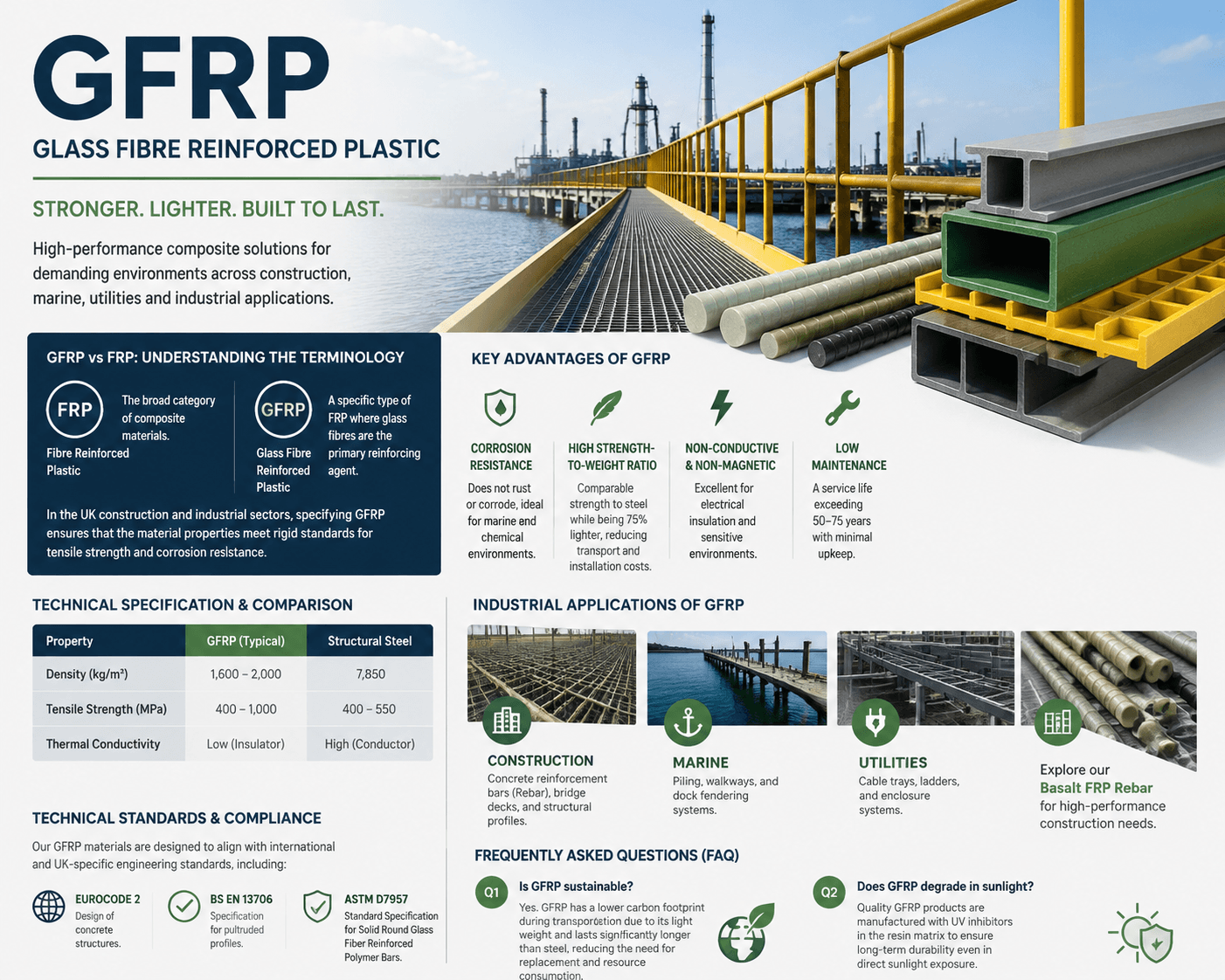
Understanding the Terminology: GFRP vs FRP
While the terms are often used interchangeably, it is important to clarify the definitions for technical compliance:
- FRP (Fibre Reinforced Plastic): The broad category of composite materials.
- GFRP (Glass Fibre Reinforced Plastic): A specific type of FRP where glass fibres are the primary reinforcing agent.
In the UK construction and industrial sectors, specifying GFRP ensures that the material properties meet rigid standards for tensile strength and corrosion resistance.
Key Advantages of GFRP Composites
GFRP has become the preferred material for infrastructure projects due to its unique physical properties:
- Corrosion Resistance: Unlike steel, GFRP does not rust or corrode, making it ideal for marine and chemical environments.
- High Strength-to-Weight Ratio: It provides comparable strength to structural steel while being 75% lighter, significantly reducing transport and installation costs.
- Non-Conductive & Non-Magnetic: Excellent for electrical insulation and sensitive electronic environments (e.g., MRI rooms or radar stations).
- Low Maintenance: A service life exceeding 50-75 years with minimal upkeep.
Technical Specification & Comparison
Below is a general comparison of GFRP properties versus traditional building materials:
| Property | GFRP (Typical) | Structural Steel |
|---|---|---|
| Density (kg/m³) | 1,600 – 2,000 | 7,850 |
| Tensile Strength (MPa) | 400 – 1,000 | 400 – 550 |
| Thermal Conductivity | Low (Insulator) | High (Conductor) |
Industrial Applications of GFRP
From infrastructure to bespoke engineering, GFRP is utilized across various sectors:
- Construction: Concrete reinforcement bars (Rebar), bridge decks, and structural profiles.
- Marine: Piling, walkways, and dock fendering systems.
- Utilities: Cable trays, ladders, and enclosure systems.
Looking for specific reinforcement solutions? Explore our Basalt FRP Rebar products for high-performance construction needs.
Technical Standards & Compliance
Our GFRP materials are designed to align with international and UK-specific engineering standards, including:
- Eurocode 2: Design of concrete structures.
- BS EN 13706: Specification for pultruded profiles.
- ASTM D7957: Standard Specification for Solid Round Glass Fiber Reinforced Polymer Bars.
Frequently Asked Questions (FAQ)
1. Is GFRP sustainable?
Yes. GFRP has a lower carbon footprint during transportation due to its light weight and lasts significantly longer than steel, reducing the need for replacement and resource consumption.
2. Does GFRP degrade in sunlight?
Quality GFRP products are manufactured with UV inhibitors in the resin matrix to ensure long-term durability even in direct sunlight exposure.